

More news on this day
Passengers at a Scottish airport faced hours of disruption after a ground power generator reportedly exploded beside a parked aircraft, covering the jet in oil and leaving travelers stranded as engineers worked to assess the damage.
Get the latest news straight to your inbox!
Incident at stand leaves aircraft soaked in oil
According to early reports from local and national media, the disruption began when a ground power unit, often described by witnesses as a generator, malfunctioned while connected to a commercial aircraft preparing for departure at a Scottish airport. The unit is reported to have failed with a loud bang, sending oil spraying across the fuselage, wing and surrounding stand area.
Images and accounts circulating on social media indicate that the affected aircraft was already boarded or in the final stages of turnaround when the incident occurred. Passengers were subsequently kept on board or held in the terminal while airport and airline teams secured the stand and began safety checks.
Ground power units are used to provide electricity to aircraft while they are parked at the gate, supplying systems such as lighting, air conditioning and avionics without relying on onboard engines. When they fail, they can leak oil or fuel, which must be carefully contained and cleaned before an aircraft or nearby equipment can be used again.
There were no immediate reports of injuries linked to the apparent explosion, but the volume of oil reported around the stand meant operations in the immediate area were temporarily suspended as a precaution.
Passengers face long delays and cancellations
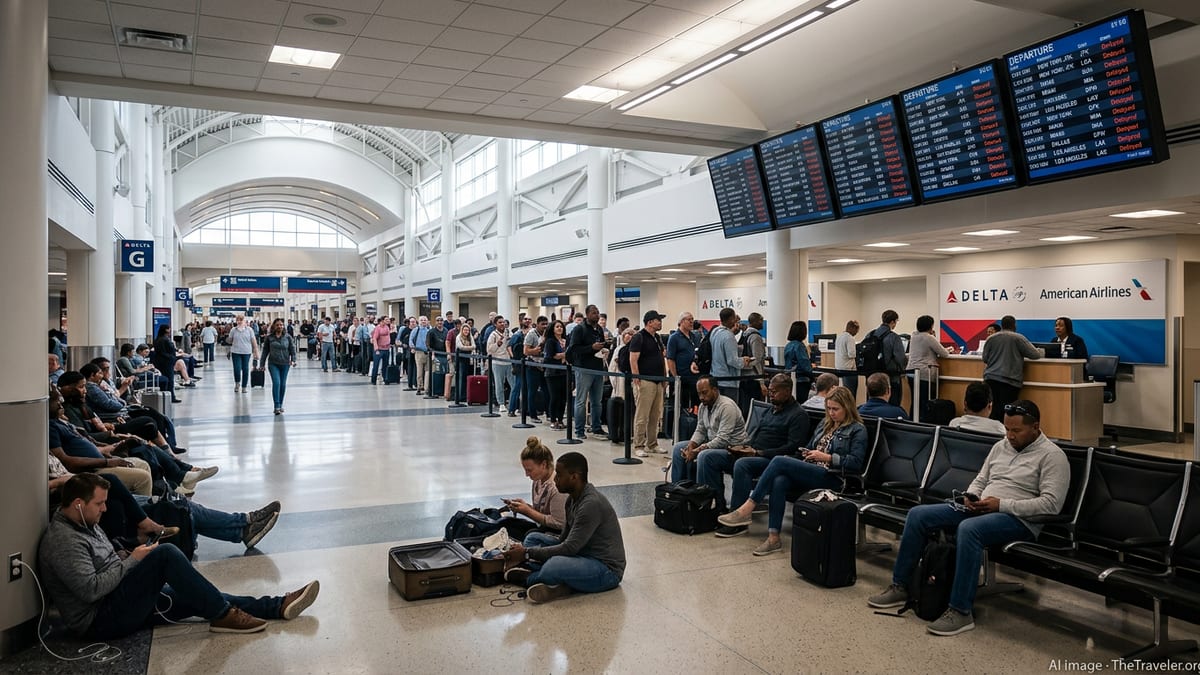
The incident quickly affected departing and arriving flights as the stand was taken out of service and the aircraft involved was grounded for detailed inspection. Travelers posting online described sitting on board for extended periods, waiting in departure lounges with limited information, and queuing to rebook after services were cancelled.
Some reports suggest that passengers on the affected flight were eventually asked to disembark and return to the terminal, where they joined lines at airline service desks seeking alternative connections. Others described knock-on delays as aircraft and crews scheduled to operate later services were left out of place.
Disruptions of this type can have a cascading effect on an airline’s schedule, particularly at airports where spare aircraft and crew are limited. A single grounded jet can lead to later rotations being cancelled or heavily delayed while planners work to reshuffle equipment and secure replacement aircraft.
Several travelers reported uncertainty about overnight arrangements, with some being offered hotel stays or rebooking options, while others said they were advised to return home or arrange their own accommodation before returning to the airport the following day.
Safety checks and clean-up operations on the apron
Publicly available information indicates that engineers and specialist cleaning teams were called to the affected stand to deal with the oil contamination. When large quantities of oil are sprayed across an aircraft and apron area, it must be removed from the fuselage, control surfaces and ground equipment before the aircraft can be declared fit for service.
Aviation maintenance procedures typically require engineers to carry out detailed inspections of surfaces, seals and moving components that have come into contact with oil. They also assess whether any flammable residues have reached hot areas or electrical systems, which would present a potential fire hazard during engine start or pushback.
On the ground, clean-up crews are tasked with spreading absorbent materials, removing contaminated water and disposing of waste in line with environmental regulations. This work can take several hours, particularly in busy apron areas where the spill must be contained without affecting adjacent stands.
Operational disruptions often persist until supervisors are satisfied that the apron surface is no longer slippery for aircraft, vehicles and staff, and that no oil can be tracked into the cabin or cockpit on shoes or equipment.
Context: rare but disruptive ground equipment failures
Industry data and past incident reports show that failures of ground power units and other support vehicles are relatively uncommon compared with more routine technical issues, but when they do occur they can be highly disruptive. Malfunctions involving electrical faults, leaks or minor explosions generally happen away from runways and taxiways, yet they can still close stands and force lengthy inspections.
In recent years, similar ground equipment failures at European airports have led to localized fires, smoke in terminal areas and, in some cases, the precautionary evacuation of nearby aircraft. Most events have been contained quickly by airport fire and rescue services, but they frequently result in passengers spending hours in terminals while alternative arrangements are organized.
For airlines, the financial impact of losing an aircraft from the schedule, paying for hotels, meals and rebooking, and handling the operational knock-on can be significant. For passengers, the more immediate concern is often a missed holiday, a lost connection or an unexpected overnight stay far from home.
Travelers affected by such incidents are generally advised to keep boarding passes and receipts for additional expenses, check the airline’s published policies, and review their travel insurance coverage to see what can be claimed back after the event.
What travelers should know about their rights
Consumer guidance from European and UK regulators notes that passengers departing from airports in Scotland may be protected by air passenger rights frameworks that apply to delays and cancellations. Eligibility for assistance and compensation depends on the length of the delay, the reason for the disruption and whether the circumstances are considered to be within the airline’s control.
In cases where an aircraft is grounded for technical or operational reasons connected to the airline or its contracted service providers, affected travelers are often entitled to care, including meals, refreshments and hotel accommodation when an overnight stay becomes necessary. Refunds or rebooking options may also be offered when flights are cancelled altogether.
Experts in passenger rights advise travelers to document the timing of announcements, boarding and deplaning, as well as any written communication from the airline. This information can be helpful when submitting claims to airlines or, if required, escalating disputes through alternative dispute resolution bodies.
While the full details and operational timeline of the generator incident at the Scottish airport are still emerging, the experience once again highlights how quickly an issue on the tarmac can cascade into a lengthy and stressful delay for passengers inside the terminal.