


More news on this day
Rail traffic on one of India’s busiest corridors was disrupted on Tuesday morning after several wagons of a goods train derailed near Ghaziabad, affecting services on the Delhi–Howrah route and triggering diversions, cancellations and lengthy delays for thousands of passengers.
Get the latest news straight to your inbox!
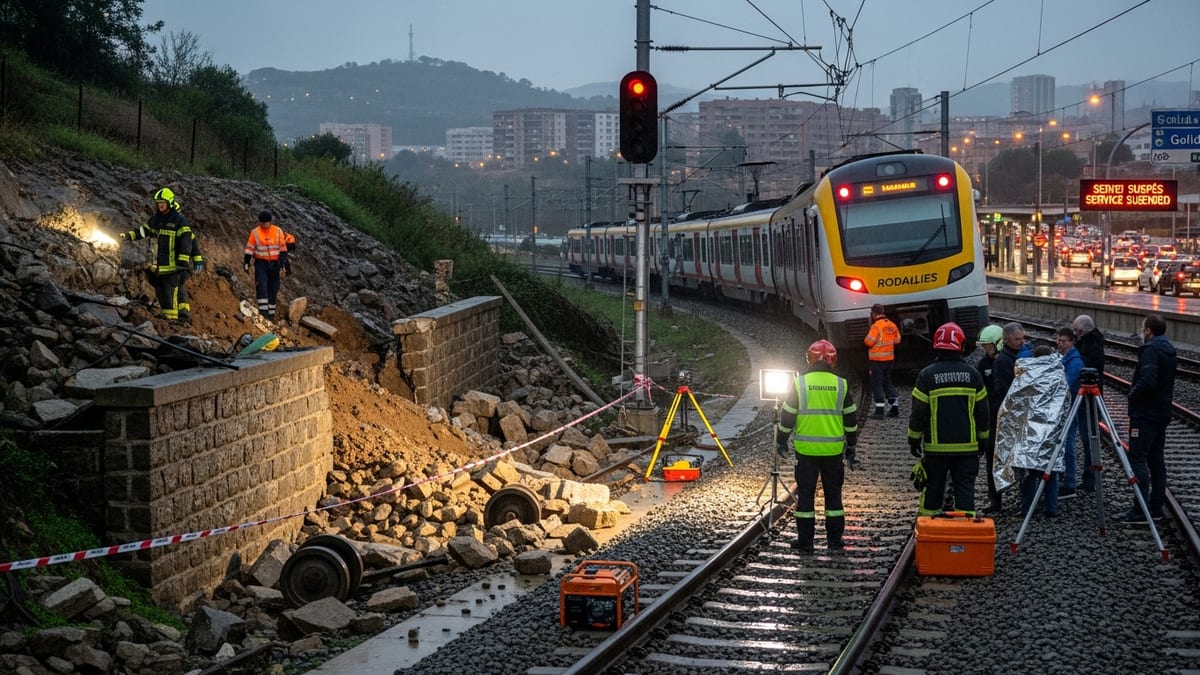
Six loaded wagons off the tracks near Sahibabad
According to multiple news reports, the derailment occurred in the early hours of July 21 on the Ghaziabad–New Delhi section, near Sahibabad, when six loaded wagons of a freight train came off the tracks. The train was reportedly carrying goods towards the national capital when the incident took place on a key approach stretch used by long distance services linking Delhi with Howrah and eastern India.
Initial coverage indicates that the affected wagons left the rails close to a crossover point, blocking movement on the section and forcing railway staff to halt following trains. Images from the scene show several wagons leaning at angles beside the track, with maintenance teams and heavy machinery deployed to remove the damaged rolling stock and clear debris.
No passenger coaches were involved in the incident, and early reports do not indicate any fatalities. However, the strategic importance of the line meant that even a freight derailment quickly had a cascading impact across the timetable, particularly for trains operating between Delhi, Kanpur, Dhanbad and Howrah.
Restoration efforts were launched soon after the incident, with track, signalling and overhead line staff working to stabilize the derailed wagons and secure the infrastructure. Authorities have not yet provided a public technical explanation for the derailment, and an investigation into the precise cause is expected to follow once operations normalize.
More than 50 long distance trains hit along Delhi–Howrah axis
Early tallies from railway control summaries and regional media place the number of affected trains at more than 50, including long distance expresses operating on the Delhi–Howrah route. Some Hindi language coverage cites a disruption footprint involving over 100 scheduled movements when diversions, partial short terminations, regulated services and freight operations are combined over the course of the day.
Publicly available information indicates that at least 16 passenger trains were fully cancelled as a result of the blockage, including services operating into and out of Delhi and Anand Vihar terminals. Around two dozen trains were diverted via alternate routes through the Delhi–New Delhi corridor and other parallel lines in the National Capital Region, while several others were partially cancelled or short terminated at intermediate stations.
In addition to express and superfast trains, commuter and intercity services on the Ghaziabad–Delhi stretch also experienced knock-on delays. Real-time running data and social media posts from passengers pointed to trains held for extended periods outside key junctions while traffic was re-sequenced around the damaged section.
The incident once again highlighted the vulnerability of dense mixed-traffic corridors such as the Delhi–Howrah main line, where freight, premium expresses and suburban services share limited track capacity. Even when a derailment involves only a goods consist, the resulting block can ripple across the network for hours, particularly around major urban nodes.
Passengers face delays, diversions and crowded alternatives
For travellers on the Delhi–Howrah axis and connecting routes, Tuesday’s disruption translated into missed connections, extended journey times and uncertain arrival estimates. Passengers reported trains slowed or halted outside Ghaziabad and nearby stations as controllers attempted to thread services through alternative paths.
With several trains cancelled at short notice, many travellers were forced to rebook on later services or seek road transport options into Delhi and adjoining cities. Crowding was reported on unaffected trains and at key interchange stations, as passengers from cancelled services were accommodated where space was available.
Journey planning tools and online status boards reflected widespread rescheduling, with some long distance trains diverted away from their usual path on the Ghaziabad–New Delhi section. Travellers heading for eastern India and the Kolkata region via Howrah were advised through public channels to check updated timings and platform information throughout the day.
For those already on board, onboard announcements and station displays gradually relayed information about the derailment and expected delays. However, as is often the case during sudden infrastructure failures, information flow remained uneven, with some passengers learning details only after significant waiting time on the line.
Restoration work focuses on clearing key choke point
Railway engineering teams concentrated their efforts on re-railing or removing the six derailed wagons and inspecting the affected stretch of track and overhead equipment. Crane units and track machines were deployed to the site, and services in the area continued under caution and with temporary restrictions while the work progressed.
Published coverage suggests that one line on the section was prioritized for early restoration to permit limited bi-directional working, a common strategy in such situations aimed at gradually reducing the backlog of stranded trains. Full capacity on parallel tracks typically follows only after detailed inspections, tamping and alignment checks are completed.
Given the heavy use of the Delhi–Howrah corridor for both passenger and freight flows, clearing the choke point near Ghaziabad is expected to remain a priority until normal throughput resumes. Experience from previous freight derailments on trunk routes indicates that even with intensive work, it can take much of a day for schedules to stabilize and for rolling stock and crew diagrams to be fully realigned.
Rail operators are expected to review the sequence of events leading up to the derailment, including train handling, track condition and recent maintenance history in the area. Any findings related to asset condition or operating practices could inform future mitigation steps, particularly on busy multi-line junction approaches into the capital.
Spotlight on safety and reliability on key national corridors
The latest disruption near Ghaziabad adds to a series of freight derailments and infrastructure incidents on busy main lines in recent years, prompting recurring scrutiny of the resilience of India’s core rail corridors. While serious passenger casualties were avoided in this event, the scale of timetable dislocation underlines the economic and social cost of even non-fatal accidents.
The Delhi–Howrah route carries a significant share of long distance traffic between northern and eastern India, including premium services that connect the national capital with Kolkata and other major cities. Any prolonged blockage on its approach sections has a disproportionate impact, not only for rail users but also for freight customers relying on time-sensitive deliveries.
According to publicly available policy documents, Indian Railways has been seeking to separate freight and passenger flows on some stretches through the construction of dedicated freight corridors and capacity upgrades. However, many access sections into metropolitan hubs remain shared, leaving them exposed to disruption when a heavy goods consist leaves the rails.
As investigations proceed into the Ghaziabad derailment, attention is likely to focus on how quickly robust technical fixes and operational safeguards can be implemented to reduce the probability and impact of similar incidents. For now, passengers on the Delhi–Howrah axis are being urged to monitor service updates closely as rail traffic gradually returns to normal patterns following Tuesday morning’s accident.