


Planning a Greek islands itinerary sounds simple until you open a ferry map and realize just how many choices you have. Cyclades or Ionian? Athens first or last? Add Crete or save it for another trip? This guide breaks the decision down into real, workable routes, with concrete examples of travel times, sample prices, and how each style of trip actually feels on the ground.
Get the latest updates straight to your inbox!
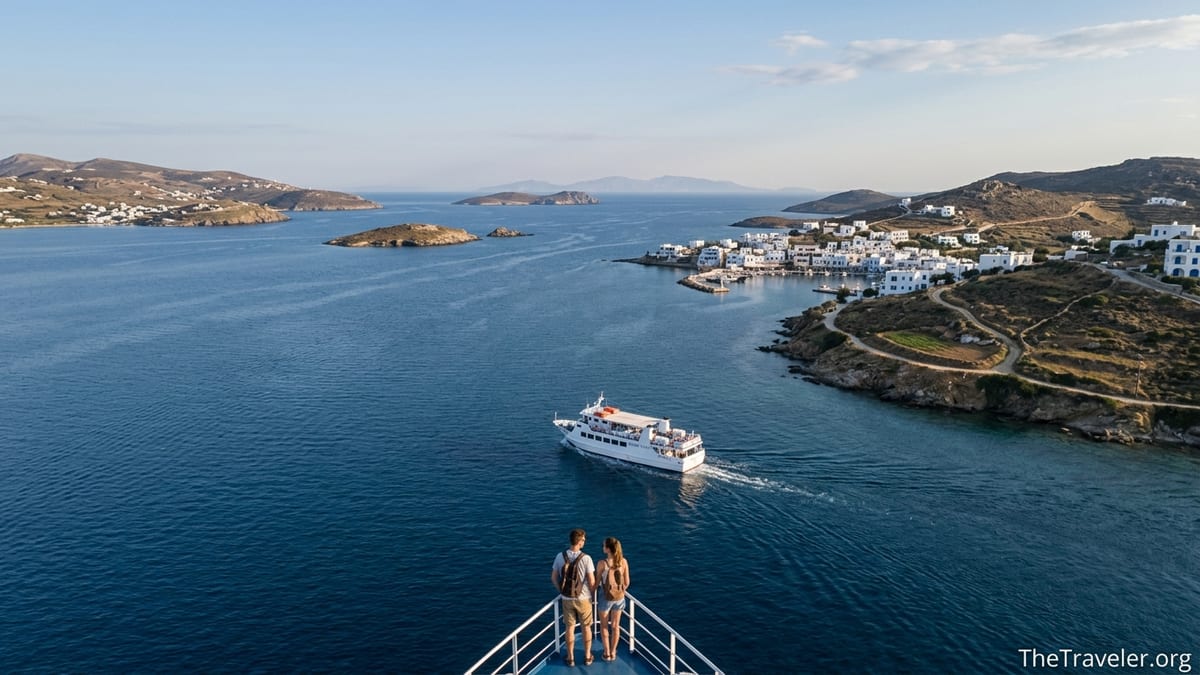
How to think about Greek islands routes
Most Greek islands trips fall into a few clear patterns: Cyclades island hopping out of Athens, a Crete‑only deep dive, or a road trip through the Ionian islands on the west coast. Within each, you decide whether you want a relaxed base‑and‑day‑trips style or a faster “see more islands” loop. For example, a 10‑night first trip might look like 3 nights in Athens, 3 in Naxos, 3 in Paros and 1 in Santorini, using direct ferries of 1 to 4 hours between islands. In contrast, a two‑week slow trip might use just one hub island, such as Naxos or Lefkada, and focus on beaches, village drives and boat excursions instead of checking new islands off a list.
Transport realities matter more than dots on a map. Ferries are the backbone of island travel, with year‑round routes and extra fast services in summer from Piraeus, Rafina and Lavrio ports near Athens to key Cyclades hubs like Paros, Naxos, Mykonos, Milos and Santorini. Typical economy tickets on a large conventional ferry for a 3 to 5 hour crossing can run the equivalent of roughly 40 to 70 US dollars per person, while high‑speed catamarans on the same routes often cost 20 to 40 percent more but cut travel time nearly in half.
Flights come into play for long legs, especially when Crete or Corfu are involved. Aegean Airlines and its low‑cost subsidiary often run multiple daily Athens–Heraklion or Athens–Chania flights in summer, with advance one‑way fares sometimes in the 60 to 120 US dollar range if booked early. Many travellers now mix ferries and flights, such as flying into Athens, hopping the Cyclades by ferry, then flying out of Santorini or Heraklion to avoid backtracking.
Finally, consider the “shape” of your itinerary: point‑to‑point or loop. A classic Cyclades spine runs roughly Piraeus–Paros–Naxos–Ios–Santorini, with Mykonos connected off the northern end. In the Ionian, the practical loop for drivers is usually Lefkada–Kefalonia–Zakynthos, using short car ferries and bridges. Trying to stitch Cyclades, Crete and the Ionians into one short trip usually leads to long travel days and higher costs with little added enjoyment.
Athens add‑ons: how many days and when to go to the islands
Almost every international itinerary touches Athens, either as a quick stop or a dedicated city break. Many tour operators and recent independent itineraries schedule 2 or 3 nights in Athens combined with 7 to 10 nights on the islands, creating a 10‑ to 13‑day trip that fits common vacation windows. A typical pattern is to land in Athens, spend one recovery night near the historic center around Syntagma or Plaka, then take an early ferry from Piraeus to the first island the next morning.
The alternative is to head straight to the islands and save Athens for the end. This approach has become popular among independent travellers who want to maximize their beach days while leaving a “buffer” in the capital before the flight home. For example, one common suggestion is to fly from your home city into Athens, connect onward the same day to Santorini or Mykonos, island‑hop back north over a week or more, then return to Athens by ferry two days before departure. That last full day in Athens lets you tour the Acropolis Museum and Acropolis hill with time to spare even if a ferry is delayed by wind.
When planning Athens add‑ons, pay attention to port logistics. Piraeus, the main ferry port, is about 10 kilometers from central Athens and is linked by metro and taxis; Rafina and Lavrio, smaller ports with useful connections to some Cyclades islands, are closer to the airport but farther from the city center. Travellers who land in late afternoon and want to sail early next day often stay one night near Piraeus rather than in central Athens to avoid a pre‑dawn metro or taxi ride with luggage.
Seasonality should also shape your Athens and islands balance. In peak summer from late June through August, the city can be hot in the middle of the day, and many visitors prefer just 1 or 2 nights there and the rest in the islands. In May, early June, September and early October, Athens is more comfortable to explore for longer, and seas are still warm enough for swimming on islands like Naxos, Paros, Crete and Kefalonia, making a 3‑night Athens stay more attractive.
Classic Cyclades loops: first‑timer friendly island chains
The Cyclades are the easiest and most popular cluster for island hopping. With around two dozen inhabited islands connected by dense ferry routes, you can create many variations, but most first‑timer itineraries cluster around Paros, Naxos, Milos, Mykonos and Santorini. One widely used spine route runs south from Athens to Milos, east to Paros and Naxos, and then further south to Ios and Santorini before looping back to Piraeus. Travel times on large ferries along this spine are often 3 to 5 hours from Piraeus to the first island, then 1 to 2 hours between islands, with some fast catamarans running shorter hops in under an hour.
A realistic 10‑day Cyclades loop for a first visit could look like this: Athens (2 nights) – Paros (3 nights) – Naxos (3 nights) – Santorini (2 nights). You would take an early morning ferry from Piraeus to Paros, arriving around midday, then a short 25‑ to 35‑minute ferry from Paros to Naxos mid‑trip, and finally a longer 2‑hour crossing from Naxos to Santorini before a direct flight or ferry back to Athens. This structure gives you time to explore Paros villages like Naousa, drive to Naxos mountain villages and beaches such as Plaka, and still catch the caldera views and wine tastings on Santorini without constant packing.
For travellers who dislike crowds, alternative loops swap out Mykonos or Santorini for slightly quieter islands. For instance, a 12‑night route might focus on Milos, Sifnos and Folegandros, using Piraeus–Milos ferries and short local hops between those three. These islands have regular summer ferry connections and a strong reputation for scenery and food, with Milos known for its moon‑like Sarakiniko beach and Sifnos for its hiking trails and tavernas. In high season, mid‑range double rooms on these islands often range from roughly 120 to 200 US dollars per night depending on view and location, with seaside tavern dinners typically around 20 to 35 dollars per person without drinks, a useful benchmark for budgeting.
Because ferry networks are so central here, it helps to think in hubs. Paros and Naxos function as hubs for the central Cyclades, with multiple daily connections in summer to smaller neighbors like Antiparos and the so‑called Small Cyclades of Koufonisia, Schinoussa and Iraklia. Instead of squeezing many check‑ins into one week, a relaxed traveller might base 6 full nights in Naxos, rent a car for 2 or 3 days to explore villages and remote beaches, then add one or two boat trips to nearby islets. That still gives the variety of an “island‑hopping” trip but with just one hotel bill and less stress over ferry timings.
Crete‑only trips vs adding Crete to the Cyclades
Crete is big enough to be its own vacation. It is the largest of the Greek islands and stretches over 250 kilometers east to west, with major hubs at Chania and Heraklion and resort areas in between. Driving from Chania in the west to Agios Nikolaos in the east can easily take 4 hours or more without stops, which surprises many visitors who try to “add Crete” to a short Cyclades loop. A realistic Crete‑only itinerary for 10 to 14 days might divide time between the Chania region, Heraklion and the south coast, visiting places such as Balos and Elafonisi beaches, the Samaria Gorge (in season), Knossos archaeological site and the villages of the southern shore.
Flights make Crete straightforward from Athens and from some European hubs in summer. Multiple daily flights typically link Athens with both Heraklion and Chania, and there are also seasonal ferries overnight from Piraeus. On the ground, distances encourage either renting a car or committing to one base and doing organized excursions. A typical mid‑range car rental in summer might run around 40 to 70 US dollars per day before fuel, and parking in old‑town centers like Chania can be tight, so many visitors choose accommodations a short walk outside the car‑free core.
Combining Crete with the Cyclades is most sensible on longer trips. A two‑week hybrid might look like 3 nights in Athens, 4 on Naxos, 3 on Santorini and 4 in Crete, with a one‑hour flight from Athens to your first island and another flight from Santorini to Crete or back to Athens. Ferries also connect Crete with some Cyclades islands, but services can be limited to certain days and seasons, so travellers on tight schedules often prefer flights for those segments to reduce the risk that wind or sea conditions will disrupt the plan.
If you are tempted to add Crete to a short 8‑ or 9‑night itinerary that already includes multiple Cyclades islands, consider the tradeoffs clearly. Every extra flight or long ferry eats half a day once transfers and check‑ins are counted. For many first‑time visitors, it can be more satisfying to treat Crete as a dedicated future trip rather than squeezing it between Paros and Santorini and experiencing none of them in depth.
Ionian road trips: Lefkada, Kefalonia, Zakynthos and beyond
On Greece’s west coast, the Ionian islands offer a different style of trip, better suited to road travel than to classic ferry hopping. Islands such as Lefkada, Kefalonia, Zakynthos and Corfu are known for tall cliffs, turquoise water and long beaches rather than whitewashed Cycladic villages. Lefkada is connected to the mainland by a causeway and bridge, so many visitors fly into the nearby Preveza airport in summer, rent a car and drive onto the island without a ferry at all. From Lefkada, short car ferries and coastal roads make it practical to combine it with Kefalonia and sometimes Zakynthos in a 10‑ to 14‑day loop.
A realistic 12‑ to 14‑night Ionian itinerary by car could be: Lefkada (4 nights), Kefalonia (5 nights), Zakynthos (3 nights), finishing either by driving back to Preveza or continuing south and eventually looping toward Athens. Car ferries link islands like Kefalonia and Ithaca, and there are occasional services to Zakynthos, though timetables vary by season and may require booking once schedules are published for the coming summer. Because public ferry connections between all Ionian islands are less dense than in the Cyclades, many independent travellers report that it is simpler to use a car and plan routes that involve short hops to the mainland rather than expecting direct island‑to‑island services.
Driving in the Ionians offers flexibility but also adds responsibilities. Mountain roads can be twisty and narrow, and coastal routes may feel exposed for nervous drivers, especially at night. Rental agencies at Preveza, Kefalonia and Zakynthos airports typically offer manuals as standard, with automatics available at a higher daily rate. Visitors often budget roughly 50 to 80 US dollars per day for a compact automatic in peak season, plus fuel, which can be more expensive per liter than in many North American markets.
For families or groups who like to unpack once, an Ionian base trip also works well. It is common, for example, to rent a villa or apartment near the water on Lefkada or Kefalonia for a full week and use it as a base for day trips to beaches, small villages and boat excursions, perhaps adding a two‑ or three‑night side trip to a second island. This contrasts with the faster hop‑every‑two‑days style more associated with the Cyclades and can feel less rushed, especially for travellers with children or lots of beach gear.
Relaxed vs fast travel: choosing your pace realistically
The biggest difference between a relaxed and a fast Greek islands itinerary is not how many islands you visit but how often you change beds. Each move between islands or major regions generally consumes at least half a day when you factor in packing, check‑out, transfers to the port or airport, the journey itself, and settling into your new accommodation. Travellers who try to visit four islands in nine days often report that they remember port transfers and ferry terminals more vividly than beaches or tavern dinners.
A relaxed pattern for a 10‑night trip might involve two bases: Athens plus one island hub. For instance, 3 nights in Athens and 7 on Naxos, using those seven nights for a mix of beach days, drives into the interior, a day trip to nearby Koufonisia by excursion boat, and a final free day with no fixed plan. You still sample ferry life once or twice but return to the same hotel bed every night. This style works especially well for couples on a honeymoon or families travelling in July and August when heat and crowds can make frequent moving more tiring.
A fast pattern might be three or four stops in the same span, such as Athens, Paros, Naxos and Santorini over 11 nights. Here you might stay 2–3 nights per island, prioritizing a clear highlight on each. That could mean focusing on one or two key beaches and Naousa village on Paros, the Portara and one long drive into Naxos’ interior, and just the caldera views and a sunset boat trip on Santorini. Fast itineraries require closer attention to ferry timetables and minimum connection times; travellers often book earlier in the day to reduce the impact of same‑day delays.
One practical way to choose your pace is to set a simple rule: with fewer than 9 nights on the ground, limit yourself to no more than two islands plus Athens, or three islands if you are skipping the capital entirely. With 10 to 14 nights, three islands plus Athens or four islands without Athens is usually comfortable if the routes between them are straightforward. When in doubt, it is almost always better to cut one island and add those nights to another than to try to fit a “dream list” into a single, fragmented trip.
The Takeaway
A strong Greek islands itinerary is less about chasing the perfect list of names and more about matching routes to your time, energy and interests. The Cyclades give you the classic whitewashed villages and the easiest island‑hopping corridors, making Paros, Naxos, Milos, Mykonos and Santorini natural building blocks for first trips. Crete rewards those who treat it as a destination in its own right or as a substantial add‑on, not just a quick extra stop. The Ionian islands suit drivers and those who prefer long beach days and cliff‑backed bays to frequent ferry rides.
Anchoring your plan with a clear structure helps: decide whether Athens comes first or last, whether your shape is a loop or a line, and whether your style is relaxed or fast. Then choose a realistic number of stops and sanity‑check the gaps between them in terms of hours, not just kilometers on a map. With that framework in place, the specifics become both easier and more enjoyable to plan, and you will spend more of your time in Greece at seaside tavern tables or in the water and less of it in transit.
FAQ
Q1. How many Greek islands should I visit in 7 to 10 days?
For most travellers, 2 islands plus Athens or 3 islands without Athens is a comfortable maximum in 7 to 10 days, as each extra move costs travel time and energy.
Q2. Is it better to start or end my trip in Athens?
Ending in Athens is usually safer because you can build in a buffer night or two before your flight home so that any ferry or flight disruption does not risk your long‑haul departure.
Q3. Do I need to book Greek island ferries in advance?
For popular summer routes like Piraeus to Paros, Naxos, Santorini or Mykonos, booking at least a few weeks ahead is wise, especially for high‑speed ferries and weekend sailings; in shoulder season, you can often book closer to departure.
Q4. Are flights or ferries better between Athens and the islands?
For nearby Cyclades such as Paros or Naxos, ferries are straightforward and part of the experience; for longer legs to Crete, Rhodes or Corfu, flights are usually faster and can be similarly priced if booked early.
Q5. Can I combine the Cyclades and Ionian islands in one trip?
It is technically possible but usually inefficient for short holidays because there are no direct ferries between the two groups, so you would need to route via Athens or the mainland, adding extra travel days.
Q6. Is renting a car necessary on the islands?
On larger islands like Crete, Naxos, Kefalonia and Zakynthos, a car gives you much more freedom to reach beaches and villages; on smaller or more compact islands like Santorini or Mykonos, buses and taxis often suffice for short stays.
Q7. How much should I budget per day on the Greek islands?
Budgets vary, but many mid‑range travellers plan roughly 150 to 250 US dollars per day for two people, including a simple hotel, meals in tavernas, local transport and small activities, not counting flights.
Q8. When is the best time of year for a Greek islands trip?
Late May, June, September and early October usually balance warm sea temperatures and open businesses with more moderate crowds and prices compared with the peak of July and August.
Q9. Do I need to worry about seasickness on Greek ferries?
Most sailings are smooth, but windier days, especially in the Aegean, can be choppy; if you are prone to motion sickness, choose larger conventional ferries, sit in the middle of the boat and consider bringing medication or wristbands.
Q10. How far in advance should I book accommodation on popular islands?
For July and August on high‑demand islands like Santorini, Mykonos, Paros and Naxos, securing preferred hotels 4 to 6 months ahead is common; in shoulder season, a few weeks to two months is often enough.