


More news on this day
Operations at Hartsfield-Jackson Atlanta International Airport are slowly ramping back up after a temporary ground stop was lifted, but travelers are still facing significant delays as storms, congestion and aircraft repositioning continue to ripple through one of the world’s busiest hubs.
Get the latest news straight to your inbox!
Ground stop lifted but disruption continues
The Federal Aviation Administration briefly halted flights bound for Hartsfield-Jackson on Friday after strong thunderstorms moved through the Atlanta area, prompting a ground stop that paused many arrivals and departures. Publicly available flight tracking data shows that once the weather system began to move out, the ground stop was allowed to expire and limited departures and arrivals resumed.
Even with the nationwide traffic management program easing, conditions inside the airport did not immediately return to normal. Aircraft and crew were left out of position, departure queues built up on the ramp, and connecting passengers missed onward flights. These aftereffects translated into rolling delays across both domestic and international networks that depend on Atlanta as a central hub.
Real time airport performance dashboards indicated that average departure delays at Hartsfield-Jackson remained elevated after the ground stop ended, with some flights pushed back by an hour or more as airlines worked through the backlog. Cancellations remained more limited but added further complexity for passengers trying to rebook during already tight summer schedules.
The situation in Atlanta unfolded as severe weather disrupted flying conditions across large portions of the eastern United States, compounding the strain on air traffic flow. With other major hubs also experiencing weather-related slowdowns, options for rerouting aircraft around the disruptions were constrained, heightening the impact in Atlanta even after local restrictions were eased.
Weather, staffing and construction amplify delays
Thunderstorms are a familiar challenge for operations at Hartsfield-Jackson, particularly in late spring and summer, when convective weather often forces controllers to reduce arrival and departure rates. Recent months have seen several episodes where lightning and low visibility triggered temporary ground stops, followed by prolonged periods of delays as volumes recovered.
The latest disruption has unfolded against a broader backdrop of pressure on airport operations. Published coverage in recent months has highlighted intermittent staffing strains among security screeners and other frontline personnel at Atlanta, with some reports describing extended wait times at checkpoints during peak travel windows. Although checkpoint conditions vary hour by hour, any staffing shortfall can magnify the effects of a weather-related slowdown once passengers begin to bunch up in the terminal.
At the same time, federal construction outlook documents note ongoing and planned airfield projects at Hartsfield-Jackson, including work on taxiways and related infrastructure. While many of these projects are designed to minimize direct capacity impacts, temporary closures of certain surfaces and shifting traffic patterns can reduce flexibility during high-demand or weather-constrained periods, leaving the operation more vulnerable to knock-on delays when a ground stop is issued.
All of these factors contribute to what aviation analysts sometimes describe as a fragile operating environment at very large hubs. When everything runs to plan, airports like Atlanta can process hundreds of thousands of passengers per day. When sudden storms intersect with heavy schedules, limited slack in the system can quickly translate into widespread delays that take hours to unwind.
Impact on airlines and connecting passengers
The persistence of delays after the ground stop’s expiration is particularly challenging at Atlanta because the airport functions as a major connection point for both domestic and international itineraries. Many passengers travel through Hartsfield-Jackson solely to change planes, relying on tightly coordinated banked schedules to make onward flights.
Once arrival waves are interrupted by a ground stop, those schedule banks can unravel. Aircraft that were supposed to arrive in sequence for afternoon or evening departures may be held on the ground at origin airports or diverted to alternate destinations. When they finally reach Atlanta, they often do so outside the planned connection windows, leaving travelers stranded or rebooked on later flights that are already close to full.
Airlines typically respond by prioritizing long-haul and high-demand routes while trimming frequencies on others, cancelling select flights to create space in the schedule and free up aircraft and crews. This strategy can help stabilize operations but can also leave some regional or short-haul markets with extended gaps in service as the operation resets after the ground stop.
For passengers, the result is a familiar mix of missed connections, extended layovers and, in some cases, overnight stays. With airport hotels and nearby accommodations already busy during the peak travel season, securing last-minute rooms and ground transportation can pose an additional challenge for those whose trips are most severely disrupted.
What travelers are experiencing on the ground
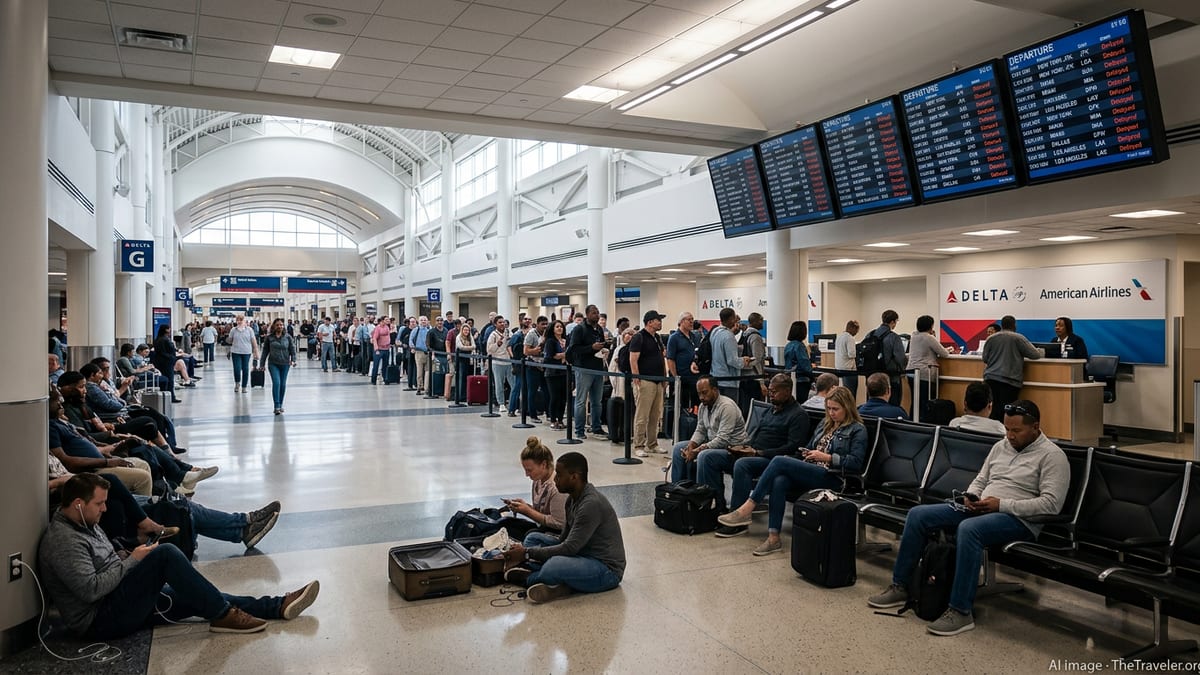
Accounts posted on social media and in local coverage describe long lines at departure gates as airlines cycle through rolling boarding announcements and schedule changes. Some travelers report repeated shifts in departure times as flights move up and down the departure queue in response to air traffic control arrival rates and the availability of crews and aircraft.
Inside the terminals, concession areas and seating zones have remained crowded as passengers wait out extended delays. Families and international travelers in particular appear affected by larger disruptions, since changes to long-haul departures or late-night schedules can be more difficult to absorb than minor adjustments on shorter domestic routes.
Security wait times have varied throughout the day, with periods of heavy congestion in some checkpoints eased by faster processing at others. Observers note that travelers who arrive early and remain flexible about which checkpoint they use often move more quickly, while those who reach the airport closer to departure time are more exposed to sudden surges in demand.
Despite the operational challenges, there are indications that the airport and airlines are gradually chipping away at the backlog as weather conditions improve and more aircraft cycle back into normal rotations. However, passengers departing later in the day or on the following morning may still encounter residual delays and gate changes as schedules are adjusted to reflect the earlier disruption.
Travel advice as operations normalize
With the ground stop now lifted but delays still common, travel experts recommend that passengers flying through Hartsfield-Jackson build extra time into their plans. Those with tight connections are encouraged to monitor itineraries frequently and, where possible, consider shifting to slightly longer connection windows to reduce the risk of misconnecting if delays persist.
Checking flight status repeatedly on airline apps or departure boards before leaving for the airport can help travelers avoid unnecessary time in terminals when flights are substantially delayed. For those already at the airport, staying close to the gate and monitoring announcements can be critical, as improvements in traffic flow can sometimes allow flights to depart earlier than a previously published delay estimate.
Passengers with flexible travel dates may find it easier to rebook to less congested periods if the delay outlook remains elevated. In contrast, those with fixed schedules are often advised to secure backup options such as later same-day departures or alternative routings through other hubs when these are offered by their airline.
As airlines and airport operators analyze the latest episode, industry observers expect further discussion of how to build resilience into operations at major hubs during peak storm seasons. For travelers, the events surrounding the latest ground stop at Hartsfield-Jackson serve as a reminder that even short-term restrictions can lead to hours of follow-on disruption, making preparation and flexibility essential for navigating one of the world’s busiest airports.