


More news on this day
A widespread ground stop across several major airports in the US Northeast on Monday, driven by an air traffic control equipment outage, triggered hours of delays and cancellations that continued to affect travelers into Tuesday.
Get the latest news straight to your inbox!
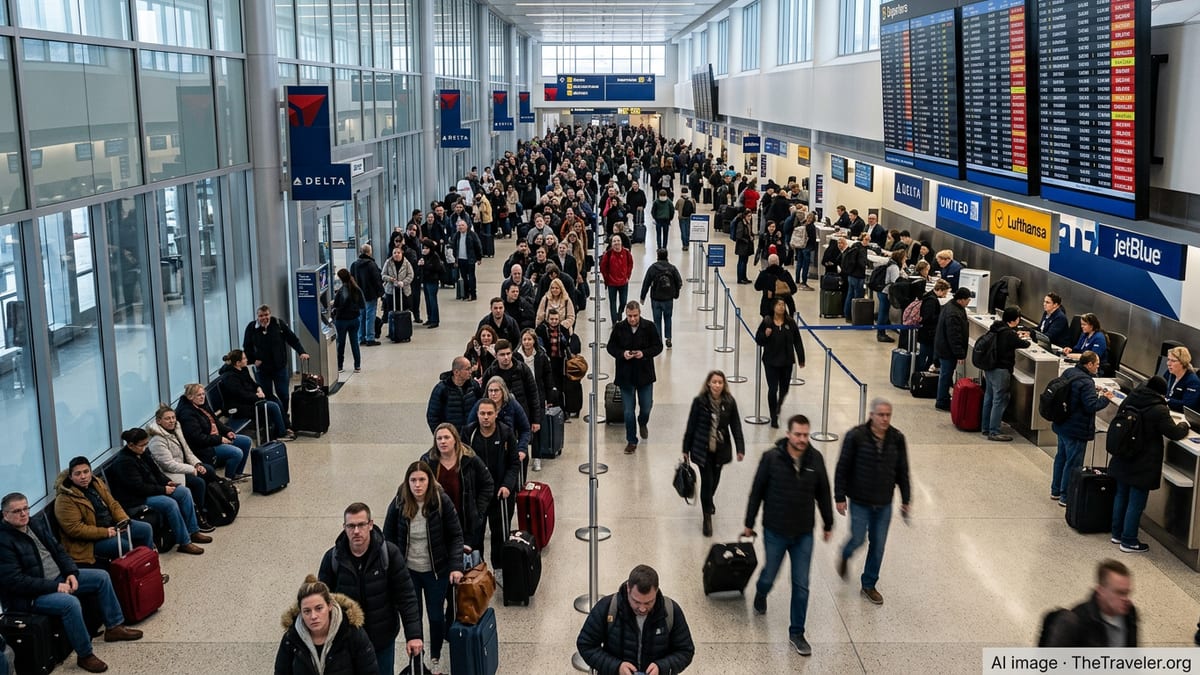
Ground stop ripples from New York and Philadelphia through the Northeast
Publicly available data from the Federal Aviation Administration and flight tracking services show that flight operations at Newark Liberty, New York John F. Kennedy, LaGuardia and Philadelphia International airports were sharply curtailed on Monday, September 21, after a critical communications failure at an air traffic control facility in the Philadelphia area. Ground stops temporarily halted most departures bound for these airports, while arrivals were significantly limited, creating a bottleneck in one of the country’s busiest air corridors.
Coverage from national and regional outlets indicates that the disruption began in the late morning at Newark and Philadelphia before expanding to include New York’s Kennedy and LaGuardia airports and nearby Teterboro. By early afternoon, the ground stop parameters had widened, forcing dozens of inbound flights to hold, divert or cancel, while outbound services were held at gates or on taxiways.
The knock-on effects spread rapidly. Boston Logan and Westchester County Airport in New York entered ground delay programs as diversions and displaced aircraft flowed north. At the height of the disruption, the average delay at Newark was reported at more than five hours, while Logan Airport in Boston recorded average delays of around 105 minutes, combining the ripple from the equipment failure with low cloud ceilings and ongoing runway construction.
Although ground stop orders at the core airports were lifted by Monday evening, airline schedules remained heavily displaced. Early indications from Tuesday morning operations suggested that some New York and Philadelphia flights were still experiencing secondary delays as aircraft and crew were repositioned.
Equipment failure and severed fiber line behind the outage
According to detailed explanations published by transportation and aviation outlets, the disruption was traced to a failure at the Philadelphia Terminal Radar Approach Control facility, which manages airspace for Philadelphia and, in recent years, portions of the Newark area. A primary circuit supporting radar and communications functions failed, triggering backup systems meant to maintain safe separation of aircraft while engineers worked on the problem.
Subsequent public statements and reporting pointed to a compounding problem: a fiber-optic backup line in New Jersey, linked to construction activity, was severed. Transportation coverage attributed the cut to an Amtrak construction crew, producing a telecom outage that undermined redundancy in the system and forced the FAA to sharply restrict traffic volumes to maintain safety.
Industry reporting notes that the same Philadelphia-area facility has been associated with previous disruptions, including a series of Newark delays in 2025. The incident has renewed scrutiny of how air traffic control infrastructure is modernized and how construction near critical communications lines is coordinated, particularly in dense rail and highway corridors.
Aviation analysts quoted in open reports have highlighted that safety margins in air traffic control are deliberately conservative. When monitoring or communication tools are degraded, regulators respond by slowing or stopping traffic rather than accepting higher operational risk, even when it leads to large-scale delays in the short term.
Traveler impact: missed connections, diversions and crowded terminals
For travelers, the ground stop translated into long queues at check-in counters, packed gate areas and uncertainty about when flights would depart. Airline status boards at Newark, LaGuardia, JFK, Philadelphia and Boston Logan showed waves of delays exceeding two and three hours, alongside same-day cancellations as carriers tried to stabilize schedules.
Flight tracking data compiled on Monday and Tuesday morning showed hundreds of delayed flights into and out of the New York and Philadelphia metro areas, with ripple effects at airports well outside the region as aircraft were held on the ground before departure. Some transatlantic flights were diverted into Boston when New York-area arrival flows were paused, adding to congestion at Logan and contributing to the ground delay program instituted there.
Travel media and local coverage reported that some passengers were offered hotel and meal vouchers, particularly when overnight delays became unavoidable, while others faced rebooking onto flights later in the week because near-term departures were already full. Crowded customer service lines formed as travelers attempted to change itineraries, with many advised to use mobile applications or airline websites where possible.
Observers noted that even travelers who were not flying to or from the Northeast sometimes experienced knock-on delays. Aircraft scheduled for routes in the Midwest, South and West Coast were occasionally out of position because they had been planned to pass through affected hubs earlier in the day.
What flyers can expect in the next 24 to 48 hours
By Tuesday, publicly accessible flight status boards indicated that the most severe delays at Newark, Philadelphia and Teterboro had eased, with a relatively modest number of cancellations compared with Monday’s peak. Nonetheless, airline operations teams were still working through displaced aircraft rotations and crew duty limits, which can lead to schedule adjustments even after the technical issue is resolved.
Travel industry analysis suggests that passengers flying into or out of the Northeast over the next one to two days should expect the possibility of residual delays, especially during peak morning and evening banks. Same-day rebooking options may be limited on heavily traveled business routes such as New York–Chicago, New York–Los Angeles and Boston–Washington, where load factors are typically high.
Publicly available guidance from airlines and airport operators continues to emphasize checking flight status frequently, arriving early for departures to allow for longer lines, and staying flexible with connections. Some carriers have issued limited travel waivers for trips involving New York City, Newark, Philadelphia and Boston, allowing customers to change to alternate flights without standard change fees or fare differences within defined date and routing windows.
Travelers with tight international connections through the Northeast are being encouraged, through airline alerts and airport announcements, to monitor any minimum connection time changes or rebook through alternative hubs if their itineraries are particularly time-sensitive.
Wider questions about infrastructure resilience in a busy air corridor
The outage comes at a time when the Northeast airspace is already under pressure from long-running staffing constraints, construction projects and slot restrictions at the major New York airports. Federal notices have previously highlighted that the close proximity of Kennedy, LaGuardia and Newark contributes to chronic congestion, and that capacity management tools such as schedule caps and waivers are used to mitigate expected delays.
Industry commentary following Monday’s disruption has focused on infrastructure resilience, especially the vulnerability of key fiber and telecom links that tie together radar, communications and traffic management systems. The fact that a single cut to a backup line, when combined with a circuit failure at an air traffic facility, could ripple across multiple major airports is drawing attention from aviation specialists and transportation policy observers.
Analysts also point to the role of newer traffic management technologies that are being introduced to handle dense airspace more efficiently. While such systems are designed to improve throughput and predictability in normal conditions, they still rely on underlying communications networks, highlighting the importance of redundancy, physical protection of cables and careful coordination with rail and highway projects.
For travelers, the episode underscores how interconnected the Northeast aviation system has become. A problem traced to a single facility in the Philadelphia region, coupled with a damaged fiber line in New Jersey, quickly affected airports from Washington-area fields up to Boston, providing a reminder that contingency planning and real-time monitoring are increasingly essential parts of modern trip planning.