


More news on this day
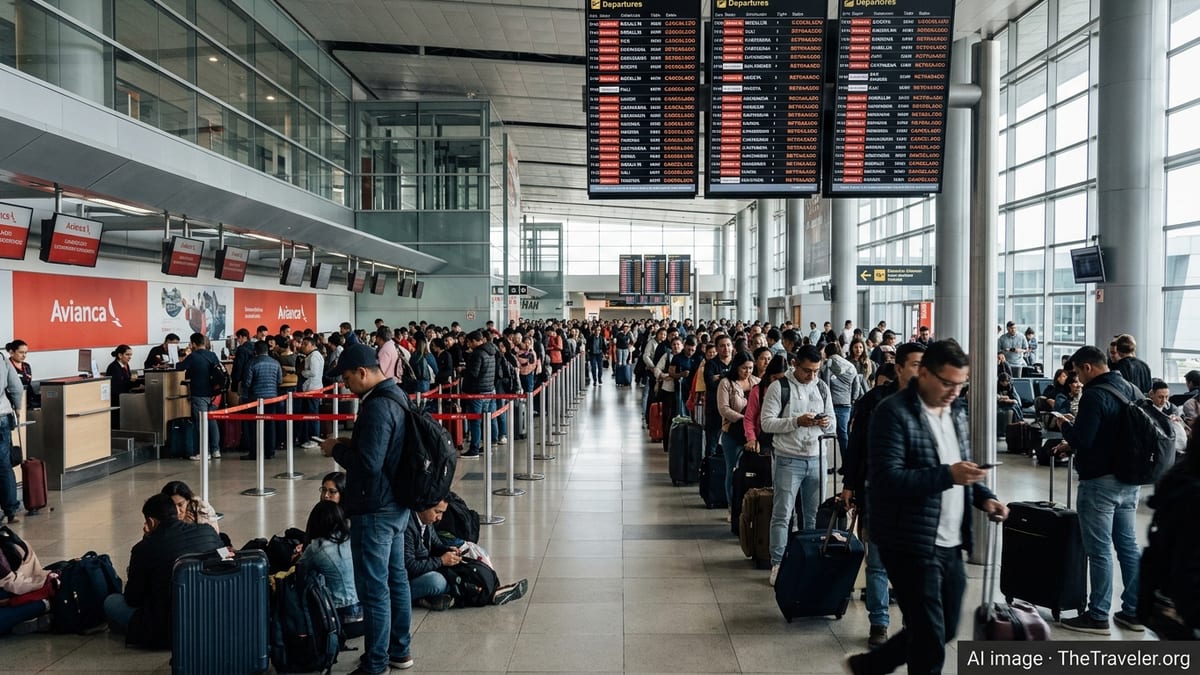
Travelers at Bogotá’s El Dorado International Airport faced cascading delays after four Avianca and LATAM Colombia flights were grounded, disrupting major links between Colombia, Europe, Brazil and the United States.
Get the latest news straight to your inbox!
Disruptions Hit One of Latin America’s Busiest Hubs
El Dorado International Airport, Colombia’s main gateway and one of Latin America’s busiest hubs, experienced a fresh wave of operational disruption as four flights operated by Avianca and LATAM Colombia were grounded on key international routes. Publicly available flight-tracking data and local media reports indicate that the grounded services affected traffic to the Netherlands, France, Brazil and multiple cities in the United States, amplifying knock-on delays across the network.
The incident added pressure on an airport already under close scrutiny after recent operational challenges, including temporary suspensions linked to airspace safety incidents and weather-related delays that have periodically slowed arrivals and departures. With Avianca and LATAM Colombia both using Bogotá as a strategic hub, interruptions on even a handful of long-haul services can rapidly ripple through connecting itineraries across South America and beyond.
On this latest occasion, the grounded flights involved wide mix of long-haul and regional segments that normally feed transatlantic and North American services. As aircraft and crews were held on the ground, departure boards showed growing clusters of late departures and rescheduled flights, leaving many passengers facing missed onward connections, extended layovers and last-minute overnight stays in Bogotá.
Airport operations continued, but the loss of capacity on high-demand routes intensified congestion at service desks and customer care points inside Terminal 1, where both carriers concentrate the bulk of their international services.
Impact on Routes to Europe and North America
Among the most closely watched disruptions were flights linking Bogotá with major European hubs in France and the Netherlands, typically served through codeshare and partner arrangements via Paris Charles de Gaulle and Amsterdam Schiphol. According to published schedules and tracking portals, one Avianca-operated service to Paris and another Europe-bound departure experienced extended ground holds, forcing rebookings onto later departures or alternative routings via other European or Latin American hubs.
Travelers bound for the United States also faced uncertainty. Bogotá’s links to cities such as Washington, Fort Lauderdale and other East Coast gateways are normally supported by a dense web of Avianca-operated services and codeshares with partner airlines. When a small number of those flights are grounded or significantly delayed, the effect can be disproportionate for passengers with tight connections onward to domestic US destinations.
Reports indicate that some travelers connecting from secondary Colombian cities into long-haul flights were particularly affected. Missed connections in Bogotá can be challenging to resolve on busy travel days, especially when alternative departures are already operating near capacity. In some cases, passengers were reprotected on later same-day services, while others were moved to flights departing the following day, extending overall travel times by many hours.
Travel forums and recent public commentary about operations at El Dorado suggest that tight connection times have become a growing concern for frequent flyers, who report that weather, congestion and ad hoc disruptions can quickly erode the buffer built into itineraries, especially on North American and European routes.
Brazil and Regional Connectivity Also Affected
The disruption was not limited to transatlantic and North American flights. At least one grounded Avianca service linked Bogotá with São Paulo, one of the busiest corridors between Colombia and Brazil. Schedule data show that this overnight route typically acts as a crucial bridge for business travelers and tourists transiting between the two countries and beyond, including onward links into southern Brazil and the wider Southern Cone.
When this type of trunk route is affected, the impact cascades into regional networks. Passengers originating in cities across Colombia who rely on El Dorado as a transfer point to Brazil often coordinate flights tightly. A grounded or heavily delayed Bogotá to São Paulo leg can leave travelers stranded in the capital or force complex alternatives via Panama City, Lima or other regional hubs.
LATAM Colombia’s role as a major domestic and regional operator added another layer of complexity. Grounding or rescheduling LATAM departures within Colombia can break the “first mile” or “last mile” of longer international itineraries that are ticketed across alliances and interline agreements. As a result, travelers on tickets involving multiple carriers sometimes encounter more complicated rebooking processes and longer waits for new itineraries to be confirmed.
Regional tourism bodies have repeatedly highlighted the importance of reliable air links between Colombia and Brazil for both leisure and business travel. Any sustained pattern of delays or groundings on this lane can influence traveler confidence and push some passengers toward alternative routings on competing carriers that bypass Bogotá altogether.
Passenger Experience: Long Queues and Missed Connections
Inside El Dorado’s international terminal, the grounding of four flights translated into crowded customer service counters, long lines at airline help desks and heavy use of self-service digital tools. As departure times slipped, travelers sought clarification on their options for rebooking, compensation and support during extended layovers.
Recent online accounts from passengers using Avianca and LATAM on Colombian and regional routes already describe a pattern of tight schedules, occasional last-minute changes and challenging customer service experiences during irregular operations. The latest disruptions appeared to reinforce those concerns among some travelers, particularly those unfamiliar with El Dorado’s layout or transfer procedures.
Families, group travelers and passengers on complex multi-leg itineraries often bear the brunt of these events, since aligning seats on alternative flights for several people on the same booking can be significantly harder once operations begin to back up. Additionally, those connecting from long-haul overnight services into early-morning departures are especially vulnerable when a grounded aircraft or crew rotation issue pushes a flight beyond its original window.
Observers note that, while El Dorado is widely regarded as a modern and efficient facility by regional standards, its role as a central hub for multiple carriers means that any operational strain can quickly be felt across the terminal, from security lanes to immigration queues and boarding gates.
What Travelers Can Do on Affected Routes
Travel specialists and publicly available airline guidance emphasize a few consistent strategies for passengers flying through Bogotá during periods of disruption. Building in longer minimum connection times, particularly for transatlantic and North American routes, is one commonly cited recommendation, as it offers some protection if the first leg into El Dorado is delayed.
In the event of a grounded flight or major delay, travelers are generally advised to monitor airline apps and airport displays in real time and to seek assistance through multiple channels, including digital customer-support platforms, rather than relying solely on airport service counters where queues can grow quickly. Many carriers, including Avianca and LATAM, also allow same-day changes or rebookings within defined parameters, which can be easier to arrange online when seats remain available.
Passengers with onward nonrefundable hotel or tour bookings in Europe, Brazil or the United States may wish to review their travel insurance coverage to understand what disruption-related costs can be reimbursed. Policy documents frequently distinguish between weather issues, technical problems and broader operational decisions, and coverage limits can vary widely.
As airlines and airport operators continue to adjust schedules and fleet utilization in response to wider operational challenges, travelers using Bogotá as a hub are likely to watch closely for further signs of instability on key routes to the Netherlands, France, Brazil and the United States. For now, the grounding of four flights at El Dorado serves as another reminder of the need for flexibility and contingency planning when connecting through one of Latin America’s most important aviation hubs.