


São Paulo’s two main airports, Guarulhos (GRU) and Congonhas (CGH), sit on opposite sides of a vast, traffic-choked metropolis. Every day, thousands of travelers land on an international flight at GRU and need to connect to a domestic departure from Congonhas, often with tight schedules, heavy luggage and jet lag. Choosing the right transfer option can make the difference between a smooth connection and a missed flight.
Get the latest updates straight to your inbox!
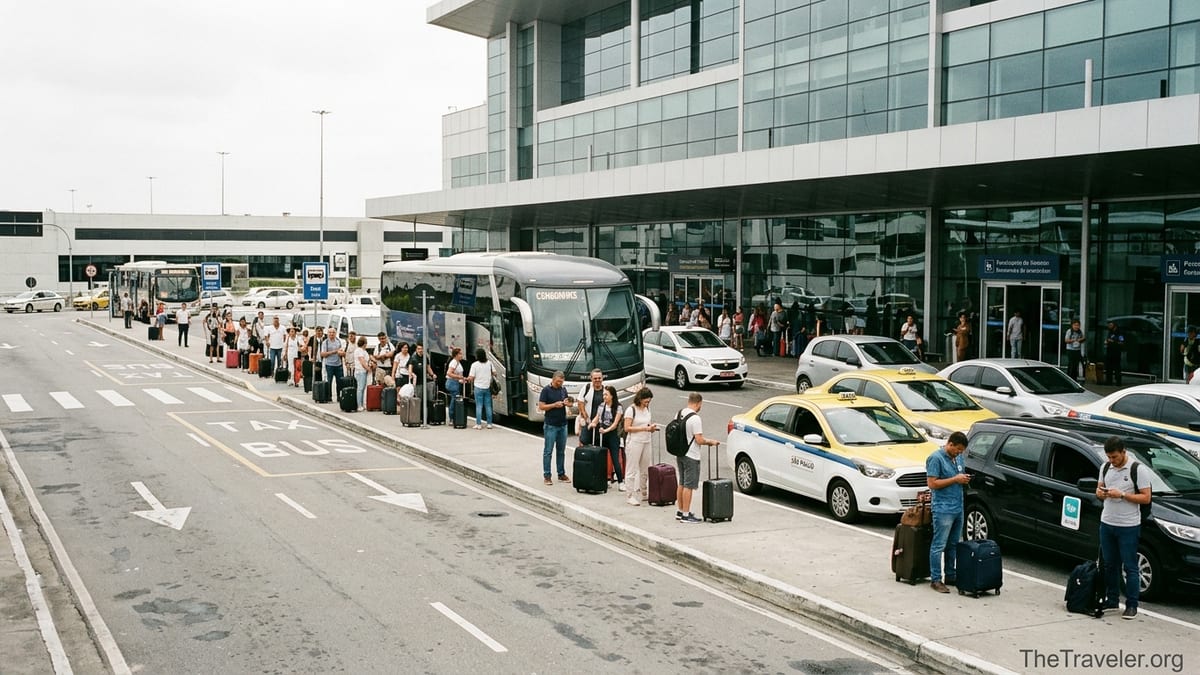
Understanding the GRU–Congonhas Airport Connection
The distance between Guarulhos International Airport and Congonhas Airport is roughly 35 kilometers in a straight line, but in practice the journey cuts across some of the busiest corridors of São Paulo. With good traffic, the drive can take about 60 to 70 minutes. In heavy rush hour or during rain and accidents, that same route can stretch to well over 2 hours. Locals regularly share stories of trips that unexpectedly doubled in time, especially on weekday evenings heading toward the city center.
Both airports are heavily slot-restricted and operate near capacity during peak hours, which means delays at one can easily cascade into the rest of your itinerary. Guarulhos handles most long-haul international flights, while Congonhas is the main business airport for Brazil’s domestic routes, particularly to Rio de Janeiro, Brasília and Belo Horizonte. Many airlines sell separate tickets that require passengers to self-transfer between the two, so planning your ground connection is critical.
Traffic patterns matter. Mornings between roughly 7:00 and 10:00 and evenings between about 16:30 and 20:00 are the most unpredictable on key avenues such as Marginal Tietê, Radial Leste and 23 de Maio. A trip that takes 1 hour at midday on a Sunday can easily turn into a 2-hour ordeal on a rainy Thursday evening. When planning your connection, always assume that the city will be slower than you expect, especially if you are unfamiliar with São Paulo’s layout and language.
For most travelers, the decision comes down to three main options: the dedicated Airport Bus Service coach, a direct car transfer by taxi or ride-hailing app, or a budget-conscious route using the train and metro network combined with a short road leg. Each has advantages and trade-offs regarding price, comfort, reliability and suitability for travelers with large suitcases or limited mobility.
Airport Bus Service: Direct Executive Coach Between GRU and CGH
The Airport Bus Service is the only regular, dedicated executive coach line specifically connecting Guarulhos and Congonhas airports. Managed by the regional transport authority and operated by a private consortium, it runs daily with multiple departures and is designed for travelers with luggage. Buses depart from Terminals 2 and 3 at GRU and arrive directly at the main curbside area of Congonhas, typically using dedicated bus corridors where available.
As of mid-2026, promotional fares on the GRU–Congonhas route are often advertised starting around 40 Brazilian reais per person for a one-way ticket, with final prices varying by departure time and how far in advance you purchase. Typical published travel time is about 1 hour 10 minutes, although the operator clearly warns that traffic can extend this. For example, a mid-morning coach leaving GRU Terminal 3 may be scheduled to reach Congonhas in about 70 to 80 minutes, but passengers report that late-afternoon trips can occasionally approach 1 hour 40 minutes when the southern access roads are congested.
The buses are standard coach-style vehicles with reclining seats, air conditioning and underfloor luggage storage, suitable for checked-sized suitcases and carry-on bags. This makes the service particularly attractive for solo travelers or couples with two or three large bags who do not want to juggle their belongings on crowded metros. Families with children also appreciate that they can board together and sit in a block of seats, rather than handling multiple taxis or app cars.
Tickets can usually be bought both online and at sales counters or kiosks at the terminals, and some travelers report boarding with same-day purchases when seats are available. However, at peak times such as Monday mornings, Friday evenings or around major holidays, seats can sell out on specific departures. If your connection is tight, reserving a bus that departs about 45 to 60 minutes after your scheduled arrival at GRU is often a reasonable compromise, assuming you are on a through ticket with checked bags automatically sent to Congonhas. If you must reclaim luggage and clear customs, aim for a bus leaving at least 90 minutes after landing.
Taxi and Ride-hailing Apps: Fastest Door-to-Door, With Caveats
For many travelers, the most straightforward way to move between GRU and Congonhas is by car. Official airport taxis and ride-hailing apps such as Uber and 99 operate widely in São Paulo. They provide door-to-door service between the terminals without transfers or intermediate stops, which is invaluable if you are tired, traveling with family or carrying bulky luggage like sports equipment or musical instruments.
Typical travel times in moderate traffic hover around 60 to 80 minutes door to door. On a clear Sunday morning, drivers sometimes make the trip in just under an hour. Yet experienced locals often warn visitors that it is easy to underestimate congestion: during a rainy weekday rush hour, some report journeys of almost 2 hours between the airports. In a few extreme cases, unexpected accidents or road closures have pushed trips even longer, highlighting why generous connection buffers are essential if you rely on road transport.
Estimated prices through ride-hailing apps fluctuate dynamically with demand, traffic conditions and tolls. On a normal weekday midday, a standard category ride from GRU to Congonhas might appear in the app at roughly 120 to 180 reais, while premium categories or peak times can push the estimate beyond 200 reais. Airport taxis often use fixed or metered tariffs published at kiosks inside the terminals, and their rates can be comparable to or slightly higher than app rides depending on time of day and traffic surcharges.
One practical advantage of licensed taxis is access to dedicated bus lanes on some key corridors into the city. In several stretches toward Congonhas, especially around Avenida 23 de Maio and parts of the central corridor, taxis are legally allowed to use bus lanes while private cars and ride-hailing vehicles are not. Locals point out that, in heavy traffic, this can easily save 15 to 30 minutes compared with an Uber or 99 taking the same route. If you are catching a tight domestic connection and budget is less important than reliability, an official taxi from the airport stand can be the best compromise between speed and predictability.
Train and Metro Combinations: Cheapest but Least Practical With Luggage
São Paulo’s rail network offers a budget-friendly but more complicated way to move from Guarulhos toward the city and, indirectly, to Congonhas. Line 13-Jade of the CPTM suburban rail system serves the Aeroporto–Guarulhos station, linked to GRU by a people mover or free shuttle buses between the terminals and the rail station. From there, passengers can connect to Line 12 and reach stations such as Tatuapé or Brás, which sit on the main metro lines feeding central São Paulo.
In theory, a very budget-conscious traveler could ride Line 13-Jade from GRU to Engenheiro Goulart, transfer to Line 12, then switch to the metro network and eventually reach the monorail corridor that connects to Congonhas. With the gradual rollout of Line 17-Gold and its station serving the airport area, passengers can move from stations like Brooklin Paulista toward Congonhas via a dedicated monorail link and pedestrian tunnel. However, this sequence involves several changes, escalators, ticket barriers and busy platforms, which can be challenging even for confident urban travelers, especially at rush hour.
Fares on the integrated train and metro system are low by international standards, typically around a few reais per ride with transfer discounts when using a local smart card. Importantly, trains and metros are primarily designed for commuters, not air travelers, which means there are few dedicated luggage racks, limited seating at peak times and crowded cars. During weekday rush hours, carrying large checked bags through packed carriages can be stressful, and you should also consider the risk of pickpocketing in very crowded conditions, as in any large city.
For these reasons, the rail option between GRU and Congonhas is generally recommended only to travelers who are very comfortable navigating public transport, traveling light with a backpack or small carry-on and not racing to catch a connection. It can work well for a backpacker landing at GRU with an evening flight from Congonhas and 6 or more hours to spare, who wants to stop for a meal near a metro station, then continue toward Congonhas using the monorail and a short walk. For most passengers with tight schedules, heavy luggage or children, the executive bus or a direct taxi is a more realistic choice.
Traffic Risks, Weather and When Journeys Go Wrong
São Paulo’s traffic is notoriously sensitive to weather and incidents. A routine late-afternoon trip can quickly change character if heavy rain, a minor crash on the ring roads or a fallen tree slows a key artery. Events such as power outages or severe storms have in the past caused long delays around both airports and in the inner city, impacting road traffic, metro operations and flight schedules at the same time. While such extremes are not an everyday occurrence, they illustrate why relying on best-case travel times is risky.
Real-world anecdotes from residents and frequent flyers often mention journeys that should have taken about 1 hour stretching to nearly 3 hours between the city center and GRU or between Congonhas and Guarulhos, particularly on weekday evenings. One common pattern is a trip that moves quickly for the first half, then stalls on congested approaches like Avenida dos Bandeirantes or 23 de Maio as commuters converge on central districts. Taxis gain some advantage by using bus corridors in several of these bottlenecks, while ride-hailing cars are forced to sit in mixed traffic.
Another factor is how long it takes to get out of and into each airport. At Guarulhos, international arrivals may experience queues at immigration and baggage claim, while at Congonhas, the compact terminal can feel crowded during evening rushes when business flights are clustered. Just walking from a distant gate to the curb, or re-clearing security with checked baggage, can consume an extra 20 to 40 minutes beyond the road journey itself. Travelers connecting from an overseas overnight flight should also factor in slower movement due to fatigue.
To reduce risk, treat the published or app-estimated travel time as the lower bound. If your app suggests that the ride will take 70 minutes in current conditions, build at least another 30 to 40 minutes of buffer into your connection plan, more if you are traveling at known busy times or during Brazil’s summer rainy season. It is always safer to arrive early at Congonhas and spend extra time in the departure lounge than to watch the minutes tick away in standstill traffic.
Luggage, Comfort and Safety Considerations
Your choice of transfer between GRU and Congonhas should reflect how much luggage you have and how comfortable you are moving with it. The executive Airport Bus Service is designed to handle full-size suitcases: staff typically load large bags into the coach’s underfloor compartments, leaving you free to keep a small backpack or handbag in the cabin. Seats are assigned on a first-come basis, and the atmosphere tends to be quieter than on crowded city buses, which suits travelers who have just come off a long-haul flight.
In taxis and ride-hailing vehicles, luggage capacity depends on the category you choose. A standard sedan can generally handle two large checked bags plus hand luggage in the trunk and back seat. If you are a group of three or four with several big suitcases, choosing a larger vehicle category in the app or requesting a minivan taxi at the stand can avoid last-minute repacking at the curb. For example, a family of four arriving from North America with three big suitcases and two carry-ons might find that a regular app ride is a tight squeeze, while a larger category costs more but provides a much less stressful experience.
Public train and metro routes are significantly less friendly to large luggage. At many stations, escalators and elevators exist but can be crowded or temporarily out of service, forcing passengers to haul heavy bags up and down stairs. On busy lines passing through Tatuapé, Brás or central interchanges, the combination of backpacks, suitcases and commuter crowds can be challenging. Travelers choosing this option should keep belongings close, use luggage locks, and avoid peak hours when possible, just as they would in any major metropolitan system.
From a personal safety standpoint, both airports and the main transfer options are heavily used by locals and visitors. Official taxis and the Airport Bus Service are generally considered safe options at all hours of operation. Ride-hailing apps offer tracking and driver information, which many travelers appreciate. On public transport, common-sense precautions apply: keep phones and wallets out of sight in crowded cars, and avoid setting bags down unattended. Most incidents reported by visitors involve petty theft rather than violent crime, but an unexpected loss can still ruin a trip, so situational awareness is important.
How Much Connection Time Should You Allow?
Determining how much time to leave between an arrival at Guarulhos and a departure from Congonhas (or the reverse) is the most critical decision for your itinerary. Airlines sometimes sell separate tickets that technically allow as little as 3 hours between flights, but frequent travelers in São Paulo widely agree that this is optimistic. A safer strategy is to think in terms of minimums for different risk profiles and times of day.
If you are arriving at GRU on an international flight, need to clear immigration, collect and re-check luggage at Congonhas, and you care deeply about not missing your connection, many experienced travelers recommend leaving at least 5 to 6 hours between scheduled arrival and departure times. This window accounts for 60 to 90 minutes to clear formalities and exit GRU, 60 to 90 minutes on the road or in the bus, and at least 90 minutes at Congonhas to check in, drop bags and clear security. During weekday peak hours or in the rainy season, adding an extra hour of buffer is a prudent choice.
For domestic-to-domestic connections where you remain within Brazil’s immigration system, do not need to clear customs, and travel outside peak traffic times, some passengers successfully make GRU–Congonhas transfers in 4 hours using a taxi or the Airport Bus Service. Even in these cases, a single delay on the incoming flight or a minor traffic disruption can erase your margin. If you choose to accept that risk, you should at least have flexible or changeable tickets for the onward flight and set your expectations accordingly.
On the other extreme, travelers with more than 7 or 8 hours between flights sometimes consider leaving the airport to visit a shopping center or have a proper meal in the city. While this can be a pleasant way to break a long layover, it adds another set of transfers and potential delays. If your main priority is to ensure a smooth connection between GRU and Congonhas, it is usually better to complete the inter-airport transfer first, then relax near your departure airport rather than shuttling back and forth across the city.
When in doubt, err on the side of a longer layover. Flight delays, baggage handling issues, unanticipated queues at security or check-in and last-minute gate changes all eat into your buffer. Many frequent flyers who once tried to “optimize” with a short 3-hour layover have a story about the time they watched their domestic flight push back while they were still in a taxi on Avenida dos Bandeirantes.
Choosing the Best Option for Your Situation
There is no single best transfer option between Guarulhos and Congonhas that fits every traveler. The right choice depends on your budget, schedule, the number of people in your group and your tolerance for complexity. A solo backpacker arriving on a low-cost carrier with only a small bag and 8 hours before a domestic hop from Congonhas might value saving money with a train and metro combination, even if it requires several transfers and careful navigation of station signage.
By contrast, a family of four arriving from Europe at 06:00 with two checked bags and a stroller for a mid-afternoon domestic departure will usually be far better off with a direct taxi or the Airport Bus Service. The incremental cost compared with four individual train tickets is relatively small once you factor in convenience, time savings and reduced stress. For a business traveler on a time-sensitive connection, an official taxi using bus lanes may offer the most reliable journey, even if ride-hailing appears slightly cheaper in the app.
It can help to run two or three scenarios before you travel. Check the approximate Airport Bus Service schedule for the day of the week you will arrive, then look at current app estimates from GRU to Congonhas at a similar time on your own travel day to get a feel for prices. If your connection falls squarely within rush hour or during the rainy season, lean toward more conservative options with fewer variables. If you speak some Portuguese or are comfortable with translation apps, you will find it easier to adapt on the fly if conditions change.
Regardless of mode, always keep essential items such as passports, medications, electronics and one change of clothes in your carry-on. In the unlikely event that traffic or operational disruptions cause you to miss your onward flight, having these basics at hand will make it easier to rebook, stay overnight if necessary, or change your route. As São Paulo’s infrastructure continues to evolve, including new rail links to both airports, the range of options will expand, but the fundamental lesson will remain: allow more time than you think you need.
The Takeaway
Transferring between Guarulhos International Airport and Congonhas Airport is a common but often underestimated challenge for travelers using São Paulo as a hub. The journey is not simply a matter of distance but of navigating one of Latin America’s busiest metropolitan areas, with variable traffic, complex road networks and two crowded airports operating close to capacity.
For most visitors, the safest and most comfortable solutions are the executive Airport Bus Service or a direct ride by official taxi or ride-hailing app, with the exact choice guided by your budget and appetite for risk. Train and metro combinations offer genuine savings but demand more time, energy and confidence, and they are best reserved for lightly loaded travelers with generous layovers.
Whatever route you choose, the key to a successful GRU–Congonhas connection is time. Build in realistic buffers for immigration, baggage, road traffic and security, especially during peak hours and poor weather. By planning conservatively and aligning your transfer choice with your circumstances, you can turn a potentially stressful cross-city dash into a manageable, even routine, part of your journey.
FAQ
Q1. How long does it usually take to travel from Guarulhos to Congonhas?
In moderate traffic, the road journey typically takes around 60 to 80 minutes, but at rush hour or in heavy rain it can exceed 2 hours.
Q2. What is the safest minimum connection time between GRU and CGH?
For an international arrival at GRU connecting to a domestic flight at Congonhas, many travelers aim for at least 5 to 6 hours between scheduled arrival and departure.
Q3. How much does the Airport Bus Service cost between the airports?
Recent promotional fares on the GRU–Congonhas route often start around 40 reais per person one way, with final prices depending on schedule and demand.
Q4. Is a taxi faster than Uber between the airports?
Often yes, because licensed taxis can legally use certain bus lanes on key avenues, which can save 15 to 30 minutes compared with app cars stuck in mixed traffic.
Q5. Is it realistic to use train and metro between GRU and Congonhas?
It is possible but complex and best suited to experienced public transport users with light luggage and generous layovers, as it requires multiple transfers.
Q6. Can I rely on a 3-hour layover to transfer between the airports?
A 3-hour layover is considered risky, especially if you must clear immigration and collect luggage. Even small delays or traffic can easily make you miss your flight.
Q7. Is the Airport Bus Service comfortable for families with children?
Yes, the executive coaches have air conditioning and luggage holds, and many families find them more comfortable and predictable than juggling multiple taxis or metro lines.
Q8. Are there late-night transfer options between GRU and Congonhas?
Taxis and ride-hailing apps generally operate 24 hours. The Airport Bus Service runs daily but with limited late-night departures, so always check the specific timetable.
Q9. What is the best option if I am traveling with very large or heavy luggage?
A direct taxi or app ride, or the Airport Bus Service, is usually best. Train and metro routes are not well suited to very large bags or multiple suitcases.
Q10. Should I book my transfer in advance or decide on arrival?
Booking in advance can be helpful at peak times or with tight connections, but many travelers successfully choose between taxi, app or bus after landing based on real-time conditions.