


Landing at São Paulo/Guarulhos International Airport (GRU) is often the first test of a Brazil trip. The airport sits about 25 kilometers from the city center, traffic can be intense, and the right transfer choice depends heavily on your budget, arrival time, luggage and hotel location. This guide walks through the main options from GRU to central São Paulo, with realistic prices, safety tips and tailored recommendations for the city’s most popular hotel areas.
Get the latest updates straight to your inbox!
Understanding the Route from GRU to São Paulo
Guarulhos International Airport lies to the northeast of São Paulo, in a separate municipality. Reaching the main hotel districts such as Avenida Paulista, Centro / Praça da República, Jardins, Itaim Bibi, Vila Olímpia and Vila Madalena usually takes between 35 minutes and 1 hour 30 minutes depending on traffic and transport mode. In light traffic, a direct car ride from GRU to Avenida Paulista can be as quick as 30 to 40 minutes. In rush hour, particularly on weekday mornings toward the city and late afternoons leaving the center, journey times can easily double.
The good news is that São Paulo offers a broad mix of services tailored to different travel styles. At the budget end, the CPTM suburban train network connects directly to the airport station, with a standard flat fare for the entire rail system. At the mid-range level, the Airport Bus Service offers direct coach-style buses to Paulista, República, Barra Funda, Tietê bus terminal and Congonhas Airport, with fares typically around the cost of a casual restaurant meal. At the upper end, app-based rides like Uber, the official Guarucoop taxi fleet and prebooked private transfers deliver door-to-door convenience at higher but still competitive prices compared with many global hubs.
Before choosing, it helps to consider three variables: your arrival time, how comfortable you are with public transport in a huge Portuguese-speaking city, and how much luggage you are carrying. A solo backpacker arriving at 10:00 on a weekday can safely prioritize cost and use the train or Airport Bus Service. A couple landing late at night with two large checked bags each may prefer to pay more for a door-to-door car, especially to neighborhoods that are further from metro stations.
CPTM Train: The Cheapest Route into Town
The CPTM suburban train is usually the cheapest way from GRU into São Paulo. Line 13 Jade connects Aeroporto–Guarulhos station to the rest of the metro-rail network. From 2025 a people mover links the terminals to the train station, replacing the earlier shuttle buses, which means you can remain inside the airport system until you board your train. The single ticket costs roughly the standard São Paulo rail fare, around 5 to 6 reais, which is a fraction of car or bus prices and has not risen dramatically in recent years.
From Aeroporto–Guarulhos, regular services run to Engenheiro Goulart, where you can connect to Line 12 Safira and then on to major interchange stations such as Brás or Tatuapé. The special Expresso Aeroporto service runs directly between the airport and central stations such as Luz or Barra Funda with limited stops. For example, a traveler heading to a hotel near Praça da República could ride the Expresso Aeroporto to Luz, then transfer one stop on the metro to República. Total travel time is often around 50 to 70 minutes, depending on waiting times.
The main strengths of the train are predictability and price. Even at peak times, you avoid the worst highway congestion, and trains are frequent by Brazilian suburban standards. However, there are trade-offs. Stations and trains can be crowded during rush hour, and while petty crime is not guaranteed, travelers are strongly advised to keep phones and wallets out of sight, avoid traveling with obviously high-value items exposed, and keep backpacks in front of their body. With large or multiple suitcases, navigating station stairways and crowded platforms can be awkward, particularly when connecting to the metro at Brás, Luz or Barra Funda.
In terms of when to use the train, it suits confident travelers arriving in daylight with limited luggage, especially those staying near metro-connected neighborhoods. For example, a budget traveler with a small backpack heading to a hostel in Vila Madalena could take the Expresso Aeroporto to Barra Funda, switch to the metro, and reach Vila Madalena station for a final short taxi or app ride. By contrast, a first-time visitor arriving late at night with two checked bags and electronics would be better advised to choose an option that minimizes transfers and walking in busy stations.
Airport Bus Service: Direct Coaches to Key Hotel Areas
Airport Bus Service operates executive-style buses linking GRU with strategic city points used by both locals and visitors. Typical destinations include Avenida Paulista via Praça da República, the Tietê and Barra Funda long-distance bus terminals, and Congonhas Airport. These buses use coach-style vehicles with comfortable seating and luggage storage, and their pricing tends to fall in a middle band: usually several times the rail fare but still far below the cost of a private transfer for one person.
A common route for tourists is the GRU to Paulista via República service. The bus departs from the terminals at regular intervals during daylight and early evening, generally starting around the early morning and running into the evening. It stops at key points along Avenida Paulista and nearby streets where many major hotels cluster, such as around Consolação, Brigadeiro and Trianon-Masp stations. For a solo traveler staying, for example, at a hotel near the MASP museum, this bus offers a direct ride from the airport to within a short walk of the front desk without any train or metro changes.
The Airport Bus Service is especially attractive for those with medium-sized luggage. You load your suitcase into the bus baggage hold at the airport, ride seated in an air-conditioned cabin, and collect your bag at the final stop. It is notably more forgiving than the train for visitors unfamiliar with São Paulo’s rail network, as you do not have to worry about ticketing complexity or transfers. The main limitations are schedule and traffic: journeys often take 1 to 1.5 hours on weekdays, sometimes longer at peak times, and services stop at night, which means a late evening arrival will likely need a different solution.
In terms of safety, the bus itself is considered a relatively secure environment. The main risks occur when you disembark in the city center. Around Praça da República, for example, the area can feel intense, with a mix of commuters, street vendors and, at times, petty crime. Travelers should keep valuables out of view, know in advance which direction to walk, and avoid wandering with open suitcases searching for their hotel. Those uncertain can ride the Airport Bus Service to Paulista, then take a short licensed taxi or app ride from the bus stop directly to the hotel lobby.
Uber and Other Ride-Hailing Apps: Flexible Door-to-Door Transport
Ride-hailing apps such as Uber, 99 and inDrive operate widely in São Paulo, including at GRU. For many visitors these services strike the best balance between price, convenience and flexibility. Fares fluctuate based on demand and traffic, but a typical UberX ride from GRU to Avenida Paulista might cost in the range of roughly 100 to 150 reais in normal conditions, with Uber Comfort and Black priced higher. During very quiet times, prices can be somewhat lower; during storms or major events they can surge significantly.
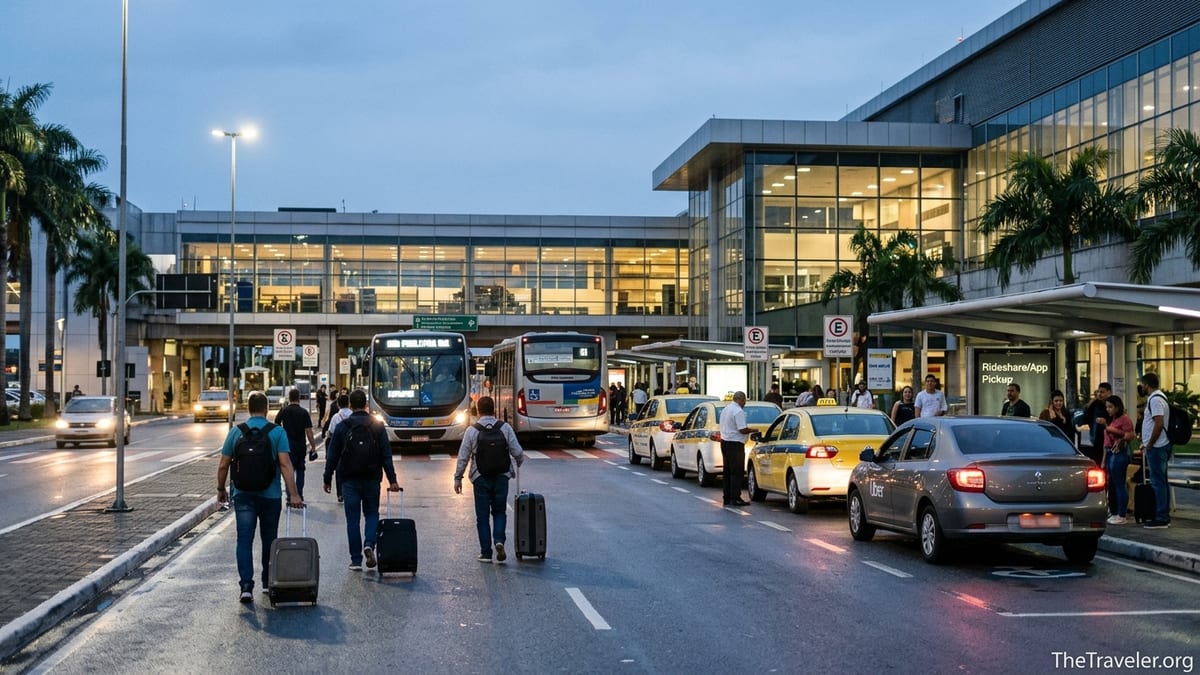
At Guarulhos, pickup areas are signposted within the terminal complex. You request your ride from inside the arrivals hall using airport Wi-Fi or a local SIM, confirm the official pickup point shown in the app, and walk there only after the driver is confirmed. Travelers consistently warn against accepting unsolicited offers of “Uber” or “taxi” from individuals approaching inside the terminal or just outside arrivals. Official ride-hail drivers do not search for passengers inside; they wait in the app-designated area, and communication should happen only through the app.
For most central hotel districts, Uber and similar apps provide genuine door-to-door service. A couple arriving at 21:00 and staying in Jardins can ride directly from GRU to the hotel entrance with no transfers or walking through busy metro stations. For a group of three or four sharing, the per-person cost often becomes competitive with the Airport Bus Service, especially if they would otherwise need taxis from the bus stop to their final destination.
In safety terms, using a ride-hailing app from GRU is generally considered acceptable, particularly to established central areas such as Paulista, Jardins, Itaim Bibi and Vila Olímpia. Common-sense precautions apply: confirm the license plate, driver name and car model before getting in; keep luggage in sight when loading and unloading; and avoid showing expensive electronics at the curb in quieter streets late at night. Some locals prefer choosing higher-tier categories, such as Uber Black, for added comfort and perceived reliability, although standard categories are widely used without incident.
Official Taxi and Private Transfers: Maximum Simplicity
For travelers who prioritize simplicity, especially after a long-haul flight or when arriving around midnight, the official Guarucoop taxi service and prebooked private transfers are attractive. Guarucoop holds the exclusive concession to operate official taxis inside GRU. Their counters are located in the arrivals halls, where you can see a fixed-fare table and pay in advance by card or cash. Fares are usually zone-based rather than metered from scratch, so you know the approximate cost before leaving. For typical central destinations like Avenida Paulista or Praça da República, travelers report values often exceeding ride-hail prices but offering the reassurance of an airport-backed operator.
The main advantages of Guarucoop are clear signage, staff used to dealing with international passengers, and the absence of negotiation or haggling. You receive a receipt, walk to the taxi rank with a printed ticket, and are escorted to your cab. The service is especially suitable for those with significant luggage, older travelers, or anyone uncomfortable using apps or public transport in Portuguese. Private transfer companies, booked in advance, offer a similar experience but with a named driver meeting you at arrivals, often holding a sign with your name, and escorting you to a dedicated vehicle such as a sedan or van.
Costs for private transfers vary widely, from competitive rates slightly above Uber Black to premium services priced at a substantial markup. Many São Paulo business hotels can arrange transfers on request, and some high-end properties in Jardins and Itaim Bibi even coordinate chauffeur services for VIP guests. While not strictly necessary for most visitors, these transfers can be worthwhile if you are arriving with young children, carrying expensive equipment such as camera gear or musical instruments, or traveling after midnight when you value a controlled, prearranged environment above all else.
In terms of safety and reliability, official taxis and reputable transfer companies are typically seen as the most predictable options. Vehicles are licensed, drivers are vetted, and if something is left in the car, there is a clear point of contact. The main drawback is cost, especially for solo travelers. For a single backpacker staying at a budget hotel near República, the price of a taxi may exceed the nightly room rate, which makes cheaper options more rational unless it is very late or the traveler has mobility issues.
Cost, Safety and Luggage: Comparing the Main Options
Looking at the big picture, the CPTM train is the most economical way into São Paulo, with a flat fare in the low single-digit reais and predictable travel times that are mostly unaffected by surface traffic. It is ideal for budget-conscious travelers with minimal luggage arriving in daylight. Its weaknesses are the need for one or more transfers to reach most hotel areas and the need to be alert in busy stations where pickpocketing can occur. Rolling a heavy suitcase up and down stairs at Brás or Luz in rush hour can quickly erase the kindness of the low ticket price.
The Airport Bus Service sits in the middle in both pricing and convenience. Fares are significantly higher than the train but still accessible, particularly for solo travelers or couples. You travel in a single vehicle from the airport to a strategic drop-off point with your luggage stored in the hold. For the Avenida Paulista corridor, this route is particularly attractive, as it places you within walking distance or a short taxi ride of many major hotels. The main limitations are that services do not run through the night and that journey times can be slow in heavy traffic.
Ride-hailing apps, official taxis and private transfers belong to the more expensive tier, but they are the only truly door-to-door services. For groups, the effective per-person cost can be close to or even below that of individual Airport Bus Service tickets, particularly if you would otherwise need a taxi from the bus terminal to your hotel. Safety is strong if you stick to official or app-based channels, confirm vehicle details, and avoid accepting off-the-books offers. For luggage, a private car is the clear winner, as your bags stay with you from the moment you leave the baggage carousel until you reach your hotel room.
From a safety perspective, the most important variable is not simply the mode of transport but the combination of time, location and behavior. Walking several blocks from a bus stop at 23:00 with two rolling suitcases on side streets around República is more exposed than stepping directly into a hotel lobby on Paulista at the same time. Many local residents advise that visitors arriving late at night, especially for the first time, should consider spending the extra money on a direct car service to their hotel, then explore cheaper options once they are familiar with the city layout and have lighter daypacks.
Best Options by Hotel Area
For Avenida Paulista and Jardins, the Airport Bus Service and ride-hailing apps are usually the best choices. If you land between early morning and evening, taking the Airport Bus Service from GRU to Paulista via República is convenient and budget friendly. You can disembark near your hotel’s cross street and walk a short distance. For example, a traveler staying near Trianon-Masp station can exit the bus near the museum and be at reception within minutes. Outside bus operating hours, an Uber or official taxi delivers a direct, reasonably fast route from airport curb to hotel door.
For Centro and República, options depend more on arrival time and comfort level. During the day, confident travelers can combine the Expresso Aeroporto train with the metro to República station, which places them within a short walk of many downtown hotels and guesthouses. Alternatively, the Airport Bus Service to Praça da República is a straightforward solution. At night, many visitors prefer a direct car, both to avoid quiet streets and to minimize time spent outside with visible luggage. For those staying near Luz or Sé, taking a ride-hail or taxi directly to the hotel entrance is usually worth the extra expense.
Itaim Bibi, Vila Olímpia and Faria Lima are major business and nightlife districts in the southwest of the city. They are less directly served by the Airport Bus Service, so ride-hailing apps, official taxis or private transfers generally make the most sense. A business traveler heading to an office hotel in Vila Olímpia might reasonably charge the cost of a private car to expenses, ensuring a predictable trip time and the ability to work or take calls en route. Budget travelers staying in hostels in Vila Madalena or Pinheiros can consider a mixed strategy: CPTM train to Barra Funda or Luz, metro to a closer station, then a short app-based ride for the final stretch.
For guests connecting to long-distance buses at Tietê or Barra Funda terminals, both the CPTM Expresso Aeroporto and the Airport Bus Service provide direct terminal access in some schedules. For instance, a traveler flying into GRU and heading straight to the coast or countryside might ride the Airport Bus Service to Tietê terminal, then transfer to an intercity coach. In such cases, staying within organized terminals reduces the need to cross busy streets or navigate unfamiliar neighborhoods with luggage.
Practical Tips for a Smooth Arrival
Whichever option you choose, a few simple practices can make your arrival at Guarulhos and transfer into São Paulo smoother. First, decide in advance how you are going to pay. Having a small amount of local currency is useful, especially if you plan to buy train or bus tickets. Most official taxis, Airport Bus Service counters and private transfers accept cards, but a backup is wise. For ride-hailing apps, ensure your profile has an active payment card and that you can access mobile data via roaming or a local SIM.
Second, map your route to your hotel before you land. Knowing whether your hotel sits closer to Paulista, República, Consolação, Jardins, Itaim Bibi or Vila Olímpia clarifies which service is most efficient. For example, if your hotel’s address includes Avenida Paulista or Rua Augusta, the Airport Bus Service to Paulista is almost certainly a strong candidate. If your address is in Vila Olímpia or Chácara Santo Antônio, a door-to-door car will likely save a lot of time and transfers compared with public transport.
Third, be conscious of your arrival time. For midday arrivals, almost every option is viable. For very late-night arrivals, especially after 23:00, prioritize services that minimize walking outdoors with luggage. Many visitors choose Uber, 99, Guarucoop taxis or prebooked transfers at these hours. If your flight lands shortly before the last Airport Bus Service departure, consider whether a small flight delay could leave you stranded; in such situations, a flexible plan involving a car service can be reassuring.
Finally, apply common-sense security habits from the moment you collect your bags. Keep your passport and primary payment card in a secure inner pocket, use a money belt if you carry larger sums of cash, and avoid handling your smartphone near bus doors or at open metro platforms. These simple steps significantly reduce the risk of petty theft and allow you to focus on the experience of arriving in one of South America’s most dynamic cities.
The Takeaway
There is no single “best” way to travel from Guarulhos International Airport to São Paulo’s city center, only options that fit different trip profiles. The CPTM train is exceptionally cheap and reasonably quick, ideal for light-packing, experienced travelers who are confident with transfers and public transport. The Airport Bus Service offers a comfortable, good-value bridge between pure budget and door-to-door comfort, especially for hotels on or near Avenida Paulista and for those heading to major bus terminals.
Ride-hailing apps, official taxis and private transfers form the premium tier, delivering direct, low-stress journeys that are particularly attractive after long flights, at late hours, or when traveling with family and hefty luggage. In many real-world cases, especially for couples or groups staying in popular central districts, the extra cost buys a level of simplicity and security that feels worthwhile. By weighing your budget, arrival time, luggage and hotel location, you can choose the transfer option that turns your first journey into São Paulo not into a challenge but into the smooth beginning of your Brazilian adventure.
FAQ
Q1. What is the cheapest way to get from Guarulhos Airport to São Paulo city center?
The cheapest option is usually the CPTM train on Line 13 Jade, which connects Aeroporto–Guarulhos station to the wider metro-rail network for a flat, low single-digit real fare.
Q2. Is the train from GRU safe for tourists with luggage?
The train is widely used and generally safe in the daytime, but stations can be crowded. Keep valuables out of sight, hold backpacks in front, and avoid traveling with very bulky luggage during rush hours.
Q3. How much does the Airport Bus Service from GRU to Avenida Paulista cost?
Fares vary over time but typically sit in a middle price range, higher than the train but lower than a private car. Expect to pay roughly the cost of a casual meal for a one-way ticket.
Q4. How long does it take to reach Avenida Paulista from Guarulhos?
In light traffic, a direct car or bus ride can take 30 to 40 minutes. During peak periods, especially weekday rush hours, total journey times of 60 to 90 minutes are common.
Q5. Are Uber and other ride-hailing services reliable at Guarulhos Airport?
Yes, Uber and similar apps are widely used at GRU. Always request your ride through the app, go to the designated pickup point, and confirm the vehicle’s details before getting in.
Q6. Should I use an official taxi instead of a ride-hailing app?
Official Guarucoop taxis offer fixed, transparent fares and are convenient if you prefer to pay at a counter or are uncomfortable using apps. They often cost more than Uber but provide a straightforward, airport-backed service.
Q7. What is the best option if I arrive late at night?
For late-night arrivals, many travelers prefer a direct car service such as Uber, 99, Guarucoop taxis or a prebooked private transfer, to minimize walking outdoors with luggage and to avoid limited late-night public transport.
Q8. Which transfer is best for hotels on Avenida Paulista?
During the day, the Airport Bus Service to Paulista via República is very convenient and affordable. At night or with heavy luggage, a ride-hailing car or official taxi directly to your hotel is usually more comfortable.
Q9. Can I pay for transport with a credit card?
Most official taxi counters, private transfers and some bus services accept credit or debit cards. Ride-hailing apps charge the card registered in your profile. For train and some local buses, carrying a bit of cash is still helpful.
Q10. Is it safe to walk from the bus or metro station to my hotel?
In busy, central areas such as Avenida Paulista and parts of Jardins, short walks along main streets are generally fine with normal precautions. Around some downtown stations like República, it is wiser to know your route and, at night, consider a short taxi or app ride instead of walking with visible luggage.