


Guavate has been romanticized for years as Puerto Rico’s legendary “pork highway,” but the official tourism photos only hint at what a real weekend feels like on the ground. I spent a full Saturday in August 2026 in Guavate, arriving just after 11:00 a.m. and staying until early evening, specifically to observe not just the food, but the traffic, music, crowds, dancing and overall social energy. What follows is a detailed, time stamped account of what the chinchorreo and party atmosphere were actually like, and whether someone who dislikes crowds should still make the trip.
Get the latest updates straight to your inbox!
Setting the Scene: What Weekends in Guavate Really Mean
Guavate is a mountain barrio of Cayey, about an hour’s drive south of San Juan along PR 52 and then up PR 184, the stretch known as La Ruta del Lechón. Puerto Rico’s tourism board describes it as a weekend pilgrimage site, where outdoor lechoneras line a twisting mountain road and live music and dancing turn lunch into an all day party. Recent guidance from Discover Puerto Rico emphasizes that weekends bring full scale local gatherings with packed open air restaurants, bands and loud salsa, while weekdays are comparatively calm and focused on the food itself.
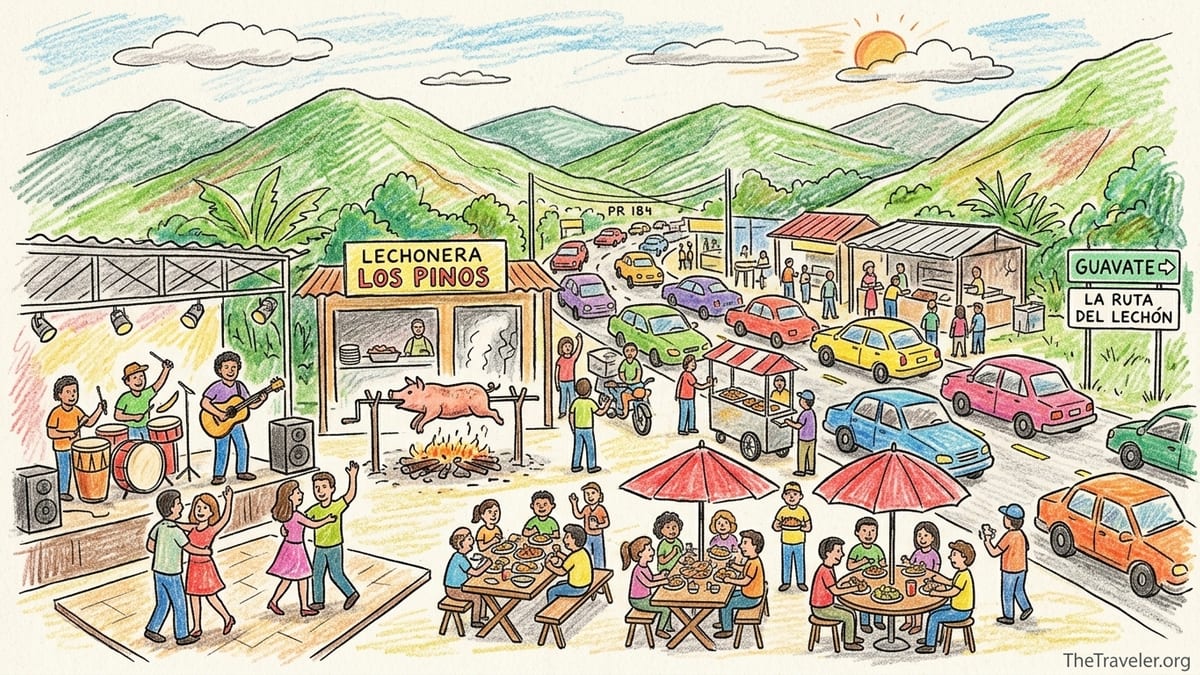
The core strip of activity runs along roughly 3 to 4 miles of PR 184, with well known lechoneras like Los Pinos, El Mojito, El Rancho Original, El Nuevo Rancho and others drawing both locals and visitors. On a Saturday or Sunday, drivers roll down their windows well before reaching the densest cluster of restaurants and can already hear salsa and merengue bouncing between concrete walls, with the smell of roast pork drifting across the two lane road. Families, groups of friends on chinchorreo road trips and couples all converge here to spend the better part of the day eating, drinking, dancing and people watching.
Because Guavate is promoted as both a cultural and culinary experience, it is important to understand that the weekend atmosphere is central to how Puerto Ricans themselves use the place. Locals describe it as an informal weekly festival rather than a simple lunch stop. That was the lens for this visit: not searching for “the best pork,” but analyzing how the crowds build, how music shapes the mood, and when the energy tips from festive to overwhelming.
Arrival, Traffic and Parking: From Quiet Road to Slow Crawl
On the Saturday I visited, I left San Juan at 9:45 a.m. and reached the Cayey exit for PR 184 a little after 10:40 a.m. The drive along PR 52 was smooth, with only light traffic and no significant slowdowns. The real change began on PR 184. Around the 10:50 a.m. mark, just as the first lechoneras appeared, cars began to bunch up behind pickup trucks and minivans pulling over to look for parking. At that hour, traffic was still flowing, but it already required patience behind drivers hesitating at every informal roadside spot.
By 11:15 a.m., the time I parked near Lechonera Los Pinos, movement along the central stretch had slowed to something close to a rolling crawl. Locals often say that on Sundays you can spend an hour or more in traffic just to navigate the last kilometer, and the pattern on this Saturday supported that reputation: as noon approached, cars were inching forward at walking speed, especially around the most popular restaurants. There is no structured parking lot system along the route, so visitors park wherever there is a patch of gravel or shoulder, frequently guided by informal attendants waving flags or reflective vests and charging a few dollars cash for a space close to a particular lechonera.
From a practical standpoint, arriving between 10:30 and 11:30 a.m. on a weekend seems crucial if you want to avoid serious frustration. Before 11:00 a.m., there were still open spaces very near several big lechoneras, and it was possible to park within a two to three minute walk of the dining areas. After 12:30 p.m., arriving cars were often being waved farther uphill or downhill, meaning a 10 to 15 minute walk along the shoulder in full sun, with music already blaring and cars backed up behind you. Anyone uncomfortable driving in tight spaces or reversing around pedestrians should consider having a confident driver at the wheel.
Securing a Table and First Impressions: Late Morning Calm
Between 11:15 a.m. and roughly 12:15 p.m., Guavate still felt manageable. At Los Pinos, I walked straight in and had my choice of tables in the large open sided dining hall. Only a third of the plastic tables were occupied, mostly by early bird families from nearby towns and a few tour groups that had arrived in small vans. Music at that point came from large speakers playing recorded salsa and merengue at a volume that encouraged conversation rather than shouting.
Service in this early window was relaxed. Lines at the carving counter were only three to four people deep, and staff had time to chat with regulars about whether they wanted more cuerito, the prized crispy pig skin, or a particular cut of meat. A typical plate of lechón with arroz con gandules and yuca in garlic oil fell in the 15 to 20 dollar range depending on weight, with local Medalla beer around 3 to 4 dollars a can. The focus at that hour was still mainly on the food; groups ate, took photos with their trays and occasionally swayed in place when a favorite song came on, but few people were dancing.
This is the time of day that someone sensitive to crowds would enjoy most. The noise level was moderate, similar to a busy casual restaurant. You could walk between lechoneras without weaving through dense foot traffic, step up to souvenir kiosks without waiting, and even find shaded spots by the river below some dining areas to sit quietly. If your primary goal is to taste Guavate’s lechón while still sampling the vibe and seeing multigenerational groups starting to gather, late morning provides a gentle on-ramp before the party fully ignites.
When the Party Peaks: Live Bands, Dancing and Crowd Mix
The character of Guavate changed dramatically between 12:30 and 3:30 p.m. Around 12:45 p.m., the first live band of the day at Los Pinos began a set of classic salsa and merengue, and neighboring lechoneras followed similar schedules. By 1:00 p.m., recorded background tracks had largely given way to full bands with brass sections, percussion and singers leading call and response choruses. The volume increased enough that conversation required raised voices, especially near the speakers.
The crowd at this peak time was notably mixed. Tables closest to the stage filled with groups of friends in their 20s, 30s and 40s, many already on their second round of beers or rum and cokes. Farther back and along the edges sat extended families with grandparents, aunts and uncles, and children running between tables with sodas and bags of cotton candy from street vendors. I counted everything from couples in their 60s in pressed guayaberas to younger visitors in beachwear fresh from San Juan, some clearly on organized tours and others on self guided chinchorreo day trips.
Dancing began in earnest shortly after the first live songs kicked off. It started with one or two couples who slipped into the open space near the stage, spinning comfortably through salsa basics. Within 30 minutes, that small dance floor became a shifting island of bodies, from confident salseros to children copying their parents. At several points, the aisle between dining rows effectively became a dance corridor, with servers weaving around people mid spin. The effect was joyous and communal rather than club like; strangers clapped, offered high fives and pulled shy onlookers into simple merengue steps.
Noise levels by mid afternoon were high. Each lechonera’s sound system and live band bled into the next, and out on the road, open car doors added their own reggaeton mixes to the sonic landscape. Anyone with sensory sensitivities would find this period intense: you are surrounded by constant music, shouting, laughter and the metallic scrape of pans from kitchens. It is electrifying if you enjoy social chaos, and potentially overwhelming if you do not.
Stress vs Enjoyment as the Day Progresses
From a social perspective, Guavate reached its most enjoyable balance between roughly 12:30 and 2:30 p.m. In that window, there was a full band playing, a packed but still breathable crowd on the dance floor and almost every table occupied, yet there remained enough structure that servers could navigate and some guests could still have seated conversations. The feel was of a large family party: boisterous, intimate and unscripted, with spontaneous birthday songs erupting at nearby tables and strangers comparing plates.
After about 3:00 p.m., the atmosphere tipped into something more hectic. At several lechoneras, lines for food stretched 15 to 20 people deep, and the wait for a table if you arrived at that hour could easily approach 30 minutes or more. Staff were working at high speed, and it showed: plates arrived faster, but interactions were reduced to shouted orders and quick nods. Outside, cars looking for late lunch or early dinner spots were still arriving, feeding the traffic jam and leaving some drivers visibly frustrated as they navigated a sea of pedestrians with drinks in hand.
Interestingly, the energy did not feel menacing or aggressive. There was plenty of alcohol consumption, but it was spread out over hours and anchored by heavy food. Groups were loudly cheerful rather than rowdy in a threatening way. Still, for someone who dislikes crowds, the combination of tight space, noise and the need to constantly watch your step around dancers and moving servers could become stressful as afternoon wore on. By around 5:00 p.m., several bands had wrapped up, the crowd began to thin, and the vibe relaxed again into an after party stage, but at that point many visitors were also facing a tired drive back down the mountain.
In simple terms, enjoyment tracks closely with your tolerance for density and stimulation. If you thrive on packed dance floors and shouted toasts, Guavate’s mid afternoon peak will feel like the purest expression of Puerto Rican social life. If you prefer controlled environments, you may want to sample the energy for a shorter window and retreat before it becomes all consuming.
Alcohol, Driving and Why Group Travel Changes Everything
Alcohol is an integral but not dominant part of Guavate’s weekend scene. Every major lechonera offered buckets of local Medalla or Magna beer, small bottles of rum for mixed drinks and basic cocktails like rum with cola or passion fruit juice. Prices at the time of this visit generally hovered around 3 to 5 dollars for beers and 6 to 9 dollars for mixed drinks, depending on brand and whether you were ordering at the bar or via table service. It was common to see a bucket of six beers shared among a group, with constant refills as the music intensified.
Because there is no practical public transport to Guavate, and ride hailing coverage becomes unreliable in the mountains, designated drivers are essential. Several groups I observed had clearly planned for this: one person stuck to soft drinks, while others rotated between beers and rum punches across the afternoon. The combination of narrow, curving mountain roads, pedestrians walking along the shoulder after drinking, and afternoon rain showers that sometimes slick the pavement justify extreme caution. Many locals recommend leaving Guavate before dusk if you are not familiar with rural driving in Puerto Rico, precisely to avoid navigating the descent in darkness after hours of celebration.
Group travel also fundamentally shifts the Guavate experience. Chinchorreo is, by definition, a social sport: hopping from spot to spot, sharing plates and drinks, egging each other onto the dance floor. Groups of four to eight friends were having the most visibly relaxed time, rotating who danced, who guarded the table and who went to the bar. Solo travelers and couples can still enjoy the scene, but they may find it harder to hold a table if they both get up to dance or explore, and they may feel more self conscious joining strangers. If you do go as a small party, consider partnering with another couple or chatting with nearby tables; locals are generally welcoming when approached respectfully.
For those intent on drinking freely, hiring a private driver from San Juan or Cayey, or joining a small group food tour that includes transport, is worth considering. Although there is no single dominant operator, several local agencies now offer full day chinchorreo excursions that include Guavate specifically because of the safe driving issue. The added cost can make sense if it allows everyone in your group to engage fully with the social experience without worrying about the return trip.
Would Crowd Averse Travelers Still Enjoy Guavate?
The honest answer is that it depends heavily on timing and expectations. During the late morning and early afternoon, before live bands hit full volume, even travelers who dislike tightly packed environments can appreciate Guavate as a scenic, lively village of restaurants rather than a wall of people. At 11:30 a.m., I watched an older couple who had deliberately chosen an out of the way corner table enjoy their lechón and pastel without any visible discomfort, then stroll slowly between lechoneras taking photos before the heaviest wave of arrivals.
Once the clock passes 1:00 or 1:30 p.m., however, Guavate becomes less about individual comfort and more about collective energy. Walking from one lechonera to another might mean brushing shoulders with dozens of strangers, stepping around people dancing in narrow passages and navigating cigarette smoke and strong food smells in all directions. For some, this is exhilarating immersion. For others, it verges on claustrophobic, especially since there are few true quiet zones once bands play at full volume.
If you know you are uncomfortable with crowds but do not want to miss Guavate entirely, a realistic strategy is to arrive around 10:30 or 11:00 a.m., eat and explore until about 1:00 or 1:30 p.m., then leave as the music and density crest. This delivers a meaningful slice of cultura boricua in action: seeing people start to dance, hearing live music kick in, watching multigenerational families claim long tables. You miss the most intense, shoulder to shoulder hours, but you also avoid the stress of packed dance floors and gridlocked exit traffic.
Comparatively, a weekday visit almost guarantees a more comfortable experience for crowd averse visitors. Official tourism descriptions and local guides consistently emphasize that many lechoneras open daily, but with lower volume, fewer bands and a quieter, food centered environment from Monday to Thursday. You might give up some of the festival feeling and see fewer people dancing in the aisles, yet you can still talk to owners, watch pigs roasting over charcoal and savor the same dishes without sensory overload.
Weekday vs Weekend: Does a Quiet Visit Lose the Culture?
Weekdays in Guavate are often described as a different dimension of the same place. The lechoneras that open daily still roast whole pigs, still serve the same arroz con gandules and morcilla, and still attract a combination of locals on lunch breaks, retirees and a trickle of visitors who prefer to avoid weekend crowds. Music typically remains at background levels, with some spots relying on radio playlists or recorded salsa rather than live bands, and the road along PR 184 flows freely, without the long backups that characterize Saturdays and especially Sundays.
From a cultural perspective, you do lose certain elements with a weekday visit. You are less likely to see extended families spanning three generations, less likely to watch toddlers learning to clap in time to a live guiro rhythm, and less likely to find a dense dance floor where strangers trade partners. The sense of Guavate as a weekly romería in the mountains, where people across Puerto Rico converge to see and be seen, is strongest on weekend afternoons.
However, a quieter weekday does open other doors. With fewer tables to manage, staff have more time to chat. On a previous midweek afternoon visit, for example, a cook at a smaller lechonera was able to step out and talk in detail about seasoning the pigs, the hours they spent turning spits before dawn and how hurricanes in recent years had affected business. It is harder to access this depth of conversation when bands play and hundreds of plates must be served each hour. For travelers who care as much about stories as spectacle, a weekday can feel richer in its own way.
Ultimately, the tradeoff is not culture versus no culture, but different facets of Puerto Rican life. Weekends foreground public celebration, dance and collective joy. Weekdays foreground work, continuity and the craft of lechon itself. If your time allows, the ideal is to combine one of each: a high energy Saturday or Sunday for the party and a quieter return on a weekday for conversations and reflection.
The Ideal Time Window and Who Should Choose Which Day
Based on this recent Saturday in August 2026 and cross checking with what local tourism officials and long time visitors describe, an ideal arrival window for most travelers is between 10:30 a.m. and 11:30 a.m. on a weekend. That timing yields manageable traffic on PR 184, relatively close parking, easy access to tables at popular lechoneras and a front row seat as the energy builds from relaxed lunch to full party. It also allows you to leave between 3:00 and 4:00 p.m., before exhaustion sets in and while there is still daylight for the drive back to San Juan, Ponce or the east coast.
If you are choosing between Saturday and Sunday, subtle distinctions matter. Sundays tend to draw more local families and can feel even more crowded, with traffic sometimes heavier as residents from across the island converge after church or morning errands. The social rewards are high: Sundays are when you are most likely to see multi generational tables singing along to old salsa standards and children splashing in the river below certain lechoneras. Saturdays are only slightly less intense but can be marginally easier for parking and may see a greater proportion of visitors from San Juan spending the day before returning to city nightlife.
For travelers who dislike crowds but still want the “real” Guavate, a Saturday visit with an early arrival and mid afternoon departure offers a reasonable compromise. Crowd lovers, especially those comfortable dancing in public and lingering for long afternoons of music and beers, may prefer Sundays, accepting the denser conditions in exchange for maximum local presence. Weekdays, meanwhile, best suit food focused travelers, families with very young children who need calmer environments and drivers who do not want to deal with steep, congested mountain roads.
In all cases, traveling with friends or family amplifies what Guavate does best. The place is built for shared jokes over heaping plates, for passing around cups of caldo from the pig, for cheering when a stranger nails a complex salsa step. Going alone is possible and safe, but going with others turns the route from a meal stop into a memory, whether you spend two hours or a full six.
The Takeaway
Guavate on a weekend is not a polished show staged for tourists. It is a living, breathing mountain gathering built around roasted pork, loud music and the simple pleasure of spending a day together outside the city. My Saturday visit in August 2026 confirmed that the tourism board’s portrayal of the place as a weekend party is accurate: traffic does slow to a crawl along PR 184, lechoneras do pack shoulder to shoulder, and live salsa really does spill onto the road as afternoon progresses.
Yet within that apparent chaos are patterns that can help you tailor the experience. Arriving before 11:30 a.m. gives you space and time. Staying into mid afternoon immerses you in the full force of Puerto Rican social life. Leaving before evening protects you from the most exhausting edges of the party and from challenging night driving on rural roads. Deciding whether to come on Saturday, Sunday or a weekday depends less on whether you “like Guavate” and more on how you like to feel on vacation: plugged into a crowd, in quiet conversation with cooks, or somewhere in between.
For many travelers, the sweet spot will be a weekend visit from late morning to late afternoon with a trusted driver and a small group of friends ready to dance at least a little. For others, a calm weekday lunch with the sound of knives on cutting boards instead of blasting trumpets will linger just as long in memory. Either way, Guavate rewards those who show up with curiosity, appetite and respect for the local rhythms that have turned a simple stretch of highway into one of Puerto Rico’s most distinctive social stages.
FAQ
Q1. How long does it take to drive to Guavate from San Juan on a weekend?
Under light conditions the drive from San Juan to Guavate takes about one hour, but on busy Saturdays and Sundays you should plan for 75 to 90 minutes each way, allowing extra time for slow traffic on PR 184 near the lechoneras.
Q2. What is the best time to arrive in Guavate on Saturday or Sunday?
Arriving between 10:30 and 11:30 a.m. usually offers the best balance of lighter traffic, easier parking, available tables and the chance to see the atmosphere build into full party mode by early afternoon.
Q3. Is Guavate safe for visitors who do not speak Spanish?
Yes, Guavate is widely visited by international travelers and many staff at larger lechoneras understand basic English. Knowing a few Spanish phrases helps, but the environment is friendly and ordering food is straightforward even with limited language skills.
Q4. Can I visit Guavate by public transportation or ride share?
There is no convenient public transport directly to the main lechonera strip and ride share coverage becomes unreliable in the mountains, so most visitors either rent a car, go with local friends or join a small group tour that includes transportation.
Q5. Are there vegetarian or non pork options at the lechoneras?
While pork is the star, many lechoneras offer side dishes like rice and beans, salads, tostones and root vegetables. However, strict vegetarians will find options limited and may want to plan ahead with snacks or choose a lechonera that explicitly notes meat free plates.
Q6. What should I wear for a day in Guavate?
Comfortable, casual clothing is best, along with sturdy shoes or sandals suitable for walking on uneven gravel and pavement. The setting is informal, but it can be hot and humid, so light fabrics and sun protection are important.
Q7. Is Guavate appropriate for children and older adults?
Yes, Guavate is very family friendly. Children enjoy the open spaces, music and treats from vendors, while older adults often sit at shaded tables and watch the dancing. Those sensitive to noise or heat may prefer earlier hours or quieter weekdays.
Q8. How much should I expect to spend per person for food and drinks?
A generous plate of lechón with traditional sides typically falls around 15 to 20 dollars per person, with local beers in the 3 to 5 dollar range. Budgeting 25 to 35 dollars per person allows for a full meal and a couple of drinks.
Q9. Do I need to reserve a table at the lechoneras?
Most lechoneras operate on a first come, first served basis and do not take formal reservations, especially for small groups. Large groups may call ahead to coordinate seating, but arriving early remains the most reliable way to secure a good table.
Q10. Is it worth visiting Guavate on a weekday instead of the weekend?
Weekdays trade the peak party atmosphere for easier parking, quieter dining rooms and more chances to talk with staff. If you prefer calm environments or are mainly focused on the food, a weekday visit can be just as rewarding in a different way.