


More news on this day
Gulf aviation hubs that anchor global east–west travel are contending with more than 1,000 flight cancellations and delays in recent days, as powerful storms and an unsettled regional security climate combine to strain already fragile airline schedules.
Get the latest news straight to your inbox!
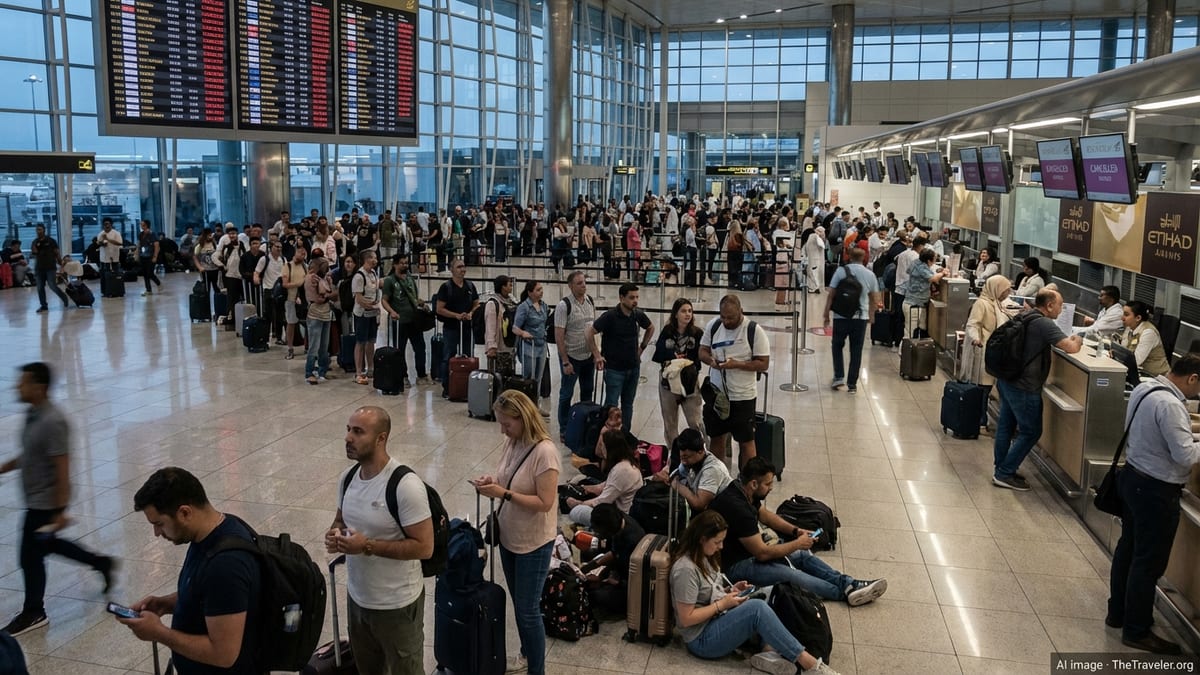
Key Gulf hubs face cascading operational pressures
Publicly available airport data and airline updates indicate that Dubai International, Abu Dhabi’s Zayed International, Doha’s Hamad International and Kuwait International have all experienced elevated levels of disruption, with cancellations, diversions and rolling delays affecting both passenger and cargo operations. Industry trackers suggest that cumulative interruptions across the wider Gulf have now surpassed 1,000 flights within a short window, as carriers repeatedly rework schedules.
Capacity at major hubs remains below pre-crisis norms following months of intermittent airspace closures and route adjustments linked to the 2026 regional conflict. Published assessments on the economic impact of that conflict describe thousands of daily cancellations at the height of the airspace shutdowns earlier this year, leaving networks more vulnerable to fresh shocks from storms and local security alerts.
Recent situation reports focused on the Middle East and Gulf show that while most airports are technically open, many are operating reduced timetables or selective closures on specific routes and time bands. This patchwork of restrictions is complicating crew rotations, aircraft positioning and passenger connections across Europe–Asia and Africa–Asia corridors that rely heavily on Gulf transfer hubs.
Storm systems compound an already fragile network
The latest wave of disruption has been triggered in part by intense summer storms passing across parts of the Arabian Peninsula and adjacent waters, bringing heavy rain, localized flooding and strong winds that periodically exceed safe operating thresholds. Aviation safety protocols require that takeoffs and landings be slowed or suspended when crosswinds, wind shear or lightning reach defined limits, quickly creating backlogs at the tightly scheduled Gulf hubs.
Regional weather events have increasingly translated into large-scale operational impacts, as seen during exceptional Gulf flooding in 2024 when more than 1,200 flights were cancelled at Dubai over two days. Although current conditions are less extreme, airport operators are again facing runway and apron congestion, out-of-position aircraft and constrained slots as recovery operations lag behind the volatility of the weather.
Storm-related constraints are not confined to a single airport. Reports covering the broader Middle East indicate that satellite hubs in Oman, Saudi Arabia and Bahrain have also reported weather-linked delays in recent weeks, reducing the flexibility of carriers to reroute aircraft and passengers away from the most heavily affected nodes.
Security environment keeps pressure on Gulf airspace
Alongside the meteorological challenges, the security environment across the Gulf and surrounding region continues to weigh on aviation planning. Analyses of the 2026 Iran war and its aftermath note that Bahrain, Kuwait, Qatar, Syria and the United Arab Emirates all imposed airspace closures or tight restrictions during periods of heightened tension, prompting mass diversions and multi-day suspensions on some routes.
Kuwait International Airport has been a particular focus of concern since a series of drone strikes earlier this year led to periodic shutdowns of operations. Travel and security advisories issued in March highlighted continuing caution around flights into and out of Kuwait, even as other Gulf hubs began cautiously rebuilding schedules.
Advisories and corporate travel briefings from March and April also point to constrained operations at Dubai, Abu Dhabi and Doha during the most recent spikes in regional tensions, with some international carriers suspending services or capping frequencies. While many routes have since been restored, the prospect of renewed restrictions remains a planning factor for airlines, especially those operating wide-body fleets on long-haul sectors.
Knock-on effects for global passengers and cargo
The combined impact of storms and security-related constraints in the Gulf is rippling far beyond the region. Network models used by airline analysts show that significant disruption at even one of the major Gulf hubs can quickly affect flights linking Europe, Africa, South Asia and Australasia, as missed connections cascade through multi-leg itineraries.
Published coverage in recent months has described passengers facing extended layovers, unscheduled overnight stays and last-minute reroutes via secondary hubs when flights through Dubai, Doha, Abu Dhabi or Kuwait are delayed or cancelled. Social media and forum accounts from travelers transiting the region this summer echo those patterns, citing late schedule changes and uncertain onward connections.
Cargo flows are also being reshaped. Industry bulletins note that export operations at some UAE airports have at times been scaled back or temporarily halted, with freighter capacity redeployed from Europe and North America to maintain essential goods movements. Priority is often given to perishables, medical supplies and critical spare parts, while general freight faces longer lead times and higher spot rates.
Airlines adjust schedules while travelers seek flexibility
As Gulf hubs work through the latest wave of disruptions, airlines are leaning more heavily on dynamic schedule management, including tactical cancellations, aircraft upgauging and ad hoc charter capacity. Some carriers have introduced temporary caps on new bookings for the most constrained routes to protect space for already-ticketed passengers needing reaccommodation.
Travel risk and corporate mobility reports encourage passengers to build extra buffer time into journeys that rely on Gulf connections, monitor flight status closely and remain prepared for routing changes on short notice. Many airlines are issuing flexible rebooking policies or change-fee waivers during declared disruption periods, allowing travelers to adjust dates or routings without additional charges.
Analysts tracking the situation say that while the current disruption is less severe than the unprecedented shutdowns seen earlier in 2026, the combination of volatile weather and a still-fluid security context means that Gulf aviation networks are likely to remain vulnerable to further shocks through the remainder of the summer travel season.