


More news on this day
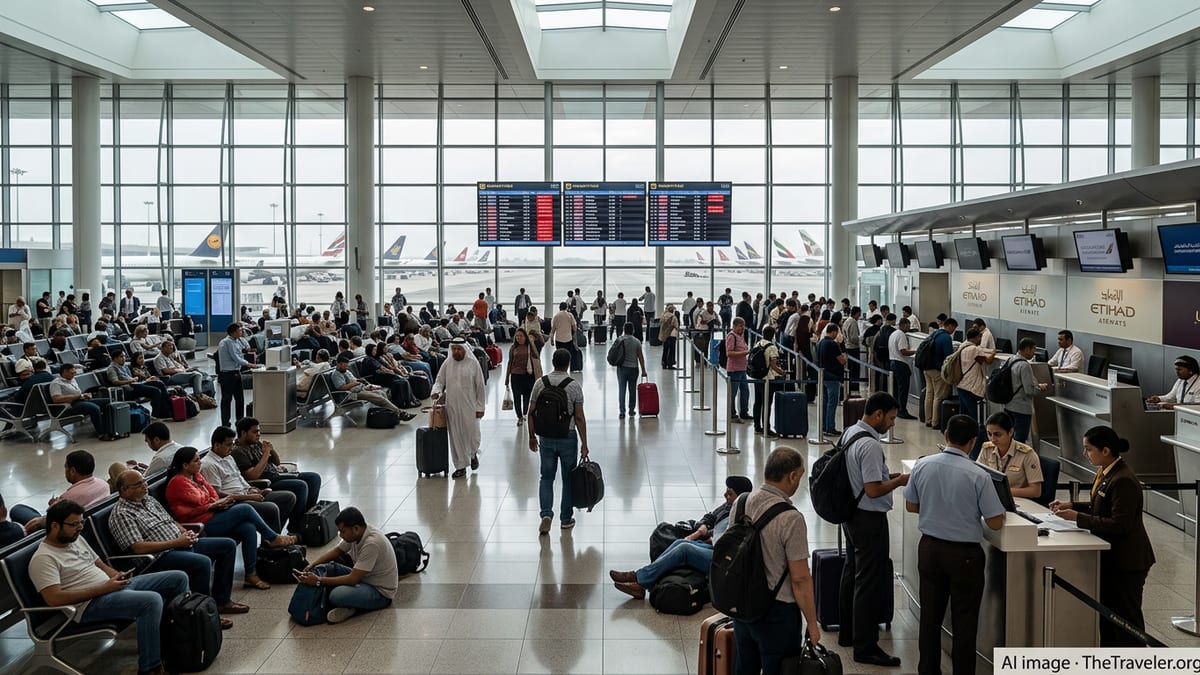
Flight disruption has become a recurring feature of Gulf air travel in 2026, with tracking data and published coverage pointing to multiple high-impact days in which hundreds of departures arrived late and dozens were removed from schedules across major hubs connecting Europe, Asia, and Africa.
Get the latest news straight to your inbox!
What the 2026 disruption numbers show
One of the clearest snapshots came on August 6, 2026, when published coverage citing flight-tracking data described 490 flight delays across Middle East aviation networks, alongside a higher tally of cancellations reported that day across the region. The report characterized the pattern as a mix of schedule trimming at some airports and delay absorption at others, a dynamic common to tightly coordinated hub operations.
More recently, disruption again surfaced on September 13, 2026, when public flight-tracking figures showed more than 170 delays across Dubai International Airport and Abu Dhabi’s Zayed International Airport by mid-afternoon local time, reflecting how quickly congestion can build in the Gulf’s highest-volume connection points.
These tallies are best read as operational “stress indicators,” not a single uniform event. Delays and cancellations can rise and fall rapidly through the day as airlines swap aircraft, retime banked connections, or consolidate flights when airspace and airport flow constraints reduce the number of safe or available movement slots.
Where the disruption is concentrating: Gulf hubs and key corridors
Dubai International remains a focal point because it is one of the world’s busiest international airports and a central transfer hub for long-haul networks. When flights into a hub arrive late, the knock-on effect often spreads through aircraft rotations and crew scheduling, raising the chance that later departures push back late or are combined with another service.
Abu Dhabi’s Zayed International Airport has also appeared in recent tracking snapshots with dozens of delays during the same periods as Dubai. Even when cancellations are limited at one airport, ripple effects can still appear via inbound aircraft arriving behind schedule, particularly on routes linking Gulf hubs with South Asia, the Levant, and Europe.
Saudi Arabia’s King Khalid International Airport in Riyadh is another pressure point in regional tracking-based reporting, with periodic spikes in cancellations or heavy delays during disruption events. In those scenarios, airlines may cut a portion of the schedule early to prevent the day’s delays from compounding into a multi-day recovery problem.
What is driving the cancellations and delays in 2026
Across 2026 coverage, disruptions have been attributed to a combination of airspace management constraints, operational incidents, and cascading schedule effects. In some weeks, regional security conditions have coincided with rerouting and flow restrictions, which can lengthen flight times, create bunching at peak arrival banks, and complicate recovery when aircraft and crews are out of position.
Separately, discrete technical and weather-related issues have also contributed to localized cancellations and significant delays, including cases where a single aircraft issue can force a cancellation and then delay subsequent flights tied to that aircraft’s planned rotation.
International network interdependence adds another layer. When air-traffic control disruptions occur outside the region, delays can still propagate into Gulf hubs because inbound aircraft arrive late and miss their planned departure windows, especially on long-haul services that are timed to feed onward connections.
What travelers can do now: practical checks before heading to the airport
For passengers connecting through Gulf hubs, the most useful step is to verify status using the airline’s own flight-status tools and alerts, and cross-check with reputable flight-tracking platforms. Flight-tracking providers note that cancellation visibility depends on receiving official cancellation messages from airlines or upstream data providers, which can explain why some pulled flights may not immediately appear as cancelled on third-party trackers.
When disruption is active, travelers often face the biggest losses from missed connections rather than the first delayed flight. Building extra time into self-planned itineraries is a practical hedge, particularly for separate tickets that are not protected by a single airline’s through-connection policy.
On days when cancellations cluster on short regional sectors, passengers may see airlines shift capacity by retiming or consolidating flights. In that environment, monitoring rebooking options early can matter, since available seats on later departures can shrink quickly as disrupted travelers are reaccommodated.
What to watch next: why 2026 disruptions may remain episodic
The Gulf’s hub-and-spoke model concentrates risk as well as connectivity. When conditions constrain airspace, reduce arrival rates, or create uneven demand across corridors, the system can shift from normal operations to heavy delay minutes within a single bank of arrivals, especially at airports handling large volumes of connecting traffic.
Travelers can expect disruption to remain episodic rather than constant, with sharp spikes around operational incidents, airspace restrictions, and peak travel periods. The fastest-moving changes are typically seen in day-of-departure delays and short-notice cancellations, where airlines adjust schedules to stabilize the broader network.
For now, published coverage and live tracker snapshots suggest the most reliable signal is not a single headline number, but the repeat pattern: concentrated delays at major hubs, intermittent cancellation surges at selected airports, and recovery that can spill into the next day when rotations and crew positioning are disrupted.