


More news on this day
As Haiti celebrates a rare World Cup appearance, thousands of its supporters are confronting a very different reality: tightened United States visa rules and suspended consular services that are casting serious doubt on whether many Haitian fans will be able to travel for the 2026 tournament in North America.
Get the latest news straight to your inbox!
Travel Bans Collide With Haiti’s World Cup Dream
Haiti’s return to football’s biggest stage has generated enormous excitement among fans at home and in the diaspora, but that optimism is running up against a restrictive US entry regime. Publicly available US government information describes a complex set of overlapping measures, including a broad travel ban affecting nationals from dozens of countries and a separate suspension of immigrant visa processing for a wider group that includes Haiti. While athletes and accredited team staff are generally covered by event-related exemptions, ordinary supporters are not automatically included in these carve-outs.
Advisories tracking the implementation of these policies note that citizens of several World Cup participant nations, among them Haiti, face either a total or partial halt to most categories of US visa issuance. In Haiti’s case, coverage from regional outlets indicates that nearly all immigrant and nonimmigrant visa categories have been affected, with only narrow exemptions for diplomatic and certain family-based cases and for individuals deemed to meet a national interest test or linked to major sporting events. Even where such exceptions exist, they are highly discretionary and require individual review.
Rights organizations and migration specialists warn that this patchwork of restrictions could translate into a sharply reduced Haitian presence in World Cup host cities in the United States. They argue that, compared with supporters from visa-waiver or low-risk countries, Haitians must now navigate a significantly higher barrier just to reach stadium turnstiles or official fan zones.
Suspended Consular Services Deepen Visa Backlog
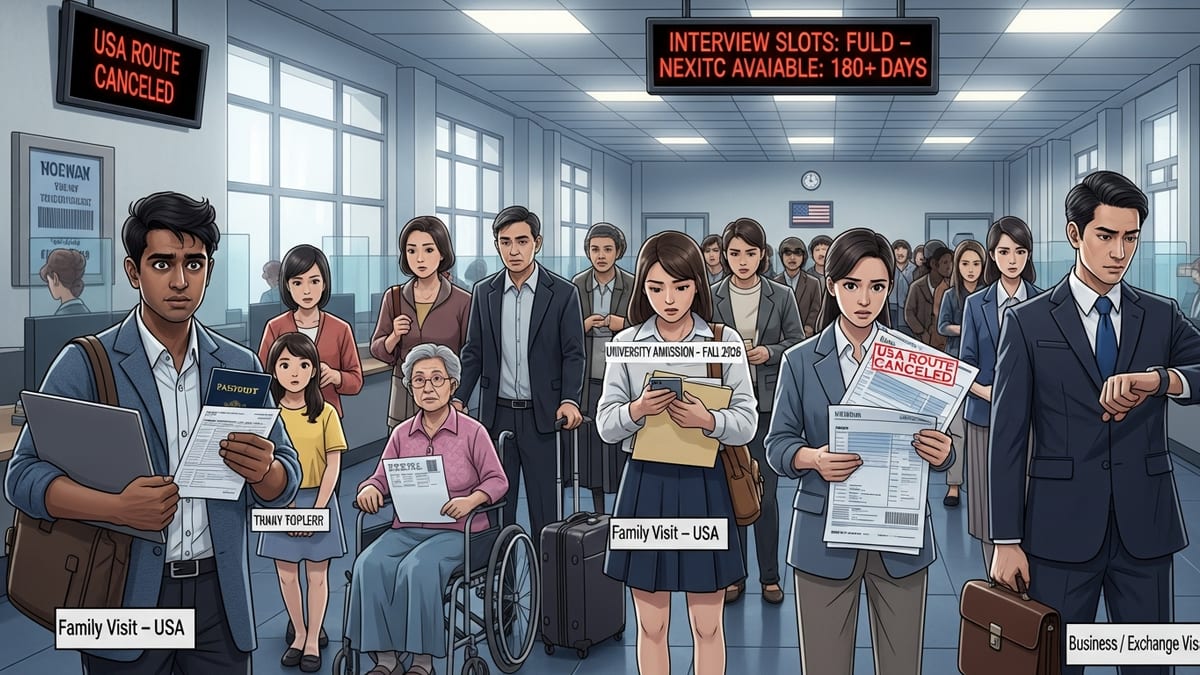
Beyond the formal entry bans, Haitians also face a practical obstacle: the limited or suspended operation of US consular services in Port-au-Prince. Official notices from the US government describe an extremely constrained embassy footprint in Haiti as a result of the country’s deteriorating security situation. This has included pauses or sharp reductions in routine visa appointments and a focus on emergency services only, making it difficult for intending travelers to even file applications in time for the June and July 2026 matches.
Separate US policy changes introduced in late 2025 and updated in early 2026 have also placed additional scrutiny on certain nationalities considered at higher risk of overstaying or requiring public assistance. Legal and academic analyses of these measures highlight Haiti among the states subject to new immigrant visa suspensions or public-benefits-related reviews, exacerbating an already pronounced backlog for family reunification and other long-term categories. While these rules are formally targeted at permanent migration, advocates say they are contributing to a wider climate of uncertainty that spills over into visitor visas as well.
Reports from Haitian communities in US cities such as New York and Miami describe families caught between the pride of qualification and the reality that relatives back home cannot secure interview slots or travel documents. In some accounts, applicants who had already been approved have seen their cases effectively frozen when printing of visas or document issuance was paused, leaving their World Cup plans in limbo.
Priority World Cup Visa Channels Offer Little Relief
In parallel with these restrictions, the United States has promoted a World Cup-specific mechanism designed to streamline visa appointments for ticket holders. According to tournament-related guidance, fans who purchased tickets directly from FIFA can request interviews through a Priority Appointment Scheduling System, an arrangement that some governments have begun flagging in their travel advice for citizens planning to attend matches in the US.
However, early data and media coverage suggest that uptake of this fast-track program has been modest and that it does not override broader nationality-based bans. Analysts following the rollout report that only a relatively small number of fans worldwide have opted into the scheme so far, and that applicants from banned or high-risk countries still face the same baseline eligibility hurdles. For Haitian supporters, this means that a FIFA-confirmed ticket is not, on its own, enough to unlock an appointment or guarantee a visa.
Travel-rights groups also point out that even when priority appointments are available, logistical and financial barriers remain significant for many Haitians. With the US embassy in Haiti operating under severe constraints, some fans would need to travel to third countries to attend interviews, adding extra costs to already expensive World Cup journeys. This stands in stark contrast to supporters from visa-waiver states, who in many cases can obtain authorization online through automated systems.
Rights Groups Warn of Unequal Access and Chilling Effect
International human rights organizations and civil liberties groups have increasingly framed the World Cup visa landscape as an equity issue. Recent travel advisories focused on the United States ahead of the tournament argue that people from certain nationalities, as well as racial and ethnic minorities and migrants more broadly, face disproportionate obstacles and risks when attempting to visit for the event. These warnings emphasize not only visa denials but also the possibility of intrusive screening and immigration enforcement within US borders.
Advocacy papers examining the new travel bans single out Haiti and several other participating nations to illustrate what they describe as a two-tier system: star players and official delegations, whose entries are shielded by event exemptions, and ordinary supporters who remain exposed to restrictive policies. Commentaries from fan groups and rights advocates argue that this divide undermines the inclusive spirit that global tournaments are meant to embody, limiting who can share in stadium experiences and communal celebrations.
Supporters’ associations and diaspora networks are responding by issuing practical guidance on documentation, itinerary planning and legal rights at ports of entry for those Haitians who still intend to make the trip. Even so, many warn that the combined impact of policy barriers and safety concerns may discourage a large number of would-be travelers from applying at all, dampening the potential for Haiti’s qualification to translate into a visible and vocal fan presence in US host cities.
Host Cities Brace for Patchy Attendance From Restricted Nations
With kick-off now just months away, host-city planners, tourism boards and local businesses are trying to anticipate how these dynamics will affect visitor patterns. Analysts who track mega-event tourism note that World Cups typically bring spikes of fans from qualifying nations, often visible in neighborhoods, fan festivals and informal gatherings even beyond stadium gates. In 2026, they suggest, arrivals from Haiti and other heavily restricted countries may be far below what their on-field participation would normally predict.
Some US-based travel and hospitality operators are preparing for a scenario in which local Haitian diaspora communities, rather than visitors from Haiti itself, provide much of the color and noise associated with national-team support. Early ticket-market commentary indicates that residents and dual nationals with existing legal status in the United States or Canada are likely to fill a significant share of seats allocated to Haiti’s matches.
Policy observers stress that there is still time for adjustments that could ease access without fully dismantling current security frameworks, such as expanding narrowly tailored exemptions for major sporting events or clarifying processing routes for bona fide short-term visitors. For now, however, publicly available information suggests that Haitian supporters outside the diaspora face a uniquely uncertain path to the 2026 World Cup, even as their team prepares to take the field on football’s biggest stage.