


More news on this day
Passengers at Paris Charles de Gaulle and Orly airports faced widespread disruption on June 20 as hundreds of delayed flights and a wave of cancellations rippled across European, transatlantic, and Middle Eastern routes, snarling connections at the start of the peak summer travel period.
Get the latest news straight to your inbox!
Heatwave and Storm Risk Compound Operational Strains
The latest disruption at Paris’s two main airports coincides with an intense heatwave affecting much of France, along with a risk of violent storms in parts of the country. Publicly available meteorological bulletins for June 20 indicate that more than thirty French départements, including the greater Paris region, have been placed under top-tier heat alerts, with temperatures forecast to approach or exceed 40 degrees Celsius in some areas. This combination of extreme heat and unstable weather has added pressure on airport and air traffic operations.
High temperatures can slow ground handling, increase the risk of technical issues, and require adjustments to aircraft performance, especially during takeoff. In parallel, the threat of thunderstorms often forces temporary ground stops or spacing of departures and arrivals for safety reasons. These factors, layered onto already busy late-June schedules, have contributed to extended turnaround times at gates and knock-on delays throughout the day.
According to live flight-tracking data and operational summaries reviewed on June 20, a total of 471 departures and arrivals at Paris Charles de Gaulle and Orly were reported delayed, with at least 10 flights cancelled. While the figures fluctuated hour by hour as airlines attempted to recover their timetables, the disruption was significant enough to affect not only short-haul intra-European services but also long-haul connections to North America, the Middle East, and parts of Africa and Asia.
The delays came against the backdrop of a steadily busier year for Paris airports. Recent traffic reports for Groupe ADP, which operates Charles de Gaulle and Orly, show passenger numbers in 2026 running close to or above pre-pandemic levels, particularly at peak periods. With limited spare capacity in both aircraft and crews, the system has less margin to absorb weather and operational shocks without visible disruption for travelers.
Ripple Effects on European and Transatlantic Networks
The delays at Paris had an immediate impact on short- and medium-haul routes across Europe. Regional hubs such as Amsterdam Schiphol, London, Frankfurt, Barcelona, and Rome reported late-arriving aircraft and altered departure slots as they absorbed misaligned rotations from Paris-based carriers and partners. In some cases, aircraft scheduled for early evening departures were arriving several hours behind plan, forcing airlines to retime onward services or consolidate flights.
Eurocontrol’s latest punctuality analyses for spring 2026 already indicated that Charles de Gaulle is among the continent’s busiest and most delay-prone hubs during peak hours, with average departure delays above ten minutes in recent months. Against this baseline, a day marked by extreme weather and heavy traffic can quickly push individual flights into delays of 45 minutes or more, especially when aircraft and crews must remain within strict duty-time limits.
Transatlantic services were also affected. Long-haul flights from Charles de Gaulle to major North American gateways, including New York, Boston, Montreal, and several U.S. hub cities, faced departure delays as arriving aircraft and connecting passengers missed tight transfer windows. Some travelers reported rebooking via alternative European hubs when their Paris connection became untenable, adding further load onto already busy evening waves at airports such as Amsterdam and London.
Flight-status summaries relating to June operations between Paris and North American destinations have recently noted a higher-than-usual incidence of delayed departures, reflecting a combination of congested airspace, crew scheduling constraints, and shifting demand patterns. Friday’s disruptions risk compounding these issues as aircraft and crews end the day out of position, potentially affecting weekend schedules if recovery plans prove insufficient.
Disrupted Links to the Middle East and Beyond
The impact of the Paris disruption extended south and east across the Mediterranean and into the Middle East. Over the past months, some European and Gulf carriers have already made adjustments to their networks in response to regional security concerns and demand volatility, leading to a more finely balanced schedule where every aircraft rotation counts. Additional delays at a major connecting point such as Paris further complicate these fragile timetables.
Recent coverage of Middle Eastern air services in 2026 highlights how operators have been periodically suspending, rerouting, or resuming specific routes depending on evolving conditions. Any significant delay to Paris departures bound for major Gulf and Levant hubs increases the risk of missed onward connections to South and Southeast Asia, East Africa, and Australasia, with the knock-on effect of stranded passengers and unplanned hotel and rebooking costs.
On June 20, several flights operating between Paris and key Middle Eastern cities were listed as heavily delayed, with late-night departures pushed further into the early hours. While most services remained scheduled to operate, the shifting departure times reduced connection options for travelers originating in other European cities and relying on intermediate stops in Paris and the Gulf to complete multi-leg journeys.
Industry analysts note that the hub-and-spoke nature of many long-haul networks magnifies the effect of any single airport’s disruption. When a major European gateway such as Paris experiences several hundred delayed movements in a single day, the resulting missed connections are often felt not only in neighboring capitals but also on routes linking secondary cities across continents.
Passenger Experiences: Long Queues, Missed Connections, Uncertain Plans
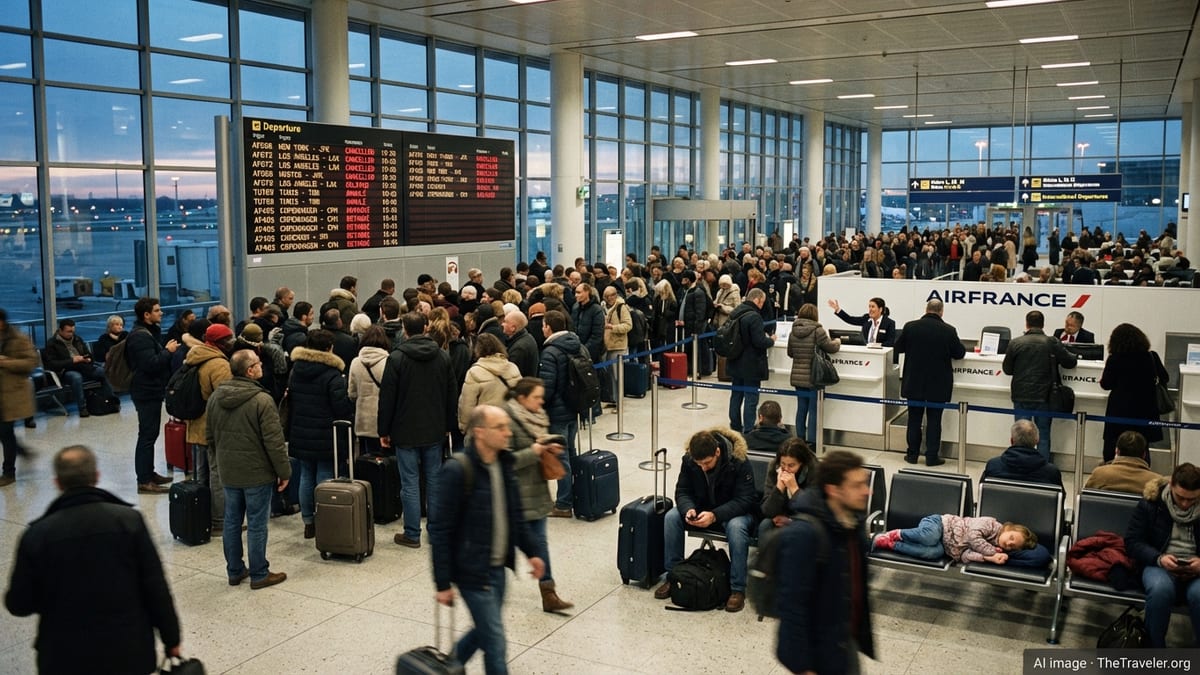
For travelers passing through Paris on June 20, the operational statistics translated into long lines at check in, security, and boarding, as well as extended waits on board aircraft held at gates or on taxiways. Social media posts and traveler forums began to capture images of crowded departure halls and departure boards dominated by orange and red delay indicators, along with accounts of missed connections and improvised overnight stays.
Recent weeks have already seen heightened concern among travelers about processing times and the new Entry/Exit System procedures at major Schengen airports, including Charles de Gaulle. Posts from mid-June described uncertainty about how long to allow for departure formalities, with some passengers opting to arrive significantly earlier than in previous years. Friday’s disruption is likely to reinforce this cautious approach, especially for those with onward long-haul flights.
At Orly, travelers have frequently reported variable experiences. Some recent accounts describe smooth transits and efficient processing, particularly when using the extended Metro line 14, which now links the airport more directly with central Paris. Others highlight challenges for passengers with reduced mobility, long waits for assistance, and crowded peak periods. The latest wave of delays added new pressure to this environment, particularly around early-morning and late-evening banked departures.
Consumer-rights organizations and compensation platforms continue to remind passengers that, under European air passenger rules, they may be entitled to assistance, rerouting, or financial compensation in cases of long delays or cancellations, depending on the cause and duration of the disruption. However, when delays are linked to adverse weather or broader air traffic control restrictions, eligibility may be more limited, leaving many travelers dependent on airline goodwill policies and available hotel capacity near the airports.
What Travelers Should Expect in the Coming Days
While Friday’s disruption centered on June 20, operational experts caution that the effects of a day with hundreds of delayed flights can linger. Aircraft and crews that finish the day out of position may require schedule adjustments across subsequent rotations, with early-morning flights on June 21 at risk of knock-on delays as airlines reset their networks. Travelers with tight connections over the weekend are being advised, through various public channels, to monitor flight status closely and to allow extra time at the airport where possible.
Recent climate and transport analyses suggest that episodes of heat-driven disruption may become more frequent in European aviation, including at Paris airports. Heatwaves in both late spring and early summer 2026 have already prompted adjustments to public transport services, anti-pollution measures, and changes to outdoor event schedules in the capital region. Airports, with their large paved surfaces and high exposure to direct sunlight, are particularly vulnerable to the stresses imposed by prolonged high temperatures.
Groupe ADP has outlined multi-year investment plans to modernize Paris-Orly and enhance resilience and passenger experience across its airport system, including upgrades to terminals, airside infrastructure, and public transport links. At Charles de Gaulle, collaborative projects with European air traffic authorities aim to streamline flows and reduce bottlenecks during peak periods. Nevertheless, days such as June 20 illustrate how quickly even a modernized hub can reach saturation when faced with simultaneous weather, capacity, and demand pressures.
As the peak summer holiday season accelerates, travelers planning to pass through Paris are likely to pay close attention to both weather forecasts and operational updates. The experience of hundreds of delays and a cluster of cancellations at Charles de Gaulle and Orly serves as a reminder that flexibility, insurance coverage, and contingency planning remain essential parts of international travel, particularly on multi-leg journeys spanning Europe, North America, the Middle East, and beyond.