


More news on this day
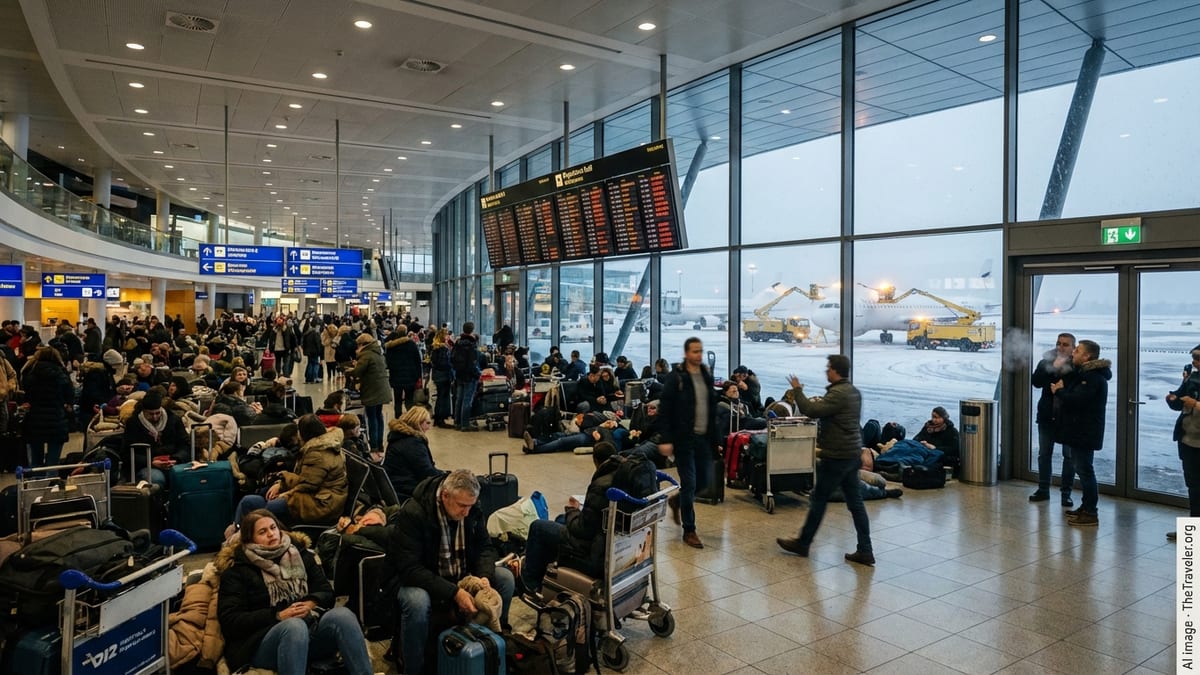
Travel across Central Europe was disrupted on Wednesday as Vienna International Airport reported 117 delayed departures and arrivals and six cancellations, affecting services operated by Eurowings, Finnair, Lauda Europe, Austrian Airlines and other carriers on busy routes between Austria and major German cities.
Get the latest news straight to your inbox!
Significant Knock-On Effects Across Central European Routes
Operational data for Vienna on Wednesday pointed to an unusually high level of disruption, with more than one hundred flights experiencing delays of varying length and a small number being cancelled outright. The pattern of affected services shows a concentration on short-haul European routes, particularly links between Austria and Germany.
According to publicly available flight status boards, services between Vienna and Berlin, Stuttgart, Frankfurt, Hamburg, Düsseldorf and Munich were among those most exposed. These city pairs form part of a dense shuttle-style network that typically runs several times a day, meaning even modest schedule instability can rapidly cascade into a larger wave of late departures and arrivals.
Reports from aviation data trackers indicate that Austrian Airlines, Eurowings, Finnair and Lauda Europe featured prominently among the delayed operations, in line with their role as major providers of capacity on Vienna’s European network. A mix of inbound and outbound sectors were affected, suggesting that disruption in one direction quickly fed back into rotations later in the day.
The spike in delays comes during the early peak of the summer season, when flight volumes across Europe are rising and airport and air traffic systems are already operating close to capacity. Industry monitoring reports for June have highlighted that even localized bottlenecks can have wider regional implications once aircraft and crews fall out of position.
Key Links Between Vienna and German Hubs Strained
Vienna International Airport serves as Austria’s primary gateway and a central hub connecting the country with Germany’s large aviation market. Published schedules show multiple daily flights from Vienna to German hubs such as Frankfurt and Munich, as well as to Berlin, Hamburg, Düsseldorf and Stuttgart, many of them operated by Austrian Airlines and partner carriers.
On the day of disruption, travel on these corridors was notably harder to predict for passengers. Departures and arrivals information for Vienna and major German airports showed a series of late operations on routes linking the Austrian capital with Germany’s financial, industrial and political centers. For business travelers who rely on tight connections between these cities, even short delays risked missed meetings or onward flights.
Travel industry analysis has repeatedly stressed the importance of the Vienna to Germany market, where high-frequency schedules are designed to facilitate same-day returns and timed connections onto long-haul services. When a sequence of these flights is delayed, airlines often need to adjust subsequent rotations, occasionally leading to cancellations where aircraft and crews can no longer be re-aligned within required duty-time limits.
Wednesday’s pattern appears consistent with those dynamics, with relatively few outright cancellations compared with the overall number of delays, but a broader deterioration in punctuality across the affected city pairs. Passengers connecting through German hubs, particularly Frankfurt and Munich, faced a heightened risk of missed onward departures as rotations slipped behind schedule.
Airlines Grapple With Punctuality Challenges
The disruption at Vienna comes against a broader backdrop of punctuality challenges in European aviation during the early summer. Recent performance summaries for major airline groups indicate that operators such as Austrian Airlines and Eurowings are managing substantial schedules in a congested airspace environment, where weather, air traffic control constraints and knock-on effects from earlier flights can all play a role in degrading on-time performance.
Monitoring reports have pointed to Vienna as both a key hub and a location where reactionary delays can build when traffic levels are high. Eurowings and its affiliated operations, together with Austrian Airlines, provide extensive connectivity between Austria and Germany, and public data shows that their schedules are particularly dense around peak morning and evening waves.
Finnair and Lauda Europe, while representing a smaller share of Vienna’s traffic compared with the main hub carrier, also contribute to the overall pattern of movements. When flights in and out of Vienna slip behind, rotation-based operations mean that disruptions can spread across several airports over the course of a day, including Berlin Brandenburg, Hamburg, Düsseldorf and Stuttgart.
Aviation analysts note that airlines are continuing to refine summer schedules in response to staffing, maintenance and airspace capacity constraints. Public communications from airline groups in recent weeks have flagged selective frequency reductions on some European routes and isolated day-by-day cancellations as part of efforts to stabilize operations overall, even as travel demand remains robust.
Passenger Experience and Rights Under EU Rules
For travelers departing from or arriving at Vienna, Wednesday’s disruption translated into longer waits at gates, rescheduled itineraries and in a minority of cases the need to seek rebooking after cancellations. Consumer-facing delay trackers and travel-rights services report sustained interest from passengers in understanding their entitlements under European Union air passenger regulations.
Under EU rules, flights departing from EU airports fall under a common framework that can provide compensation or assistance in cases of significant delay or cancellation, depending on the cause and length of the disruption as well as the distance flown. This includes the short- and medium-haul flights linking Vienna with the German cities most affected on Wednesday.
Passenger advocacy platforms typically advise travelers facing delays to retain boarding passes and document the posted reason and duration of disruption. Where delays extend beyond certain thresholds, airlines may be required to offer meals, refreshments or hotel accommodation, although the precise obligations vary according to the circumstances and the length of the wait.
While there is no immediate indication that the disruptions at Vienna were linked to a single underlying factor such as severe weather or a system outage, the scale of the impact on schedules is likely to prompt further scrutiny from consumer groups, particularly in relation to how consistently airlines applied assistance and rebooking options across the various affected routes.
Outlook for the Remainder of the Week
With the summer travel season underway and demand strong on Austria–Germany routes, operational stability at Vienna International Airport will be closely watched in the coming days. The airport functions as a central node in a network that ties Austria to key political and commercial centers in Germany, and any extended period of disruption would quickly be felt by both leisure and corporate travelers.
Industry monitoring for June shows that European carriers are attempting to balance high load factors with the need to maintain resilience in their schedules. Adjustments to flight frequencies, aircraft rotations and crew planning continue across the region, particularly on domestic German and cross-border routes that feed major hubs in Frankfurt and Munich.
For now, the episode of 117 delays and six cancellations at Vienna stands as another reminder of the fragility of tightly timed short-haul networks during peak season. Even when outright cancellations remain limited, a broad deterioration in punctuality on high-frequency corridors between Austria and Germany can have outsized effects on passengers, especially those with onward connections.
Travel advisers recommend that passengers flying between Vienna and the German cities most affected build in additional connection time where possible and monitor flight status closely on the day of departure. While airlines continue to refine schedules in an effort to reduce last-minute changes, the experience at Vienna illustrates that the margin for disruption in Europe’s crowded skies remains narrow at the height of summer.