


More news on this day
A helicopter air ambulance was among the resources sent to a fatal collision between two passenger trains near Bedford on Friday evening, as emergency services mounted a large-scale response to one of Britain’s most serious rail incidents in recent years.
Get the latest news straight to your inbox!
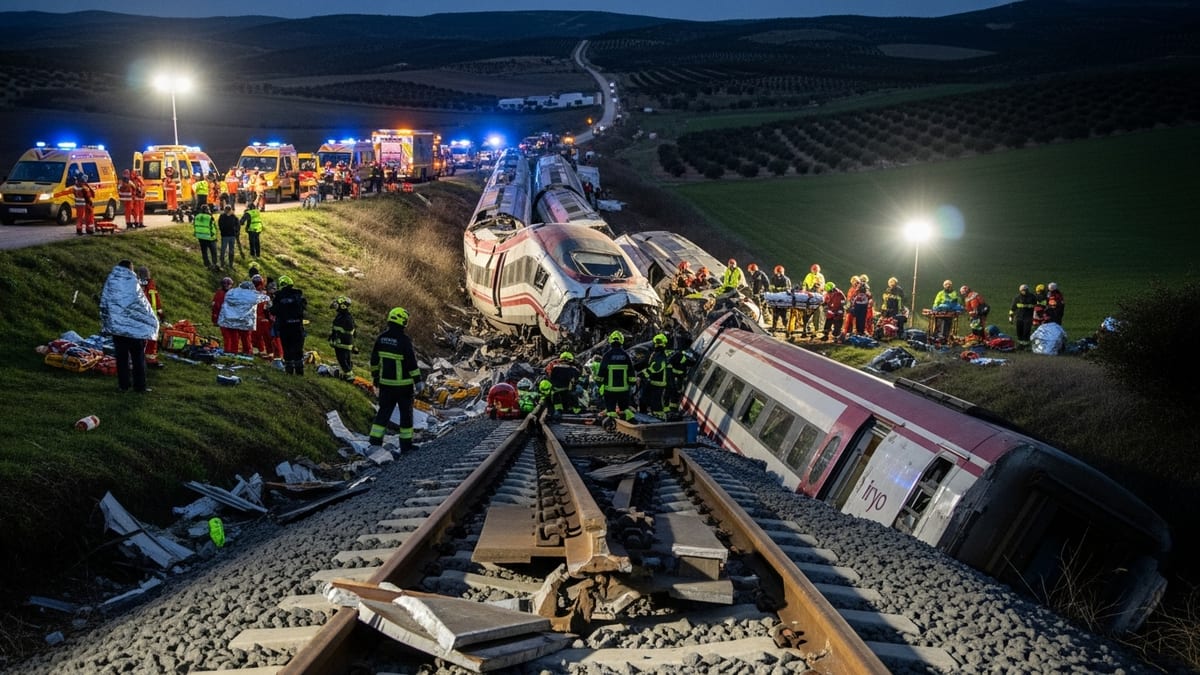
Major Incident South of Bedford at Rush Hour
The collision occurred on the evening of Friday 19 June on the main line just south of Bedford, around 60 miles north of London. Reports indicate that two southbound East Midlands Railway services heading for London St Pancras collided on a busy commuter corridor used by intercity and airport services.
According to published coverage, one of the trains had been travelling from Corby and the other from Nottingham when they came together on the approach to Bedford. Rail tracking data described in news reports suggests that the rear train struck the one in front several miles outside the town, leaving both formations badly damaged but still on the tracks.
Initial information from multiple outlets indicates that one train driver died in the impact and that dozens of passengers and crew were injured, with figures cited in some reports reaching close to 90 casualties. Images from the scene published by media organisations show shattered carriage ends, buckled metalwork and a line of emergency vehicles positioned along the railway.
The force of the impact was described in eyewitness accounts reported by broadcasters as similar to an explosion, with passengers thrown from their seats amid smoke and debris. Social media footage reviewed by newsrooms showed travellers tending to the injured while waiting for rescuers to reach the line on foot and by air.
Helicopter and Air Ambulance Teams Deployed
Publicly available information from regional ambulance services and news agencies shows that the medical response included multiple ambulances on the ground, specialist hazardous area teams and at least one helicopter air ambulance. Reports indicate that the East of England Ambulance Service sent more than twenty ambulances and several air ambulances as part of what was described as a major incident on the railway south of Bedford.
The deployment of a helicopter to the scene allowed advanced medical teams to reach the crash site quickly despite difficult access from nearby roads and fields. Rail corridors in this part of Bedfordshire run through embankments and cuttings, which can slow the movement of conventional road ambulances and stretchers.
Air ambulance helicopters operating in the region typically carry critical care doctors or advanced paramedics able to begin hospital-level interventions at the trackside. In situations such as the Bedford collision, these crews are often tasked with triaging the most seriously injured, stabilising patients for transport and coordinating with ground units to decide which casualties require airlift to major trauma centres.
As darkness approached on Friday night, helicopters also provided an aerial overview of the scene, assisting commanders on the ground in understanding the extent of the wreckage and the movement of passengers being evacuated from the trains. The use of air assets is standard practice for high-casualty incidents on railways, where distances, terrain and time to definitive care are critical factors.
Casualties, Passenger Accounts and On-Scene Challenges
By early Saturday, a picture of the human impact had begun to emerge from multiple media reports. One train driver was reported to have died at the scene, while dozens of passengers sustained injuries ranging from minor cuts and bruises to serious fractures and head trauma. Some outlets cited figures of more than 30 people seriously hurt, with total injuries reported close to 90.
Accounts relayed by British and international news organisations described carriages strewn with luggage and glass, with travellers helping one another into safer areas before rescue teams arrived. Some passengers spoke of seeing “bloodied faces” and people on the floor of the train, while others recounted smoke in the carriages and confusion over how to exit to the tracks.
Reaching the collision site posed significant challenges for responders. The affected stretch of line lies away from public roads, requiring crews to approach along access tracks or by traversing fields, while also ensuring that the wider rail network was secured against any further train movements. Helicopter teams helped bridge that gap, landing in nearby open areas and ferrying medical staff and equipment closer to the wreckage.
Once on site, emergency personnel established triage points beside the line, prioritising the most seriously injured for rapid evacuation. Published coverage indicates that some casualties were transported by helicopter to specialist trauma centres, while many others were taken by road to hospitals in Bedford and the wider region after initial treatment at the scene.
Severe Disruption on Key London–Midlands Corridor
The crash triggered immediate suspension of train services on one of the busiest intercity corridors in the United Kingdom. Rail operators reported that all lines between Luton and Bedford were blocked for many hours as emergency crews worked among the carriages, inspected the track and overhead lines, and began recovering passengers.
According to information released by rail companies and summarised in news reports, East Midlands Railway and Thameslink services were unable to run in or out of London on the affected route for the rest of Friday. Passengers were advised to use alternative lines, with significant knock-on delays and cancellations spreading across the Midlands and into northern England.
Images carried by broadcasters showed long queues at London St Pancras and other major stations as travellers sought alternative routes or waited for updates. Rail operators issued “do not travel” notices for parts of the network during the evening peak, citing both the ongoing emergency and the need to keep lines clear for recovery trains and investigative teams.
Engineers face a complex task in the days ahead. Before traffic can resume fully, damaged rolling stock must be removed, tracks inspected or repaired, and signalling and power systems checked. Given the severity of the impact, rail analysts quoted in coverage suggested that restrictions and partial closures on the line south of Bedford could continue while structural assessments are carried out.
Investigation Focus and Questions Over Rail Safety
National and rail industry investigators are expected to examine multiple strands as they seek to establish how two modern passenger trains came to collide on a heavily monitored main line. Early reporting points to a detailed review of signalling data, train protection systems and any communication between drivers and control centres in the minutes before the crash.
Specialist teams routinely download information from on-board data recorders, sometimes compared to aircraft “black boxes,” to reconstruct train speed, braking and signal aspects at key moments. Investigators are also likely to conduct extensive interviews with surviving crew and passengers, alongside technical inspections of the track, points and signalling equipment in the area.
The Bedford incident comes at a time when Britain’s mainline railway is generally regarded as one of the safer networks in Europe, with serious collisions relatively rare. Commentators cited in weekend analysis pieces noted that technological improvements, including automatic train protection and more sophisticated signalling, have significantly reduced the risk of high-speed crashes, making any event of this kind subject to intense scrutiny.
While formal findings will take time, early attention is likely to fall on whether any equipment fault, human error or a combination of factors allowed one train to be on the line in front of another travelling at speed. The performance of the emergency response, including the deployment of helicopters and specialist medical teams, will also be reviewed, both to identify effective practices and to highlight areas for improvement in dealing with major rail incidents.