


Helsinki Airport has quietly become one of Northern Europe’s most efficient hubs, especially for travelers connecting between Europe and Asia or starting a trip in Finland. The airport has completed a major, decade-long redevelopment, and as of 2026 it operates as a single, modern terminal with clear separation between Schengen and non-Schengen flights under one roof. If you are planning flights through Helsinki and want to understand how the terminal works, where your flight will depart, and how to move between the airport and the city, this guide walks you through everything step by step.
Get the latest updates straight to your inbox!
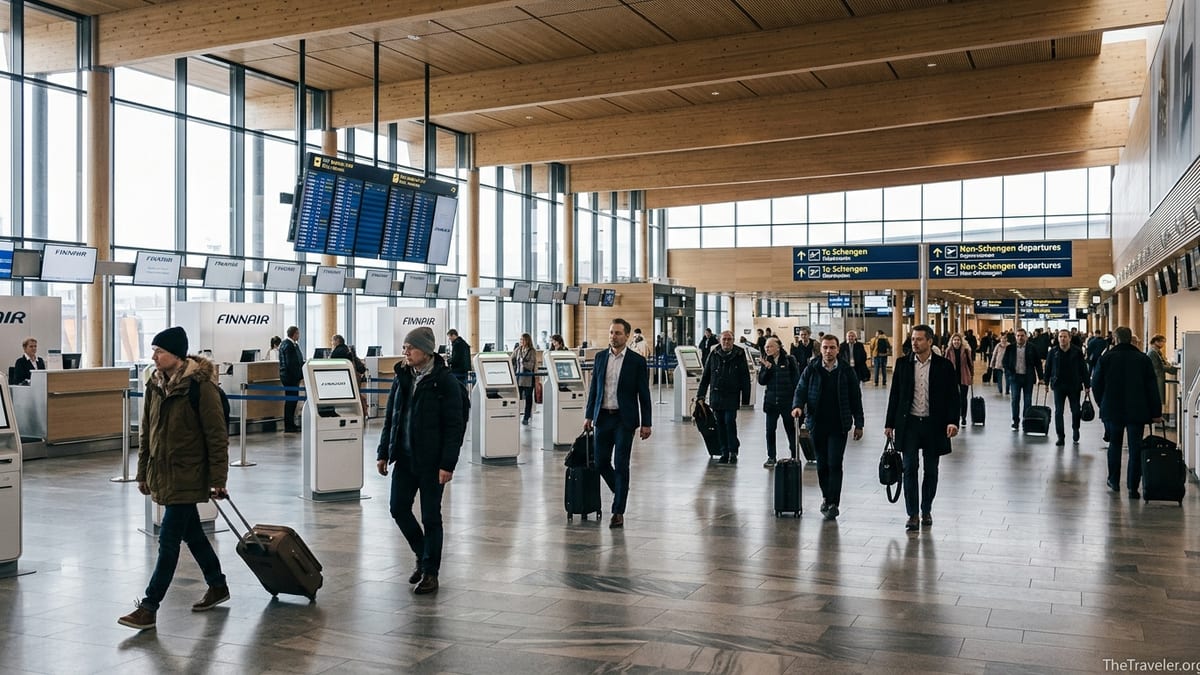
Understanding Helsinki Airport’s Single-Terminal Layout
Helsinki Airport, also known as Helsinki-Vantaa (code HEL), now functions as one integrated terminal complex rather than the old Terminal 1 and Terminal 2 setup. All passengers, whether flying short-haul within Europe or long-haul to Asia or North America, arrive and depart through the same departures and arrivals halls. Behind the scenes, the terminal branches into clearly signed Schengen and non-Schengen gate areas, but from a traveler’s perspective it feels like one continuous building, which makes navigating the airport significantly easier.
Check-in and security are located in the large, wood-ceilinged departures hall, which opened in phases between 2021 and 2023. Airlines that used to be spread across two terminals now use shared check-in islands and common security lanes. For example, a Finnair flight to London, a Lufthansa flight to Munich, and a Norwegian flight to Stockholm may all check in within a few minutes’ walk of each other. This unified layout is particularly convenient if you arrive by train or bus, as all public transport now feeds into a single central entrance.
Airside, the terminal is compact by global hub standards. A typical walk from the central “Aukio” plaza to a mid-range Schengen gate can take under 10 minutes at a normal pace, while the furthest non-Schengen gates may take closer to 15 minutes. This is a major advantage for tight connections: a traveler arriving from Tokyo and connecting to Rovaniemi, for instance, will usually find the journey involves a change of zone (non-Schengen to Schengen) but not a change of terminal, reducing stress and confusion.
The terminal is built around a central commercial spine of shops, cafés and services, with gate areas branching off like arms. Most wayfinding is bilingual in Finnish and English, and many signs also include Swedish. Large flight information displays are positioned at every junction so you can confirm your gate and boarding time as you move through the building, which is particularly reassuring if your gate changes shortly before departure.
Schengen vs Non-Schengen Flights: Where Will You Depart?
Helsinki Airport’s single terminal is divided into Schengen and non-Schengen zones, which determines whether you pass passport control before boarding. Flights within most of continental Europe, such as Helsinki to Paris, Berlin, or Lisbon, use Schengen gates. Flights to the United Kingdom, Ireland, North America, most of Asia, and the Middle East typically depart from non-Schengen gates, where you go through exit passport control even if you are only in transit.
As a real-world example, a Finnair passenger flying from New York to Helsinki and then onward to Oslo on a single ticket will arrive in the non-Schengen area, clear Schengen border control, and then walk to a Schengen gate for the Oslo flight. The two areas are connected by a row of automated passport e-gates and staffed booths. In the other direction, a traveler flying from Helsinki to Singapore will complete security in the departures hall, walk through the central Schengen commercial area, then pass exit passport control to reach the non-Schengen gate wing where long-haul flights typically board.
Boarding procedures are similar in both zones, with airlines generally starting boarding 30 to 40 minutes before departure. Many flights board through jet bridges, though remote stands with bus transfers are used at busy times. Long-haul flights such as Helsinki to Tokyo or Bangkok often use the newer non-Schengen piers with higher ceilings, more seating and multiple boarding doors for different cabin classes. Short-haul flights to regional destinations inside Finland, such as Oulu or Kuopio, usually depart from Schengen gates closer to the center of the terminal.
If your itinerary is non-Schengen to non-Schengen on a single ticket, such as Hong Kong to Helsinki to Chicago, you may remain entirely in the non-Schengen area without formally entering the Schengen zone. In those cases you simply follow the transfer signs, clear the security or transfer check if required, and proceed to your onward gate. Screens along the way keep you updated on any changes, which is particularly important in winter when weather-related delays can reshape the departure sequence.
Check-in, Security and Baggage: What To Expect
The unified departures hall at Helsinki Airport brings together airline check-in counters, self-service kiosks, and bag-drop points in a single, airy space. Major carriers such as Finnair, Lufthansa, KLM, British Airways and Qatar Airways typically offer self-service bag tags and automatic bag drops, which can significantly shorten your pre-security time. For instance, a morning Finnair departure to Amsterdam might see frequent flyers checking in at home, printing bag tags at a kiosk and using an automated bag-drop, finishing the whole process in under 10 minutes if queues are light.
Helsinki has invested heavily in next-generation security screening. Many lanes now use advanced scanners that allow passengers to keep most electronics and liquids inside their bags. At the time of writing, local rules permit passengers to carry more liquids in cabin baggage than the traditional 100-milliliter limit, but procedures have evolved over time and can still be subject to change. In practice, it is wise to arrive with some margin: travelers departing on busy Friday afternoons, especially during school holidays, report that security queues can lengthen when several lanes are not fully staffed.
The arrivals process is generally straightforward. After landing, passengers follow signs for baggage claim, which is located in a central hall shared between Schengen and non-Schengen arrivals, separated by immigration control. Bags for typical European flights often reach the carousel within 15 to 30 minutes, although long-haul flights may take a little longer when multiple widebody aircraft land close together. Customs checks are usually low-key for most travelers; you walk through either the green “Nothing to declare” or red channel depending on what you are bringing into Finland.
For through-checked baggage on connecting flights, most passengers will not see their suitcase until the final destination. For example, someone flying from Los Angeles to Helsinki and then on to Lapland on a single Finnair ticket will usually have baggage transferred automatically. However, if you have separate tickets, such as a low-cost carrier to Helsinki and a separate booking onward, you may have to clear immigration, collect your bag, pass customs, and then re-check in; in that scenario, allowing at least three hours between flights is prudent, particularly in winter.
Helsinki Airport Flights, Airlines and Typical Routes
Helsinki Airport serves as the main hub for Finnair, which operates an extensive network across Europe and a focused long-haul schedule to Asia and North America. Finnair uses Helsinki as a connecting point for flights like Tokyo to Stockholm, Seoul to Paris, or Dallas to Tallinn, with connection times often targeted at around 60 to 90 minutes. Other major airlines at Helsinki include Lufthansa, SAS, KLM, Air Baltic, Ryanair, Norwegian and several Gulf and Asian carriers, which together link Finland to major hubs such as Frankfurt, Amsterdam, Doha, Istanbul and Dubai.
For travelers originating in North America, typical itineraries include flights from cities such as New York, Dallas or Seattle into Helsinki, connecting onwards to destinations across Europe or to seasonal leisure routes within Finland. An example would be a Seattle to Helsinki to Rovaniemi trip in December, when many travelers head to Lapland for winter tourism. In summer, Helsinki acts as a gateway for travelers from Asia flying onwards to regional European cities that may have limited direct service, such as Krakow, Vilnius or Bergen.
Within Finland, Helsinki is the key hub for domestic flights to cities including Oulu, Tampere, Kuopio, Rovaniemi, Ivalo and Kittilä. These routes are crucial in winter when road and rail conditions can be more challenging in the north. A traveler flying from London to Ivalo to reach ski resorts, for example, will typically connect through Helsinki with a domestic Finnair flight departing from a nearby Schengen gate, often within a one- to two-hour transfer window.
Seasonality plays a noticeable role in flight patterns. Winter brings an increase in leisure flights to Lapland and higher demand from European markets, while summer sees stronger traffic from Asia and North America as passengers take advantage of long Nordic days and milder weather. This can affect pricing and availability: flights from central Europe to Helsinki may be relatively inexpensive in late autumn, while December weekends can be considerably busier and more expensive as travelers chase snow and northern lights excursions further north.
Lounges, Dining and Services Between Flights
Helsinki Airport’s redevelopment has significantly improved the airside experience, and many passengers now plan their layovers to take advantage of the lounges, shops and dining options. Finnair operates several lounges in both the Schengen and non-Schengen areas, which typically offer hot and cold buffet food, showers, workspaces and quiet zones. These lounges are popular with oneworld alliance frequent flyers traveling, for example, from Singapore to Stockholm via Helsinki, who can spend a couple of hours relaxing, showering and catching up on work between flights.
Outside the lounges, the central commercial area features a mix of international and distinctly Finnish brands. Travelers can expect to see local names such as Marimekko, Iittala and Moomin-themed shops alongside duty-free outlets, electronics stores and fashion chains. A passenger with a two-hour connection between Frankfurt and Osaka could realistically pick up Finnish design souvenirs, enjoy a sit-down meal and still comfortably reach a nearby gate in time for boarding.
Dining ranges from quick coffee bars and bakeries selling cinnamon buns and rye sandwiches to full-service restaurants offering Nordic-inspired dishes. Prices are similar to central Helsinki: a barista coffee might cost roughly the equivalent of several euros, while a casual sit-down meal of salmon, potatoes and a drink can easily approach a mid-range restaurant price. For travelers looking to economize, supermarket-style outlets in the terminal sell packaged snacks, salads and drinks that reflect local pricing rather than premium tourist markups.
Other services include currency exchange desks, ATMs, children’s play areas, a small on-site hotel connected to the terminal and various quiet corners to rest. Free Wi-Fi is available throughout the terminal without complicated sign-up processes, which is useful for downloading boarding passes, contacting hotel hosts or arranging ground transport. Charging points and power sockets are scattered generously around seating areas, so travelers using laptops or tablets during layovers will usually find a spot without much difficulty.
Getting Between Helsinki Airport and the City
One of Helsinki Airport’s biggest strengths is its direct rail connection to the city center. The airport train station sits beneath the terminal, reached via escalators and elevators from the arrivals hall. Two commuter train lines, typically labeled I and P, run in opposite loops through the suburbs and converge at Helsinki Central Railway Station. The ride to the center generally takes about 30 minutes, and trains usually run every 10 to 20 minutes throughout most of the day, including early mornings and late evenings.
Tickets for the train are sold through the regional transport authority’s machines and mobile app. The airport lies in zone C of the metropolitan fare system, so most travelers heading to central Helsinki need an ABC zone ticket. As a practical example, a visitor landing at 09:00 from Paris could clear immigration and baggage, buy an ABC ticket at a machine using a bank card, and be on a train to the city by around 09:45, reaching Helsinki Central shortly after 10:15, assuming typical processing times and no major delays.
In addition to trains, several bus lines link the airport with different parts of the city and nearby towns. Local buses serve districts such as Pasila and various northern suburbs, while regional coaches connect the airport with other Finnish cities. For instance, a traveler connecting directly to Turku, Tampere or Lahti might opt for an intercity coach that departs from the airport’s bus bays, reducing the need to transit through central Helsinki. Schedules can vary by day and season, so it is worth checking times shortly before travel, particularly late at night.
Taxis and licensed ride services are available outside arrivals, with fares to central Helsinki typically falling within a wide but predictable band depending on time of day and traffic. A late-night ride to neighborhoods near the city center can often cost the equivalent of several tens of euros, which may be competitive for two or three people compared with train tickets, especially if you have heavy luggage or are staying away from direct rail connections. Official taxi ranks are clearly marked, and passengers are advised to use licensed services rather than unmarked cars to avoid unexpected charges.
Connection Tips, Layover Strategies and Winter Realities
Helsinki’s compact footprint makes it well suited to short connections, but allowing a realistic buffer is still important. For a same-ticket international to Schengen connection, such as London to Helsinki to Tallinn, a transfer time of around 60 to 75 minutes is usually workable, assuming on-time arrival and normal queues. You will walk from your arrival gate, clear passport control if changing zones, and reach your onward gate without leaving the terminal. That said, travelers with checked bags on separate tickets, or those needing special assistance, should aim for at least two to three hours.
Many visitors consider leaving the airport during longer layovers. With the train taking roughly half an hour each way, a layover of six to eight hours can be enough for a brief visit to central Helsinki. A traveler landing from Hong Kong in mid-morning with a seven-hour layover before a flight to Lisbon, for instance, could take the train into the city, walk around the harbor and cathedral area, have lunch, and return to the airport with a comfortable margin. In winter, however, snow and ice can slow surface travel and security queues can fluctuate, so building in extra time is wise.
Winter weather is a defining feature for many Helsinki flights. Snowfall and icy conditions are common, especially between December and March, and aircraft often require de-icing before departure. While the airport is well practiced at handling winter operations, this can still introduce delays. Connecting passengers flying, for example, from New York to Helsinki to Rovaniemi should keep an eye on flight information screens and be prepared for gate changes or slightly longer ground times, particularly during storms.
If your connection is tight and you are worried about queues, it can help to move promptly from the aircraft to passport control and security rather than stopping at shops immediately. Staff at transfer desks and information points scattered through the terminal can advise on the best route to your gate and whether your flight is boarding early or late. Many travelers report clearing security and passport checks in under 20 minutes during off-peak times, but at busy holiday periods waiting times can be considerably longer when some lanes are closed or understaffed.
The Takeaway
Helsinki Airport has evolved into a streamlined, single-terminal hub that is relatively easy to understand once you know how its Schengen and non-Schengen areas fit together. All passengers now use the same departures and arrivals halls, with modern check-in facilities, advanced security screening and a compact layout that keeps walking times manageable, even for tight connections.
For travelers, the key advantages are clear routes, reliable rail links to the city and a calm terminal environment with plenty of natural light and Scandinavian design touches. Whether you are connecting from North America to Lapland, flying point-to-point from another European capital, or using Helsinki as a layover between Asia and Southern Europe, planning a bit of extra time for winter operations and potential queues will help keep your journey smooth.
By understanding where your flight is likely to depart, how to move between Schengen and non-Schengen zones and what services are available along the way, you can make the most of Helsinki Airport’s renewed facilities. For many travelers, what used to be a simple transit point now becomes a pleasant part of the trip, with good coffee, Finnish design shopping and easy access to the city if your schedule allows.
FAQ
Q1. Does Helsinki Airport still have separate Terminal 1 and Terminal 2 buildings?
Helsinki Airport now operates as a single unified terminal. The old Terminal 1 and Terminal 2 designations are no longer used for passengers; everyone uses the same departures and arrivals halls.
Q2. How early should I arrive at Helsinki Airport before my flight?
For most European departures, arriving about two hours before scheduled take-off is generally sufficient. For long-haul flights or during peak holiday periods, many travelers prefer to arrive around three hours early to allow for possible security or check-in queues.
Q3. Is 1 hour enough for a connecting flight at Helsinki?
On a single ticket with through-checked baggage, a 60-minute connection can be workable, especially between nearby gates. However, if you need to change from non-Schengen to Schengen and face queues at passport control, or if your inbound flight is delayed, you will be more comfortable with 75 to 90 minutes.
Q4. How do I get from Helsinki Airport to the city center?
The most convenient option is the commuter train from the station beneath the terminal, with lines typically labeled I and P running to Helsinki Central in about 30 minutes. Local buses and taxis are also available, and an ABC zone public transport ticket usually covers the airport-to-city journey.
Q5. Are there sleeping options at Helsinki Airport for long layovers?
There is an on-site hotel connected to the terminal, and some travelers also book nearby airport hotels reached by short shuttle or local bus rides. Inside the terminal, seating areas are generally comfortable enough for short rest breaks, though they are not designed for full overnight stays.
Q6. Do I need to go through passport control if I am only transiting?
If you are traveling non-Schengen to non-Schengen on one ticket and your bags are checked through, you often stay airside and may not enter the Schengen area. If your connection involves entering or leaving the Schengen zone, for example flying from Tokyo to Helsinki and onward to Berlin, you will pass through passport control between the non-Schengen and Schengen areas.
Q7. Are there good food and shopping options at Helsinki Airport?
Yes. The central commercial area offers cafés, Nordic-style restaurants, duty-free shops and well-known Finnish brands. Travelers with even a modest layover can usually find a sit-down meal or browse local design stores before heading to their gate.
Q8. What is security like at Helsinki Airport?
Helsinki uses modern scanners at many lanes, which often allow passengers to keep laptops and liquids in their bags. Queues are typically moderate, but at busy holiday periods or peak departure banks, waiting times can increase, so building in extra buffer time is advisable.
Q9. Is Helsinki Airport easy to navigate for first-time visitors?
The terminal is relatively compact with clear English signage, frequent flight information displays and straightforward pathways between key areas. Most first-time visitors find that simply following the overhead signs and checking screens at each junction is enough to move confidently between arrivals, security and gates.
Q10. Can I visit central Helsinki during a long layover?
With the train taking about 30 minutes each way, layovers of six hours or more can allow a brief visit to the city center, especially in summer. Always factor in time for immigration, baggage if needed, security on your return and possible weather-related delays, particularly in winter.