


Long before most travelers ever see Cannes, they have probably seen its staircase. The pale concrete facade of the Palais des Festivals, the sweep of 24 broad steps dressed in red each May, and the flash of cameras at the Cannes Film Festival give this building an outsized place in the imagination. Standing in front of it for the first time, at the edge of La Croisette with the Mediterranean glittering behind you, is the moment the festival stops feeling like a distant media event and starts to feel astonishingly real.
Get the latest updates straight to your inbox!
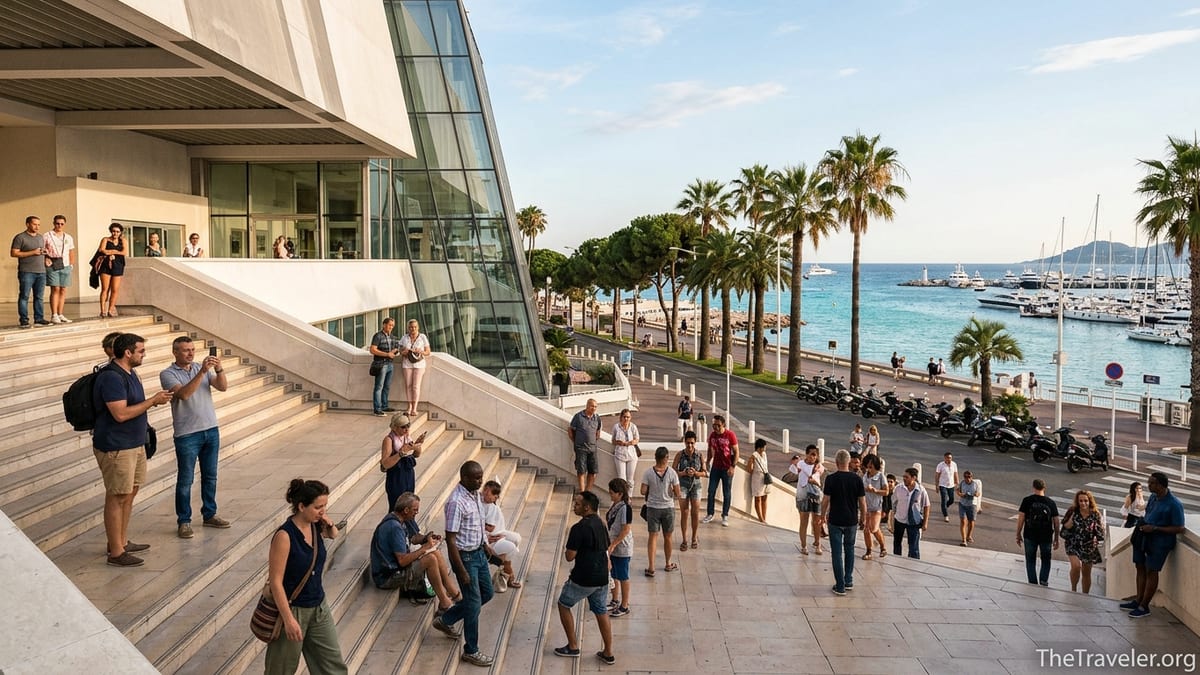
Arriving at the Palace You Already Know by Heart
The Palais des Festivals et des Congrès sits at the beginning of La Croisette, facing the marina and the bay of Cannes. Even if you arrive by local train from Nice or Antibes, you step out of Cannes station, walk ten minutes downhill, and suddenly there it is: the low, angular building that has framed decades of film history. Outside the May festival dates it functions as a convention center that hosts everything from television markets to gaming fairs, but to most visitors it is simply “the place where Cannes happens.”
That familiarity is part of the shock. You recognize the outline of the building from movie-magazine covers and news footage, yet the first real-world impressions are not the limousines or jewels but practical details: the palm trees in square planters, the queue of taxis along the Boulevard de la Croisette, the bus stop where commuters wait with grocery bags. In front of the facade, a broad open plaza is usually dotted with tourists taking photos on the bare steps that will later be covered in red carpet. It feels less like a distant temple of cinema and more like a public square that happens to host one of the world’s most photographed events.
There is no ticket barrier to simply reach this space outside the festival period. You can stroll up from the Vieux Port, gelato in hand, and be standing at the foot of those famous stairs in minutes. If you are arriving by cruise ship, the tenders drop passengers at the marina directly opposite the Palais, which means visitors in shorts and sunhats can be snapping selfies on the staircase within half an hour of coming ashore. That immediate, physical access is part of what makes the experience so vivid: it belongs to working film professionals for twelve days a year, and to everyone else for the other fifty weeks.
The moment you tilt your head back and trace the line of the steps up to the terrace, the television images you have seen for years suddenly gain depth, sound, and scale. You hear the hum of scooters on the road behind you, the clink of glasses from the café across the boulevard, and the gulls circling over the harbor. The festival is no longer a montage of edited red-carpet shots; it becomes a real place, under a very real Mediterranean sun.
On the Red-Carpet Steps: From Screen to Sidewalk
The heart of the experience is simple: climbing the steps. There are 24 of them, wide and shallow, framed by glass balustrades. During the festival they are dressed with a bright red carpet and flanked by rows of photographers. For the rest of the year, they are simply pale stone stairs that you can walk up at your own pace. Standing on the first landing and looking back at the sea, you understand how the festival has engineered its own iconography. The cameras that usually face the stars also face the bay, so every shot carries a hint of blue water and white yachts behind the glamour.
Travelers routinely turn this into a personal ritual. A solo visitor might hand their phone to another traveler and ask for a quick photograph “like at the premiere,” while couples often recreate red-carpet poses in everyday clothes, laughing as passing strangers snap pictures for them. Some groups arrive with a touch of theater: matching outfits, sunglasses even on cloudy days, and an improvised “paparazzi” friend crouching at the bottom of the steps. There is a small but real pleasure in borrowing an image that was once reserved for household-name actors and making it part of your own travel memory.
During the festival itself, the dynamic changes dramatically. The city and festival organizers create a restricted “Festival Zone” around the Palais, with security checkpoints and badge controls at each entrance. Without accreditation or an official invitation, you will not get farther than the outer security cordon, and the famous staircase is guarded by staff checking dress codes and barcodes on evening invitations. Even then, casual visitors tend to gather as close as possible, pressing up against the barriers in the early evening as the sun sets and waiting to glimpse a few arrivals between official cars.
Yet even at those peak moments of inaccessibility, standing near the steps gives you a powerful sense of proximity. You can hear the burst of camera shutters when a major star arrives, see the television cranes swing in toward the staircase, and watch as festival ushers in tuxedos manage the flow of guests up the incline. For anyone who has only seen the festival on broadcast highlights, being within earshot of that noise and seeing the real geography of the space is strangely grounding.
Planning Your Visit: When Cannes Feels Most Alive
For many film lovers, the question is not whether to stand at the Palais des Festivals but when. Visiting outside the May festival period is the easiest option: hotel rates are lower, the Croisette is calm, and you can approach the steps freely at almost any hour. A midweek morning in early spring or late autumn offers a particularly pleasant experience, with soft light on the bay and fewer groups waiting to take photos.
If your goal is to feel the pulse of the actual Cannes Film Festival, timing becomes trickier. Accommodation in central Cannes during the festival often climbs to several times low-season rates, and rooms at the grand seafront hotels such as the Carlton, Martinez, or Majestic can run into high three or even four figures per night. Many visitors on a budget base themselves in nearby towns like Antibes or Nice and commute by regional train, which runs frequently along the coast and takes around 30 to 40 minutes from Nice to Cannes.
Even without accreditation, the festival period is an intense way to experience the Palais area. Each afternoon and evening, the Croisette fills with people in black-tie attire and cocktail dresses walking toward the security lines around the palace. Police vehicles and security staff are everywhere. Metal barriers create temporary corridors along the sidewalks. On certain evenings, fireworks from the bay coincide with gala screenings. Just navigating this environment, even on your way to dinner at one of the brasseries behind the Palais or a pizza spot on Rue Félix Faure, gives you a sense of being inside the event instead of watching it from thousands of kilometers away.
For those who want a structured connection to the festival, several options exist that do not require being an established producer or star. Student programs and cinephile accreditations periodically open to younger film enthusiasts and film-school groups, giving limited access to screenings and talks. Some of these badge holders stay at hostels or two-star hotels up the hill in Le Suquet, walking down each morning in sneakers and swapping them for formal shoes carried in bags before reaching the Palais security gate. Watching this quiet daily transformation on the sidewalks is another reminder that the event is built on thousands of ordinary journeys to a somewhat extraordinary staircase.
Reading the City Around the Palace
Standing at the Palais can feel overwhelming, so it helps to lift your gaze and read the surroundings. To one side stretches the Vieux Port, with its mix of local fishing boats and glossy yachts. On the other side, La Croisette curves away past designer boutiques, palm trees, and beach clubs. Behind the Palais, pedestrian streets lead uphill toward the old quarter of Le Suquet, where narrow lanes and a hilltop church overlook the bay. This compact geography is part of why the festival feels so intense: everything important happens within a few walkable blocks.
For visitors, that compactness makes it easy to combine cinematic pilgrimage with ordinary Riviera pleasures. You might spend an hour around the Palais, climbing the steps and wandering through the adjacent square, then cross the road to one of the public beaches for a swim. Later, a short walk takes you to a café on Rue Hoche for coffee and a pastry, or to the Provençal market at Marché Forville for fresh fruit and socca. The Palais remains in sight from many of these places, a low white presence reminding you that film history is unfolding just a few streets away.
Because the Palais is a working convention center year-round, you may find your visit coinciding with another major event: a music industry market, a television content fair, a games festival, or an advertising congress. At these times the steps may be dressed with different branding or temporary structures, and the square can be filled with exhibition pavilions. It can be mildly disorienting to realize that the same entrance seen in festival coverage also hosts corporate parties on other dates of the year. Yet that very ordinariness contributes to breaking the spell of distance: Cannes is not a mythical city built purely for cinema but a coastal town that lends its infrastructure to many kinds of gatherings.
In the evenings, the area around the Palais becomes a crossroads. Locals walk their dogs along the promenade, joggers loop past the harbor, and groups heading to dinners or bars cut diagonally across the square. During the festival this same space hosts television crews doing live hits and security guards scanning badges, but on a quiet September night it is simply a wide, well-lit public plaza where teenagers sit on the steps sharing take-out. The dual life of the Palais, between global spotlight and local routine, becomes very visible when you linger here instead of snapping a quick photo and moving on.
Practical Tips for Experiencing the Palais Like an Insider
Turning a simple visit to the Palais into a meaningful experience often comes down to practical choices. Clothing is one of them. Outside the festival dates, casual wear is accepted everywhere around the palace; you will see travelers in swimwear and flip-flops walking past the steps on their way to the beach. During the festival, security controls and an unwritten dress code apply to those actually entering the building for evening premieres, where formal attire is expected. Even if you are only observing from outside the barriers, packing at least one smart outfit can help you blend into the crowd of festival-goers and feel psychologically closer to the action.
Timing is another factor. In high season, late morning and early afternoon bring the largest number of tour groups to the steps. If you want a more reflective moment, aim for early morning just after sunrise, when the bay is calm and the cleaning crews have finished washing the plaza. Standing alone on the staircase at that hour, with delivery vans pulling up and staff beginning their shifts inside the Palais, gives you a candid backstage view of a place usually seen at its most polished.
It is also worth exploring just beyond the immediate facade. On the harbor side of the building there is a lower promenade that curves along the water, offering a perspective back toward the steps and the facade that photographers rarely show on television. From here, the building looks more like the functional conference center it is: glass walls, terraces, and service entrances. This reverse view helps demystify the red-carpet image without diminishing its power. You begin to see the Palais as both a stage and a piece of everyday architecture.
Budget-conscious travelers should keep in mind that eating or drinking at seaside hotel bars along the Croisette can be significantly more expensive than cafés and bakeries a few streets inland. It is common for visitors to grab an espresso and croissant at a stand-up counter near Rue d’Antibes in the morning, spend their time near the Palais and the waterfront, and then head to more affordable restaurants in the old town for dinner. By understanding this rhythm, you can spend your money on experiences that matter to you, whether that means a single splurge cocktail overlooking the red-carpet entrance or a boat trip to the nearby Lérins Islands after your Palais visit.
How Standing at the Palais Changes the Way You Watch Cannes
Perhaps the most enduring effect of standing on the Palais steps is how it changes the way you experience the festival from afar. Once you have walked across the plaza, waited at the traffic lights of the Croisette, and felt the shallow rise of each step underfoot, televised gala coverage becomes strangely intimate. You can pinpoint exactly where the camera cranes stand, where the journalists are penned in, and how the guests move from their cars to the top of the staircase and into the Grand Théâtre Lumière.
The geography of the event stops being an abstract backdrop. When you later see wide shots of the Palais brushed with searchlights at night, you find yourself imagining the quieter corners just off camera: the side entrance where staff slip out on cigarette breaks, the harbor promenade where a couple leans against the railings watching the commotion, the cluster of fans pressed to the far barriers hoping for a glimpse of a favorite director. Your own memory of sunlight on the plaza or the sound of waves against the quay becomes part of the mental picture.
For travelers who work in film or media, that shift can be especially significant. The Palais is where film markets, panels, and press conferences unfold in rooms that rarely appear on screen. Standing in front of the building as a visitor, you may find it easier to imagine returning one day with a badge around your neck instead of a camera in your hand. In that sense, the experience can be quietly motivating. Even if you never climb the steps in formal wear for a world premiere, you have occupied the same physical space, looked out at the same harbor, and stood under the same lights that illuminate some of cinema’s most talked-about nights.
For others, the emotional resonance is simpler but no less powerful. If you grew up watching festival coverage or following award-season chatter, the realization that this monumental stage is actually an accessible corner of a small Mediterranean city is oddly comforting. It reminds you that the cultural spectacles that seem untouchable on screen are anchored in real streets and real buildings, walked across by ordinary people every day.
The Takeaway
Standing at the Palais des Festivals in Cannes is not only a matter of ticking off a famous landmark. It is a way of shrinking the distance between the myth of Cannes and the reality of a walkable coastal town. Whether you visit in the quiet months and have the staircase almost to yourself, or come during the festival and press up against the security barriers as the red carpet glows under the spotlights, the experience grounds the idea of Cannes in your own footsteps.
In purely practical terms, the Palais is easy to reach, free to approach outside the festival zone, and surrounded by neighborhoods, markets, and beaches that turn a cinematic pilgrimage into a well-rounded day on the Riviera. In emotional terms, it offers something subtler: a chance to see how the most photographed staircase in cinema looks at street level, at eye height, under changing Mediterranean skies. Once you have stood there, the next time you watch the festival unfold on television or read headlines about a premiere, you will know exactly where the cameras are pointing, and just out of frame, where you once stood yourself.
FAQ
Q1. Can I walk up the Cannes red-carpet steps if I am not attending the festival?
Yes, for most of the year the steps of the Palais des Festivals are open to the public, and you can walk up and take photos freely when no major event or construction is in progress.
Q2. Is it possible to see celebrities at the Palais during the Cannes Film Festival without a ticket?
It is sometimes possible to glimpse celebrities arriving on the red carpet from behind security barriers, especially in the early evening, but you will not be able to get close to the steps without accreditation or an official invitation.
Q3. Do I need to dress formally just to visit the Palais des Festivals?
No, casual clothing is fine outside festival screenings and events. Formal attire is required only for those entering certain evening premieres and official functions inside the Palais.
Q4. How close is the Palais des Festivals to the Cannes train station?
The Palais is roughly a ten-minute walk from Cannes railway station, mostly downhill along central streets, making it easy to visit on a day trip from nearby towns.
Q5. Are there security checks to reach the area around the Palais?
Outside major events, you can usually access the plaza and steps without screening. During the Cannes Film Festival and some large conventions, security perimeters and bag checks are set up, and certain areas require badges.
Q6. Can I visit the inside of the Palais des Festivals as a tourist?
There is no permanent public tour inside, but parts of the building are accessible if you attend a congress, show, or festival held there, and occasional guided visits may be offered during quieter periods.
Q7. What is the best time of day to visit the Palais for photos?
Early morning or late afternoon provides softer light on the steps and fewer tour groups. Midday can be very bright, with strong sun reflecting off the pavement and facade.
Q8. Is the area around the Palais des Festivals expensive for food and drinks?
Prices at cafés and bars directly on La Croisette and near the major hotels are typically higher. More affordable options can be found a few streets inland or in the old town of Le Suquet.
Q9. Is the Palais des Festivals accessible for visitors with reduced mobility?
The building and surrounding area include ramps, lifts, and adapted facilities, and during major events staff are present to assist accredited guests with reduced mobility.
Q10. Can I combine a visit to the Palais with a beach or island trip in one day?
Yes, the Palais is opposite central beaches and close to the departure point for boats to the Lérins Islands, so it is easy to climb the steps in the morning and spend the afternoon by the sea or on an island excursion.