


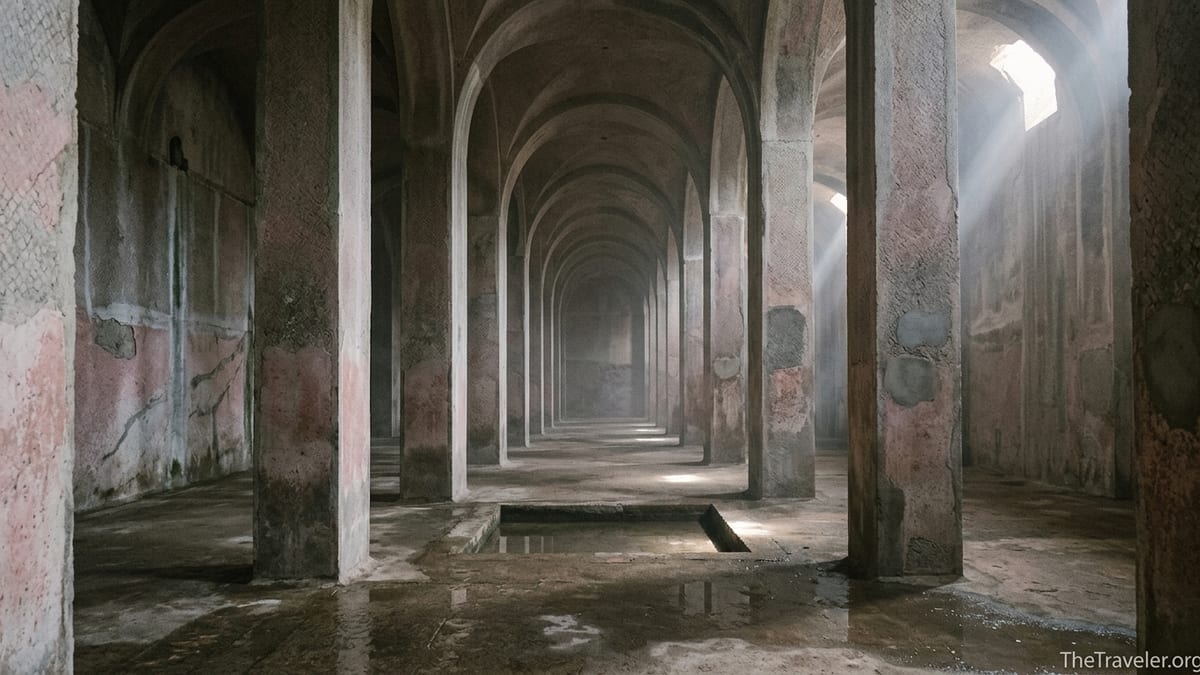
First impressions of Piscina Mirabilis tend to be about sheer size: a forest of stone pillars vanishing into shadow, like a Roman cathedral turned upside down. Yet what lingers most for observant visitors is not the scale but the details. Subtle engineering tricks, faint inscriptions and almost invisible scars of use tell a far richer story than the usual description of “a big Roman water tank.” Look closely, and this quiet cistern beneath a residential street in Bacoli reveals itself as one of the most intricate and atmospheric surviving pieces of ancient infrastructure in Italy.
Get the latest updates straight to your inbox!
The First Descent: Reading the Staircase and the Threshold
Almost everyone hurries down the modern entrance steps, keen to see the famous “underground basilica” of columns. Yet the descent itself hides several clues to how Romans once accessed and controlled this immense cistern. Today you enter from a side opening cut into the vaulted roof, but originally watermen and inspectors used two diagonal staircases located at opposite corners. One of these corkscrew-like stairways, at the northwest corner, still survives and can be glimpsed from certain angles once you are inside, a tight wedge of steps disappearing up into darkness. It is easy to mistake it for a later repair, but it is actually an integral part of the Augustan design, a carefully engineered vertical link between street level and the maintenance walkways that once ran around the rim.
At the bottom of the modern staircase, pause before you walk into the forest of pillars and look down. Set into the floor of the central nave is a shallow rectangular basin about one meter deep, a so-called piscina limaria, used to collect sediment and allow for periodic cleaning and emptying. Most visitors step over it without a second thought, but this sump is the key to understanding how Romans kept almost 12,000 cubic meters of water clear enough for drinking. During cleaning cycles, sluice gates and channels would guide water and silt into this lower basin, where it could be drained separately and shoveled out. The wear along the basin’s rim, and the slightly smoother texture of its floor, are the physical scars of generations of workers performing that same chore.
Look closely at the threshold stones where you move from the staircase into the main chamber. They are more worn and rounded than the surrounding blocks, an echo of centuries of boots and sandals using this as a work entrance long before it became a tourist doorway. On damp days, fine calcite sheen on these stones hints at how often condensation drips here, an ongoing reminder that this interior environment is still governed by water, even when the cistern stands dry.
The Forest of Piers: Subtle Asymmetries and Engineering Logic
The overwhelming visual experience inside Piscina Mirabilis is the grid of 48 massive piers that divide the 72-meter-long space into twelve barrel-vaulted aisles. From the first vantage point, it may look perfectly symmetrical, but attentive visitors will notice that not every interval is identical. Some bays are fractionally wider, some joints slightly offset. These small irregularities are not sloppy workmanship; they reflect the builders adapting to geological constraints and the need to distribute weight evenly within the volcanic tuff hillside above Bacoli.
Walk slowly along one of the side aisles and focus on the junctions where the piers meet the barrel vaults. You will see gentle haunching and thickening of masonry where loads concentrate, a subtle bulge that reveals the Roman engineers’ understanding of thrust and stress. In places the corners of capitals flare just a little more than in neighboring bays, evidence of incremental adjustments as the work advanced across the excavation. It is the sort of nuance you would expect in a modern engineering project where on-site measurements trump ideal drawings.
Another hidden detail lies in the way the piers were finished. Unlike the polished marble columns of temples, these supports are faced in plain hydraulic plaster, their sharp edges softened by two thousand years of damp. On some piers you can still detect a faint pattern where the underlying blockwork shows through, a ghost-grid that hints at the opus caementicium core beneath the coating. In the best-preserved corners, near the back of the cistern, you may notice trowel marks running in consistent, vertical strokes, as if the plasterers worked methodically from floor to springing point of the vault. Those traces turn the space from an abstract feat of engineering into something very human: you can almost imagine the workers standing on wooden scaffolds in the half-light, smoothing a wall that would rarely be seen by anyone other than water technicians.
Walls That Breathe: Opus Signinum, Patina and Water Lines
Most guidebooks mention that Piscina Mirabilis is coated in waterproof plaster, but few visitors take the time to study its texture and color. Move your hand close to the wall of one of the side bays and you will notice that it is not smooth like modern concrete but slightly granular, with tiny fragments of brick and tile embedded in a pinkish-grey matrix. This is opus signinum, a durable waterproof mortar that Romans used for tanks and baths. Its roughened texture improved adhesion and created a microscopic landscape that trapped lime crystals over time, enhancing the seal as water pressure increased.
The walls quietly record the cistern’s working life. In some stretches, a pale horizontal band encircles the bays at roughly mid-height, a faint tide mark where mineral-rich water once stood for years on end. Above this ghostly line the plaster tends to be more matte and slightly darker; below it, prolonged immersion has left a smoother, paler surface, often with delicate veils of calcite. These subtle color shifts allow you to imagine the cistern filled almost to the crown of the vaults, transforming what now feels like an underground cloister into a pressure vessel holding thousands of tons of water supplied by the great Augustan aqueduct from the interior of Campania.
Look for small patches of different mortar colors, especially near joints and corners. These reveal past repairs made during Roman times and later. A slightly redder plug of plaster might mark where a minor leak was sealed; a patch with coarser, more modern aggregate could date to 20th-century stabilization efforts when local authorities and archaeologists began consolidating the structure. The contrast between original opus signinum and later interventions is particularly noticeable in the upper zones around the access openings, where new concrete rings secure the roof after earlier collapses.
Light, Shadow and the Quiet Illusions of Space
One of the most striking, yet seldom analyzed, aspects of Piscina Mirabilis is its light. There are no grand oculi or decorative windows. Illumination enters mainly through small roof openings and the modern access cut, spilling shafts of daylight that drift and fade as clouds move over Bacoli’s modest hilltop neighborhood above. Time your visit for late morning or late afternoon and you may see sharp columns of light slanting across the bays, catching suspended dust and moisture like underwater beams. Many visitors take a quick photo and move on, but if you stand still for a few minutes, the changing geometry of these beams gradually reshapes your sense of the space.
As your eyes adjust, you will notice a subtle optical illusion: the far end of the cistern often seems to recede infinitely, especially when low light hides the back wall. The repeating pattern of piers and vaults tricks the brain into underestimating distances, much like a colonnaded cloister or the interior of a medieval cathedral. Some local guides play with this effect by asking guests to guess how long the cistern is, then revealing that the answer is roughly the length of a modern intercity train. The illusion is enhanced on days when a thin layer of moisture on the floor catches reflections, doubling the forest of piers and adding a faint mirror image beneath your feet.
Another detail easy to miss is the way acoustics alter your perception. Gentle footsteps echo with a soft delay, and a whispered conversation at one end of a nave can carry surprisingly clearly to the next. Recent acoustic studies have explored how the geometry of vaults and piers diffuses and lengthens sound, which is why occasional art installations and concerts are staged here under careful supervision. A single note from a flute or a singer’s voice can seem to hang in the air longer than expected, reinforced by subtle reverberations between the curved ceilings and vertical supports. That sonic behavior is a by-product of the same carefully calculated geometry that once tamed the pressure of millions of liters of water.
Traces of Work: Graffiti, Niches and Maintenance Rituals
Walk close to the piers and you may spot faint scratches, letters or simple symbols etched into the plaster. These are not grand inscriptions carved for emperors, but everyday graffiti left by workers and later visitors. Some are little more than initials or short names, others simple crosses or geometric marks. Because the surfaces are fragile, not all are easy to photograph, and they are best appreciated with the naked eye, at an angle where grazing light reveals the incisions. While archaeologists treat them cautiously, several likely date back to late Roman or medieval times when the cistern may have been intermittently reused or explored.
Set into the walls at intervals are shallow niches and recesses that many visitors overlook. Some probably held small wooden beams or braces for the maintenance walkways that once circled the cistern at higher levels. Others may have supported lamps or tools. Imagine an inspector walking along a wooden gallery two stories above the floor, pausing to check for leaks or to open and close sluices connected to the aqueduct. The stubby remains of such channels can still be seen where vaulted roofs meet the side walls, often reinforced with thicker plaster to resist the impact of inflowing water.
On the floor and lower walls, fine horizontal scratches mark the routes of carts, barrels or drag sleds used during cleaning cycles when the cistern was partially emptied. These faint grooves can be easiest to spot near the central sedimentation basin, where repeated shoveling and hauling would have concentrated. In some areas, patches of floor plaster show a slightly different slope, hinting at subtle regrading to help water and silt flow toward discharge points. All of this points to a working life that was anything but static; Piscina Mirabilis functioned as a living piece of infrastructure that needed constant adjustment and manual attention.
From Naval Lifeline to Forgotten Cellar and Back Again
The standard story of Piscina Mirabilis describes it as the terminal reservoir of the Augustan aqueduct supplying the Roman fleet at Misenum. What few visitors realize is how dramatically the meaning of this space changed over the centuries. After the decline of the imperial navy, the cistern likely passed through phases of neglect, partial reuse and reinvention. Local traditions speak of it as a place of refuge in troubled times, and later as a curious underground feature beneath vineyards and gardens in what would become the town of Bacoli.
By the early modern period, when antiquarians began to sketch the site, access was far more rudimentary than today. Some illustrations show makeshift ladders and rough openings in the vaults rather than the controlled entrance visitors now use. In the 19th and early 20th centuries, archaeologists and engineers carried out consolidation works, leaving behind subtle clues: metal anchors embedded high in the vaults, cement rings around roof openings, and masonry buttresses at vulnerable corners. These interventions are discreet but visible if you know where to look, and they tell a secondary story of how attitudes to conservation have evolved.
In recent years, renewed attention from Italian heritage organizations and local associations has led to improved access and more regular opening hours. Visitors today typically pay a modest admission fee in line with other Campi Flegrei sites and can often join short guided visits that last around 45 to 60 minutes. These tours tend to focus on history and engineering, but the real reward for independent travelers is to linger after the group has moved on, tracing the layered marks of reuse and repair that transformed an imperial water machine into a modern symbol of Bacoli’s hidden heritage.
Planning a Visit: Practicalities and Quiet Moments
Piscina Mirabilis sits inconspicuously behind ordinary houses on Via Piscina Mirabile, a short walk uphill from Bacoli’s small center and the shoreline of Lago Miseno. There is no monumental gateway heralding its presence, just a gate and a modest ticket point. As of the most recent updates, the site typically opens on a limited weekly schedule, often centered around weekends, with small-group guided entries at set times during the day. Exact days and hours can change with staffing and conservation needs, so travelers should check current information through local tourist offices or municipal channels shortly before their trip.
Entrance fees are usually in the range of a few euros per adult, sometimes combined with or supplemented by optional guided tours offered in Italian and, increasingly, in English or French. Compared with the crowded sites of Pompeii or the Colosseum, this is a remarkably calm experience. On many days, especially outside peak summer holidays, you may share the cistern with only a handful of other visitors. Photographers often prefer late morning or mid-afternoon slots when angled light produces strong contrasts and long shadows among the piers, while those more interested in atmosphere may appreciate the cooler, quieter feel of an earlier visit.
Wear shoes with good grip, as the stone steps and occasionally damp floor can be slippery. The interior stays relatively cool even on hot days, so a light layer can be useful in shoulder seasons. Because there are no facilities inside the cistern, plan to use restrooms and pick up water or snacks in Bacoli beforehand. A popular way to structure a day is to combine Piscina Mirabilis with visits to nearby sites such as the so-called Tomb of Agrippina on the coast or the archaeological area of Baiae, using local buses or a rental car to move between them. Seen this way, the cistern becomes part of a larger narrative about how Romans managed water, harbor defenses and leisure in the entire Bay of Naples.
The Takeaway
Many travelers describe Piscina Mirabilis as a hidden gem simply because it is less visited than Pompeii or Herculaneum. The deeper truth is that it rewards a different kind of attention. This is not a place of frescoed dining rooms or dramatic casts of victims, but of tiny scratches on plaster, faint tide marks on walls and the soft echo of footsteps beneath a long-vanished sea of water. Its most intriguing stories are written in small details that require patience to discover.
If you allow time to wander slowly between piers, to study the texture of opus signinum, to trace old repairs and imagine the rhythm of ancient maintenance crews, the cistern shifts from an impressive ruin into a living diagram of Roman problem-solving. It also becomes a lens on the present: on how a quiet town like Bacoli balances conservation with everyday life, and on the delicate work required to keep such fragile spaces open to the public. In the end, the hidden details most visitors never notice are precisely what make Piscina Mirabilis unforgettable.
FAQ
Q1. Where exactly is Piscina Mirabilis and how do I get there from Naples?
Piscina Mirabilis is in Bacoli, in the Campi Flegrei area west of Naples. Most visitors take the Cumana railway or a regional bus toward Baia or Bacoli, then walk uphill about 10 to 15 minutes from the town center to Via Piscina Mirabile, where the entrance is tucked into a residential street.
Q2. Do I need to book tickets in advance to visit Piscina Mirabilis?
Advance booking is not always mandatory, but because opening days and visitor numbers are limited, it is wise to check the latest information through local tourist offices or official regional ticketing channels shortly before your visit, particularly on weekends and in high season.
Q3. How much time should I plan to spend inside the cistern?
Most guided visits last about 45 minutes, which covers the main history and engineering points. Travelers who enjoy photography or quiet contemplation often prefer to stay closer to an hour to fully appreciate changing light and subtle details like plaster textures and graffiti.
Q4. Is Piscina Mirabilis suitable for children and travelers with limited mobility?
Children who like atmospheric spaces and simple engineering stories usually find the cistern fascinating, but very young kids may be unsettled by the dim light. Access involves descending and climbing relatively steep stone stairs, and the floor can be uneven, so it is not ideal for visitors with serious mobility issues or those who cannot manage steps safely.
Q5. Can I visit Piscina Mirabilis on the same day as Pompeii?
It is technically possible, but it makes for a long and rushed day. Most travelers find it more enjoyable to combine Piscina Mirabilis with closer Campi Flegrei sites such as Baiae or Cuma, and to dedicate a separate day to Pompeii from Naples or Sorrento.
Q6. Are guided tours inside Piscina Mirabilis worth it?
Yes, a good guide can point out hidden details that are easy to miss, such as the sedimentation basin, original staircases and signs of ancient maintenance. For a modest additional cost compared with the basic ticket, most visitors feel the explanations significantly enrich the experience.
Q7. Is photography allowed inside Piscina Mirabilis?
Photography for personal use is generally allowed, and the play of light and shadow makes this one of the most photogenic underground spaces in Italy. Tripods, flashes or professional setups may be restricted or require special permission, so it is best to travel light and confirm any current rules at the entrance.
Q8. What should I wear and bring for a visit?
Wear closed shoes with good traction and bring a light layer, as the interior is cooler and slightly damp compared with the streets above. Because there are no services inside, carry a small bottle of water and any essentials, but leave bulky bags behind to move more easily among the piers.
Q9. Are there other attractions nearby that relate to Piscina Mirabilis?
Yes, the whole Campi Flegrei area tells a connected story of Roman water management and coastal life. Nearby you can visit the archaeological remains of Baiae, the so-called Tomb of Agrippina on the seafront, and the harbor area around Lago Miseno, all of which were once tied to the same naval and urban network that Piscina Mirabilis supplied.
Q10. When is the best time of day or year to experience the cistern’s atmosphere?
Late morning and mid-afternoon often offer the most dramatic light beams and shadows, while shoulder seasons such as spring and autumn provide cooler temperatures and fewer crowds. In high summer, an early visit can be especially pleasant, as the interior stays refreshingly cool compared with the streets and beaches outside.