


High above the blue curve of the Bay of Naples, buried beneath a quiet residential street in Bacoli, lies one of the Roman world’s most astonishing works of engineering. The Piscina Mirabilis, a vast underground cistern carved into volcanic rock, once stored drinking water for the imperial fleet and the elite villas of the Campi Flegrei. Today, travelers who descend its worn stone staircase step into a silent “cathedral of water” that reveals just how far Roman engineers were willing to go to control one of the most essential resources of the ancient world.
Get the latest updates straight to your inbox!
What Exactly Is Piscina Mirabilis?
Piscina Mirabilis is a monumental Roman cistern hidden beneath the modern town of Bacoli, around 25 kilometers west of central Naples. Built in the Augustan age, it formed the terminal reservoir of the Aqua Augusta, also known as the Serino aqueduct, which carried spring water roughly 90 to 100 kilometers from the mountains near Serino to the Bay of Naples. Cut into the local tufa rock and lined with waterproof mortar, the cistern stored an estimated 12,600 cubic meters of water, roughly comparable to five modern Olympic swimming pools.
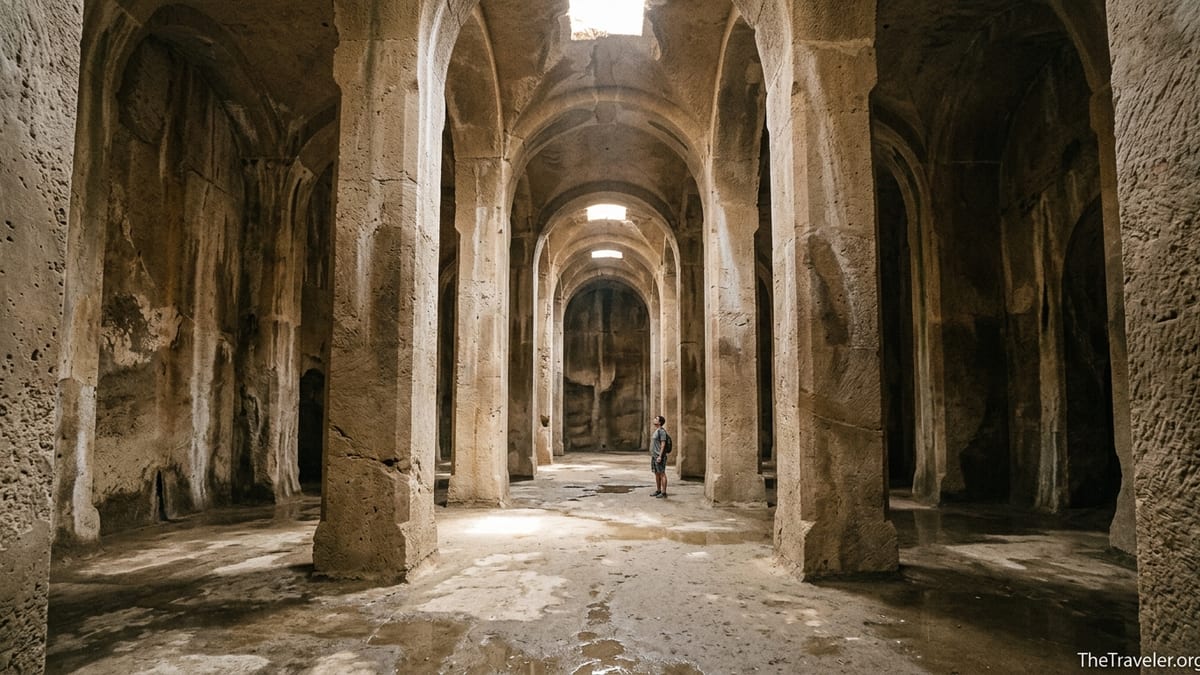
Step inside today and the first impression is not of an industrial tank but of a vast subterranean basilica. The interior measures about 72 meters long, 25 meters wide, and 15 meters high. Forty-eight cruciform pillars rise in regular rows, dividing the space into long “naves” and smaller side bays. Barrel vaults span overhead, streaked with centuries of mineral deposits. In the filtered light that enters through a few rooftop openings, the pillars and arches recede into shadow, giving the cistern its popular nickname: the “water cathedral” of Bacoli.
In Roman times, this was not a place meant for public visitation. It was utilitarian infrastructure at the highest level, part of a regional water system that fed cities such as Naples and key ports like Miseno, headquarters of the imperial fleet in the Tyrrhenian Sea. Yet Roman engineers designed it with such scale, precision, and redundancy that it remains one of the most impressive hydraulic structures to survive anywhere in the former empire.
For modern travelers exploring Campania beyond Pompeii and Naples, Piscina Mirabilis offers a rare chance to walk directly into the heart of that system. Unlike ruins where only foundations or fragments remain, here the entire three-dimensional volume of a major Roman infrastructure work is still intact, allowing you to literally stand inside the machine that kept a navy and an entire coastal region supplied with fresh water.
The Strategic Role: Watering an Imperial Fleet
To understand why the Romans invested so heavily in a single cistern, you have to picture the Bay of Naples in the early first century. The Campi Flegrei area was both a volcanic landscape and a strategic prize. At Miseno, a short walk from Bacoli’s modern waterfront, the Roman navy maintained its principal western fleet base. Thousands of sailors, soldiers, shipwrights, and support staff lived around the sheltered Lago Miseno lagoon and the surrounding hillsides.
All of those people, along with the crews of warships anchored in the harbor, needed reliable drinking water. Local springs and wells could not meet the demand year-round, particularly in dry summers. The Aqua Augusta solved that problem by channeling clean spring water from the Apennine foothills, far inland and high enough to provide good pressure by gravity alone. Piscina Mirabilis sat at the end of this system, ensuring both storage and regulation of flow before water was distributed to the fleet and to the luxurious villas that dotted the coastline.
Archaeologists have identified outlets in the northwestern section of the cistern where the aqueduct water entered and where distribution channels likely began. From there, water could be directed to pipelines feeding the naval base, fountains, baths, and private properties. When you walk along Bacoli’s seafront promenade today, past small fishing boats and cafes selling espresso and sfogliatelle, it can be hard to imagine that an entire imperial logistics network once depended on the invisible reservoir up on the hill behind town.
The storage capacity of Piscina Mirabilis also insulated the fleet from short-term interruptions in supply. Storm damage, maintenance along the aqueduct, or brief contamination at the source could all be buffered by tens of thousands of cubic meters of reserve water. In modern terms, it functioned like a regional water tower on a gigantic scale, smoothing out fluctuations so that naval operations were not held hostage to daily weather or local shortages.
A Masterpiece of Roman Hydraulic Engineering
What makes Piscina Mirabilis one of Rome’s greatest engineering feats is not only its size but how elegantly it integrates geology, structural engineering, hydraulics, and materials science. Roman builders chose to excavate the chamber directly into the soft yet stable tufa bedrock of Bacoli’s hill. This reduced the need for external retaining walls and used the surrounding rock mass to resist the immense lateral pressure exerted by millions of liters of stored water.
Inside this excavated shell, they constructed 48 massive pillars and the surrounding barrel vaults in opus caementicium, a Roman concrete that combined lime, volcanic sand, and aggregate. The vaults distribute the weight of the rock and soil above, allowing the cistern to support the modern houses and narrow streets you see at ground level today. Engineers also coated the walls and floor in opus signinum, a waterproof mortar made with crushed tiles that minimized seepage and helped maintain water quality.
From a hydraulic standpoint, the cistern had to be filled and emptied in a controlled way to avoid damaging surges. Inlet channels brought water from the Aqua Augusta at a carefully calculated gradient that preserved flow without eroding the conduits. At the base of the walls and pillars, inspection walkways and small openings allowed maintenance crews to monitor sediment buildup, repair plaster, and clear blockages. The roof terrace contained ventilation and access shafts, some of which now serve as the light wells that create the dramatic beams of sunlight visitors see inside.
One striking aspect of the design is how it anticipates modern concepts of resilience and redundancy. Multiple internal bays allowed parts of the cistern to be isolated for cleaning while the rest remained in service. The volume was large enough to cover variations in supply from the springs at Serino. And by burying the entire structure, Roman engineers protected the water from evaporation, algae growth, and deliberate contamination, all concerns that still preoccupy water authorities around the world today.
Aqua Augusta: The Long Road from Mountain Springs to Sea
Piscina Mirabilis only makes sense when seen as the culmination of the Aqua Augusta, one of the longest and most ambitious aqueducts in the Roman world. The system began at high-quality springs near the modern town of Serino in the Terminio-Tuoro mountains, more than 90 kilometers east of Naples. From there, water traveled along a primarily underground route across valleys and ridges, maintaining a gentle gradient over tens of kilometers to keep gravity doing the work.
Along the way, the aqueduct supplied multiple cities and settlements: Nola, Acerra, Pompeii, Herculaneum, Naples, and several smaller communities in the Campi Flegrei. For travelers who have visited the aqueduct arches outside Rome or the Pont du Gard in southern France, the Aqua Augusta is a reminder that some of the most sophisticated Roman waterworks were largely hidden, threading below hills and urban neighborhoods rather than marching across open countryside in spectacular arcades.
Traces of the Aqua Augusta still appear in unexpected places. Sections have been identified under modern Naples, where contemporary apartment blocks rise above ancient masonry tunnels. In the countryside between Serino and the coast, cuttings and short bridges mark points where the aqueduct crossed ravines or geological obstacles. Guides in Campania sometimes point out these fragments when leading tours that connect Pompeii, Herculaneum, and the Phlegraean Fields, allowing visitors to follow the water’s path as it approached the coast.
For modern engineers, the Aqua Augusta remains an object of study. Research into its route and capacity has shown how Roman surveyors maintained consistent slopes over long distances using only simple instruments, calculating gradients often within a few centimeters over hundreds of meters. That precision is what allowed the water to reach Bacoli with enough head to fill Piscina Mirabilis to its impressive height, all without pumps or mechanical lifting devices.
Visiting Piscina Mirabilis Today
For contemporary travelers, Piscina Mirabilis offers a quieter, more contemplative experience than the major archaeological parks of Pompeii or Herculaneum. The cistern lies in a residential part of Bacoli, reachable from Naples by a combination of regional train or metro and local bus or taxi. Many visitors pair it with other Phlegraean sights such as the submerged Roman ruins of Baia, the amphitheater of Pozzuoli, or the volcanic crater of Solfatara when access conditions allow.
Inside the cistern, the atmosphere is cool and humid even on hot summer days. The floor is generally dry, but patches of moisture and moss cling to lower walls and the base of pillars, a reminder that this was built to hold water, not tourists. Basic lighting has been installed, but much of the visual drama comes from natural light shafts through the ceiling openings, which shift over the course of the day. Visiting in late morning or mid afternoon often yields the most striking interplay of light and shadow for photography.
Access is typically managed through timed entries, often restricted to a few days per week, and numbers per time slot can be limited. In practice, this means that even in peak travel months you are unlikely to find large crowds inside. A small group might gather at the entrance stairway, then disperse quickly among the pillars, so it is relatively easy to find a corner where you can stand alone and absorb the scale in near silence. Guiding is sometimes provided in Italian, and independent travelers often supplement with printed materials or audio guides from private tour operators.
Surrounding the site, visitors encounter the contrast that defines so much of Campania: everyday life layered directly on top of world-class archaeology. Local children walk home from school past the modest gate to the cistern, Vespas clatter along the narrow lane above, and laundry hangs from balconies built on the same hill that once shielded Rome’s fleet water supply. This proximity to normal neighborhood life is part of the experience and a reminder that Piscina Mirabilis, for all its grandeur, was always infrastructure serving a living community.
How Piscina Mirabilis Compares to Other Ancient Cisterns
Travelers who have explored other great ancient cisterns, such as the Basilica Cistern under Istanbul, often remark on the similarities and differences when they step into Piscina Mirabilis. Both spaces feature dense forests of columns and vaulted ceilings, and both were critical to urban or military water security. Yet Piscina Mirabilis predates the great Byzantine cisterns by several centuries and represents an earlier Roman approach that relied more heavily on carving into natural rock rather than building freestanding underground chambers.
In terms of capacity, Piscina Mirabilis is large but not unique. Some cisterns in later imperial or Byzantine cities stored greater volumes. What distinguishes it is the combination of scale, preservation, and context at the endpoint of a single long-distance aqueduct. Few other sites allow travelers to so clearly visualize the chain from remote mountain springs to a specific military installation at the sea.
Architecturally, the cistern also showcases a distinctive Roman sense of rhythm and proportion. The spacing of the pillars, the curvature of the vaults, and the way the bays guide your eye down the length of the hall all echo formal religious or civic buildings above ground. This has led some visitors to describe the sensation of walking through the cistern as akin to exploring a stripped, unadorned basilica or cathedral, where structure alone provides the aesthetic impact.
For those interested in the broader story of water in the ancient Mediterranean, combining a visit to Piscina Mirabilis with sites like the aqueduct remains near Naples, the cisterns of Istanbul, and reservoirs in North African cities can build a comparative picture. Each region adapted Roman hydraulic principles to its own geology and political needs, but few individual structures capture that integration as powerfully as this “miraculous pool” tucked beneath a Campanian hillside.
Planning Your Trip: Practical Tips and Nearby Highlights
Most international visitors base themselves in Naples and reach Bacoli as a half-day or full-day excursion. A common route uses the Cumana railway from Naples toward the Phlegraean area, followed by a short local bus or taxi ride up to the neighborhood above the port of Miseno. Journey times vary depending on connections, but many travelers report around an hour door to door from central Naples hotels to the entrance of the cistern.
Once in Bacoli, it is practical to combine Piscina Mirabilis with at least one other nearby archaeological or natural site. Many visitors continue down to the shoreline to see the ancient harbor area around Lago Miseno or drive a short distance to the archaeological park of Baia, where partially submerged Roman villas can be viewed from boats with glass panels or through organized snorkeling excursions by local dive centers. Others head toward Pozzuoli to see the Flavian Amphitheater and the Temple of Serapis, where columns marked by marine organisms tell the story of ground movements in the Campi Flegrei.
Inside the cistern, conditions are generally easy for able-bodied visitors, though the staircase at the entrance is steep and surfaces can be uneven. Closed shoes with good grip are advisable, and a light jacket can be useful even in summer, as the interior temperature is lower than outside. There are no services such as cafes or restrooms inside the site itself, so most travelers plan a coffee stop in Bacoli’s center or a seaside lunch after the visit. Simple trattorias near the port serve local dishes like spaghetti alle vongole, fried anchovies, and seasonal vegetables from the volcanic soils of the surrounding hills.
Because access days and entry systems can change, particularly as local authorities adjust conservation measures or manage regional events, it is wise to confirm practical details shortly before your visit through current tourist information channels or accommodation hosts. Some travelers choose to join small-group tours that include transport from Naples and pre-arranged entry, which can simplify logistics if you are short on time or unfamiliar with local public transport.
The Takeaway
For all its technical complexity, Piscina Mirabilis leaves most visitors with an emotional impression rather than a purely analytical one. Descending from bright Mediterranean sun into a cavernous hall of pillars, you feel the weight of rock and history overhead and the cool breath of centuries of stored water. It is an encounter not just with Roman engineering skill but with their priorities: an empire willing to invest enormous resources in bringing clean water to where it was strategically needed.
Seen in the context of the Aqua Augusta and the naval base at Miseno, the cistern becomes a lens through which to read the entire Bay of Naples. The villas of the wealthy, the bustling port towns, the military harbors, and the fertile fields of the Phlegraean countryside all depended on invisible networks of supply that places like Piscina Mirabilis made possible. In an era when modern cities still struggle with water scarcity, leakage, and distribution, the endurance of this 2,000-year-old structure feels particularly relevant.
For travelers who have already checked Pompeii, Capri, and the Amalfi Coast off their itineraries, Piscina Mirabilis offers a different kind of highlight: quiet, atmospheric, and deeply connected to the everyday workings of the ancient world. Standing between its pillars, you are not just looking at ruins. You are standing inside one of Rome’s greatest machines, one that once turned mountain springs into naval power and urban comfort, and that still, after two millennia, holds its form beneath the streets of a small Campanian town.
FAQ
Q1. Where is Piscina Mirabilis located in relation to Naples?
It is in the town of Bacoli, about 25 kilometers west of central Naples, in the Phlegraean Fields area overlooking the Bay of Naples.
Q2. Why was Piscina Mirabilis built in the first place?
It was constructed as the terminal reservoir of the Aqua Augusta aqueduct to store and regulate fresh water for the Roman naval base at Miseno and nearby settlements.
Q3. How big is Piscina Mirabilis?
The cistern is approximately 72 meters long, 25 meters wide, and 15 meters high, with a capacity of around 12,600 cubic meters of water.
Q4. What makes Piscina Mirabilis such an important engineering feat?
Its significance lies in its scale, the precision of its hydraulic design, its integration into the long-distance Aqua Augusta aqueduct, and the excellent preservation of its underground architecture.
Q5. How do I get to Piscina Mirabilis from central Naples?
Most visitors travel by regional rail or metro toward the Phlegraean area, then switch to a local bus or taxi to Bacoli, allowing roughly an hour for the journey depending on connections.
Q6. Is a visit suitable for children and non-specialists?
Yes. The cistern’s dramatic interior appeals to many visitors, including children, even without deep background in Roman history or engineering, though steep stairs require supervision.
Q7. Do I need to book in advance to visit?
Because access is often managed through timed entries and limited opening days, it is advisable to check current arrangements shortly before your trip and reserve if required.
Q8. How long should I plan for a visit inside the cistern?
Most travelers spend between 30 minutes and one hour inside, allowing time to walk through the bays, take photographs, and absorb the atmosphere without rushing.
Q9. What other sites can I combine with Piscina Mirabilis in a day trip?
Popular combinations include the submerged Roman ruins of Baia, the amphitheater and Temple of Serapis in Pozzuoli, and scenic viewpoints around Lago Miseno.
Q10. Can I visit Piscina Mirabilis on my own or do I need a tour guide?
You can usually visit independently during opening hours, though many travelers appreciate local guides or organized tours for deeper historical and engineering context.