


High on a quiet residential hillside above the Bay of Naples, behind a modest gate on Via Piscina Mirabile in Bacoli, lies one of the Roman world’s least-known yet most astonishing engineering works. Step down a narrow staircase and you enter a vast, dim cathedral of stone pillars and stillness: the Piscina Mirabilis, an immense Augustan-era cistern that once stored fresh water for the imperial fleet at Misenum. To understand this underground forest of columns is to understand how Rome turned water into power, projecting its influence across the Mediterranean through an invisible but sophisticated hydraulic network.
Get the latest updates straight to your inbox!
The Naval Harbor That Needed a Hidden Ocean
When Emperor Augustus chose Misenum, at the western tip of the Gulf of Naples, as the main base for the Western imperial fleet, he needed more than a good harbor. He needed a guaranteed supply of fresh water for thousands of sailors, support staff and shipbuilders living in a densely built coastal landscape with limited local springs. The answer was not a surface reservoir vulnerable to attack, but a massive underground cistern dug into the tuff rock above the harbor, today known as the Piscina Mirabilis, or “wondrous pool.”
The name “Mirabilis” was coined in the Middle Ages by the poet Petrarch, but the structure itself dates to the reign of Augustus, around the late first century BC to early first century AD. At that time, Misenum’s fleet, the Classis Misenensis, guarded the western Mediterranean, from Spain to North Africa. Supplying thousands of men with clean water every day required a level of reliability impossible from wells alone. Instead, Rome brought water from distant, high-quality springs in the Apennines and stored it here, in what was effectively a strategic water bunker overlooking the sea.
Modern visitors arriving from Naples typically take a regional train to Fusaro or a suburban bus into Bacoli, then walk five to ten minutes through narrow streets lined with low houses. Nothing outside hints at the scale underground. It is only after paying a modest entry fee, usually under 10 euros and often collected by a local custodian, that you descend into the cool gloom and realize that this hillside once contained enough water to keep an entire naval harbor functioning even under siege.
Travelers familiar with the Basilica Cistern in Istanbul often compare the two. While Istanbul’s cistern served the Byzantine capital centuries later, Piscina Mirabilis was part of an earlier, region-wide water strategy. Seen in this context, it is not an isolated marvel but the endpoint of one of the most ambitious Roman aqueduct systems ever built.
Inside the “Cathedral of Water”
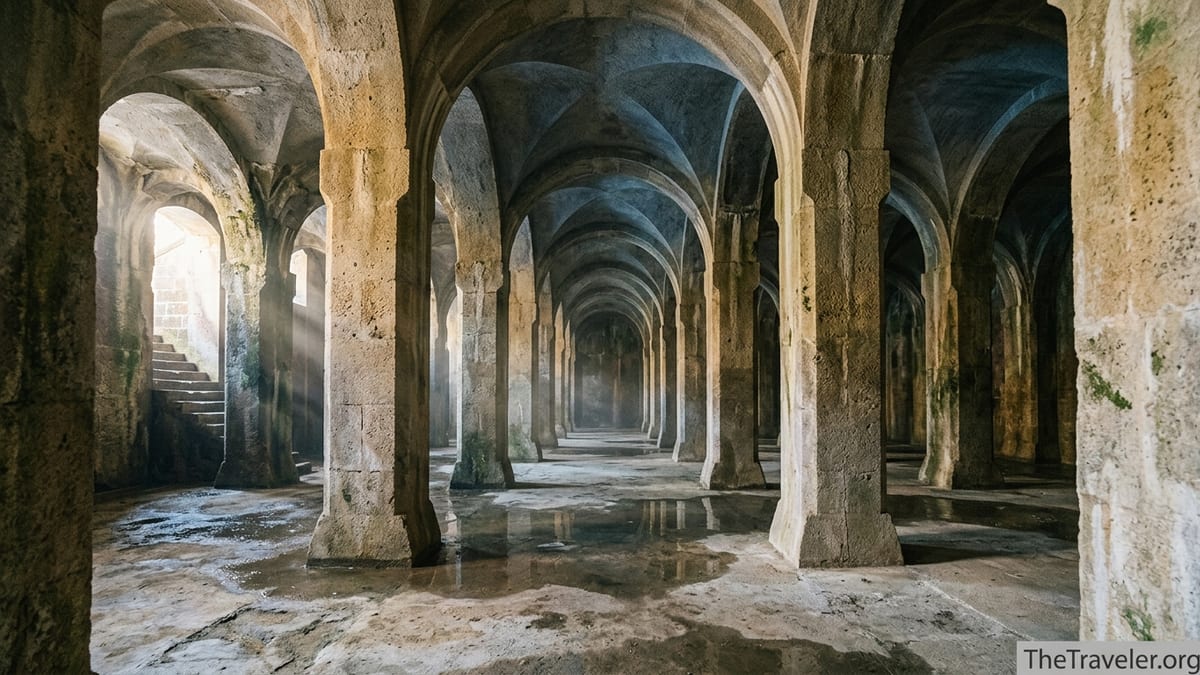
Architecturally, Piscina Mirabilis feels as much like a temple as an infrastructure work. The interior measures roughly 70 meters long and 25 meters wide, with a height of about 15 meters. Forty-eight massive cruciform pillars, laid out in a symmetrical grid of four rows by twelve columns, support a series of barrel vaults that crisscross overhead. The effect, especially when shafts of sunlight strike airborne dust or moisture, is eerily similar to walking into a Romanesque church, only without altars or frescoes. Here, the sacred element was water itself.
The floor was lined with waterproof cocciopesto, a mix of crushed pottery and lime that created a durable hydraulic plaster. The walls and pillars were treated in the same way, ensuring the cistern could hold tens of thousands of cubic meters of water without seeping into the surrounding rock. In several places you can still trace the mineral lines that marked historic water levels, faint bands on the stone like tide marks in a natural cave, vivid physical reminders that this silent chamber was once filled almost to the vaults.
From a traveler’s point of view, the details make the technology suddenly tangible. Look for the arched niches in the walls where settling of sediments was controlled, and examine the ceiling where small ventilation openings once regulated air, reducing humidity and helping keep the stored water fresh. In some sections, guides will point out channels and holes where wooden beams and walkways allowed maintenance workers to move above the water surface, scraping algae and sediment from the walls. These were not anonymous laborers but specialized hydraulic technicians whose work kept the fleet’s lifeline functioning.
Photography here can be magical. In mid-morning, when the sun is higher and the entrance light is strong, you can capture long, luminous beams cutting through the dimness, illuminating the damp textures of the columns. A full-frame camera with a wide-angle lens in the 16–24 mm range is ideal, but even a modern smartphone, set to a night or low-light mode and braced against a column, can record the repeating forest of pillars that has inspired photographers and archaeologists alike.
Aqua Augusta: The Hidden Artery of Campania
Piscina Mirabilis did not exist in isolation. It was the terminus of the Aqua Augusta, also known as the Serino aqueduct, one of the most complex regional water systems of the Roman world. Built under Augustus, roughly between 30 and 20 BC, the aqueduct began at springs near modern Serino in the Apennines and snaked for close to 100 kilometers or more through tunnels and bridges to reach multiple cities around the Bay of Naples, including Pompeii, Herculaneum, Naples, Cumae, Puteoli and eventually Misenum.
Unlike the iconic aqueduct bridges around Rome, most of Aqua Augusta ran underground, following the contours of the hilly volcanic terrain. Engineers maintained a steady gradient of only a few centimeters per hundred meters, enough for gravity to do the work but gentle enough to avoid damaging turbulence. In practice, this meant cutting two-kilometer-long tunnels through tuff hills, reinforcing them with stone arches, and, in some stretches, building siphon systems to cross valleys. Archaeological studies have identified branches peeling off the main channel to feed urban distribution tanks, such as the castellum aquae that visitors can see today at the highest point of Pompeii.
For modern travelers, the most accessible way to “trace” Aqua Augusta is conceptually rather than physically. In a single day you can travel from the Serino area, where the springs still supply the region, down to Pompeii’s water tower, then on to Bacoli and Misenum. Each stop reveals a different expression of the same hydraulic logic. In Pompeii, you might follow the line of public fountains down Via dell’Abbondanza and notice how their steady flow and overflow grooves are all oriented downhill. Hours later, standing in the shadowy expanse of Piscina Mirabilis, you can mentally reconnect the dots: the same mountain water that once splashed from a street fountain in Pompeii also filled this cavern beneath your feet.
Recent research by Italian and international scholars has underlined how unusual Aqua Augusta was. Most Roman aqueducts served a single city. This one was a regional network, calibrating flows among multiple communities and strategic sites. That made maintenance complex. Repairs to a section near Naples, for example, could impact supply to Baiae or Misenum. Yet for roughly two centuries, this hidden artery kept Campania’s cities, villas and naval base supplied, allowing urban life and imperial operations to flourish.
How the Roman System Managed, Stored and Moved Water
To understand Piscina Mirabilis as a traveler, it helps to picture not just a static tank but a node in a living system regulated by gravity, pressure and routine human intervention. Water from Aqua Augusta entered the cistern at high level, slowed and settled, then exited through lower outlets that fed local distribution pipes and fountains around Misenum and Baiae. The cistern evened out fluctuations in flow from the aqueduct and covered periods of higher demand, operating much like a modern service reservoir above a city.
Inside, the forest of pillars did more than impress the eye. Structurally, they supported the heavy vaulted roof against the pressure of the surrounding earth. Hydraulically, they broke up wave motion when the water level changed suddenly, preventing sloshing that could damage the walls. If you imagine a sudden closure of valves or a temporary shift in inflow, the pillars acted as baffles, dissipating energy. The Romans did not describe fluid dynamics in modern terms, but their design reflects generations of practical experience managing large volumes of water.
From an everyday perspective, sailors and townspeople did not walk into the cistern to scoop water. Instead, they drew it from wells, basins and fountains connected by lead and terracotta pipes. These outlets were fed from the pressurized head created by the elevation difference between the cistern and the points of use. At street level in ancient Misenum, a sailor filling a jar at a fountain might never have seen the source. Yet his supply depended on teams of aquarii, the water officials who periodically descended into the cistern via shafts and stairways to inspect masonry, remove sediments and adjust flow devices.
For visitors interested in engineering, local guides in Bacoli sometimes illustrate these principles by comparing Piscina Mirabilis to a modern municipal reservoir serving Naples today. Both systems buffer variations in demand, both rely on gravity and both require constant monitoring. The striking difference is that the Roman solution is entirely masonry and gravity powered, with no electrical pumps or digital sensors. That it functioned on this scale for generations speaks to a pragmatic engineering culture that prized redundancy, careful surveying and ongoing maintenance.
Visiting Piscina Mirabilis Today: What Travelers Need to Know
Reaching Piscina Mirabilis from central Naples is relatively straightforward. Many travelers take the Cumana railway toward Torregaveta and get off at stations serving Bacoli or Fusaro, continuing on foot or by local bus for the final stretch. Others opt for a ride-share or taxi, especially in summer when temperatures climb and uphill walks feel longer. The cistern lies in a residential quarter rather than a large archaeological park, so arrival can feel almost anticlimactic: a small sign, a doorway, a short path and then the stairway down.
Opening arrangements have varied in recent years, so it is wise to check locally in Naples before you set out. As of mid-2026, the site is often open on set days and hours, with the municipality periodically organizing guided visits, especially on weekends and during cultural events. Entry fees are modest, typically only a few euros, and sometimes visits are by pre-booked tour with local associations that specialize in the archaeological heritage of Bacoli and Campi Flegrei. Many travelers combine the cistern with nearby sites such as the Parco Archeologico delle Terme di Baia and the submerged ruins of Baiae, accessible by glass-bottom boat tours in good weather.
Inside the cistern, conditions are cool and damp even on hot days, with occasionally slippery stone steps. Closed shoes with good grip are strongly recommended, and a light jacket can be useful in shoulder seasons. Lighting is minimal, often provided by a few electric fixtures near the entrance, so bringing a small torch or using your phone’s light can help you appreciate details in the far reaches of the chamber. Tripods are sometimes restricted, but a monopod or simply leaning your camera against a column can steady low-light shots.
Because the cistern is in a residential area, services directly on site are limited. There is usually no café or large visitor center. However, within a ten-minute walk you can find local bars serving espresso for around 1 to 1.50 euros, as well as simple trattorie offering lunch menus with seafood pasta, fried anchovies and house wine. Planning a half-day that includes the visit plus a relaxed meal overlooking the bay at Bacoli or nearby Capo Miseno can turn a technical side trip into a memorable part of a Campania itinerary.
Linking Bacoli, Baiae and Pompeii: Following the Water Trail
One of the most rewarding ways to experience Piscina Mirabilis is to see it as part of a broader “water trail” through Campania’s archaeological landscape. Start in Pompeii, roughly 30 kilometers southeast of Naples, where the city’s relationship with Aqua Augusta is carved into its very streets. At the castellum aquae near the Vesuvian Gate, you can observe the distribution tank where water from the aqueduct was split into three lead pipes serving different quarters. From there, follow the line of basalt paving stones, noting how public fountains stand at regular intervals, fed by a constant flow that would have overflowed down small channels to clean the streets.
From Pompeii, travelers often continue by Circumvesuviana train back toward Naples and on to Pozzuoli and Baiae. At Baiae’s thermal complex, now partially submerged beneath the bay, you can see how abundant water enabled sprawling bath facilities that catered to Rome’s elite. The same supply that filled private plunge pools and steam rooms in imperial villas supported the security and logistics of the fleet at Misenum, connecting luxury and military power through shared infrastructure.
By the time you stand in Piscina Mirabilis, you have seen the system’s different faces: urban, recreational and strategic. A modern analogy might be the way a single hydroelectric dam today might supply a city’s homes, an industrial port and a military base. Romans grasped that controlling water on a regional scale could stabilize food supplies, support population growth and project power. Walking these sites in a single trip, using commuter trains and local buses that roughly parallel the old aqueduct route, brings that abstract idea down to human scale.
This approach also reveals smaller, often overlooked details. In Bacoli and nearby towns, look for remnants of ancient channels cut into the rock, reused cisterns beneath churches and villa foundations perched above old water tunnels. Local festivals sometimes include guided evening walks focusing on underground structures, where residents share stories about cellars that turn out to be Roman reservoirs. In this way, the story of Aqua Augusta and Piscina Mirabilis becomes not just a tale of imperial Rome but a living part of community identity in today’s Campi Flegrei.
Why Piscina Mirabilis Matters in the Age of Water Scarcity
For all its age, Piscina Mirabilis speaks directly to concerns that are increasingly central to 21st-century travelers: water security, climate resilience and sustainable infrastructure. The Romans, operating without modern pumps or electricity, built a system that moved high-quality spring water over long distances using nearly continuous gradient alone, stored it in large, covered reservoirs to minimize evaporation and contamination, and then distributed it through a carefully calibrated network of pipes and fountains.
Standing in the cool dark of the cistern, you may notice how protected it feels from surface conditions. The thick tuff roof insulates it from heat and cold. Its underground location shields it from direct attack, accidental contamination and the volcanic ash that periodically dusts the Campi Flegrei region. In effect, it was an early form of climate-adaptive infrastructure. Even if drought affected local wells or heavy rains muddied rivers, the fleet at Misenum could rely, at least for a time, on a stable reserve of clean water.
Modern engineers and historians have drawn lessons from this design. Studies of Aqua Augusta and Piscina Mirabilis highlight the value of redundancy in water systems, the advantages of gravity-fed networks that require little energy, and the importance of investing in durable materials and long-term maintenance. These insights resonate in regions today where rapid urbanization strains aquifers and climate change alters rainfall patterns. While no one is suggesting that contemporary megacities should simply copy Roman methods, the underlying principles of diversified sources, protected storage and logical distribution remain strikingly relevant.
For travelers, engaging with these ideas can deepen the experience of visiting Campania’s ancient sites. A day that begins with an espresso in Naples, includes a train ride beneath Vesuvius to Pompeii, and ends with a quiet descent into Piscina Mirabilis becomes more than sightseeing. It becomes a meditation on how societies past and present secure the most basic prerequisite for urban life: the reliable, shared management of water.
The Takeaway
Piscina Mirabilis is not as famous as the Colosseum or Pompeii, yet it embodies a different side of Roman greatness. Where amphitheaters speak of spectacle and empire in stone, this silent cistern speaks of planning, logistics and the invisible systems that made daily life possible for soldiers, merchants and citizens alike. As the endpoint of the Aqua Augusta, it tied together a string of cities around the Bay of Naples, from humble fountains to grand bath complexes and a formidable naval base.
Visiting today is relatively simple in practical terms but extraordinarily rich in rewards. For the cost of a short suburban ride from Naples and a modest entrance fee, you can walk through a space that once held an artificial lake suspended above the sea, engineered with such care that its masonry still stands after two millennia. Pair your visit with stops at Pompeii, Baiae and Misenum and you will come away with a coherent picture of how Rome’s mastery of water underpinned its urban culture and military reach.
In an era when many destinations compete on surface spectacle, Piscina Mirabilis offers something more subtle yet enduring: an encounter with the quiet, structural intelligence of a civilization that understood that empires, like cities, ultimately run on water. For travelers willing to descend a few dozen damp steps into the earth, it is one of southern Italy’s most thought-provoking experiences.
FAQ
Q1. Where exactly is Piscina Mirabilis located?
Piscina Mirabilis is in the town of Bacoli, on a hillside above the Bay of Naples in southern Italy, roughly 25 kilometers west of central Naples and close to the ancient naval base of Misenum.
Q2. How can I get to Piscina Mirabilis from Naples without a car?
Most visitors take a regional train or the Cumana railway toward the western suburbs, then transfer to a local bus or walk from stations near Bacoli or Fusaro. Alternatively, taxis or ride-share services from central Naples provide a direct but more expensive option, often chosen by small groups or time-pressed travelers.
Q3. Do I need to book a guided tour to visit Piscina Mirabilis?
Access conditions vary, but visits are often organized through the local municipality or cultural associations that offer scheduled guided tours, especially on weekends. While it is sometimes possible to enter independently during opening hours, a guided visit adds substantial context about the aqueduct, the naval base and the engineering details inside the cistern.
Q4. How long should I plan for a visit to Piscina Mirabilis?
Most travelers spend 30 to 60 minutes inside the cistern itself, enough time to walk around the pillars, take photographs and listen to explanations if on a tour. Including travel from Naples and perhaps a coffee or meal in Bacoli, plan at least a half-day for the excursion.
Q5. Is Piscina Mirabilis suitable for children and people with limited mobility?
The site involves descending and ascending a relatively steep stone staircase, which can be damp and uneven. There are no elevators, and handrails may be limited, so visitors with serious mobility issues can find access difficult. Older children who are comfortable with stairs usually enjoy the visit, especially if the engineering story is explained in simple terms.
Q6. What should I wear and bring when visiting the cistern?
Wear closed, non-slip shoes because the steps and floor can be damp. Inside it is cooler than outside, so a light layer can be helpful in spring and autumn. A small torch or phone light enhances visibility in darker corners, and a camera with good low-light capability will help capture the interior without flash.
Q7. Can I combine Piscina Mirabilis with other nearby archaeological sites in one day?
Yes. Many visitors pair the cistern with the archaeological park of Baiae, the ancient amphitheater at Pozzuoli or a walk around Capo Miseno. With an early start, it is also possible to visit Pompeii in the morning and the Bacoli area in the afternoon, though that makes for a long, full day.
Q8. What makes Piscina Mirabilis different from other Roman cisterns?
Piscina Mirabilis stands out for its size, its remarkably well-preserved interior with forty-eight massive pillars, and its role as the terminal reservoir of the Aqua Augusta, a regional aqueduct that supplied multiple cities and the main western imperial fleet base. Few other cisterns combine this scale, architectural impact and strategic function.
Q9. Was the water in Piscina Mirabilis used only for the navy?
The primary purpose was to secure a reliable supply for the naval base at Misenum, but the stored water also supported the wider harbor community, nearby villas and local infrastructure. As with many Roman systems, military and civilian uses overlapped, with the cistern acting as a shared strategic resource.
Q10. Is it safe to visit given the volcanic activity in the Campi Flegrei area?
The Bacoli and Misenum area lies within the wider Campi Flegrei volcanic district, which is closely monitored by Italian authorities. Tourist sites open and operate according to current safety assessments. Visitors typically experience only minor phenomena such as fumaroles in certain parks elsewhere in the region, and standard advice is to follow local guidance and any official instructions during your stay.