


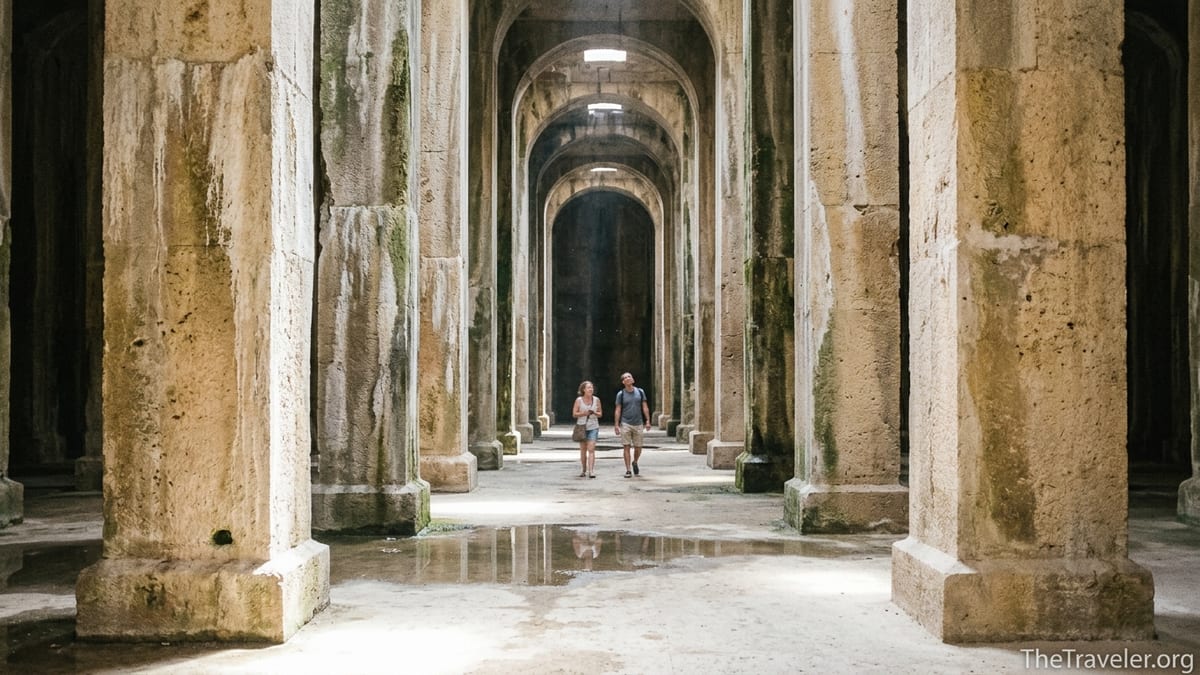
The first step down into Piscina Mirabilis is a step out of the familiar world. Sunlight thins, the air cools, and a damp mineral scent rises from the stone. A moment later, you are standing on the floor of one of the largest Roman water cisterns ever built, forty eight cruciform pillars marching into the distance like a submerged cathedral. It is here, in this silent underground forest of stone, that Roman engineering stops being an abstract marvel and becomes something intensely physical and close.
Get the latest updates straight to your inbox!
From Footnote to First Encounter
For many travelers, Roman engineering lives in fragments: a broken aqueduct beyond a highway, a diagram on a museum panel, a line in a guidebook about the genius of Roman water systems. Before visiting Piscina Mirabilis, I could have recited the basics. I knew that the Aqua Augusta, also called the Serino aqueduct, once fed the naval base at Misenum. I knew that Roman concrete was durable, that their networks were extensive. Yet all of this felt curiously distant, like reading about a great storm while sitting in a quiet room.
That distance collapses the moment you emerge at the entrance above Bacoli, about an hour’s local train and bus ride from central Naples. The opening is modest, hidden in a residential street behind low walls and washing lines, with the Tyrrhenian Sea a short walk away. There is no grand visitor center, no multimedia spectacle. Instead, a custodian’s table, a simple ticket, and a staircase descending into shadow. Entry prices in 2026 are modest, with a standard adult ticket around the cost of a coffee and pastry in central Naples, and a slightly higher fee if you opt for a guided visit in Italian or English.
On my visit, a handful of travelers clustered at the top of the stairs: a German couple still folding their bike helmets from a ride through the Campi Flegrei, an American family who had detoured from Pompeii, and two Neapolitans treating a visiting friend. All of us knew, in theory, that we were about to see a cistern. None of us quite expected to feel as if we were walking into the nave of a church sunk under the town.
The guide handed out hard hats, more for falling dust than any serious risk, and gestured to the stairway, cut into the volcanic tuff. “Se non soffrite di claustrofobia,” she smiled. If you are not claustrophobic. And then we began to descend.
Inside the “Water Cathedral”
The floor arrives sooner than your imagination expects, and with it a sudden expansion of space. Piscina Mirabilis is roughly seventy meters long, about twenty six meters wide, and plunges around twenty five meters from the roof terrace to the floor. The interior is divided into five long naves by twelve rows of massive cruciform pillars, forty eight in total. Your eyes take a few seconds to adjust, then the lines of stone clarify into a regular grid, receding into soft darkness. Many locals call it the Duomo dell’Acqua, the Water Cathedral, and the nickname feels precise rather than poetic.
What photographs flatten into symmetry becomes, in person, a textured, almost bodily experience. The pillars are not smooth marble but warm, porous tuff, coated in ancient waterproof mortar. You can trace your fingers over the roughness and feel the tiny fragments of stone pressed into the Roman concrete. Mineral streaks run like pale veins down the walls where water once condensed, and in places a fine green film of algae catches what little light filters in, a reminder that this was once filled with fresh water for thousands of sailors at Misenum.
Stand still for a moment and listen. When the guide speaks, her words swell and hang in the air, the acoustics long and resonant. Researchers have noted that unamplified speech here is strangely difficult, the reverberation too strong for clear conversation, yet it is perfect for slow explanations and the measured echo of footsteps. A dropped whisper becomes a private secret magnified by two thousand years of stone.
Near the center of the floor, the guide paused beside a rectangular depression, about a meter deep, carved into the central nave. This basin, once used to clean and empty the cistern, suddenly made maintenance a tangible act rather than an abstract “system.” You can picture workers wading through ankle deep water during scheduled cleanings, sediment rushing toward this sump, sluice gates opening, voices bouncing off the pillars as they shout instructions. Roman hydraulic management becomes a shift on a job site, not a line in a Latin inscription.
Roman Engineering, Felt Rather Than Told
It is only when you walk the length of Piscina Mirabilis that numbers like “over 12,000 cubic meters of water” begin to mean something. At one end, the guide points up to the vaulted ceiling, its surface still bearing the reddish tones of the original mortar. There, faintly, you can see outlets where water once arrived from the aqueduct. The Aqua Augusta captured mountain springs inland and carried water more than 90 kilometers, through tunnels and bridges, to end in this cavernous tank above the harbor at Misenum.
Many Roman sites present you with fragments: a surviving arch of an aqueduct, a broken channel, a dry fountain. Here, the system feels intact. You are standing at the terminal of a network that once fed bathhouses, fountains, and the kitchens of the Roman fleet. A visitor from nearby Pozzuoli mentioned seeing fragments of the same aqueduct arches in the countryside only a day earlier. To walk from those ruins into this wholly preserved cistern is like stepping from a sketch of a machine into its full scale engine room.
For travelers used to the polished narrative of Rome’s great monuments, the bare functionality of Piscina Mirabilis is disarming. There are no statues, no mosaic floors, no imperial busts. The decoration is the engineering itself: the way the barrel vaults press weight down into the pillars, the way the cross shaped supports maximize strength while keeping the interior navigable, the way the tank is cut into stable volcanic tuff to reduce the risk of collapse. Everything here serves a purpose, from the thickness of the waterproof lining to the small air shafts that once helped control temperature and evaporation.
Modern comparisons creep inevitably into your thoughts. Five Olympic size swimming pools, a guide notes, approximates the capacity of the tank when full. For anyone who has watched a contemporary city panic during a water outage, it becomes startlingly clear how ambitious it was to keep a naval base supplied through a single cistern and a sinuous mountain aqueduct. You begin to imagine the constant calculations: rainfall, consumption, cleaning cycles, emergencies. Roman engineering reveals itself as a daily act of risk management, not merely a burst of ancient genius.
Seeing Bacoli and the Bay Through Roman Eyes
Stepping back outside into the glare of southern Campania, the present day town of Bacoli feels quietly layered. Street level life carries on with scooters, kids walking home from school, a bakery selling sfogliatelle still warm from the oven. It is a modest place compared to nearby Naples, yet once this headland was a strategic node in the Roman world, anchored by the massive fleet base of Misenum and villas that cascaded down terraces toward the sea.
From the cistern, it is a short stroll through residential lanes to reach viewpoints over the modern marina and Lago Miseno, the circular lagoon that served as part of the ancient harbor. Looking back up toward the hill where Piscina Mirabilis is hidden, you gain a better sense of why Roman engineers put it here. Elevated above the harbor yet close enough for gravity, the tank could feed ships and shoreline installations through a spiderweb of smaller pipes. In the same way that a contemporary water tower stores and pressurizes water for a neighborhood, this cistern did the same for an imperial navy.
Travelers often combine a visit here with other sites in the Campi Flegrei, such as the submerged ruins of Baia, reachable by small glass bottom boats that drift over drowned villas, or the amphitheater at Pozzuoli with its labyrinth of service tunnels. Compared to the crowds at Pompeii or Herculaneum, the numbers at Piscina Mirabilis remain small. On a Friday in shoulder season, you may share the space with only a dozen people. This quieter context makes it easier to imagine the logistics of moving water, supplies, and people across the bay two millennia ago.
Practical planning reinforces how intimately modern life still depends on the same basic considerations. In summer, regional trains from Naples to Fusaro or Baia can be busy with commuters and beachgoers, so buying your ticket in advance at a station kiosk, rather than trying to navigate onboard machines, saves time. Local buses between the train station and Bacoli run on variable schedules, and drivers expect passengers to flag them down from marked stops. Setting out in the morning, with a return timed for late afternoon, gives you enough flexibility to explore both Piscina Mirabilis and the waterfront without rushing.
What It Feels Like to Walk the Grid of Pillars
Returning inside the cistern, the most striking part of the experience is simply walking. The floor is uneven in places, with shallow puddles after rain and patches of fine sediment that cling to your shoes. Light pours in from the stair opening and a few skylights, then fades quickly, leaving some corners in a diluted half darkness. Your eyes develop a new sensitivity to gradients of shadow, to the way pillars appear and disappear as you move, like trees in a foggy forest.
Every few steps, your perspective shifts. Look along the length of a nave and the pillars line up in a disciplined procession. Look diagonally and the grid dissolves into a complex weave of crosses and arches. This is the sort of space that architectural students sketch obsessively; for travelers, it is a rare chance to inhabit the three dimensional logic of Roman design without distraction. Unlike a forum or a busy basilica, there are no stray walls or later additions here. It is all of a piece, preserved because it spent most of its life out of sight and out of the way.
Sensory details accumulate. The air is cooler than outside, sometimes by several degrees, and holds a constant, damp freshness. The smell is clean stone, touched with earth and a faint suggestion of moss. Sound behaves unpredictably. A coin dropped on the floor rings longer than you expect. Footsteps from another visitor echo around a corner before you see them. Photographers experiment with this, capturing people silhouetted against the brighter end of a nave or reflected in a film of water on the floor.
At one point, the guide turned off her torch and let the group stand in near darkness. A thin shaft of daylight from a shaft above sliced down onto one pillar, its edges feathered by centuries of erosion. In that moment, the technical choices of Roman builders became emotional ones. The size of the tank, the height of the vaults, the rhythm of the supports, all combined to produce a feeling that is part awe, part unease. You understand that engineering is not just about solving problems but shaping how people inhabit space.
Planning Your Visit: Times, Tickets, and Local Realities
Because Piscina Mirabilis is still managed as an archaeological site rather than a mass tourism attraction, visiting requires a little more forethought than simply turning up with a city pass. In recent seasons, opening days have typically clustered around the middle of the week and weekends, often from late morning into mid afternoon, with slightly longer hours in the warmer months. Schedules can shift due to conservation work or local events, so it is wise to check information from local tourism offices in Bacoli or the regional cultural authorities shortly before you travel.
Ticket prices remain accessible. A standalone adult entry is usually only a handful of euros, with reduced prices for young people, and combined tickets that include nearby sites in Bacoli offered at a small discount compared to buying separate entries. Some packages, sold through regional platforms or at visitor desks in the Campi Flegrei, bundle Piscina Mirabilis with other highlights like the so called Cento Camerelle tunnels or the archaeological park of Baia. These combinations are popular with Italian school groups and small private tours, so if you are visiting during spring weekends or Italian holidays, booking a timed slot is prudent.
Guided tours, offered in Italian and often in English, add only a small supplement to the basic ticket price and are worth considering. Time slots commonly fall late morning and mid afternoon, and group sizes are kept modest. Visitors with limited mobility should be aware that the main access involves a substantial staircase without lift alternatives, and the damp floor can be slippery. Handrails help, but this is not yet a fully barrier free site. Wearing shoes with good grip and carrying a light jacket, even on hot days, makes the visit more comfortable.
Photography is generally allowed for personal use, although tripods or elaborate equipment may require advance permission. The combination of dim interiors and dramatic shafts of light rewards cameras with good low light performance, but even modern smartphones handle the scene surprisingly well if you brace against a pillar. Respect the site’s fragility by not touching walls more than necessary and avoiding any attempt to climb on structures. The very fact that the cistern feels so intact is a reminder of how easily careless behavior could damage it.
Connecting Piscina Mirabilis to Other Subterranean Worlds
Walking through Piscina Mirabilis changes the way you experience other underground sites across Italy. Later, descending beneath the streets of Naples into its network of ancient quarries and cisterns, you start to recognize the same logic behind different layouts: the use of soft volcanic stone, the desire to stabilize temperatures, the constant concern with water quality and storage. The elegant, almost monumental regularity of Bacoli’s cistern stands in contrast to the more labyrinthine reservoirs under Naples, yet both express the same Roman confidence in reshaping the subsoil to serve urban life.
Further afield, in Rome, a visit to Vicus Caprarius, a compact underground museum a short walk from the Trevi Fountain, offers another lens on water management. There you see smaller reservoirs and channels tucked beneath an insula, reinforcing just how densely woven water infrastructure was into daily life. After Piscina Mirabilis, these fragments feel less isolated. You can mentally plug them into a larger system whose terminus you have already walked through, far from the capital but entirely connected to its engineering culture.
Even surface sites begin to look different. Aqueduct arches striding across a valley near Pompeii, or the remnants of channels carved into rock on Capri, become not just scenic backdrops but links in a chain of supply. Having stood inside a terminal cistern of the imperial navy, you may find yourself asking new questions: Where was this water going? Who maintained it? How often did they clean the channels? That mental shift, from ruins as isolated marvels to components of a working system, is one of the most valuable souvenirs a visit to Piscina Mirabilis can give you.
Travelers with more time often build an itinerary around this theme, using Bacoli as a base for a few days. Modest guesthouses and small seaside hotels in town remain more affordable than central Naples in peak months, and evening strolls along the waterfront, with views back toward the headland that hides the cistern, help anchor the day’s historical impressions in the rhythms of contemporary life.
The Takeaway
On paper, Piscina Mirabilis is a superlative: one of the largest Roman cisterns in Italy, a technical masterpiece of the Augustan age, a key node in the Aqua Augusta system. In person, it becomes something more intimate. Walking its naves, you begin to feel Roman engineering not as a series of abstract achievements, but as a set of decisions carved into stone: how wide to make a nave, how thick to lay the waterproof mortar, how deep to cut the cleaning basin. The past shifts from concept to contact.
For travelers willing to venture a little beyond Naples and the big name ruins, a visit here offers an unusually complete encounter with the infrastructure that made Roman life possible. You leave with damp soles, a phone full of moody photographs, and a sharpened sense of how water, power, and daily routine intertwined along this volcanic coast. Most of all, you leave with the memory of that first moment on the cistern floor, looking up at rows of pillars vanishing into gloom, realizing that you are standing inside the beating heart of an ancient machine.
FAQ
Q1. Where exactly is Piscina Mirabilis and how do I get there from Naples?
Piscina Mirabilis is in Bacoli, on the Campi Flegrei coastline northwest of Naples. Most visitors take a regional train from Naples to stations like Fusaro or Baia, then continue by local bus or taxi for the final few kilometers uphill to the cistern’s residential neighborhood.
Q2. Do I need to book my visit in advance?
Advance booking is strongly recommended, especially in spring and autumn weekends or around Italian holidays. Visitor numbers are managed to protect the site, and reserving a time slot through local tourism channels or regional cultural authorities helps avoid disappointment if you arrive on a day with limited access.
Q3. What are the usual opening days and hours?
In recent seasons the cistern has typically opened several days per week, often around midweek and weekends, with hours concentrated from late morning to mid or late afternoon. Times can change for maintenance or events, so always check the latest schedule shortly before you travel rather than relying on older guidebooks.
Q4. How much does it cost to visit Piscina Mirabilis?
Standard adult tickets are generally very affordable, roughly the price of a simple café meal in Naples, with reduced rates for young visitors and occasional combined tickets that include other Bacoli sites at a small discount. Guided tours in Italian or English add only a modest supplement to the base price.
Q5. Is Piscina Mirabilis suitable for visitors with limited mobility?
Access involves descending and later climbing a substantial staircase, and there is no elevator. Inside, the floor can be damp and uneven. Visitors with serious mobility challenges may find the visit difficult, while those who can manage stairs with care and a handrail usually cope well with suitable footwear and patience.
Q6. How long should I plan to spend inside the cistern?
Most visitors spend about 45 to 60 minutes inside. Guided tours often last around an hour, giving time for explanations, pauses for photographs, and a slow walk along several of the naves. If you are particularly interested in architecture or photography, allow a little longer to explore different viewpoints.
Q7. What should I wear and bring with me?
Wear comfortable shoes with good grip, as the stone steps and floor can be slick. Even in summer the temperature inside is noticeably cooler, so a light layer is helpful. A small flashlight or a phone with a good torch function can enrich the experience, although basic lighting is provided.
Q8. Can I combine Piscina Mirabilis with other nearby sites in one day?
Yes. Many travelers pair the cistern with a visit to the archaeological park of Baia, the lakefront at Miseno, or other remains around Bacoli and Pozzuoli. With an early start from Naples, you can comfortably visit Piscina Mirabilis and at least one additional site, returning to the city by early evening.
Q9. Is the visit suitable for children?
The cistern can be fascinating for older children and teenagers who enjoy atmospheric spaces and stories about Romans and engineering. Younger children may find the dim light and echoes unsettling, and close supervision is essential on the stairs and around any damp patches on the floor.
Q10. Why visit Piscina Mirabilis if I have already seen Pompeii and other big sites?
While Pompeii shows how Romans lived on the surface, Piscina Mirabilis reveals the hidden infrastructure that kept that world running. Standing inside this vast cistern, you experience Roman engineering from the inside out, gaining a more complete understanding of how water, logistics, and power underpinned everyday life along the Bay of Naples.