


Ask most visitors what they know about Fuorigrotta and you will hear the same names on repeat: the Diego Armando Maradona Stadium, Edenlandia, the zoo, the tunnels to Pozzuoli. Yet this western suburb of Naples, reshaped in the 1930s and fringed by the volcanic landscape of the Campi Flegrei, hides a surprising concentration of calm corners, rationalist architecture, and lived-in neighborhood life that rarely appears in guidebooks. If you are ready to step away from the historic center for half a day, Fuorigrotta offers a side of Naples that is local, spacious and quietly fascinating.
Get the latest updates straight to your inbox!
The Real Face of Fuorigrotta Beyond the Stadium
Fuorigrotta is often treated as a place to pass through. Local trains on the Cumana and Circumflegrea lines rattle in from Montesanto, crowds pour out at Campi Flegrei station, and football fans disappear toward the Diego Armando Maradona Stadium. For many travelers, the neighborhood is just a transport knot, but spend a few hours here and you will find a slice of everyday Naples that is easier to navigate than the centro storico and far less touristed.
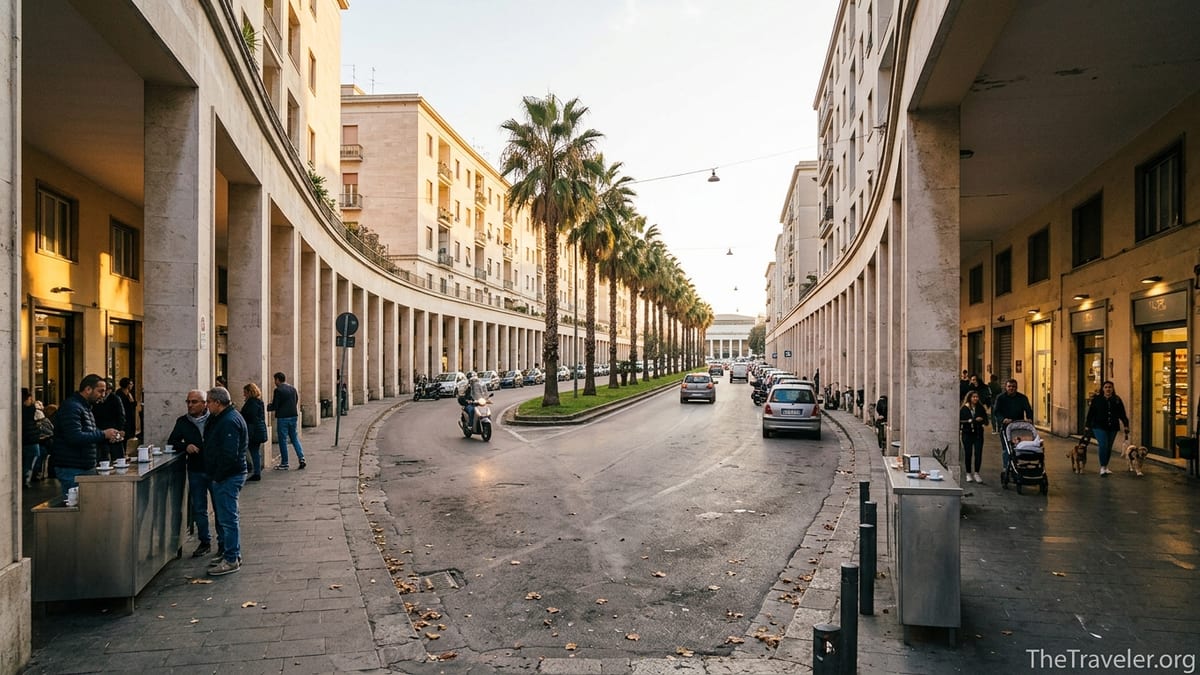
The area grew rapidly in the Fascist era, when wide boulevards such as Viale Augusto replaced old rural settlements and the huge exhibition complex of the Mostra d’Oltremare was carved out between the hills and the sea. Today, that history survives in long rationalist facades, deep porticoes and monumental fountains, softened by palms, pine trees and the smell of coffee drifting from ground floor bars. It is a working neighborhood, with university faculties, residential blocks and small family-run businesses, but that is exactly what makes it compelling.
Because so many visitors skip Fuorigrotta, prices tend to be more local than in the city center. A morning cappuccino at the bar near Piazzale Tecchio might cost around 1.30 to 1.50 euros, and a slice of hot pizza al taglio on Via Giacomo Leopardi often comes in under 3 euros. Trattorias on side streets serve generous plates of pasta and seafood for roughly 10 to 15 euros, without the multilingual menus and surcharge traps that can appear around the old town.
Fuorigrotta also makes logistical sense. It is on direct metro and suburban rail lines from central Naples, and from here buses and trains fan out toward the thermal area of Agnano, the crater lakes of the Campi Flegrei and the coastal district of Bagnoli. Base yourself in the center, but plan one slow half day out here to experience how Naples breathes when it is not performing for visitors.
Mostra d’Oltremare: A Silent City of Rationalist Architecture
The name Mostra d’Oltremare usually appears in events listings rather than in travel features, described as one of the country’s major fairgrounds with exhibition halls, conference spaces and a large outdoor arena. Step past the ticket booths on a quiet weekday, however, and it reveals itself as a strange, almost dreamlike city of rationalist architecture and greenery that most tourists never see.
The complex stretches across a vast area laid out in the late 1930s, with straight avenues, geometric gardens and white and cream pavilions made of stone, glass and steel. Many facades are pure Italian rationalism: clean lines, minimal decoration and a kind of solemn grandeur. In between them, rows of tall palms, clipped hedges and lawns create unexpected shade. Entry policies vary depending on events, but on days when the park is open you can often wander sections of the grounds for a small fee that is usually just a few euros, a fraction of what you would pay for many other attractions in Italy.
One of the pleasures here is how empty it can feel. While visitors throng the cloisters of Santa Chiara in the old town, you may find yourself almost alone under massive porticoes, walking across stone plazas or pausing on steps that were designed for crowds. Look up at the reliefs, still bearing traces of the propaganda language of the era, and then down at the cracked paving stones and moss between them. It is a reminder that Naples carries many layers of history beyond its baroque churches and Spanish-era palaces.
From the main entrance near Piazzale Tecchio, follow the tree-lined avenues into the heart of the complex. Side paths slip behind pavilions toward quieter corners where workers eat packed lunches and local joggers loop around in the late afternoon. The sense of scale is impressive: you could easily spend an hour just walking the main axes, stopping for a coffee or cold drink at one of the kiosks that open during trade fairs and public events.
Fontana dell’Esedra and the Hidden Lake of Fasilides
At the center of the Mostra d’Oltremare lies a feature that would be world famous if it were in almost any other European city. The Fontana dell’Esedra, completed in 1940, is the largest fountain in Naples, a sweeping semicircle of cascading basins stepping down a gentle slope with water jets that can shoot many meters into the air. In the evening, when the fountain operates as part of a light and music show on selected dates, the water is choreographed to soundtracks ranging from classical to contemporary, with tickets often costing around 1 or 2 euros for local residents and visitors.
Visit in the daytime and you may find this monumental work almost to yourself. Stone balustrades curve around the basins, and from the top terrace you get a broad view of the whole composition framed by palms and fair pavilions. The steps are wide enough to sit on, and many local families treat them as bleachers during events, but on a quiet day you can linger, listening mostly to running water and distant traffic from the tunnels.
Just beyond the main fountain, tucked deeper into the park, is an even more unexpected sight: the Laghetto di Fasilides. This small lake with its stone structures and arched bridge is a stylized reconstruction of an Ethiopian royal complex, complete with crenellated walls and towers reflected in still green water. When there are no private events, visitors can walk around the perimeter, watching ducks and turtles and peering through the gaps in the brickwork. It feels a world away from Naples, yet the faint smell of the sea and the shouts of teenagers on nearby sports fields anchor you back in the city.
These two water features are not heavily advertised to tourists, so there is little in the way of signage in other languages. You may need to ask a guard or a local where to find them, and opening days can change with the event calendar. Allow flexibility in your schedule and treat the visit as a discovery rather than a guaranteed checklist stop. When everything aligns, the reward is a tranquil pocket of 20th-century landscape design and a rare chance to sit by the water without the crowds that cluster around the lungomare.
Everyday Life on Viale Augusto and Via Leopardi
Step outside the gates of Mostra d’Oltremare and the wide curve of Viale Augusto gives you one of the clearest impressions of how Fuorigrotta was reshaped in the 20th century. This long arterial road, divided by a central strip of greenery and palms, is lined with tall residential blocks and commercial ground floors. Under the porticoes you will find hardware stores, tiny fashion boutiques, greengrocers with crates spilling onto the pavement and classic Neapolitan bars serving endless coffees to regulars.
This is an excellent place to experience the rhythms of an ordinary weekday. In the morning, pensioners stand at the counter nursing cornetti and espresso, while students from the nearby engineering faculty stream past with backpacks and plastic cups of sugary coffee. By late afternoon, parents push strollers along the shaded side of the street, stopping to chat outside bakeries that sell warm pane cafone and taralli still glistening with oil. Prices are written by hand on paper signs, and the occasional supermarket promotion hints at how much less you pay here than in Chiaia or the historic center.
Continue on to Via Giacomo Leopardi, a slightly narrower and more chaotic artery that runs roughly parallel. Here you will feel the density of Fuorigrotta: balconies heavy with laundry, scooters weaving between buses, kiosks selling lottery tickets and packets of chewing gum. Seek out a neighborhood bakery or rosticceria displaying trays of pasta al forno, crocchè and frittatine di pasta in the window. A filling takeaway lunch from one of these counters often costs under 6 to 8 euros, and you can eat it standing at a high table while watching the flow of local life.
In the evenings, simple trattorias around the intersections with side streets begin to fill. Some specialize in seafood from the nearby coast, offering spaghetti alle vongole or fried anchovies at prices that are still moderate by Naples standards. Others focus on pizza, always a safe bet in this city. The atmosphere is informal, often with televisions showing football highlights and conversations spilling between tables. You are a guest in a local dining room rather than in a polished tourist venue, which is part of the charm.
From Fuorigrotta to the Thermal Landscape of Agnano
One of Fuorigrotta’s great advantages is how close it sits to the volcanic basin of Agnano, a wide crater that today hosts a mix of racetrack, thermal facilities and patches of countryside. Buses and local trains roll out from the neighborhood toward this hinterland, and within fifteen to twenty minutes you move from rationalist boulevards to a landscape shaped by fumaroles, hot springs and low hills.
Agnano has a long history as a thermal area, with ancient Roman remains scattered around the basin and modern spa establishments drawing on mineral-rich waters. Some facilities focus on medical treatments, while others offer more straightforward wellness experiences with pools, mud therapies and massages. Prices vary, but partial-day access to pools and basic spa services can often be found in the range of 20 to 40 euros, less than in many better-known Italian spa towns.
Although Agnano itself is formally a separate zone, the easiest way to approach it as a visitor is from Fuorigrotta. Start your day with coffee on Viale Augusto, then take a bus or train up toward the crater, watching the urban fabric thin out into patches of green. Plan ahead, as opening days and times for thermal facilities can shift seasonally and some may require advance reservations, particularly on weekends.
Even if you are not interested in spa treatments, the Agnano area gives you a feel for the broader Campi Flegrei landscape. From certain vantage points you can look back toward Fuorigrotta and imagine how the entire area, from the crater rim down to the sea, is perched on restless volcanic ground. It is a very different experience from the crowded seafront promenades, and one that deepens your sense of the geography that shapes Naples.
Student Energy and Street Corners Near the University
Fuorigrotta is also an important university district. Several faculties of the University of Naples are based here, particularly in engineering and sciences, and their presence gives pockets of the neighborhood a youthful feel that contrasts with the more traditional streets closer to the center. Around the Monte Sant’Angelo campus and along the streets that feed into it you will find photocopy shops, low-cost pizzerias, kebab counters and tiny bars that stay open later than the average neighborhood cafe.
For visitors, this student presence adds another layer of interest. Cheap fixed-price lunch menus appear on blackboards outside trattorias, usually offering a first course, second course and a side dish for around 12 to 15 euros. Coffee bars advertise discounts on cornetti and espresso before morning lectures. Small stationery stores sell technical drawing tools and reams of paper, while secondhand bookshops cater to those chasing last semester’s manuals.
If you walk these streets in the late afternoon, you will see small groups of students sitting on low walls or leaning on parked scooters, drinking plastic cups of aperitivo spritz or beer bought from the bar next door. Music leaks from open windows and the murmur of conversation is mostly in Italian, with occasional bursts of other languages from Erasmus and international students. For a traveler, it is a chance to blend briefly into the background and observe a contemporary, everyday Naples far away from souvenir stands.
Because this part of Fuorigrotta is more about function than aesthetics, it rarely appears in travel photography. Yet if you appreciate cities as living organisms, not just as collections of monuments, it is worth an hour of your time. Bring cash, as some of the smallest bars and copy shops still prefer it to cards, and dress casually so that you feel at ease among the crowds of students in jeans and sneakers.
The Takeaway
Fuorigrotta will probably never rival the historic center in terms of headline sights, and that is precisely why it rewards the curious traveler. In a single compact area you can walk through a rationalist exhibition city, sit beside a monumental fountain and a reconstructed Ethiopian lake, trace the everyday rhythms of Neapolitan life along Viale Augusto and Via Leopardi, and set out toward the thermal basin of Agnano. All of this unfolds at local pace, with few tour groups and modest prices.
To make the most of Fuorigrotta, plan your visit around its natural anchors. Check when sections of the Mostra d’Oltremare park are open to the public, aim to catch a Fontana dell’Esedra water and light show if one is scheduled, and leave enough time to simply drift between bars, bakeries and small shops. Use it as a half-day counterpoint to the intensity of Spaccanapoli or the crowds on Via Toledo, a chance to reset your senses and see how Neapolitans live outside the postcard frame.
Above all, come with an open, observant attitude. The hidden gems here are not about spectacle alone. They are about discovering a fountain with almost no visitors, sharing a counter with office workers on their espresso break, or riding a tram toward the crater of Agnano as the sun drops behind the hills. Fuorigrotta will not shout for your attention, but if you listen closely, it tells an important part of Naples’ story.
FAQ
Q1. Is Fuorigrotta safe for visitors who are not familiar with Naples?
Fuorigrotta feels similar in safety to many other residential areas of Naples. Normal city precautions apply, such as keeping valuables secure, avoiding poorly lit backstreets at night and staying aware of traffic and scooters. During events near the stadium and exhibition grounds, there is usually a visible police presence and many local families on the streets.
Q2. How do I get to Fuorigrotta from central Naples without a car?
Fuorigrotta is well connected by public transport. You can reach it using the metro network or by taking the Cumana or Circumflegrea suburban trains from central stations toward the western districts. The journey typically takes 10 to 20 minutes depending on your starting point, and tickets are generally inexpensive compared with many other European cities.
Q3. Do I need a ticket to enter the Mostra d’Oltremare grounds?
Access to the Mostra d’Oltremare depends on the day and the events taking place. When large fairs or shows are running, parts of the complex may only be open to ticket holders. On other days, sections of the park and some outdoor areas can be accessed for a small fee or as a public park space. It is wise to check opening conditions locally shortly before your visit.
Q4. Can I see the Fontana dell’Esedra water and light show all year round?
The fountain itself is a permanent feature, but the choreographed water, light and music shows run on specific days rather than continuously. Schedules may change between seasons and from year to year, so you should not rely on them without checking locally. Even without the show, the fountain is still an impressive monument to visit during daylight hours.
Q5. Is Fuorigrotta a good area to stay overnight, or just for a day visit?
Most travelers choose to stay closer to the historic center, but Fuorigrotta can work as a base if you prefer a quieter, more residential environment and plan to explore the western districts and Campi Flegrei. Accommodation options are more limited and often simpler than in central Naples, but prices can be lower. For a first visit focused on classic sights, Fuorigrotta usually works best as a half-day trip.
Q6. Are there good food options in Fuorigrotta for travelers on a budget?
Yes, Fuorigrotta is an excellent neighborhood for affordable eating. Bars, bakeries, rosticcerie and student-friendly pizzerias offer filling meals at prices often below those in the more touristed areas. You can expect to find espresso at typical Neapolitan prices and generous portions of pizza, pasta or fried snacks that fit easily within a modest daily food budget.
Q7. What should I wear when exploring Fuorigrotta and the Agnano area?
Comfortable, casual clothing is ideal. Streets in Fuorigrotta are mostly paved, but you will likely walk a lot, so supportive shoes or sneakers are important. If you plan to visit thermal facilities in the Agnano basin, bring swimwear, flip-flops and a light towel, and consider a change of clothes if you will be returning to the city center afterward.
Q8. Is Fuorigrotta suitable for families with children?
Fuorigrotta can work well for families. Wide pavements, parks and nearby recreational areas such as amusement facilities and open green spaces make it easier to move around with strollers. Many local eateries are family friendly and used to serving children. As always, keep an eye on traffic and scooters when crossing streets, and consider scheduling your visit outside major football match times if your children are sensitive to crowds.
Q9. How much time should I plan to explore Fuorigrotta’s hidden gems?
A half day is usually enough to get a good feel for the neighborhood. This allows time to walk through parts of Mostra d’Oltremare, visit the Fontana dell’Esedra and Laghetto di Fasilides if accessible, stroll along Viale Augusto and Via Leopardi, and pause for a meal or coffee. If you add a visit to thermal facilities in Agnano, plan on a full day to avoid feeling rushed.
Q10. Do I need to speak Italian to enjoy Fuorigrotta, or is English widely understood?
Basic English is understood in some hotels, larger cafes and by younger residents, especially students, but Italian is the primary language in Fuorigrotta. Learning a few simple phrases for ordering food, buying tickets and asking directions will make interactions smoother. Most locals are patient and friendly if you make a small effort, and gestures and smiles go a long way when words are limited.