


Nice’s Carré d’Or is usually summed up in a single image: glossy boutiques between the Promenade des Anglais and boulevard Victor Hugo, packed with shoppers on a sunny afternoon. Yet behind the flagship stores and busy café terraces, this compact grid hides a surprisingly local side. Slip one street back from the crowds and you find family‑run restaurants, tiny bars, secret courtyards and craftspeople who still know their regulars by name. This guide traces that quieter layer of the Carré d’Or and shows you the places most visitors walk right past.
Get the latest updates straight to your inbox!
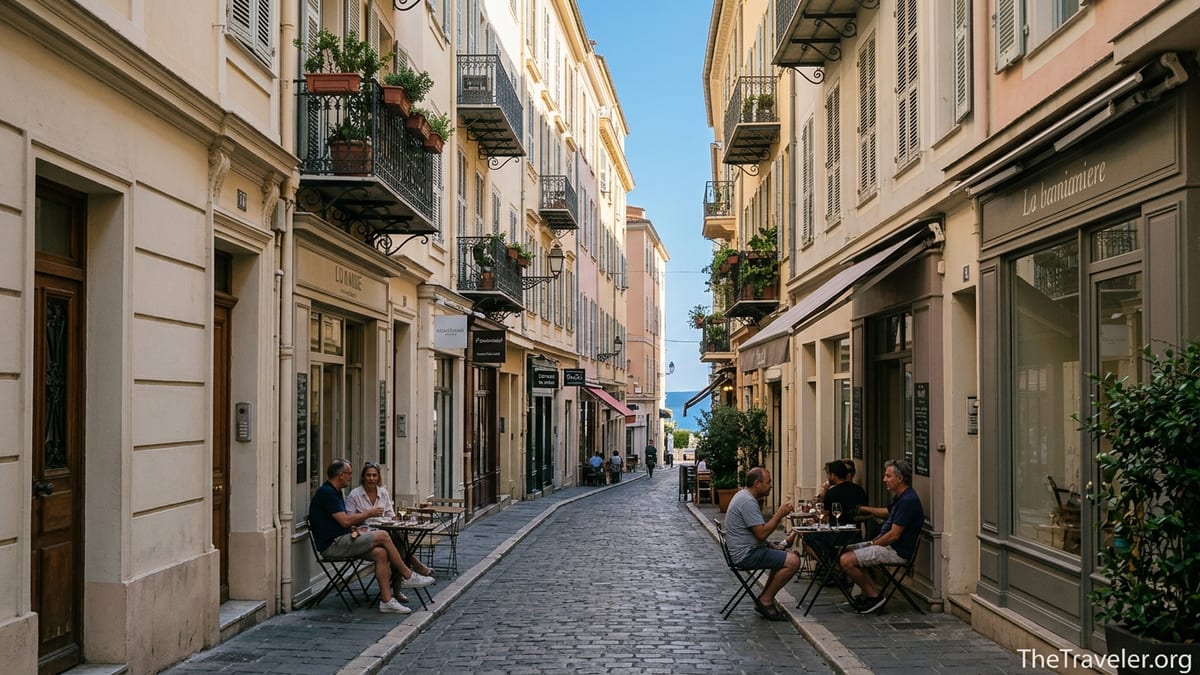
Understanding the Real Carré d’Or
The Carré d’Or is not just a vague upscale label. It is a clearly defined rectangle framed by boulevard Victor Hugo to the north, the Promenade des Anglais to the south, boulevard Gambetta to the west and avenue Jean Médecin to the east. Within that grid sit some of Nice’s grandest Belle Époque façades and a dense mix of shops, offices and apartments. It is one of the city’s wealthiest districts, but also one where everyday life plays out on side streets only a minute from heavy foot traffic.
Most visitors experience just a few axes: rue Masséna, the main pedestrian shopping street; rue de France, which runs roughly parallel and is lined with brasseries and souvenir stands; and the seafront on the Promenade. These arteries can feel almost theme‑park busy in peak season. Yet if you step just one block north or inland, especially around streets like rue de la Buffa, rue Maréchal Joffre and rue de la Liberté, the atmosphere changes. You start to see schools emptying out, neighbours greeting each other at the bakery and diners who clearly are not on a tight sightseeing schedule.
The trick to uncovering hidden gems here is to think like a resident rather than a shopper. Look for lunch menus written inside on chalkboards instead of laminated photo menus outside, ignore the most aggressive terrace touts and focus on spots with a mix of ages and languages at the tables. In the Carré d’Or, that usually means ducking off the postcard‑pretty promenades and onto quieter cross streets.
Rue de la Buffa: Everyday Life in Miniature
Rue de la Buffa is one of the Carré d’Or’s most revealing streets. Cutting across the neighbourhood parallel to the sea, it looks ordinary at first glance: eight or so blocks of apartment buildings with ground‑floor shops. Many tourists walk it only to reach their hotel. Yet locals know it as a small culinary world, where you can eat Caucasian dumplings for lunch, pick up Vietnamese skewers for dinner and find Lebanese mezze a few doors down.
At number 65, Waynakh serves hearty Caucasian and Turkish‑influenced cooking in a setting far more modest than the food deserves. The open kitchen turns out manty dumplings, plov rice and grilled meats in generous portions, at prices that are often lower than comparable tourist‑zone restaurants closer to the sea. It is popular with local families and workers from nearby offices, which keeps the atmosphere grounded even when the district is busy in summer.
A short walk away at number 18, Deli Roll has quietly built a following for Vietnamese bun cha and grilled skewers. The restaurant is small, tables sit close together and there is no glossy street‑side marketing, just a straightforward sign and the smell of grilling meat around lunchtime and in the evening. Portions tend to be satisfying rather than showy, and you will often hear French, Vietnamese and English at the tables, a sign that it draws both residents and visitors who have strayed a little off the obvious circuit.
Further along the same street, small Lebanese addresses such as From Beyrouth With Love round out the picture, offering home‑style mezze and slow‑cooked dishes rather than fusion small plates. None of these places shout for attention; they live on word of mouth and repeat business. If you are staying in an apartment nearby, this is also a convenient street for practical needs: greengrocers, pharmacies, bakeries and small supermarkets sit side by side with dining rooms, making it an easy place to assemble a picnic or a simple dinner at home.
Quiet Terraces and Rooftops Above the Rush
Given the Carré d’Or’s density and traffic, escaping to a higher vantage point can be a relief. Many visitors know only the large hotel rooftops on the Promenade, where sunset cocktails often come with premium prices and large groups. Yet there are more intimate options sprinkled through the district that are easy to miss if you stay at ground level.
On the eastern edge of the Carré d’Or, the historic Anantara Plaza hotel hides one of the area’s most compelling views from its rooftop bar and restaurant. Six floors above Place Masséna, you can look out over the gardens, rooftops and the curve of the Baie des Anges. In the early evening, especially outside peak weekends, it is possible to find a quieter corner table for a glass of wine or a spritz without the crush that defines the seafront promenades below. Prices reflect the setting, but you are paying for space and perspective as much as for the drink.
In the heart of the Carré d’Or, a short walk from boulevard Victor Hugo, smaller wine and champagne bars with upper‑level terraces offer a different type of escape. Places such as La Cave de Bacchus focus on well‑chosen bottles from Provence and beyond, with a casual bar‑food menu. Rather than fighting for pavement space on rue Masséna, you can sit upstairs with a plate of charcuterie or olives and watch the sky turn pink over the tiled roofs.
These rooftops and upper‑floor terraces are not hiding in the sense of being secret, but they are easy to miss if you think only in terms of street‑level terraces. When you walk through the district, get into the habit of looking up: you will often spot a few tables on a set‑back balcony or a discreet sign pointing to a bar one floor above a shop. In the dense grid of the Carré d’Or, elevation is often the simplest form of calm.
From Glossy Brands to Independent Creators
The Carré d’Or is widely marketed as a shopping destination, and for good reason. Many big international brands anchor the main streets, and new chains continue to move in. Real‑estate agents and local business associations describe a constant flow of high‑street names opening on avenues like Jean Médecin and in the blocks closest to the Promenade. For many visitors, this is the only side of Carré d’Or retail they ever notice.
Yet between these flagships, the neighbourhood shelters a quieter ecosystem of small ateliers and independent boutiques. On side streets running between boulevard Victor Hugo and rue de France you will find one‑room jewellery studios, Italian and Scandinavian design shops, and small French fashion labels that produce in limited runs. Prices are usually higher than in chain stores, but the experience is different: you are often speaking directly to the person who designed or sourced the piece you are holding.
One way to find these places is to walk the grid without an agenda, zigzagging from Victor Hugo down towards the sea while avoiding the loudest commercial stretches. Look for hand‑written window signs, small displays of ceramics or textiles, and shops where there are more locals browsing than tourists taking photos. Stores specialising in regional products, natural cosmetics or French stationery can be particularly enjoyable if you are seeking gifts that will still feel special when you are back home.
Because rent in the Carré d’Or is high and competition tough, openings and closures are constant. That means printed guidebooks are often out of date. Rely on your eyes and on simple indicators of quality: well‑presented but not over‑themed interiors, staff who seem genuinely engaged and a clientele that includes residents running errands as well as visitors lingering over purchases.
Courtyards, Passages and Everyday Rituals
Beyond restaurants and shops, some of the Carré d’Or’s most overlooked charms lie in its micro‑spaces: courtyards, small squares and covered passages that sit just out of sight of the main flow. They are not formal sights with names and plaques. Instead, they are fragments of everyday Nice that you stumble across when cutting through a building or turning down a side alley.
Between boulevard Victor Hugo and rue de la Liberté, several mid‑rise Belle Époque buildings are built around interior courtyards. Many remain private, but in a few cases ground‑floor arcades or open gates offer a quick glimpse inside. You might pass a palm tree, a cluster of mailboxes and bicycles leaned against a stone wall, with washing lines strung between balconies above. Pausing for a moment here can give you a sense of how densely yet quietly people live at the heart of the district.
Small squares such as place Grimaldi, on the western side of the Carré d’Or, function like open‑air living rooms for local residents. They are ringed with cafés, bistros and small shops, but the mood is looser than on the big promenades. On a weekday morning you will see people lingering over coffee and a pastry, dogs lying under tables and children weaving between chairs. In the evening, it becomes a casual aperitif spot, with drinks prices slightly lower than the front‑row sea‑view terraces.
To appreciate these spaces, adopt the local rhythm. Start your day with a coffee at a corner bar that puts more effort into its espresso than its decor, ideally somewhere a block or two away from the busiest streets. Later, swing by again for a pre‑dinner glass of rosé or a small beer. Over a couple of days you will start to notice familiar faces: the same man reading his paper, the same group of colleagues chatting after work. In a neighbourhood built around tourism and commerce, these repeating scenes are the real hidden texture.
Eating Well Without Falling into Tourist Traps
The central position of the Carré d’Or means that many visitors end up eating here by default. Unfortunately, that also makes it fertile ground for restaurants designed more for turnover than for taste, particularly along rue Masséna and parts of rue de France. Menus translated into several languages with photos displayed on large street‑side boards, staff trying to steer you inside and all‑day “happy hour” offers are all signs that the focus may not be on food quality.
One simple strategy is to walk just two or three minutes away from the busiest stretches before choosing a table. Places like Rue de la Buffa, the small streets clustering around boulevard Victor Hugo or the lanes leading towards Place Grimaldi tend to cater more to residents and office workers. Lunch menus here are often better value, with dishes like grilled fish, steak frites or vegetarian plates priced more moderately than the sea‑view terraces, and portions aimed at satisfying rather than impressing for social media.
Look inside before you sit down. In the better local spots you are likely to see a compact menu that changes with the season, chalkboards listing a few daily specials and a mix of diners rather than an almost exclusively tourist crowd. A restaurant that is full of locals at 12.30 or 13.00 is usually a safer bet than one offering dinner at mid‑afternoon with large cocktails and picture menus.
Finally, do not neglect simple takeaway options. The Carré d’Or is scattered with bakeries, traiteurs and small supermarkets where you can put together an excellent picnic for the beach or a bench on boulevard Victor Hugo: a still‑warm baguette, local olives, a tub of tapenade, tomatoes and a piece of cheese. Eating like this once or twice not only saves money, it also lets you experience the neighbourhood in a more relaxed way than always sitting at a full‑service restaurant table.
Planning Your Time in the Carré d’Or
Because the Carré d’Or is so compact, it is tempting to treat it purely as a passageway between the old town, the beach and hilltop viewpoints. To uncover its hidden side, it helps to dedicate at least half a day to the neighbourhood itself, ideally at different times of day. Early morning, late afternoon and evening all show different faces.
Start in the morning with a walk along boulevard Victor Hugo, where light filters through the trees and the façades of Belle Époque apartment buildings are easiest to appreciate. Stop for a coffee and pastry at a café set back from the main intersections, then drift south on side streets towards rue de la Buffa for a late breakfast shop at a bakery or greengrocer. Resist the pull of the Promenade for a while and instead sit on a quiet bench to watch locals on their way to work.
In the afternoon, when the sun is high and the tourist streets grow crowded, escape upwards to a rooftop or upper‑floor bar for a drink and a different perspective. Later, circle back to streets like rue Maréchal Joffre or the blocks around place Grimaldi to choose a dinner spot. If you are staying several nights, mix things up: one evening in a classic brasserie, another at a small ethnic restaurant on Rue de la Buffa, perhaps a final sunset drink with a sea view.
Allow room for improvisation. Some of the most rewarding discoveries in the Carré d’Or are unplanned: a tiny wine bar you only notice because the doors are open and jazz is spilling out, or a pastry shop where the display stops you in your tracks. Plan the broad strokes, then leave gaps for whatever you stumble across while moving between them.
The Takeaway
The Carré d’Or’s reputation as a polished, high‑end district is not wrong, but it is incomplete. Beyond the flagship stores and busy terraces lies a lived‑in neighbourhood of modest apartment blocks, small restaurants, independent shops and everyday rituals that most visitors never see. The hidden gems here are not dramatic secrets so much as quieter alternatives running in parallel to the tourist circuit.
By stepping a street or two away from the main drags, looking up to find higher terraces and paying attention to where locals actually spend their time, you can turn what is often just a corridor between other attractions into a rewarding destination in its own right. The reward is a version of Nice that feels less staged: a glass of wine on a shaded square, a bowl of noodles on Rue de la Buffa, a glimpse into a courtyard where washing hangs between sun‑faded shutters.
If you treat the Carré d’Or not only as a place to shop but as a small city within the city, with its own rhythms and routines, you will leave with a richer sense of Nice as a whole. That, more than any single restaurant or bar, is the real hidden gem most visitors walk straight past.
FAQ
Q1. Where exactly is the Carré d’Or in Nice?
It is the central upscale district framed by boulevard Victor Hugo to the north, the Promenade des Anglais to the south, boulevard Gambetta to the west and avenue Jean Médecin to the east.
Q2. Is the Carré d’Or only about luxury shopping?
No. While there are many major brands, the area also includes independent boutiques, small food shops, local bars, schools and residential buildings where people live year‑round.
Q3. How can I avoid tourist trap restaurants in the Carré d’Or?
Walk a few minutes away from rue Masséna and the busiest parts of rue de France, look for simple chalkboard menus, and choose places with a mix of locals and visitors instead of aggressive touting on the street.
Q4. Are prices in the Carré d’Or much higher than elsewhere in Nice?
Sea‑view terraces and big‑name venues usually charge more, but side‑street cafés, ethnic restaurants on streets like rue de la Buffa and takeaway bakeries can be fairly priced, especially at lunchtime.
Q5. Is the Carré d’Or a good area to stay in?
Yes. It is central, close to the beach, well served by public transport and full of shops and restaurants, while quieter back streets offer a more residential feel than the old town.
Q6. What time of day is best for exploring the Carré d’Or’s hidden side?
Early morning and early evening are ideal. Streets are calmer, locals are out running errands or enjoying an aperitif, and you can appreciate the architecture and courtyards without heavy crowds.
Q7. Are there family‑friendly spots in the Carré d’Or?
Yes. Squares such as place Grimaldi and shaded stretches of boulevard Victor Hugo work well for families, and many local restaurants on side streets welcome children, especially at lunchtime.
Q8. Do I need reservations for smaller local restaurants?
For popular spots, especially on Rue de la Buffa and around place Grimaldi, it is wise to reserve for dinner in high season or weekends. At lunch, walk‑ins are often possible if you arrive early.
Q9. Can I explore the Carré d’Or entirely on foot?
Absolutely. The district is compact and flat, and walking is the best way to find courtyards, passages and small businesses that you would miss when passing through by tram or car.
Q10. Is the Carré d’Or safe to walk around at night?
Generally yes. It is a well‑lit, busy central district. Normal city precautions apply, but most visitors and residents feel comfortable walking between restaurants, bars and accommodations after dark.