


First-time visitors to Vatican City tend to follow the same route: queue, museums, Sistine Chapel, a quick glance at St. Peter’s Basilica, then back out into Rome’s traffic. Yet hidden behind the basilica’s vast stone shell lies a world that feels almost incompatible with the crowds outside. The Vatican Gardens occupy more than half of Vatican City’s tiny territory, but only a fraction of visitors ever step inside. Skipping them might mean missing the most serene, revealing experience the Vatican has to offer.
Get the latest updates straight to your inbox!
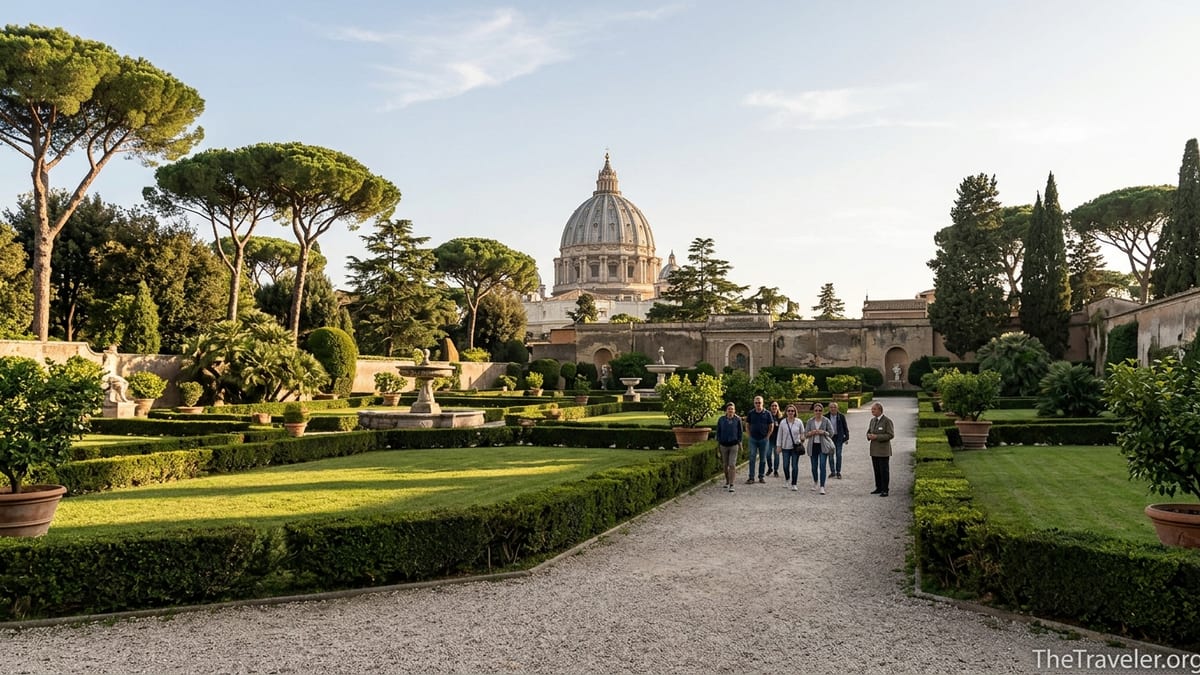
The Green Heart of the Smallest Country in the World
Behind the high walls that ring Vatican City stretches a landscape most visitors only glimpse as a smear of green from a museum window. The Vatican Gardens cover around 23 hectares, or roughly two thirds of the state’s surface, a patchwork of manicured Italian parterres, softer English-style lawns, and formal French-inspired avenues. This is the place where popes have walked, prayed and retreated from public life since the late 13th century, when Pope Nicholas III moved the papal residence to the Vatican and ordered the first enclosure planted.
Walk a few minutes inside the gardens and the city evaporates. The thrum of Roman traffic gives way to the hiss of sprinklers, the slap of sandals on gravel, the occasional toll of St. Peter’s bells. You might stand under a stone pine and watch a Vatican service vehicle glide past toward the Governor’s Palace, or hear the faint crackle of Vatican Radio, which broadcasts from studios tucked discreetly in the greenery. For all the spiritual and political weight concentrated in Vatican City, this is where the place feels most human and lived in.
The gardens are not a simple park. They hold working infrastructure for the micro-state: the papal heliport, the Governorate buildings, the little Vatican railway spur, even the modern headquarters of the Pontifical Academy of Sciences in the softly Baroque Casina Pio IV. Yet everything is softened by landscape: dense holm oaks, fountains splashing into travertine basins, rosaries of terracotta pots lining stairways. It is this mixture of power, devotion and ordinary maintenance, all softened by plants, that makes the gardens unlike any other green space in Rome.
There is also a deep layer of symbolism beneath the lawns. Pious tradition holds that soil from Jerusalem’s Golgotha was scattered here in antiquity, symbolically linking Christ’s crucifixion with the martyrs who died nearby in Nero’s circus. Whether or not that story is literally true matters less than the mindset it reflects. For centuries, popes and gardeners have treated this ground as a kind of open-air extension of the Vatican’s chapels, inscribing theology into topiary, shrines and winding paths.
What You Actually See on a Vatican Gardens Tour
Because they are not open for casual strolling, the Vatican Gardens remain a curated experience, but that structure works in the visitor’s favor. A standard ticket combines a guided or audio-guided tour of the gardens with timed entry to the Vatican Museums and the Sistine Chapel. Most tours last around 90 minutes and are offered in the morning, when the light is soft and temperatures, at least outside high summer, are more forgiving.
On a typical morning visit, you might start near the 19th-century Lourdes Grotto, a popular papal prayer spot tucked into rockwork and ivy. As your small group follows a guide or an audio narration, St. Peter’s immense dome shifts in and out of view, framed by cypresses or rising above the terracotta roofs of Vatican offices. A few steps later, you emerge into the Italian Garden, with geometrically clipped box hedges and gravel alleys that feel straight out of the Renaissance. The perspective lines pull your eye toward statues of saints, Marian shrines or coats of arms celebrating past pontiffs.
The route usually continues through softer, English-style sections, where winding paths and irregular tree clusters are punctuated by fountains and small pavilions. Somewhere along the way, many tours pause near the heliport, a surprisingly modest concrete circle surrounded by lawn, where the papal helicopter lands on trips to Castel Gandolfo or regional visits. Beyond it, broad sweeps of lawn lead up toward the Vatican Radio mast, a utilitarian structure that nonetheless becomes picturesque when glimpsed between palms and umbrella pines.
Guides often highlight details that casual eyes would miss. A statue commemorating the 1981 assassination attempt on John Paul II, for instance, turns a quiet corner into a powerful memorial. A bed of roses may have been a gift from a Latin American country, chosen to echo the colors of a national flag. Plaques and inscriptions in multiple languages testify to visits by world leaders and religious delegations whose trees now grow as living diplomatic souvenirs. The overall impression is not merely of beauty, but of a garden that records the Vatican’s global relationships in living wood and stone.
Why the Gardens Feel More Serene Than the Museums
Anyone who has shuffled shoulder to shoulder through the Gallery of Maps or craned upward in the Sistine Chapel during peak season knows that a Vatican visit can be exhausting. Visitor numbers to the museums regularly reach tens of thousands per day in busy months. By contrast, the Vatican Gardens strictly limit their capacity, admitting relatively small groups on fixed time slots. That controlled access keeps paths uncrowded and allows pockets of near silence that are almost impossible to find inside.
Part of the serenity is simple acoustics. High garden walls, dense vegetation and changes in elevation blunt the roar of Rome beyond. In spring, the loudest sounds you may hear are blackbirds singing from the pines and gardeners trimming shrubs with electric shears. Even in summer, when cicadas buzz and sprinklers whirr, the noise feels organic rather than mechanical. For visitors arriving from long-haul flights or back-to-back sightseeing, this natural soundscape can feel like a pressure valve releasing.
The pace is different too. Museum tours often move briskly to fit highlights into a few hours. In the gardens, the itinerary is looser, the stakes lower. No one is pressing you to decipher a Raphael fresco in three minutes. Guides might pause simply to let guests take in a view of the dome rising above hydrangea beds or to point out an unexpected cactus collection basking beside an old brick wall. That slower rhythm makes it easier to absorb not just what you are seeing, but how the place feels.
For many travelers, the gardens end up providing the spiritual atmosphere they had hoped to find elsewhere. A solo visitor from Chicago might step into a shaded avenue and realize this is the first time all week she has been able to sit quietly on a bench and reflect. A family with teenagers who were restless in the museums suddenly watch them relax, phones dangling at their sides as they photograph turtles in a fountain or the intricate bark on an ancient olive tree. The gardens allow Vatican City to be experienced not only as a repository of masterpieces, but as a functioning, breathing community.
How Much Does It Cost, and How to Book Smart
Visiting the Vatican Gardens is more expensive than a standard museum ticket, but the price includes more than many travelers realize. Recent ticketing information indicates that garden tours for individuals usually fall in the range of roughly 32 to 40 euros for adults, with reduced rates a bit lower for children and students. Those prices typically cover the guided or audio-guided visit plus regular admission to the Vatican Museums and the Sistine Chapel for the same day. Considering that a timed-entry museum ticket alone often costs in the low to mid twenties, the surcharge starts to look like reasonable value for a quieter, more expansive experience.
The catch is availability. Because capacity is capped, garden tour slots can sell out well before popular museum times, especially during spring and autumn when weather is ideal. Travelers who wait until arriving in Rome to book often discover that their preferred day, or even their whole travel window, is gone. Many find themselves scouring third-party sites that resell garden-inclusive packages at a hefty markup, sometimes above 80 or 90 euros per person, simply because standard museum tickets have sold out. Planning a month or two ahead, especially for trips between April and October, can prevent this last-minute scramble.
When booking, it helps to understand the ticket categories. A garden tour ticket is distinct from a normal museum entry or from a basic guided tour of the collections. If you want the gardens, you must choose a product explicitly labeled for Vatican Gardens access. That might be a walking tour with a Vatican-employed guide, a small group experience with live commentary, or a panoramic bus tour that loops through the grounds with headsets. Whichever option you pick, check the start time carefully. Garden visits are almost always scheduled in the morning, and you will visit the museums only after the garden portion concludes.
Travelers on tight itineraries often worry about overcommitting their day. In practice, a morning gardens tour followed by a self-paced afternoon in the museums makes for one long but coherent Vatican immersion. If you are combining the visit with the Colosseum or another major attraction on the same day, be realistic. Back-to-back blockbuster sites under the Roman sun can be more draining than most travelers expect. Many experienced visitors recommend dedicating one full day or at least a solid long half-day to Vatican City alone, keeping the gardens as the unhurried opening chapter.
Walking, Bus Tours, and Accessibility: Choosing the Right Format
Not every Vatican Gardens experience looks the same. The simplest distinction is between walking tours and open-bus tours, which are designed to accommodate visitors with mobility concerns or those who prefer not to walk long distances. A walking tour covers only a portion of the 23 hectares but allows time to linger along paths, stop for photos and appreciate details like inscriptions, plant labels and minor shrines. Expect some gentle slopes, gravel surfaces and occasional steps, but nothing resembling a strenuous hike for most reasonably fit visitors.
Open-bus tours follow a fixed loop, often starting from near the museums’ entrance and circling the core of the gardens on a small electric or diesel-powered vehicle. Audio guides in multiple languages provide commentary as the bus glides past major landmarks such as the heliport, the Casina Pio IV and the French-style terraces. These tours are particularly useful for older travelers, families with small children, or anyone visiting during the peak summer heat of July and August. While you lose the ability to wander, you gain shade, a breeze and the comfort of a seat.
The Vatican has also developed specific itineraries for visitors with disabilities, including tactile and multisensory experiences designed for people with visual impairments. On these specialized visits, guests may be invited to touch selected sculptures, architectural fragments or textured plants, with curated stops at viewpoints that provide rich audio descriptions of the surroundings. Information panels in large print and Braille, as well as accessible routes mapped in advance, make it possible for more travelers to experience the quiet side of Vatican City.
Whichever format you choose, pay attention to practicalities. Comfortable, closed shoes are advisable, especially on walking tours where gravel and uneven paving are common. Modest dress codes similar to those in the basilica apply: shoulders and knees should be covered, which means packing a light shawl or wearing longer shorts even on a hot day. Water bottles are permitted, and on hotter days many visitors are grateful for a refill at one of the discreetly placed fountains along the route.
How the Gardens Change Through the Seasons
The best time to visit the Vatican Gardens depends on what kind of experience you want. In spring, from roughly late March through May, the grounds feel freshest. Wisteria drapes pergolas in soft purple, roses unfurl along trellises, and lawns glow an almost unreal shade of green after the winter rains. Morning visits in April often start in cool, crisp air with long shadows, then warm into T-shirt weather by the time you emerge into the museums. For many gardeners and photographers, this is the optimal season, with enough color to enliven the views without the crowds and heat of summer.
Summer, roughly June through early September, brings more intense sun and larger tourist numbers in Rome overall, but the gardens still function as a kind of refuge. On scorching afternoons the stone courtyards and basilica square can feel brutal. Inside the gardens, even though temperatures are similar, the combination of shade, irrigation and plant transpiration softens the impact. Open-bus tours in particular benefit from the faint breeze created by movement. If you book in high summer, an early morning slot is worth seeking out, both for comfort and for the way soft light filters through umbrella pines and olive branches.
Autumn is arguably the most underrated time. From late September into November, days are often still mild while crowds thin. Deciduous trees in the English-style sections shift toward ochre and rust, while low sun angles give the dome and palace facades a burnished glow. Gardeners are busy with seasonal pruning and planting, so you may catch the scent of fresh earth or cut bay leaves on the air. Winter, by contrast, is quieter and visually more austere, but clear days offer extraordinary visibility. Without dense foliage, architectural lines stand out, and the sculptural silhouettes of pines and cypresses become even more pronounced against a pale sky.
The gardens’ maintenance regime increasingly reflects broader environmental concerns. In recent years, Vatican staff have shifted many lawns and planting beds to more organic care, reducing chemical inputs and experimenting with species that can withstand hotter, drier summers. For visitors this is mostly invisible, but you may notice wildflower patches left deliberately unmown or compost areas discreetly tucked behind hedges. These practical choices subtly align the Vatican’s private green world with the ecological messages that often echo from St. Peter’s balcony.
Planning Your Day: Fitting the Gardens into a Vatican Itinerary
Because garden access is only possible with a tour and is tied to specific time slots, it makes sense to plan your entire Vatican day around it. A common and effective pattern is to start with a 9:00 or 10:00 a.m. garden visit, emerging around late morning or midday. After a short break for coffee or a quick lunch just outside the museum complex, you re-enter for a self-paced exploration of the galleries, courtyards and Sistine Chapel. This sequence front-loads tranquility and outdoor time, leaving the denser, more mentally demanding art collections for later in the day.
Travelers who are particularly keen on St. Peter’s Basilica need to factor in its separate security line and opening hours. The basilica remains free to enter but requires airport-style screening at the square. If you want to climb the dome and also see the gardens, you have two realistic options. Either arrive very early, queue for the dome at opening time, descend around mid-morning and then head to your gardens slot, or reverse the order and plan the dome for late afternoon when queues tend to shorten. Attempting to squeeze dome, gardens, museums and an evening Colosseum visit into one day is technically possible but often leaves visitors frazzled rather than fulfilled.
Families and older travelers may find that the gardens serve as a gentle start that determines how much more they can comfortably absorb. One common scenario: a couple in their sixties walks the gardens in relative ease, but after an hour in the crowded museums they decide to skip certain wings and head straight to the Raphael Rooms and the Sistine Chapel. Because the gardens ticket grants full museum access, you are free to tailor the remainder of your day without feeling you must cover every room to justify the cost.
If your time in Rome is extremely limited, you might be tempted to drop the gardens in favor of a quick-hit visit that focuses only on the most famous interior highlights. Yet many repeat visitors argue the opposite. When you strip the Vatican experience to its essentials, it is the contrast between intense interior art and the quiet, almost monastic calm of the gardens that lingers. In that sense, the gardens are not an add-on at all, but the place where the Vatican reveals its inner rhythm.
The Takeaway
Skipping the Vatican Gardens means missing more than pretty lawns. It means forgoing the one part of Vatican City where the state’s religious, political and human dimensions come together in a space that still feels authentically lived in. Within a carefully planned 90-minute tour you see not only shrines and statues, but radio towers, heliports, offices and memorials, all softened by trees whose roots reach back centuries. You hear the bells of St. Peter’s against birdsong, and smell Mediterranean herbs rather than marble dust and tour-bus exhaust.
For travelers willing to plan ahead and invest a little extra, the gardens transform a Vatican visit from a checklist exercise into something closer to a retreat. They frame the museums and basilica, giving emotional context to the crowds and masterpieces you will encounter later in the day. In a city famous for drama, ruins and noise, this pocket of measured, deliberate calm is a rare gift. If your time and budget allow, treating the Vatican Gardens as essential rather than optional may be the single best decision you make in planning your time inside the world’s smallest country.
FAQ
Q1. Are the Vatican Gardens included in a regular Vatican Museums ticket?
In most cases, no. Standard Vatican Museums tickets, including basic skip-the-line entries and many guided tours, do not include access to the gardens. You must specifically book a Vatican Gardens tour, which will then include museum and Sistine Chapel entry for the same day.
Q2. How far in advance should I book a Vatican Gardens tour?
Availability varies by season, but spring and autumn dates can sell out weeks in advance. If you are visiting between April and October, it is sensible to look for garden tour slots at least four to six weeks before your trip, especially if your time in Rome is limited to a few days.
Q3. Is a Vatican Gardens visit suitable for travelers with limited mobility?
Yes, with some planning. Open-bus tours provide a way to see the main garden areas without extensive walking, and the Vatican offers specific accessible itineraries on request. Surfaces on walking tours can include gravel and gentle slopes, so visitors who use wheelchairs or have difficulty walking long distances should choose their tour type carefully and mention any needs when booking.
Q4. Can I visit only the gardens and skip the museums?
Practically speaking, no. Garden access is bundled with Vatican Museums and Sistine Chapel entry on the same ticket. After the garden tour, you are free to decide how much time to spend inside the museums, but buying a gardens-only ticket without museum access is not the standard arrangement for individual visitors.
Q5. What is the best time of day to visit the Vatican Gardens?
Most tours run in the morning, which is ideal. Earlier slots, around 9:00 or 10:00 a.m., offer cooler temperatures and softer light for photography. Morning visits also set a calm tone for the rest of your Vatican day before you enter the busier indoor galleries.
Q6. Are there strict dress codes for the gardens like in St. Peter’s Basilica?
Yes, similar modesty rules apply. Shoulders and knees should be covered for both men and women, so plan on wearing longer shorts, skirts or trousers and avoiding sleeveless tops. A light scarf or shawl is an easy way to adapt your outfit if you are visiting during hot weather.
Q7. Can I bring children on a Vatican Gardens tour?
Children are welcome, and many families find the gardens easier for younger travelers than long stretches inside the museums. Open space, fountains and changing views hold children’s attention better than dense galleries of paintings. Be aware, however, that running and loud play are discouraged, as the gardens are treated as a place of reflection.
Q8. Is photography allowed in the Vatican Gardens?
Yes, personal photography is generally permitted, and the gardens offer some of the most striking vantage points for St. Peter’s dome. Tripods, drones and professional equipment may be restricted, so if you are a serious photographer it is wise to check specific rules in advance and plan to travel light.
Q9. What happens if it rains on the day of my garden tour?
Light rain usually does not cancel tours, so bring a compact umbrella or waterproof jacket if showers are forecast. In cases of severe weather that could make the paths unsafe or disrupt operations, the Vatican may alter the route, postpone the tour or offer alternatives at its discretion.
Q10. Is the extra cost of a Vatican Gardens ticket really worth it?
For many travelers, yes. While the gardens ticket costs more than standard museum entry, it includes museum and Sistine Chapel access and provides a far quieter, more contemplative experience of Vatican City. If your budget allows and you value calm, outdoor spaces as much as indoor masterpieces, the gardens are often remembered as the highlight of the entire visit.