


When I first booked an apartment in Nice’s Carré d’Or, I assumed I was choosing convenience over charm. The listings leaned heavily on words like “prestigious” and “upmarket,” and I pictured wide boulevards more suited to luxury cars than aimless strolls. What surprised me most when I arrived, though, was how walkable the neighborhood felt. Within a few hours I realized that in Carré d’Or, nearly everything that matters to a visitor fits comfortably within a 10 to 15 minute radius on foot, from the Promenade des Anglais to everyday bakeries and tram stops.
Get the latest updates straight to your inbox!
Understanding Where Carré d’Or Sits in Nice
Part of what makes Carré d’Or feel so walkable is its geography. Locals often describe it as the “golden square” between the sea and the city. Roughly speaking, the neighborhood is framed by Boulevard Victor Hugo to the north, the Promenade des Anglais to the south, Avenue Jean Médecin and Place Masséna to the east, and Boulevard Gambetta to the west. That rectangle places you right in the middle of modern Nice, meaning the beach, Old Town, shopping streets, and the train station all sit within a short, straightforward walk.
On my first evening, I timed the basics. From a side street off Rue de France, it took just over five minutes to reach the pebbly shore of the Promenade des Anglais, about seven minutes to walk to Place Masséna, and under 15 minutes to reach Nice-Ville train station at a comfortable pace. You quickly realize that the places you will likely visit most as a traveler form a compact cluster around you: the seafront, the tram running along Avenue Jean Médecin, the park of Promenade du Paillon, and the lanes of Vieux Nice.
The official tourism maps highlight several central pedestrian routes radiating out from this area, but you do not need a map for long. After a day or two of simple loops from your hotel to the sea and back, you build an internal mental grid. The sea is always south, the tram tracks are east, and the leafy line of Boulevard Victor Hugo marks the northern edge. That intuitive layout makes it very hard to get truly lost, even when you turn down small residential streets on a whim.
Because Carré d’Or is both central and compact, it also becomes a practical base for day trips. A 12 to 15 minute walk brings you to Nice-Ville station, where regional trains fan out to Cannes, Antibes, Menton, or Monaco. This means you can explore much of the Côte d’Azur without ever needing a car, then stroll back through familiar streets each evening.
From Grand Boulevards to Human-Scale Streets
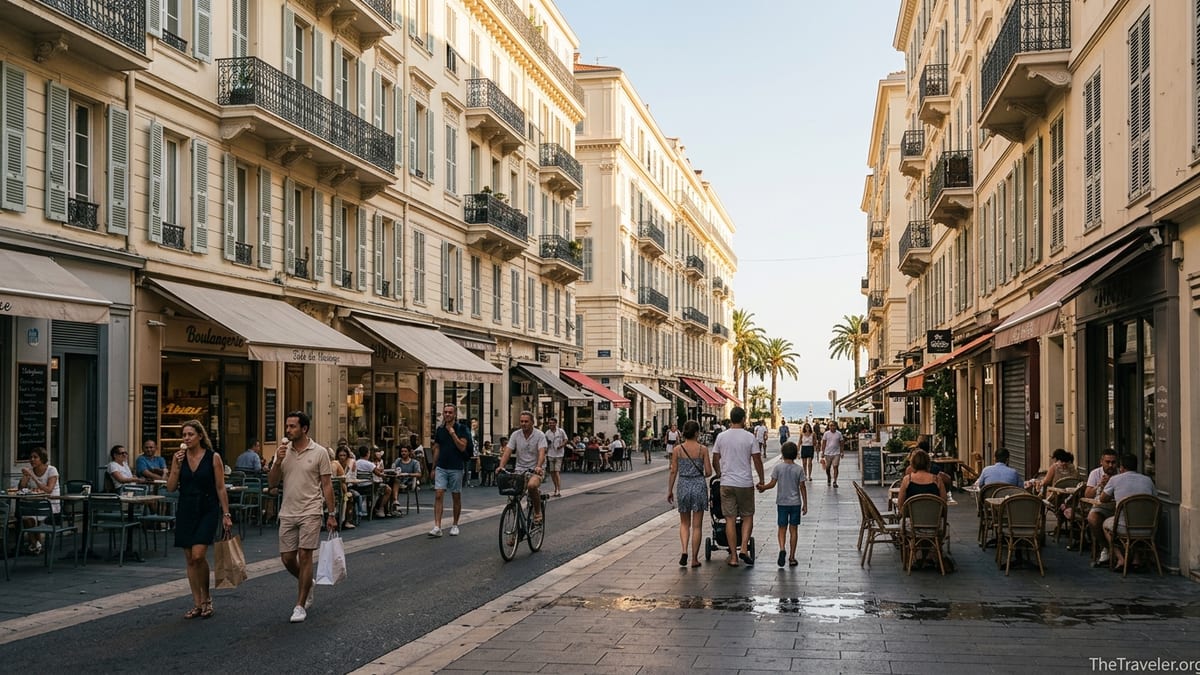
Online descriptions often frame Carré d’Or as one of Nice’s wealthiest districts, lined with Belle Époque facades and elegant apartment blocks. That is accurate, but does not capture how human the streets feel at ground level. Boulevard Victor Hugo, for instance, reads on a map like a major artery, yet when you walk it you find a calm, tree-lined boulevard where residents walk dogs, older couples rest on benches, and traffic hums by at a manageable distance.
South of Victor Hugo, the character shifts to narrower, more intimate streets. Rue de France, which runs roughly parallel to the Promenade des Anglais, feels almost like the neighborhood’s spine. Here you pass a mix of small pharmacies, greengrocers with crates of tomatoes spilling onto the pavement, independent clothing boutiques, and the occasional chain such as Monoprix or Carrefour City tucked under stone balconies. Even the more luxe stretches around Rue Paradis and Rue Alphonse Karr, with their designer stores, never feel as forbidding as a pure shopping district might. There are always a few shaded corners with cafés where locals linger over an espresso.
One of the biggest surprises is that many of these streets are built on a comfortable pedestrian scale. Widths are generally modest, crossings frequent, and speeds low. Even where cars share the space, you rarely find yourself hemmed in by wide roads or long signal phases. Instead, you weave naturally between shady side streets and busier axes, pausing at a boulangerie for a baguette or at a café terrace for a glass of rosé without feeling you are battling traffic.
Architecturally, the Belle Époque and Art Deco buildings help this sense of walkability. Facades with wrought-iron balconies, tall shutters, and carved stone details encourage you to look up. Because the majority of buildings are mid-rise rather than soaring high-rises, sunlight still reaches the pavements, and you do not get the canyon effect that can make some modern city centers feel harsh to walk through.
Pedestrian Zones and the Joy of Wandering
The beating heart of Carré d’Or’s walkability lies in its pedestrian zones. Just east of the neighborhood, Place Masséna acts as a gateway to a car-free area that locals simply call “la piétonne,” focused around Rue Masséna. This is where you feel the city shift decisively toward the pedestrian. Cafés spill onto the paving stones, children chase each other between ice cream shops, and buskers set up with guitars or accordions.
Walking from Carré d’Or down to Rue Masséna is a short, pleasant journey. Within a few blocks you transition from quiet residential streets to a fully pedestrianized corridor that runs almost all the way to the sea. One evening I wandered from Boulevard Victor Hugo down a side street toward Place Magenta, then continued into Rue Masséna without once needing to wait at a traffic light. In less than 10 minutes I had crossed an entire slice of the city in a straight, car-free line.
Parallel to the sea, parts of Rue de France also turn into a semi-pedestrian environment near the Masséna Museum, where cars move slowly and pedestrians dominate the space. Add in the generous seafront promenade of the Promenade des Anglais and you begin to see how contiguous these walking corridors are. You can feasibly start at the tram stop on Avenue Jean Médecin, cross Place Masséna, drift along Rue Masséna and Rue de France, and end up at the Promenade without ever feeling relegated to a narrow, leftover strip of sidewalk.
Equally important is Promenade du Paillon, the green park and linear garden just east of Carré d’Or. In practical terms it gives walkers a soft, traffic-free alternative to the city streets. I often left the apartment, walked five minutes toward Place Masséna, then cut through the lawn and fountains of Promenade du Paillon to reach Old Town. Because it runs roughly north-south between the theater and the sea, it becomes a natural walking axis, shaded in parts and dotted with playgrounds and benches.
Everyday Errands on Foot: Cafés, Groceries, and Bakeries
Travelers sometimes worry that a “prestige” neighborhood will be heavy on luxury shopping and light on simple, everyday services. Carré d’Or proved the opposite. Within a five to seven minute loop around my accommodation I could cover nearly everything needed for a relaxed stay: a corner bakery that sold croissants for about 1.30 to 1.50 euros, a Carrefour City for basics like bottled water, fruit, and yogurt, an organic shop with local olive oil, and several pharmacies.
This density of essential shops makes the area particularly convenient if you dislike planning around big supermarket runs. One morning I realized I had nothing for breakfast at 8 a.m.; three minutes later I was in line at a boulangerie on Rue de la Buffa, buying a still-warm pain au chocolat and a small baguette to carry back. Another day I set out to buy sunscreen and ended up combining the errand with a slow stroll down Rue de France, stopping at a café terrace for a coffee while watching the neighborhood wake up.
Eating out is just as simple without transport. Around Rue de France, Rue Dalpozzo, and the cross streets near the sea, you find a cluster of brasseries, pizzerias, Niçoise bistros, and small wine bars. Prices vary, but it is easy to find a casual main dish in the 15 to 22 euro range and a glass of wine for 5 to 7 euros. If you prefer a sunset drink on the beach, it is a matter of walking five to eight minutes to one of the private beach clubs on the Promenade des Anglais, where a spritz or chilled rosé costs a bit more but comes with a front-row seat to the Mediterranean.
Because everything is reachable on foot, you naturally start combining errands with exploration. Pick up fruit at a greengrocer on Rue de la Liberté, then detour through Place Masséna to cross the red-and-white checkerboard square. Stop at a gelato shop on Rue Masséna on your way back from the tram. After a few days, everyday tasks become an excuse to wander and notice new details, like a pastel courtyard glimpsed through an open gate or a tiny wine shop that only opens in the late afternoon.
Trams, Trains, and When You Do Not Need Them
Nice has invested heavily in public transport, particularly its tram network, but one of the revelations of staying in Carré d’Or is how rarely you actually need it for local movements. The main north-south tram line runs along Avenue Jean Médecin just to the east of the neighborhood, connecting to both the airport line and the northern districts. From much of Carré d’Or, the nearest tram stop sits 5 to 10 minutes away on foot, which makes it easy to reach if you are heading further afield.
For most days, though, I found my tram pass remained largely unused. Walking from Carré d’Or to Old Town via Place Masséna and Promenade du Paillon took around 15 minutes at a relaxed pace. The Port of Nice, slightly further, required a 25 to 30 minute stroll, but it was a pleasant route along the edge of Old Town rather than a slog along busy roads. The Promenade des Anglais in particular, with its wide seafront walkway, makes walking longer distances feel appealing instead of tiring.
Getting to and from the train station was similarly straightforward. Instead of transferring to the tram, I simply followed Avenue Thiers or Avenue Jean Médecin for about 12 to 15 minutes, watching the architecture shift from seaside elegance to the more functional buildings around Nice-Ville. On departure day, even pulling a rolling suitcase along these smooth pavements felt manageable. This walk-versus-tram choice gives travelers flexibility: you can default to walking on sunny days and save the tram for when the weather turns or when you are carrying heavy bags.
For airport access, the new tram connection from the center to Nice Côte d’Azur Airport means you can still avoid taxis if you wish. It is perfectly feasible to walk 8 to 10 minutes from your accommodation in Carré d’Or to the airport tram stop near Jean Médecin, ride directly to the terminal, and remain within a pedestrian-plus-tram bubble for your entire stay.
Safety, Noise, and Walking After Dark
Walkability is not only about distance; it is also about whether you feel comfortable covering those distances at different times of day. Carré d’Or has a reputation among residents as a generally safe and well-kept area, with streets that remain active into the evening without tipping into rowdy nightlife. That balance contributes greatly to how inviting it feels to walk home after dinner or to take an impromptu late stroll along the Promenade des Anglais.
In practice, evenings in Carré d’Or have a steady background buzz. Around Rue Masséna and the seafront, crowds swell during summer, especially from May to September when festivals and events draw extra visitors. Yet if you step a few blocks inland, around streets bordering Boulevard Victor Hugo or close to Jardin Alsace-Lorraine at the western edge of the neighborhood, the mood softens. You still pass people walking dogs, families returning from the beach, or students sitting on benches with takeaway pizza, but it rarely feels chaotic.
Noise is something to consider if you choose accommodation right on the pedestrianized Rue Masséna or directly facing the Promenade. These prime spots come with the most energy and the latest closing hours for bars and restaurants. If you are sensitive to sound but still want the walkable experience, look for a side street between Boulevard Victor Hugo and Rue de France. You will typically gain quieter nights while keeping your walk to the sea at under 10 minutes.
As in any city, it makes sense to take standard precautions after dark: keep valuables secure, stick to well-lit routes, and avoid very empty back streets deep into the night. The advantage in Carré d’Or is that the most logical routes between key points, such as from Rue de France to Place Masséna, are also the liveliest and best illuminated. That means your most practical walking choices are usually the ones that feel most comfortable.
Planning Your Stay to Maximize Walkability
If you want to experience this walkable side of Carré d’Or, where you choose to stay within the neighborhood matters. Broadly, the sweet spot for many visitors sits between Boulevard Victor Hugo and the Promenade des Anglais, and between Place Masséna and Jardin Alsace-Lorraine. From this area you can reach the beach in five to eight minutes, the tram in 10 minutes, and Old Town in around 15 minutes on foot, while also staying close to everyday shops and cafés.
When comparing hotels or apartments, pay attention to nearby landmarks mentioned in descriptions. References to Rue de France or Rue Masséna often signal a central, walk-everywhere location. Mentions of Boulevard Gambetta or Jardin Alsace-Lorraine tell you that you will be toward the quieter western edge, but still well within a comfortable walking radius of the sea and main sights. Addresses near Promenade des Anglais usually offer immediate beach access and classic sea views in exchange for slightly higher prices and more street activity.
Another practical tip is to look at how far your accommodation is from Nice-Ville train station if you plan day trips. A straight-line walk of around one kilometer, or 10 to 15 minutes, is ideal. That way you do not have to budget extra time for trams or buses when catching a morning train to places like Cannes, Antibes, or Monaco. You can simply roll your suitcase or day pack along the pavements and focus on the journey ahead.
Finally, consider your own walking habits. If you already enjoy walking 8,000 to 12,000 steps a day at home, you will likely find that Carré d’Or lets you cover most of your vacation days entirely on foot. If you are less used to long distances, you might aim for an address closer to Place Masséna and Avenue Jean Médecin, where you can cut some walks shorter while still accessing tram lines easily when you prefer a ride.
The Takeaway
Staying in Carré d’Or reshaped my expectations of what a “prestige” neighborhood can feel like. Instead of a district designed around cars and showpiece storefronts, I found a compact, human-scale area where daily life unfolds at walking pace. The sea, the historic lanes of Old Town, the main shopping streets, and the city’s tram and train connections all meet within a surprisingly small radius.
What surprised me most was how quickly walking became the default, not a chore. A morning could start with a five-minute stroll to the bakery, continue with a 10-minute wander down to the Promenade des Anglais for a swim, then stretch into an afternoon spent crisscrossing Promenade du Paillon and Vieux Nice, all without consulting transit maps. Even after dark, the mix of lively but manageable streets made it easy to trust my feet to carry me home.
If you are wondering whether Carré d’Or is worth the slight premium many accommodations command, the answer may well come down to how much you value walking. For travelers who like to step out the door and be in the middle of things within minutes, this golden square of Nice offers a rare combination: the elegance of Belle Époque architecture, the convenience of a transport hub, and the simplicity of knowing that almost everything you came to see is just a short, pleasant walk away.
FAQ
Q1. Where exactly is Carré d’Or located in Nice?
It sits between Boulevard Victor Hugo and the Promenade des Anglais, and between Avenue Jean Médecin and Boulevard Gambetta, placing it right in central Nice.
Q2. Is Carré d’Or a good base for first-time visitors?
Yes, it works very well for first-timers because you can walk to the beach, Old Town, the main shopping streets, and the train station in 5 to 20 minutes.
Q3. How long does it take to walk from Carré d’Or to the beach?
From most streets in Carré d’Or, it takes about 5 to 8 minutes on foot to reach the Promenade des Anglais and the public or private sections of the beach.
Q4. Can I reach Old Town from Carré d’Or without using public transport?
Yes. A relaxed 15-minute walk via Place Masséna and Promenade du Paillon brings you into the heart of Vieux Nice without needing a tram or bus.
Q5. Is Carré d’Or noisy at night?
Streets directly on Rue Masséna or the Promenade can be lively and noisy, but side streets between Boulevard Victor Hugo and Rue de France are generally quieter while remaining central.
Q6. Are there grocery stores and bakeries within walking distance?
There are several small supermarkets, convenience stores, and boulangeries scattered around Rue de France and nearby streets, usually within a 5 to 7 minute walk.
Q7. Do I need a car if I stay in Carré d’Or?
Most visitors do not. You can walk to key sights and use trams or regional trains for day trips along the Côte d’Azur, avoiding parking and traffic entirely.
Q8. How safe is it to walk in Carré d’Or after dark?
It is generally considered a safe and well-lit area, with plenty of people around in the evening. Normal city precautions are still advisable, as in any urban neighborhood.
Q9. What type of accommodation is common in Carré d’Or?
You will find a mix of mid-range and upscale hotels, serviced apartments, and vacation rentals in Belle Époque or Art Deco buildings, many within minutes of the sea.
Q10. Is Carré d’Or suitable for families with children?
Yes. Families often appreciate the flat streets, short walks to the beach, nearby parks like Promenade du Paillon, and easy access to trams and trains for outings.