


Tivoli’s fame rests on two world‑class stars, Villa d’Este and Hadrian’s Villa, and most day trippers barely see anything else before rushing back to Rome. Yet this small hill town, hanging above the Aniene River, hides a network of temples, ravines, viewpoints and local haunts that rarely make it into standard itineraries. Give Tivoli just a little more time, and you discover a town that feels lived‑in, layered and quietly spectacular.
Get the latest updates straight to your inbox!
Why Tivoli’s “in‑between” spaces are its real treasure
Most travelers arrive in Tivoli with one of two plans: a half‑day around Villa d’Este’s fountains or a combined tour that shuttles them between Hadrian’s Villa and the historic center. The result is that streets, parks and viewpoints just beyond the ticketed sites stay remarkably quiet, even in high season. You can step off the main route by a single block and suddenly find yourself alone with a Roman wall or a view that looks pulled from a 19th‑century landscape painting.
The key to discovering Tivoli’s hidden gems is to slow down and treat the town as more than a checklist of monuments. Build in at least one overnight if you can, or at minimum plan a long, late return to Rome so you can wander after the tour buses have gone. You will notice how locals actually use the town: older residents strolling the Belvedere, teenagers gathering near the temples at blue hour, families buying gelato before heading into Villa Gregoriana’s green ravine. Following their rhythms is often more rewarding than following a guidebook map.
These lesser‑known corners are also where practical advantages appear. Small bars serve espresso for the same prices you would pay in a residential Roman neighborhood rather than the inflated rates around Villa d’Este’s main gate. Trattorias just off the main square offer generous plates of pasta alla gricia or fettuccine ai funghi for around 10 to 14 euro, instead of the fixed “tour menu” you see closer to the bus stops. Hidden does not have to mean hard to reach; it often just means no one has told day trippers there is something worth seeing around the corner.
Villa Gregoriana’s wild side and quiet corners
Parco Villa Gregoriana sits technically in plain sight, just beyond Piazza Rivarola and the rebuilt Ponte Gregoriano, yet many visitors skip it to prioritize Villa d’Este. That is a missed opportunity. Once through the modest ticket office you enter a steep gorge where the Aniene River was diverted in the 19th century, creating roaring waterfalls and a microclimate of cool air and moss‑covered rock. Within minutes the sounds of traffic disappear, replaced by water and birdsong, even on a busy day in town.
Most people follow the main signed loop and snap a few photos at the Grande Cascata viewpoint before hurrying out. To find the park’s real magic, take the detours toward the smaller belvedere terraces and the less marked paths leading to the Grotto of Neptune and the Grotto of the Sirens. These shaded pockets feel almost theatrical, with narrow staircases cut into the rock and railings opening onto vertical drops where you can watch the river disappear into tunnels carved under Tivoli. Bring shoes with good grip; steps can stay damp, especially after rain, and the park is more of a hike than a garden promenade.
If you want Villa Gregoriana nearly to yourself, arrive when it opens in the morning or in the late afternoon, especially outside of peak summer weekends. Plan about two hours for a relaxed circuit with photo stops and time just to sit on a bench overlooking the valley. Tickets are typically in the low‑teens in euro and are often included in combination passes with other Tivoli sites, which can be good value if you are visiting at least two of them in one or two days. Pack a refillable water bottle; there are a few fountains, but they are not as frequent as in central Rome.
The Sanctuary of Hercules Victor: archaeology without the crowds
On the edge of the historic center sits the Santuario di Ercole Vincitore, the Sanctuary of Hercules Victor, one of the largest sacred complexes of the Roman Republic. Many visitors walk right past its entrance, assuming the site is industrial or closed, because the remains are woven into later factory buildings and terraced platforms. In reality it is one of Tivoli’s most atmospheric spaces, where ancient cult, medieval adaptation and 19th‑century industry overlap in a single visit.
Inside, you can explore monumental substructures that once supported a temple, theater and portico dedicated to Hercules, Tivoli’s protective hero. Massive retaining walls loom over the Aniene valley, and walkways take you along the same axes worshippers would have used two millennia ago. Interpretive panels, often in both Italian and English, explain how the site later hosted workshops and a hydroelectric plant, making it a rare example of a religious sanctuary that morphed into an industrial hub. The scale is surprising; the complex feels closer to something you might expect in Rome itself than in a provincial hill town.
The sanctuary tends to have fluctuating opening hours that vary by season and day of the week, and there are occasional free‑admission days tied to nationwide cultural initiatives. Before you go, check the latest schedule posted by the Villae cultural authority or at the tourist office in Tivoli’s center rather than relying on old blog posts. Entry prices are usually modest, often under 10 euro, and on a typical weekday you may share the site with only a handful of other visitors. A light jacket is helpful inside the shaded galleries, even in summer, and the mix of indoor and outdoor sections makes this a good option when the midday sun makes Villa d’Este’s terraces feel intense.
Forgotten temples, acropolis lanes and secret viewpoints
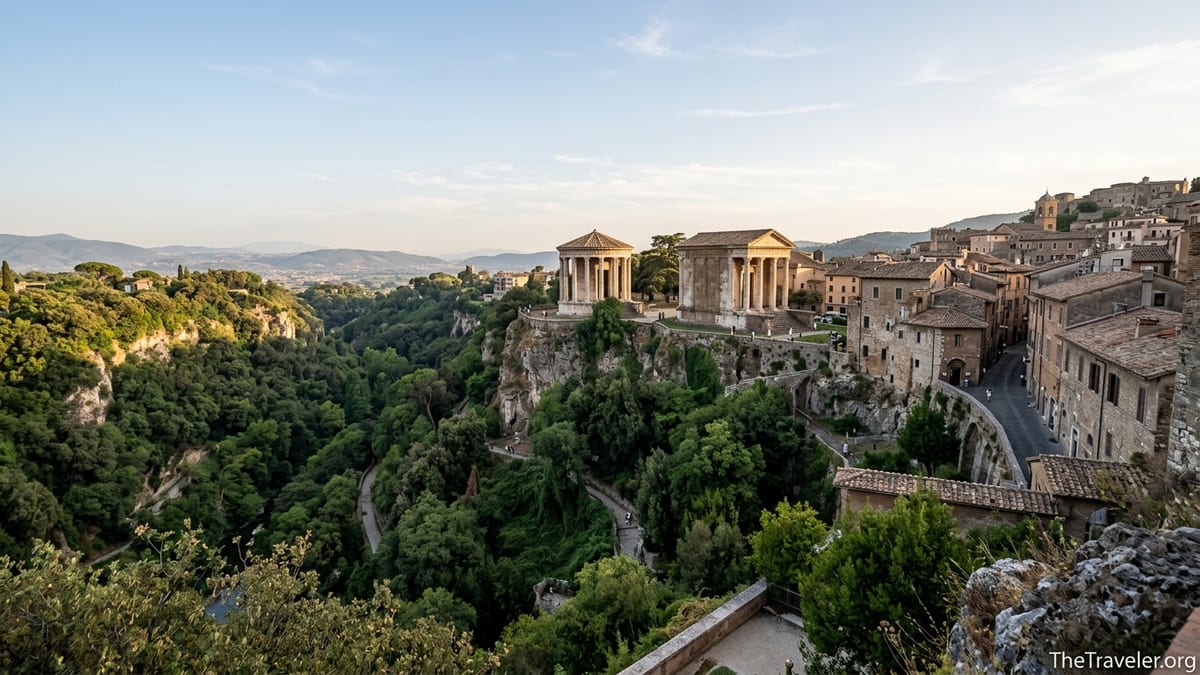
High above the Aniene gorge, the acropolis of Tivoli is crowned by the circular Temple of Vesta and the rectangular Temple of the Sibyl, two of the town’s most iconic silhouettes. Many travelers glimpse them only from afar, framed in postcards or as a photo stop from a coach window. Walking up to them on foot, however, reveals a quieter side. The short climb from the center leads you through narrow lanes where laundry hangs between balconies and the scent of tomato sauce drifts from open windows at lunchtime.
Once at the top, do not stop at the first obvious lookout. Continue along Via della Sibilla and the adjoining alleys, where small breaks between houses open onto unexpected viewpoints over Villa Gregoriana and the wider Roman countryside. At one such terrace, a simple stone wall serves as a bench, and locals lean on it while pointing out landmarks in the distance. Arrive in the golden hour before sunset when the temples glow and the gorge falls into deep shadow. The scene feels strikingly similar to 18th‑ and 19th‑century paintings that helped make Tivoli a key stop on the Grand Tour, yet there is every chance you will share it with only a few residents and perhaps a cat.
Another often overlooked relic lies a short walk from the center along the old Via Tiburtina: the so‑called Tempio della Tosse, or Temple of the Cough. This circular structure, probably a late Roman mausoleum later converted into a church, sits quietly near the river and a section of villa terraces. It does not have the manicured presentation of a major attraction; instead, you find weathered brickwork, overgrown edges and the sense of stumbling upon a structure that locals take for granted. Combine a visit here with a stroll along the lower parts of Villa d’Este’s gardens from the outside, where you can see how the famous fountains cascade over the town’s edge.
From monuments to everyday Tivoli: markets, bars and neighborhood corners
It is tempting to treat Tivoli as an open‑air museum, but some of the most rewarding hidden gems are ordinary spaces where the town’s 21st‑century life plays out. In the streets radiating from Piazza Garibaldi and Piazza Rivarola you will find small alimentari selling local pecorino, dried porcini and packets of handmade pasta from nearby Abruzzo. Prices are usually comparable to or lower than central Rome: a wedge of cheese big enough for a picnic might cost 5 to 8 euro, and a decent local bottle of Lazio wine often starts under 10 euro. These shops are ideal for assembling a simple lunch to eat on a bench overlooking the valley instead of sitting in a touristy café.
Morning is the best time to see Tivoli wake up. Walk into any bar that does not advertise photos of cocktails and you will likely pay 1.20 to 1.50 euro for a cappuccino at the counter, with a cornetto for around 1.20 euro more. Workers on their way to Rome stand shoulder to shoulder with retirees reading the newspaper. If you listen, you will hear as much Roman dialect as standard Italian. Choosing a spot one or two streets back from the main pedestrian routes gives you a better chance of blending into this everyday rhythm instead of queueing behind tour groups.
In the evenings, especially outside high summer, Tivoli’s center takes on an almost provincial calm. Small wine bars near the acropolis and along the main drag pour glasses of Frascati or Cesanese del Piglio for 4 to 6 euro, often with complimentary snacks like olives or small tramezzini. Ask for something “del territorio” and the staff will usually recommend a label from Lazio rather than defaulting to the big national names. These venues rarely appear in English‑language guides, but they are easy to find simply by walking around after 7 pm and looking for places filled with local voices rather than laminated menus.
Eating with a view: restaurants most tour groups miss
Tivoli has long attracted Roman day trippers in search of a meal with a view, and weekend lunches can be busy at well‑known spots near the temples. Yet visitors who stay into the evening or avoid Sundays often find they can dine in spectacular settings without the crowds. One longstanding restaurant perched below the Temple of Vesta has become a favorite among those who know Tivoli beyond its top two sights. From its terrace, diners look straight onto the acropolis and down into the gorge where the Aniene once thundered along its old course.
Tables on these panoramic terraces tend to command a small premium, but not an outrageous one by Italian tourist‑town standards. A two‑course dinner of an antipasto and pasta, plus house wine, might land in the 30 to 40 euro range per person, depending on what you order. Reserve in advance for Friday and Saturday evenings, especially in late spring and early autumn, when Romans drive up for dinner to escape the city heat. If the terrace is full, consider asking for a table indoors; the vaulted rooms often retain historic details, and you can step outside between courses to take in the view.
For a more low‑key meal, look toward the backstreets between Villa d’Este and the train station, where small osterie serve classic Roman and Tiburtine dishes to a mostly local clientele. Here, dishes like fettuccine with porcini mushrooms or abbacchio al forno (roast lamb) usually cost under 15 euro, and the coperto, or cover charge, remains modest. Menus are sometimes only in Italian, but staff are generally happy to explain dishes. Eating in these backstreets after the day‑trippers have left can be one of the most pleasant ways to feel Tivoli as a town rather than a destination.
Planning your visit to uncover Tivoli’s hidden side
To give yourself the best chance of enjoying these lesser‑known spots, consider spending a full day or an overnight rather than a compressed half‑day tour. Trains from Rome’s Tiburtina or Termini stations typically take 35 to 60 minutes depending on the service, with regional tickets costing only a few euro. Budget extra time for the walk between Tivoli’s station and the historic center, which is about 10 to 15 minutes uphill at a relaxed pace. If you visit Hadrian’s Villa, note that it lies several kilometers out of town; local buses and organized shuttles are frequent, but factor in waiting times.
Comfortable footwear is essential. Even if you do not plan a dedicated hike, you will find yourself on uneven stone staircases in Villa Gregoriana, steep lanes up to the acropolis and cobbled streets around the Sanctuary of Hercules Victor. In summer, temperatures can climb quickly, so an early start lets you explore Villa Gregoriana and the acropolis viewpoints before the heat sets in. Keep a lightweight scarf or shawl handy if you plan to step into churches, and a light jacket for evenings between roughly April and October, when the gorge and hilltop can feel cooler than Rome.
For access and opening hours, use official channels: the Villae cultural authority’s information for Villa Gregoriana, Villa d’Este, the Sanctuary of Hercules Victor and Hadrian’s Villa, plus the municipality’s updates for local events. Schedules can shift from one year to the next, particularly for smaller sites like the Tempio della Tosse or special sections of the sanctuary. When in doubt, stop at Tivoli’s tourist office near the main square; staff can confirm which sites are open that day and may point you to temporary exhibitions, concerts or guided walks that do not reach international listings.
FAQ
Q1. Is Tivoli worth visiting if I have already seen Villa d’Este and Hadrian’s Villa?
Tivoli is absolutely worth a return visit. Beyond the two headline sites, places like Villa Gregoriana, the Sanctuary of Hercules Victor, the Tempio della Tosse and the acropolis viewpoints offer a very different atmosphere, with fewer crowds and more contact with the town’s everyday life.
Q2. How much time do I need to explore Tivoli’s hidden gems?
If you want to see Villa Gregoriana, the acropolis, a lesser‑known church or temple and still have time for a relaxed meal, plan at least a full day. An overnight stay lets you experience quieter evenings and early mornings, when viewpoints and parks are at their most atmospheric.
Q3. Are these lesser‑known sites suitable for children or travelers with limited mobility?
Some hidden gems, such as Villa Gregoriana and the paths around the acropolis, involve steep, uneven terrain and many steps, which can be challenging for small children, strollers or anyone with mobility issues. Flatter areas like the town squares, certain sections of the Sanctuary of Hercules Victor and the streets around the Tempio della Tosse are more accessible, but it is wise to check current access information in advance.
Q4. Can I visit Tivoli’s hidden spots on a day trip from Rome using public transport?
Yes. Regular regional trains connect Rome with Tivoli in under an hour, and local buses or taxis can take you to more distant sites like Hadrian’s Villa if needed. Within the historic center, all the spots described are reachable on foot, though expect hills and stairs. Planning your route ahead of time helps you make the most of a single day.
Q5. What should I budget for a day exploring these lesser‑known places?
Costs vary by season and ticket combinations, but a typical day might include 10 to 15 euro to enter Villa Gregoriana, a similar amount if you choose to visit another paid site, 10 to 15 euro for a simple lunch and 20 to 40 euro for a sit‑down dinner. Coffee, gelato and bus tickets usually add only a few euro each. Overall, Tivoli is often slightly cheaper than Rome’s historic center.
Q6. When is the best time of year to see Tivoli without heavy crowds?
Spring and autumn are ideal, particularly midweek outside of Italian school holidays. Even in summer, the hidden corners of Villa Gregoriana and the backstreets around the acropolis tend to be quieter than Villa d’Este and Hadrian’s Villa, especially early in the morning or in the evening.
Q7. Do I need a guided tour to enjoy these hidden gems?
A guide can add depth at complex sites like the Sanctuary of Hercules Victor, but many hidden spots are enjoyable independently with basic background reading. Clear signage at Villa Gregoriana and around the acropolis, combined with a good offline map, is usually enough for most travelers who like exploring at their own pace.
Q8. Is it safe to wander off the main tourist routes in Tivoli?
Central Tivoli generally feels safe during daylight and early evening, with people out walking, shopping and socializing. As in any town, keep an eye on your belongings and avoid poorly lit, isolated areas late at night. Sticking to residential streets and main lanes leading to the acropolis is usually comfortable for most visitors.
Q9. Can I combine Tivoli’s hidden gems with a visit to Hadrian’s Villa in one day?
It is possible but will make for a long, busy day. A realistic plan is to visit Hadrian’s Villa in the morning, return to the historic center after lunch and then focus on one or two hidden gems such as Villa Gregoriana and the acropolis viewpoints. Trying to see everything in one day often means you rush through the quieter places that make Tivoli special.
Q10. What should I wear and bring for exploring these lesser‑known areas?
Wear comfortable walking shoes with good grip, as many paths are steep or uneven. In warmer months, bring water, sunscreen and a hat, and in cooler seasons a light jacket for the breezy acropolis and the shaded gorge of Villa Gregoriana. A small backpack, rather than a wheeled suitcase, makes it easier to navigate stairs and cobbled streets.