


Rome rarely whispers. It is all blaring sirens, espresso spoons on saucers, and motorinos threading impossible gaps in traffic. So when I stepped off the bus in Tivoli, just 30 kilometers away, I expected more of the same. Instead, I found something I hadn’t associated with Lazio in high season at all: an almost disarming sense of peace.
Get the latest updates straight to your inbox!
Leaving Rome’s Rush Behind
The contrast begins long before you see a single fountain in Tivoli. The journey itself sets the tone. From Rome’s Ponte Mammolo bus station, the blue Cotral buses roll out of the city roughly every 15 to 30 minutes, depending on the time of day, and within an hour you trade apartment blocks for olive groves and the soft outline of the Sabine Hills on the horizon. Even the regional train from Tiburtina station, which takes a similar amount of time, feels calmer than most city metro rides, with commuters gradually giving way to day trippers carrying guidebooks and water bottles.
Prices quietly announce that this is a normal Italian town, not an open-air museum designed around tourists. A one-way bus ticket from Ponte Mammolo to Tivoli typically costs just a few euros, bought from a tabacchi kiosk or via local apps, far less than many organized tours charging from around 75 to over 120 euros per person for a full-day outing with transport and guide included. Those tours have their place, especially if you value commentary and logistics handled for you, but the DIY route immediately feels more local and less rushed.
Arriving in Tivoli itself is almost underwhelming in the best way. There is no grand piazza full of tour groups the moment you step off the bus. Instead, you find low-rise buildings, a few bars serving cappuccino to office workers, and quiet residential streets. It feels like you have arrived in a real town that just happens to shelter some of Italy’s most remarkable historic gardens and ruins, rather than a town that exists only because of them.
That ordinary, lived-in atmosphere was my first surprise. After a few days in central Rome, where every corner seems optimized for photos and queues, Tivoli’s everyday rhythms are a relief. Elderly residents chat in doorways, children ride bicycles along side streets, and the loudest sound is often the Aniene River rushing far below the historic center.
The Calm Geometry of Villa d’Este’s Gardens
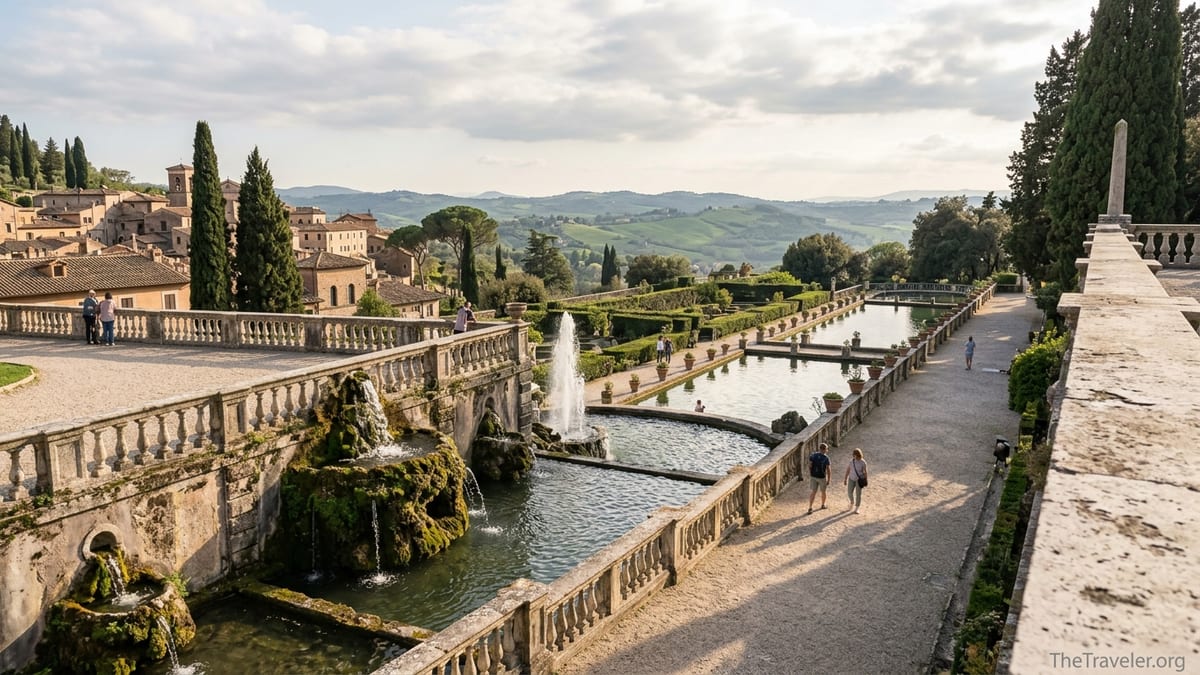
Most travelers come to Tivoli first for Villa d’Este, a UNESCO-listed Renaissance villa famous for its cascading terraces and elaborate fountains. On paper, it sounds like a recipe for crowds: hundreds of fountains, a water organ, sweeping views over the Roman countryside. In reality, the way the garden is structured gives you corners of solitude even on busy days.
After you pass through the entrance and a handful of frescoed rooms, the garden opens up in a series of terraces. Many visitors stop right away to photograph the iconic view over the grand Fountain of Neptune and the long pools of the Fishpond. But if you simply keep walking down a level or two, the pathways thin out. At the edges of the garden, near simple stone balustrades overgrown with moss, you can often stand alone listening to the constant hiss and splash of water that has been running here, more or less continuously, since the 1500s.
What surprised me most was how hushed it felt between those fountains. The success of the villa’s designer is not only in visual drama but in acoustics. The sound of water creates a soft wall, muting snatches of conversation and the occasional school group. Around the Hundred Fountains, an extraordinary wall where thin jets spill from stone masks and carved lilies in a long, green corridor, the steady white noise lets you walk in near silence even when you can see other people just a few meters away.
Practical details help sustain the calm. Timed entry is increasingly common in Italian state museums, and Villa d’Este has adapted with controlled access and clearly marked routes. Entrance tickets, which are broadly in line with other major Italian monuments, feel fairly priced for the time you can spend there; many visitors report wandering for two to three hours without feeling hurried. As the afternoon wears on, group tours peel away back to Rome, and the late-day light turns the spray from the fountains a soft gold, the garden feels even more like the private retreat Cardinal Ippolito II d’Este originally envisioned.
Hadrian’s Villa: Ruins Made for Quiet Wandering
If Villa d’Este feels like a staged Renaissance dream, Hadrian’s Villa, or Villa Adriana, just outside town, offers a more rugged kind of peace. Built around the 2nd century AD as Emperor Hadrian’s retreat from Rome, the complex sprawls across a broad area of countryside. Even with several tour groups onsite, the sheer size of the place means you can walk for long stretches accompanied only by the crunch of gravel underfoot and cicadas in summer.
Reaching Hadrian’s Villa independently takes a little more effort. From Rome, many travelers take the metro to Ponte Mammolo, then a Cotral bus toward Tivoli and get off at the stop for Villa Adriana, walking about a kilometer and a half to the entrance. Others base themselves in Tivoli’s center first, then catch a local bus or taxi to the site. That bit of logistical friction turns away the most casual of visitors and keeps overall numbers lower than at Rome’s most central ruins.
Inside, the stillness becomes part of the experience. Standing at the edge of the Canopus, the long pool lined with columns and statues that echoes ancient Egyptian canals, you can look back toward crumbling brick walls and imagine the empire’s business unfolding far away. Signs offer context, but the site encourages open-ended wandering rather than funneling you along a strict sequence. You might spend 20 quiet minutes among the remains of the palace area, then suddenly find yourself alone in a sunken garden with wildflowers pushing through stone.
What surprised me here was how much space there is to be introspective. Unlike the Roman Forum, where tightly packed ruins and steady foot traffic mean you are always aware of the crowd, Hadrian’s Villa gives you distance. Even on popular touring days, it is easy to step a few meters off the main route and sit on a low wall facing a half-collapsed dome or tangled grove of pines, letting the wind and distant highway noise blend into a kind of modern pastoral soundtrack.
Villa Gregoriana and the Sound of the Aniene
For many, the real revelation in Tivoli is neither Hadrian’s Villa nor Villa d’Este but Parco Villa Gregoriana, the dramatically wooded gorge just below the historic center. Restored and managed by Italy’s environmental trust FAI, the park feels more like a wild canyon walk than a manicured Italian garden, despite its 19th-century origins as a papal project to tame the Aniene River’s devastating floods.
Entrance is from near the edge of the old town, where you step through a gate and almost immediately descend into a world of stone paths, dripping grottos, and sudden views of waterfalls. The most famous is the Great Waterfall, where the diverted Aniene plunges into the gorge, the sound roaring up to the balconies carved into the cliff. Yet even here, the flow of people is usually gentle. The park’s one-way circuits and frequent staircases naturally space visitors out, so you often walk for several minutes without seeing another person, only hearing their voices faintly around the next bend.
Concrete examples make the peace tangible. On a recent spring weekend, while crowds in central Rome packed into the Trevi Fountain’s viewing area shoulder to shoulder, a visitor in Villa Gregoriana might pause at the “Belvedere of the Temple of Vesta,” looking across the gorge at the circular Roman temple perched on the cliff above, with only swallows and the waterfall for company. Benches set into small stone alcoves invite you to sit and watch light shift across the rock face, a different kind of spectacle from any piazza in the capital.
The park keeps relatively regular hours, often from mid-morning to late afternoon, with seasonal variations. Tickets are priced similarly to a small museum, and FAI members receive discounts, which brings in a mix of Italian visitors and international travelers. Because Villa Gregoriana is less known abroad than the two UNESCO-listed villas, it sees fewer tour buses. That lower profile is exactly what preserves the park’s contemplative character.
A Town That Still Feels Like It Belongs to Its Residents
Beyond the headline sights, Tivoli’s streets were another pleasant surprise. Many famous European day-trip towns can feel hollow once you step off the main drag, but Tivoli remains a place where people work, shop, and go to school. That everyday life softens the presence of tourists and creates opportunities for small, peaceful encounters.
Walk from Villa d’Este toward the main square and you pass fruit shops selling crates of seasonal produce at normal supermarket prices, not souvenir stand markups. A simple espresso at the counter of a bar near Piazza Garibaldi often costs about the same as in non-touristy Roman neighborhoods, while a slice of pizza al taglio eaten standing at a high table might set you back just a few euros. You share the space with local teenagers on their break and retirees reading newspapers, not only other visitors.
Because Tivoli is perched above the valley carved by the Aniene, viewpoints appear suddenly at the ends of side streets. One moment you are squeezing past a tiny grocery van unloading cases of mineral water, the next you reach a low railing and look out over terracotta roofs toward the distant hazy outline of Rome’s eastern suburbs. These little balconies rarely feel crowded. People drift in, take in the view in quiet conversation, and drift out again.
Even practical errands can feel calming here. Buying bus tickets at a tabacchi on a weekday morning, you may find someone ahead of you topping up a phone card or playing the lottery, and nobody seems in much of a rush. After Rome, where pressing through a crowd to order a coffee can feel like a competitive sport, Tivoli’s slower pace is its own form of relief.
Planning a Peaceful Tivoli Day Trip in Practice
Part of what made Tivoli feel so restful to me was not just the town itself but the way the day was structured. With a little planning, you can build in enough time and space to avoid the worst of the crowds and enjoy the calm that surprised me.
A common approach is to start with Hadrian’s Villa in the morning, either on your own or with a tour. Many full-day tours from Rome include both Hadrian’s Villa and Villa d’Este, departing around 8:00 or 8:30 in the morning and returning by early evening. These often cost somewhere between 75 and 125 euros or more per person, depending on group size, whether lunch is included, and whether skip-the-line tickets are part of the package. The advantage is a smooth, guided experience. The trade-off is moving at the group’s pace and spending much of the day with the same people.
If you prefer quiet, a DIY day can be more restful. Take an early bus or train, head straight to Hadrian’s Villa while large tours are still assembling in Rome, and aim to arrive close to opening time. After two or three hours strolling the ruins, you can return to Tivoli town by bus or taxi for lunch at a simple trattoria near the center. Menus often feature straightforward Roman and regional dishes: plates of cacio e pepe, grilled lamb, or seasonal vegetables, at prices that feel fair rather than inflated.
In the afternoon, you can visit Villa d’Este or Villa Gregoriana. If it is a hot day, Villa Gregoriana’s shaded paths and proximity to water may feel more refreshing. On cooler days, Villa d’Este’s sunlit terraces are ideal. Admission tickets to each site are roughly in line with what you would expect for major Italian cultural attractions, and there are often combined ticket options or reduced rates for EU residents in certain age brackets, though details can change and are best checked shortly before your visit.
Give yourself permission not to see everything. One of the simplest ways to preserve Tivoli’s peaceful mood is to accept that you may not manage all three major sites in a single day without turning the trip into a race. Many recent visitors who tried to squeeze in Hadrian’s Villa, Villa d’Este, and Villa Gregoriana reported tired legs and a blur of impressions. Choosing two and leaving space for an extra coffee in the main square can feel far more luxurious.
Why Tivoli Feels So Different From Rome
There are structural reasons Tivoli feels so much calmer than the capital, and understanding them can help you appreciate the experience more deeply. First is simple scale. Tivoli is a town of tens of thousands, not millions. Its historic center is compact, and while it sees a healthy number of day-trippers, visitor density rarely approaches that of the Spanish Steps or Vatican Museums.
Second is the type of attractions Tivoli offers. In Rome, many headline sites, from the Colosseum to the Pantheon, sit directly within the urban fabric, surrounded by busy roads and dense neighborhoods. Tivoli’s main draws are gardens and ruins spaced out over hillsides and countryside, naturally creating breathing room. Even when Villa d’Este’s central viewpoints fill with people taking photos, quiet corners wait just a few steps away among cypress trees and stone staircases.
Third is the rhythm of time. In Rome, long opening hours and evening events encourage visitors to string together attractions without much pause. In Tivoli, sites like Villa Gregoriana typically operate within defined daytime windows, and locals still observe traditional meal hours and afternoon rests. By early evening, many travelers are already on a train or bus back to the city, and Tivoli returns to its everyday routines.
Finally, there is the psychological effect of escape. Knowing you are just far enough from Rome to see open countryside changes how you move. The horizon expands. Even if the actual distance is not great, those 30 kilometers east of the city center feel like a threshold between hustle and a more relaxed state of mind. That sensation may be subjective, but it is one repeatedly echoed by travelers who describe Tivoli as one of the most unexpectedly serene day trips from Rome.
The Takeaway
What surprised me most about Tivoli was not simply that it is beautiful. Guidebooks and glossy photos had already told me that. It was the way beauty and everyday life, artifice and nature, come together to create a place that feels genuinely peaceful a short hop from one of Europe’s busiest capitals.
In the water-soaked terraces of Villa d’Este, the sprawling ruins of Hadrian’s Villa, the shaded gorge of Villa Gregoriana, and the quiet corners of Tivoli’s streets and viewpoints, you can move at a human pace again. Whether you join a guided tour or navigate on your own with regional buses and trains, the town rewards those who slow down. For travelers who find Rome exhilarating but occasionally overwhelming, Tivoli offers something rare: a day where history is as present as ever, but the volume, mercifully, is turned down.
FAQ
Q1. How far is Tivoli from Rome and how long does it take to get there?
Tivoli is about 30 kilometers east of central Rome. By regional train from Tiburtina station or Cotral bus from Ponte Mammolo, the journey usually takes around 45 to 60 minutes, depending on connections and traffic.
Q2. Is Tivoli really less crowded than central Rome?
Yes, generally Tivoli feels noticeably less crowded than Rome’s main sights. Popular spots like Villa d’Este and Hadrian’s Villa do attract tour groups, especially in high season, but their size and layout mean you can usually find quiet corners and uncrowded paths.
Q3. Can I visit Hadrian’s Villa, Villa d’Este, and Villa Gregoriana all in one day?
It is possible but can feel rushed. Most travelers comfortably manage two of the three in a day, with time left for a relaxed lunch and a stroll in town. Trying to see all three often means cutting each visit short and walking a lot of uphill and downhill routes.
Q4. Do I need to book tickets for Tivoli’s villas in advance?
Booking ahead is not always mandatory, but it is wise during weekends, holidays, and peak months to avoid potential queues and capacity limits. Many travelers reserve tickets or tours online shortly before their trip, especially for Villa d’Este and Hadrian’s Villa.
Q5. Is a guided tour worth it, or should I go on my own?
Guided tours, which often cost from around 75 euros upward per person including transport and tickets, are useful if you value expert commentary and hassle-free logistics. Independent travelers who prefer flexibility and quieter moments may enjoy taking the train or bus and visiting at their own pace with a guidebook or audio guide.
Q6. What should I wear and bring for a day in Tivoli?
Wear comfortable walking shoes, as you will encounter uneven paths, stairs, and slopes, especially in Hadrian’s Villa and Villa Gregoriana. Bring water, sun protection in warm months, and a light layer in spring or autumn. A small backpack is more practical than a suitcase or large bag.
Q7. Are there places to eat near the main sights?
Yes. Tivoli’s historic center has numerous cafes, gelaterias, and trattorias within walking distance of Villa d’Este and Villa Gregoriana. Around Hadrian’s Villa there are a few bars and restaurants, though options are more limited, so many visitors plan to eat their main meal back in town.
Q8. Is Tivoli suitable for travelers with limited mobility?
Tivoli’s terrain can be challenging. Villa d’Este has many stairs and terraces, Villa Gregoriana involves steep paths and uneven ground, and Hadrian’s Villa includes rough surfaces. Some areas are accessible, but anyone with limited mobility should research current accessibility information and be prepared to focus on the more level sections.
Q9. When is the best time of year to visit Tivoli for a peaceful experience?
Spring and early autumn are often ideal, with mild temperatures and pleasant light. Weekdays outside major holidays tend to be quieter than summer weekends. Arriving early in the day or later in the afternoon also helps avoid peak tour-group times.
Q10. Can I stay overnight in Tivoli instead of just doing a day trip?
Yes, Tivoli has a range of small hotels, guesthouses, and bed and breakfasts. Staying overnight lets you enjoy the town after most day-trippers have left, stroll the streets in the evening, and visit the villas early the next morning, which can be especially peaceful.