


Many travelers leave Rome convinced they have “done” Lazio, only to realize later that they sped right past one of the region’s most atmospheric escapes. Perched in the Sabine Hills less than an hour from the capital, Tivoli mixes imperial history, Renaissance glamour and wild canyon scenery in a compact town that still feels thoroughly local. Skipping it can mean missing some of central Italy’s most memorable gardens, views and summer-evening strolls.
Get the latest updates straight to your inbox!
Why Tivoli Deserves a Spot Next to Rome on Your Itinerary
Tivoli sits about 30 kilometers east of Rome, where the Aniene River drops dramatically out of the Sabine Hills. That shift in altitude is not just a line on a map; you feel it in the cooler air, the fresher evenings and the way locals from Rome still come here to escape summer heat on weekends. The town’s history stretches from ancient Rome through the Renaissance and into 19th century Romanticism, and that layered past is written into its villas, ruins and cliffside paths.
Unlike some day‑trip destinations that revolve around a single monument, Tivoli offers three distinct anchor sites, each with its own personality. Hadrian’s Villa on the plain below town is one of the most important archaeological complexes in Italy, a vast spread of pools, porticoes and palaces that once formed the emperor’s private retreat. Up in the historic center, Villa d’Este dazzles with an almost theatrical display of Renaissance fountains and terraced gardens. A short walk away, Villa Gregoriana plunges into a gorge of waterfalls and footpaths that feel surprisingly wild for somewhere so close to Rome.
For many visitors, what makes Tivoli special is the way these headline sights are woven into an ordinary working town. In the afternoon, schoolchildren still cut across Piazza Garibaldi on their way home as tour groups peel off toward Villa d’Este, and commuters linger over espresso at corner bars that are open far earlier than the big villas. It is entirely possible to spend a day here wandering between UNESCO‑listed showpieces and then end it with a plate of grilled lamb and local red wine on a side street with no English menus in sight.
From a practical perspective, Tivoli is straightforward to reach and affordable once you arrive, especially compared with coastal hot spots further from Rome. A regional train ticket from Roma Tiburtina to Tivoli typically costs well under 10 euros each way, and Cotral buses from the same area are a similarly budget‑friendly option. That combination of accessibility and variety makes Tivoli one of the easiest places to add depth to a Lazio itinerary without adding logistical headaches.
Villa d’Este: A Renaissance Dream of Fountains and Terraces
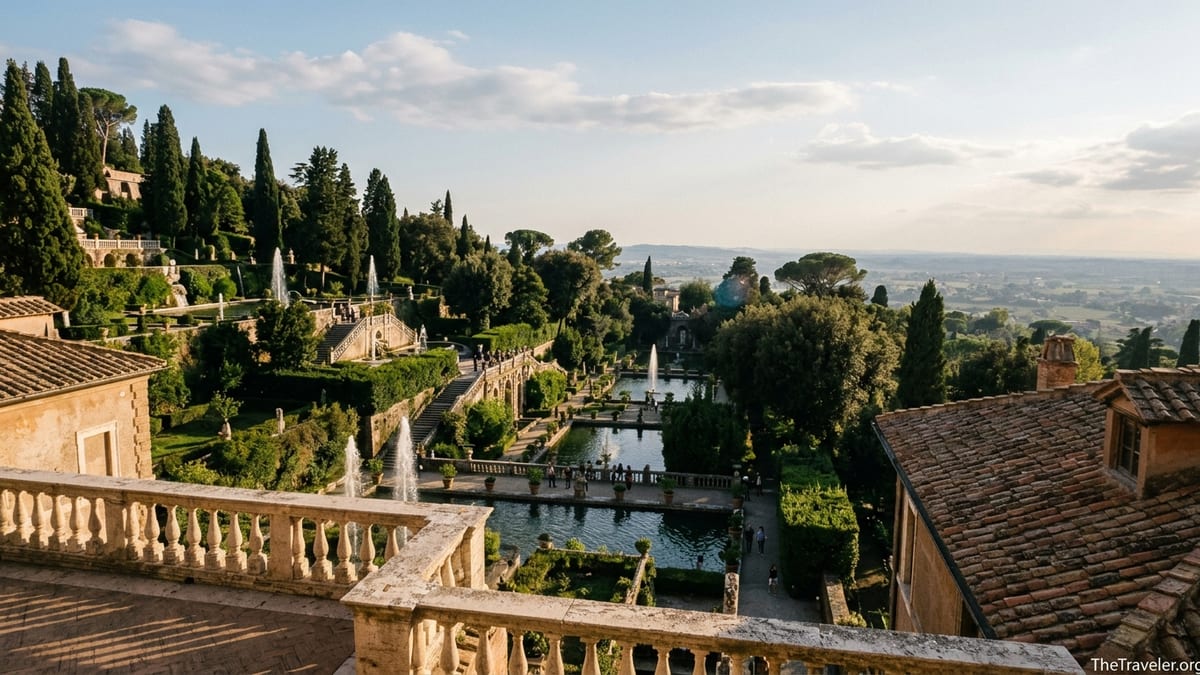
Most travelers’ first stop in Tivoli is Villa d’Este, a 16th‑century palace and garden complex commissioned by Cardinal Ippolito d’Este. From the outside, its entrance on Piazza Trento is almost understated. Inside, however, you step into a sequence of frescoed salons and then out onto a hillside that seems to dissolve into water, greenery and sky. More than 500 fountains, cascades and spouts animate the terraces, fed largely by gravity rather than pumps, a feat of Renaissance engineering that still feels miraculous.
Visitors today follow paths past the famous Hundred Fountains, a long, moss‑lined wall where dozens of spouts spill into a narrow channel, and down toward the Fontana dell’Ovato, an oval basin framed by grotto‑like stonework and manicured hedges. On busy spring weekends you may find visitors lining the parapets to photograph the view back toward Tivoli’s rooftops, but even on those days there are quieter corners where you can sit on a shaded stone bench and listen to the steady rush of water.
Standard single tickets for Villa d’Este are generally in the mid‑teens in euros for adults, with reduced rates for EU residents aged 18 to 25 and free or symbolic‑cost entries for under‑18s and certain categories of visitors. Prices can fluctuate slightly during special exhibitions, so it is wise to check official schedules shortly before traveling, but you can reasonably plan on a ticket costing less than a typical Colosseum or Vatican visit. Many travelers find that two hours allows enough time to move through the palace rooms, descend the main garden axis and linger at a few favorite fountains without rushing.
If you are coming in from Rome on a morning train, a common pattern is to arrive in Tivoli around 9:30 or 10:00, stop for a coffee and pastry at a bar near Piazza Garibaldi, then walk the few minutes downhill to the villa’s entrance for opening time. That early start lets you enjoy the gardens while the light is still soft, the stone stairways are not yet hot and the tour buses have not fully arrived. For photographers, this is when the reflections in the pools are clearest and the contrast between shaded cypresses and bright fountains is easiest to capture.
Hadrian’s Villa: Walking Through an Emperor’s Private World
Where Villa d’Este is vertical and theatrical, Hadrian’s Villa spreads horizontally over the countryside. Located a few kilometers outside Tivoli’s center on the Via Tiburtina, this archaeological park preserves the remains of the retreat built by Emperor Hadrian in the 2nd century. It was never a single “villa” in the modern sense but an entire complex of palaces, libraries, baths and gardens inspired by places Hadrian admired across the empire, from Egypt to Greece.
Today, visitors wander along crushed‑stone paths that thread between ruins of grand halls and marble‑lined pools. The Canopus, a long canal flanked by columns and statues, is one of the most photographed sections, and on clear days its still water mirrors the surrounding ruins. Elsewhere, you might climb a gentle slope to look back across a patchwork of olive trees and low arches while trying to reconstruct, in your mind, how the complex would have functioned when courtiers, guards and servants moved constantly between its different quarters.
Adult tickets for Hadrian’s Villa are typically in the low teens in euros, with similar reductions for younger visitors and local residents. In recent years, Italian cultural authorities have occasionally offered combined tickets that include both Hadrian’s Villa and Villa d’Este, sometimes with additional smaller sites in Tivoli. If you are planning to see both on the same day, it is worth asking at the first ticket office whether a cumulative option is available; when it is, it can save a few euros per person and occasionally includes discounts on audio guides.
Reaching Hadrian’s Villa requires a short transfer from Tivoli proper. Many independent travelers take a Cotral bus from Rome that stops near the archaeological park entrance, visit the site in the morning, then continue by bus up to Tivoli’s historic center for Villa d’Este in the afternoon. Others prefer to take the regional train to Tivoli and then connect by local bus or taxi to the villa. However you arrive, plan for at least two to three hours on site, especially in warm weather, as the complex is large, walking is largely in the open and shaded rest spots are relatively spaced out.
Villa Gregoriana: Waterfalls, Gorges and a Wild Side of Lazio
If Villa d’Este and Hadrian’s Villa are about human control over space, Villa Gregoriana is where nature steals the scene. Managed by the Italian environmental trust FAI, this park begins just below Tivoli’s acropolis and descends into a dramatic gorge carved by the Aniene River. Paths twist past viewpoints of the so‑called Great Waterfall, where the river drops in a white plume, and through pockets of woodland that feel far removed from the tiled roofs above.
The park’s story is unusual. In the 19th century, after repeated floods threatened Tivoli, engineers diverted part of the river through tunnels, creating the spectacular falls and reshaping the gorge. Pope Gregory XVI then ordered the area turned into a romantic landscape park, complete with winding paths and lookout points. After decades of neglect, FAI restored and reopened it in the early 2000s, and it has since become a favorite with walkers looking to balance the formal geometry of Villa d’Este with something more rugged.
Entrance prices for Villa Gregoriana are generally in the high single digits or low double digits in euros for adults, with various discounts for students, children and FAI members. Tickets usually include access to a downloadable audio guide, which can be helpful in understanding both the natural history and past human interventions in the gorge. Because much of the route involves stairs, rocky paths and some steep gradients, comfortable shoes are essential, and travelers with mobility issues may find only parts of the park accessible.
In practical terms, Villa Gregoriana fits neatly into a Tivoli town walk. From Piazza Garibaldi, where many buses drop visitors, it is about a ten‑minute stroll through the historic streets to the park entrance. Many travelers combine a late‑afternoon visit with an early dinner nearby, timing their descent into the gorge for the cooler part of the day. The contrast between the golden light on Tivoli’s temples high above and the cool shade along the riverbed below is one of the experiences that sticks with people long after they have returned to Rome.
Planning Your Escape: Getting To Tivoli and Getting Around
Reaching Tivoli from Rome is straightforward, which is one reason local residents often recommend it as a first day trip for visitors who want to navigate on their own. The most flexible option is the regional train from Roma Tiburtina or Roma Termini to Tivoli station, which usually takes around 40 to 50 minutes depending on the service. Tickets for these regional trains are typically well under 10 euros each way. From the station, it is a 15‑ to 20‑minute uphill walk to Piazza Garibaldi and the old town, or a short ride on a local bus.
Another popular option is the Cotral bus from the Tiburtina bus terminal area in Rome. These buses run toward Tivoli along Via Tiburtina and can be especially convenient if you plan to visit Hadrian’s Villa first, as many routes stop near its entrance before continuing up to town. Journey times vary with traffic but are often similar to the train, around 50 minutes to an hour. As with most regional services, it is wise to arrive early, validate paper tickets where required and build in extra time at the end of the day in case of delays on the way back to Rome.
Once in Tivoli, you will likely string together walking and short transfers. Villa d’Este and Villa Gregoriana are within easy walking distance of one another and of the town’s main squares. Hadrian’s Villa, by contrast, sits far enough out that a bus, taxi or organized shuttle makes sense. Some travelers choose to base themselves in Tivoli for a night, using a local bed‑and‑breakfast just off the main square as a base to explore at a gentler pace, enjoy dinner in town and then visit Hadrian’s Villa the following morning, when the light is softer and crowds thinner.
Guided day tours from Rome, offered by various operators, combine transport and site visits in a single package. These often cost significantly more than a do‑it‑yourself trip by public transport but can make sense for those with limited time or mobility concerns. Typical itineraries include coach pickup near central Rome, a morning at Hadrian’s Villa, a restaurant lunch in Tivoli and an afternoon at Villa d’Este, with the group returning to Rome by early evening.
When to Go, What It Costs and How to Pace Your Day
Season and timing can shape your experience of Tivoli as much as any ticket choice. Spring and early autumn are generally the most comfortable times to visit, with mild daytime temperatures and long enough daylight hours to see at least two of the major sites without hurrying. In late May and June, Villa d’Este’s gardens are particularly lush, and the play of light and water feels almost theatrical. Summer brings stronger heat and more tour groups, but the slightly higher elevation compared with Rome means evenings cool more quickly, and a post‑dinner stroll along the belvedere still feels pleasant.
Budget‑conscious travelers often plan Tivoli as a self‑guided day trip. A typical outlay might include under 20 euros for return train or bus tickets from Rome, plus separate admissions to one, two or three villas. Visiting all three headline sites in a single day will usually mean spending somewhere between 30 and 40 euros per adult on entrance fees alone, depending on available combined tickets and any special exhibitions. Add a sit‑down lunch at a simple trattoria in Tivoli’s historic center and you might comfortably keep the entire day within a mid‑range budget, particularly if you opt for coffee at the bar counter and casual slices of pizza al taglio instead of full multi‑course meals.
Pacing is important. Many visitors underestimate the amount of walking involved, especially when including Hadrian’s Villa. Trying to see all three major sites in one day is technically possible during long summer days, but for most people it feels rushed. A more relaxed approach is to choose two: for example, Hadrian’s Villa in the morning and Villa d’Este in the afternoon, or Villa d’Este plus Villa Gregoriana if you prefer to stay within town limits. Those with a deeper interest in archaeology or garden design might devote almost an entire day to a single site, returning to Rome on a later train after an early dinner in Tivoli.
Weather also matters. In midsummer, plan to tackle the most exposed sites early or late in the day, carry water and take advantage of shaded benches in the gardens. In winter, the gorge at Villa Gregoriana can feel noticeably cooler and damper than the town squares above, so layered clothing and non‑slip footwear are helpful. Light rain, however, can transform the atmosphere of the villas, deepening colors and bringing out scents in the gardens, and you will often find far fewer visitors at these times.
Beyond the Villas: Food, Views and Local Life in Tivoli
While Tivoli’s famous villas draw the crowds, the town itself rewards travelers who slow down. Narrow lanes radiate from Piazza Plebiscito and Piazza Garibaldi, lined with small shops selling pastries, gelato and everyday groceries. It is easy to duck into a bakery for a slice of pizza bianca sprinkled with rosemary or to join locals at a standing counter for a quick espresso and cornetto before continuing to your next site. Prices in these neighborhood spots are generally comparable to or slightly lower than central Rome, especially if you order at the bar rather than sit at outdoor tables in the most scenic squares.
Meal options range from simple trattorie that specialize in grilled meats and hearty pastas to wine bars serving small plates in the evening. Lamb, particularly abbacchio, features prominently on menus thanks to the nearby hills, as do dishes built around artichokes, seasonal greens and pecorino cheese from the wider Lazio region. One common pattern is to have a leisurely lunch between villa visits, especially if you are visiting Hadrian’s Villa in the morning and Villa d’Este in the afternoon. A plate of pasta all’amatriciana and a glass of house red in a family‑run place near the center might cost less than a quick‑service meal back in Rome’s most touristy districts.
For many, the real charm of Tivoli emerges in the early evening. As day‑trippers drift back toward trains and buses, locals reclaim the streets. Children ride bicycles around the edges of the main squares, older residents occupy favorite benches and groups of friends gather at aperitivo bars, ordering spritzes and small plates. If you have booked a room in town, you can join this rhythm before retreating to a terrace or balcony overlooking the valley, where the sound of distant waterfalls underscores the quiet.
There are also smaller points of interest beyond the headline villas. The remains of the Roman Temple of Vesta and Temple of Sibyl sit on the cliff edge above Villa Gregoriana, providing some of the classic postcard views of Tivoli’s acropolis. A short stroll away, modest churches and overlook terraces provide views across the Aniene valley toward olive‑covered slopes. None of these require tickets, and taken together they help explain why artists, writers and musicians, from Romantic‑era painters to composers like Franz Liszt, have been drawn to Tivoli for centuries.
The Takeaway
Choosing how to spend limited days around Rome inevitably involves trade‑offs, and it is easy to default to a checklist of big‑city monuments. Yet leaving Tivoli off the list can quietly subtract some of the most vivid experiences Lazio has to offer. Where else can you in a single day wander through an emperor’s sprawling retreat, descend into a canyon laced with waterfalls and then climb back to a Renaissance terrace where fountains play against a skyline of tiled roofs and distant hills.
In practical terms, Tivoli combines ease of access with a mix of history, landscape and everyday life that few other nearby destinations match. Whether you come for half a day to see Villa d’Este’s fountains, or devote a full overnight stay to exploring all three major sites at a comfortable pace, the town adds nuance to any Rome‑based trip. Travelers who make space for it often report that their memories of Lazio are colored as much by a cool breeze on a Tivoli terrace or the echo of footsteps in Hadrian’s Villa as by the crowds in front of the Colosseum.
If your itinerary currently jumps straight from central Rome to more distant regions, consider carving out at least one day for this hillside town. Skipping Tivoli may not ruin a trip, but including it often transforms one, grounding the grandeur of the capital in the wider landscapes and histories that once made it such a desirable place to rule, retreat and dream.
FAQ
Q1. Is Tivoli really worth a day trip from Rome if I’m short on time?
Yes. Because Tivoli is only about 40 to 50 minutes from Rome by regional train or bus, you can see at least one or two major sites and still be back in the city for dinner. Many travelers say their Tivoli day ended up being one of the most memorable parts of their Lazio visit.
Q2. Can I visit Villa d’Este, Hadrian’s Villa and Villa Gregoriana all in one day?
It is technically possible in longer summer days, but it makes for a very full schedule with a lot of walking. Most visitors are happier choosing two sites, such as Hadrian’s Villa in the morning and Villa d’Este or Villa Gregoriana in the afternoon, and leaving the third for a future trip or overnight stay.
Q3. How much should I budget for a Tivoli day trip from Rome?
A typical self‑guided day might include under 20 euros for return train or bus tickets plus separate entry fees for the villas. Expect to spend roughly the equivalent of a mid‑range Rome museum ticket for each major site, then add whatever you plan for meals and coffee. Overall, many travelers keep the day within a moderate budget.
Q4. Which is better to see if I only have time for one villa?
If you love gardens, views and water features, Villa d’Este is usually the best single choice. If you are more interested in Roman history and archaeology, Hadrian’s Villa offers a deeper look into the imperial world. Travelers who enjoy dramatic landscapes often pick Villa Gregoriana for its waterfalls and gorge.
Q5. Do I need to book tickets for Tivoli’s villas in advance?
Advance booking is not always mandatory, but it can help on peak weekends and holidays, especially for Villa d’Este and Hadrian’s Villa. When online booking systems are unavailable or confusing, many travelers simply arrive near opening time and buy tickets at the entrance, building some flexibility into their day.
Q6. What is the easiest way to get from Rome to Tivoli?
For most visitors, the easiest options are the regional train from Roma Tiburtina or Termini to Tivoli station, or the Cotral bus from the Tiburtina bus terminal area. Both take around 40 to 60 minutes depending on traffic and specific services and run regularly throughout the day.
Q7. Is Tivoli a good option in hot summer weather?
Yes, with some planning. Tivoli’s elevation makes evenings a little cooler than central Rome, and there is ample shade in Villa d’Este’s gardens and parts of Villa Gregoriana. In high summer, visit the most exposed areas of Hadrian’s Villa early or late, carry water and take breaks in shaded spots.
Q8. Are the sites in Tivoli accessible for travelers with limited mobility?
Access varies. Parts of Villa d’Este and Hadrian’s Villa include stairs, uneven paths and slopes, while Villa Gregoriana has many steep sections and may be challenging. It is best to check the latest accessibility information from official sources and consider focusing on the more level areas or choosing a guided tour that can adapt the route.
Q9. Is it better to take a guided tour or explore Tivoli on my own?
Independent travel using regional trains or buses is very feasible and economical, and many travelers enjoy moving at their own pace. Guided tours, usually by coach from Rome, cost more but bundle logistics, commentary and admissions, which can be reassuring if you are nervous about regional transport or traveling with older relatives.
Q10. Can I stay overnight in Tivoli, or is it mainly a day‑trip town?
You can absolutely stay overnight. Tivoli has a range of small hotels and bed‑and‑breakfasts, often in converted townhouses near the historic center. Spending the night lets you enjoy Villa d’Este or Hadrian’s Villa in quieter early‑morning or late‑afternoon hours and experience the town’s evening atmosphere without watching the clock for the last train.