


Just 30 minutes from central Rome, Ostia Antica feels like stepping into a time capsule of everyday Roman life. Unlike the Forum or the Colosseum, which are enveloped by the modern city, Ostia Antica stretches out as a self-contained Roman town, with streets, apartment blocks, warehouses, taverns, baths and even a theater still clearly recognizable. For travelers who want to go beyond the headline monuments and see how ordinary Romans really lived, this former port of the empire is one of Italy’s most rewarding ancient sites.
Get the latest updates straight to your inbox!
What Exactly Is Ostia Antica?
Ostia Antica is the archaeological site of Rome’s ancient port city, located near the Tiber River’s former mouth, about 25 kilometers southwest of central Rome. Traditionally founded in the 7th century BCE as a military outpost to protect Rome from seaborne threats, it later grew into a bustling commercial hub that supplied the capital with grain, olive oil, wine and goods from across the Mediterranean. Today the ruins form a vast open-air museum where you can wander for hours through intact streets and buildings without the dense crowds found in central Rome.
At its peak during the imperial period, Ostia probably housed tens of thousands of residents, from wealthy merchants and shipowners to dockworkers, slaves and foreign traders. Excavations have uncovered multi-story apartment buildings known as insulae, elegant houses with mosaics and gardens, religious sanctuaries for different cults, and infrastructure such as baths, bakeries and warehouses. Walking through the site feels more like exploring a ghost town than a collection of isolated ruins, which is a big part of its appeal for visitors.
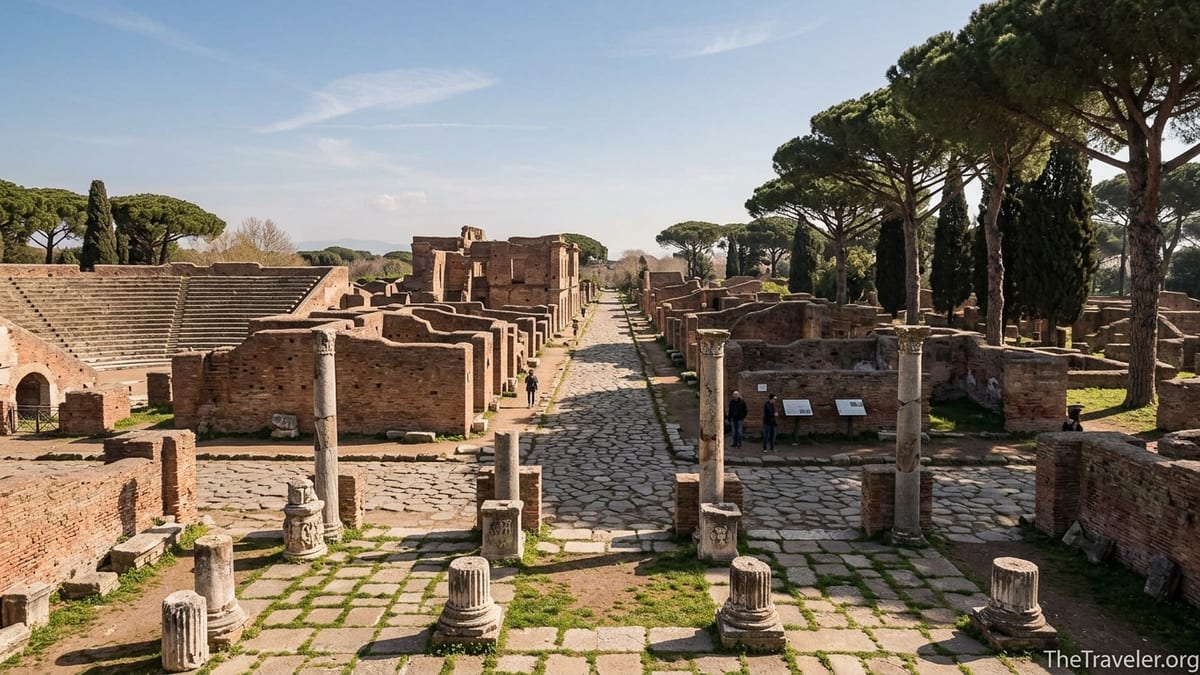
Unlike many archaeological areas that are tightly fenced off, much of Ostia Antica is remarkably accessible. You can walk along the ancient basalt-paved Decumanus Maximus, peek into former taverns with marble counters still in place, sit on the stone steps of the theater or study shop signs made of mosaics. This level of immersion helps you grasp how a Roman port functioned day to day, from grain shipments arriving at the docks to sailors finding a cheap bed in one of the simple lodging houses near the gates.
For modern travelers, another major advantage is practicality. The site sits within Rome’s public transport network, reached by the Metromare / Roma–Lido suburban train and a short walk. That makes it easy to fit into a Rome stay without renting a car or booking an expensive tour, and you can combine it with a stop at the nearby modern seaside district of Ostia for a late lunch or a stroll along the waterfront.
A Short History of Rome’s Ancient Port City
Ostia’s story mirrors the rise and transformation of Rome itself. The earliest settlement began as a fortified camp guarding the coastline and the salt pans that gave the town its name (from “ostium,” meaning “mouth,” referring to the river’s mouth). As Rome expanded its power across the Mediterranean, Ostia evolved from frontier outpost into a strategic maritime hub. By the 1st and 2nd centuries CE, massive investments in harbor infrastructure, including the nearby imperial ports of Claudius and Trajan, turned the area into a logistical engine feeding a city of over a million inhabitants.
The port district buzzed with activity. Grain ships from North Africa and Egypt docked in the harbor complex, their cargoes transferred into warehouses and then shipped upriver to Rome. Archaeologists have found physical traces of this traffic, from stamped amphorae used for olive oil and wine to horrea, the state and private warehouses that lined the main streets. Guild offices housed the corporations of shipowners, grain measurers, and riverboat pilots, evidence of an economy that depended on specialized skills and carefully managed trade networks.
From the 3rd century onward, a mix of factors changed Ostia’s fortunes. Silting of the Tiber’s mouth, shifts in trade routes, and the growing importance of the better-protected harbor of Portus diminished the city’s centrality. Population declined, and by late antiquity Ostia had partly transformed into a quieter residential and religious center rather than a frenetic port. Yet life persisted: Christian churches were built, existing structures were repurposed, and repairs to baths and streets show that the town did not simply vanish overnight.
Over the Middle Ages the area was gradually abandoned, hit by malaria and coastal raids, and buried by layers of silt and vegetation. That slow disappearance is the reason the site is so well preserved. Systematic excavations began in the late 19th and early 20th centuries, intensifying under Italian state archaeological campaigns. By the mid-1900s, large swaths of the ancient city had been uncovered, revealing an urban landscape often compared to Pompeii for its completeness, but with a focus on trade and everyday life rather than a sudden volcanic catastrophe.
Why Many Travelers Prefer Ostia Antica to Busier Sites
For visitors who have already seen the Colosseum and the Roman Forum or who find them overwhelming, Ostia Antica offers a calmer, more spacious alternative. The ruins stretch across roughly 85 hectares, yet the number of daily visitors is far lower than sites like Pompeii or the Vatican Museums. Even in peak season you can often walk along entire streets or sit in the theater almost alone, especially if you arrive at opening time or stay toward closing.
The atmosphere is strikingly different from central Rome. Eucalyptus, pine and cypress trees line the ancient roads, and wildflowers spill through the cracks of paving stones in spring. You can hear birdsong more clearly than tour guides’ microphones. Families find it easier to let children roam a little ahead without losing them in crowds, and photography enthusiasts appreciate the freedom to frame shots without a sea of people in the background. For many travelers, this sense of space transforms the experience from a rushed checklist stop into an unhurried exploration.
Ostia Antica is also physically easier to read than archaeological layers compressed in a modern city center. Standing at a crossroads, you can see how a main street, side alley, apartment blocks, a bath complex and shops relate to one another. Guided tours often point out how the ground-floor units along main roads housed commercial spaces such as taverns and workshops, while upper stories served as living quarters. When you step into an insula with staircases and interior courtyards still visible, you get a concrete sense of how multi-story Roman housing worked in practice.
The practicalities also work in Ostia’s favor. Unlike a trip to Pompeii from Rome, which usually involves a high-speed train to Naples plus a regional train to the site and often costs upwards of 60 to 80 euros per person once tickets and transport are tallied, a day at Ostia Antica can cost a fraction of that. The Metromare / Roma–Lido suburban line from Piramide station uses the same integrated tickets as other Rome public transport, so a standard ticket that costs only a few euros each way, plus the archaeological park entrance ticket, can cover a full day’s outing without complex planning.
Highlights Inside the Ruins: What Not to Miss
Most visits begin on the ancient Via Ostiensis, a straight approach road that once connected the town to Rome. After passing the necropolis of tombs just outside the former city gate, you enter the ruins and quickly reach the Decumanus Maximus, Ostia’s main east–west thoroughfare. This long, stone-paved road is lined with the remains of shops, guild headquarters and residential blocks, making it an ideal spine for orienting yourself as you explore.
One of the first major monuments you encounter is the theater, originally built under Augustus and later expanded. With seating for several thousand people, its semicircular rows of stone seats still host performances during summer festivals. Climb to the upper tiers for a panoramic view across the site: from here you can pick out the forum, bath complexes and the grid of side streets stretching into the distance. At the base of the theater lies the Piazza delle Corporazioni, a rectangular square once surrounded by offices of shipping and trade guilds, whose black-and-white floor mosaics depict symbols such as ships, grain measures and exotic animals.
Further along, the forum area formed the political and religious heart of the city. Here you will see the foundations of the Capitolium, the main temple dedicated to Jupiter, Juno and Minerva, raised high above the square. Traces of the basilica, curia and other public buildings surround the plaza. Nearby bath complexes, such as the Baths of Neptune with its famous mosaic of the sea god driving his chariot of hippocamps, illustrate how bathing functioned as a daily social ritual as well as a hygiene practice. Many travelers find these mosaics more peaceful to appreciate than those in central Rome because there is space and time to linger.
Some of the most evocative corners are the residential and commercial districts. The House of Diana, one of the best known insulae, preserves multiple floors, staircases and interior rooms that help you imagine multi-family living arrangements. In former taverns you may still see counters with inset jars that once held food and wine, while traces of painted advertisements and shop signs survive on wall fragments. For a glimpse into Ostia’s religious diversity, seek out one of the mithraea, underground or windowless sanctuaries dedicated to the eastern god Mithras, or visit the ruins of the synagogue near the ancient shoreline, one of the oldest known synagogues in the western Mediterranean.
Practical Visiting Tips, Tickets and Opening Hours
The Archaeological Park of Ostia Antica is managed by Italy’s Ministry of Culture, with clear, up-to-date visitor information published on its official channels. The site is usually open from Tuesday to Sunday, with opening at 8:30 a.m. year-round. Closing times vary seasonally: in winter months the park generally closes in late afternoon, while from April through September it stays open into the early evening, often around 7:00 p.m. The ticket office and last admission typically close one hour before the posted closing time. The park is normally closed on Mondays, 25 December and 1 January, so it is worth checking dates if you are visiting over Christmas or New Year.
Ticket prices change occasionally, but in recent seasons a standard adult ticket for the archaeological area has been in the mid- to high-teens in euros, with reduced prices for young people from other European Union countries and occasional free-entry days. Combination tickets may cover additional sites managed by the same archaeological park in the nearby Fiumicino area, such as the ancient ports of Claudius and Trajan or the Ship Museum, though opening days for those satellite sites can differ. Children, students and teachers should bring proof of age or status to access any discounts that apply under current regulations.
There is a café and basic refreshment point near the modern entrance and another kiosk deeper within the site in high season, but many visitors prefer to bring water and light snacks, especially on hot days. The park provides drinking fountains at several points, though they can be spaced far apart, so carrying a refillable bottle is practical. Comfortable walking shoes are essential, as paths are a mix of uneven basalt paving, gravel and packed earth, and it is common to walk several kilometers during a standard visit.
Interpretive signage is provided in Italian and English at major monuments, and the on-site museum, the Ostiense Museum, displays sculptures, inscriptions and decorative objects recovered from the excavations. For travelers wanting additional context, several tour operators run half-day group or private tours starting from Rome, often including train tickets, a guide and skip-the-line entry. These typically cost noticeably more than visiting independently, but can be worth it if you prefer structured explanations of architecture, religion and trade rather than self-guided wandering.
How to Reach Ostia Antica from Central Rome
Reaching Ostia Antica is straightforward by public transport, which is one of the reasons the site works so well as a day trip from Rome. The most common route is to take Metro Line B to Piramide station, then follow signs within the same transport hub to the adjacent Porta San Paolo station. From there you board the Metromare / Roma–Lido suburban railway heading toward Lido di Ostia. The journey to Ostia Antica station typically takes around 25 to 30 minutes, depending on the service pattern that day.
Ostia Antica station is only a short walk from the ruins. After exiting the station, you cross a pedestrian overpass above the road and railway, then follow the path into the small modern village of Ostia Antica. From here it is roughly five minutes on foot along a signposted route to the entrance of the archaeological park. Many travelers are surprised by how quickly they transition from an urban metro environment to a semi-rural landscape of fields, pine trees and ancient brick walls.
The Metromare / Roma–Lido line is integrated into Rome’s urban transport system, so standard metro and bus tickets and passes are valid within the city’s normal fare zones, which include the Ostia Antica stop. For example, a single-ride ticket valid for 100 minutes on buses and metro can cover travel between Piramide and Ostia Antica, and day or multi-day passes also apply. Because timetables and operators have gone through changes in recent years, it is wise to double-check current schedules on the official Rome public transport information sources or ask your hotel reception to confirm expected waiting times.
If you prefer to drive, the journey from central Rome to Ostia Antica usually takes around 40 to 60 minutes depending on traffic, using routes such as Via del Mare or Via Ostiense toward the coast. There is parking near the entrance of the archaeological site, though spaces can fill up on sunny weekends when locals also head toward the seaside. Some visitors arriving at or departing from Fiumicino Airport choose to stay overnight in nearby accommodations in Ostia or Fiumicino town and then visit Ostia Antica by local bus or taxi, turning the site into a relaxed start or finish to their Italy trip.
Planning Your Visit: How Long to Spend and When to Go
Most travelers should plan at least half a day at Ostia Antica, and many find that a full day allows for a more relaxed pace. A quick visit that focuses only on the theater, forum and one or two bath complexes can be done in two to three hours, but this leaves little time for the quieter residential streets and the more atmospheric corners of the site. If you are interested in photography, archaeology or social history, four to six hours is more realistic and lets you include a visit to the Ostiense Museum as well.
Season and time of day make a big difference to your experience. Spring and autumn generally offer the most comfortable temperatures, with wildflowers or autumn light softening the ruins. Summer can be hot, especially in July and August, but there is more shade here than at some other archaeological sites thanks to umbrella pines and tall trees throughout the park. If you visit in high summer, try to arrive at opening time, take a long break around midday, and continue in the later afternoon when the light is gentler. In winter, cooler temperatures and lower visitor numbers create a contemplative atmosphere, but shorter daylight hours mean you will want to keep an eye on closing times.
Ostia Antica’s relative lack of crowds means you can improvise more than at the Vatican Museums or Colosseum, where timed tickets and advance booking are now the norm. That said, certain days can still be busier, such as free-entry days or major public holidays. On those occasions, arriving early remains the best strategy. Families with children often find that giving kids a simple “challenge,” such as spotting animal mosaics or counting how many bath complexes they see, keeps younger visitors engaged across the large area.
After your time among the ruins, you might extend the day with a short ride farther along the Metromare line to Lido Centro or Stella Polare and walk to the beach. In warm weather, locals head to public stretches of sand or to stabilimenti, private beach clubs where you can rent a sunbed and umbrella for a few hours. Ending an archaeology-focused morning with a swim or seafood lunch along the waterfront is a very Roman way to round off the excursion.
The Takeaway
Ostia Antica is one of Italy’s best ancient Roman sites because it preserves an entire cityscape, not just isolated monuments. Here you can walk on original streets, step into apartment blocks, study shopfront mosaics and sit in a theater where performances are once again staged each summer. The ruins tell a vivid story of how trade, migration, religion and everyday routines shaped life in Rome’s principal port over many centuries.
For travelers, the combination of historical richness, relative tranquility and easy access from central Rome makes Ostia Antica an exceptional value. A modest transport fare and an entry ticket open up a full day of exploration that rivals far more famous sites in insight and atmosphere. Whether you are a first-time visitor to Rome or returning for a deeper dive into its past, setting aside a day for Ostia Antica offers a rare chance to experience the Roman world on a human scale, at walking pace, with the space to imagine the city as its residents once did.
FAQ
Q1. What is Ostia Antica in simple terms?
Ostia Antica is the archaeological site of ancient Rome’s main port city, a large area of well-preserved ruins where you can explore streets, houses, baths, theaters and shops that once served as the gateway between Rome and the Mediterranean.
Q2. How do I get to Ostia Antica from central Rome?
The easiest way is to take Metro Line B to Piramide, walk into the connected Porta San Paolo station, then board the Metromare / Roma–Lido train toward Lido di Ostia and get off at Ostia Antica. From the station it is about a five-minute walk across a pedestrian bridge to the site entrance.
Q3. How much time do I need to visit Ostia Antica?
Plan at least half a day. A quick overview takes two to three hours, but four to six hours lets you explore the theater, forum, baths, residential streets and the on-site museum at a relaxed pace.
Q4. Is Ostia Antica suitable for children and less experienced travelers?
Yes. The site is spacious and generally less crowded than central Rome, so families can move more freely. Paths are uneven in places, but there are many open areas to explore, and spotting mosaics, inscriptions and animals can keep children engaged.
Q5. Do I need a guided tour, or can I visit on my own?
You can easily visit on your own using the site map and information panels. However, a guided tour, whether group or private, can add depth by explaining trade, religion and daily life, and is often appreciated by visitors who like structured storytelling.
Q6. What are the opening days and typical hours?
The archaeological park usually opens at 8:30 a.m. from Tuesday to Sunday and closes in the late afternoon or early evening, with earlier closing times in winter and later ones in summer. It is generally closed on Mondays, 25 December and 1 January, so always confirm current hours before your visit.
Q7. How much does it cost to visit Ostia Antica?
Ticket prices can change, but a standard adult ticket has recently been in the mid- to high-teens in euros, with reductions for certain age groups and occasional free-entry days. Transport from central Rome is inexpensive, using regular public transit tickets or passes valid on the Metromare / Roma–Lido line.
Q8. What should I wear and bring with me?
Wear comfortable walking shoes, as you will be on uneven stone and dirt paths for several hours. Bring sun protection, water and perhaps a light snack, especially in warmer months, since shade and refreshment points are spaced out across the large site.
Q9. Is Ostia Antica accessible for people with mobility issues?
Some main paths and areas are relatively level, but many sections have steps, cobblestones and uneven surfaces. Visitors with limited mobility may need to focus on selected areas close to the entrance and should check the latest accessibility information from the park before planning a visit.
Q10. How does Ostia Antica compare to Pompeii?
Both sites offer extensive Roman ruins, but Ostia Antica represents a commercial port town near Rome, while Pompeii preserves a provincial city frozen by volcanic eruption. Ostia is usually less crowded and easier and cheaper to reach from Rome, making it an excellent alternative or complement to a longer trip south to Pompeii.