


Most travelers who cross Bologna’s Piazza del Nettuno pause long enough to snap a photo of the famous Fountain of Neptune, then move on toward the cafés and porticoed streets. Yet this sixteenth century monument was designed to be read as carefully as a political manifesto. Its creator, the Flemish sculptor Giambologna, filled every corner with coded symbols, optical illusions and references to global power that still speak volumes if you know where to look. Slow down in front of the bronze giant and an entirely different city story begins to surface.
Get the latest updates straight to your inbox!
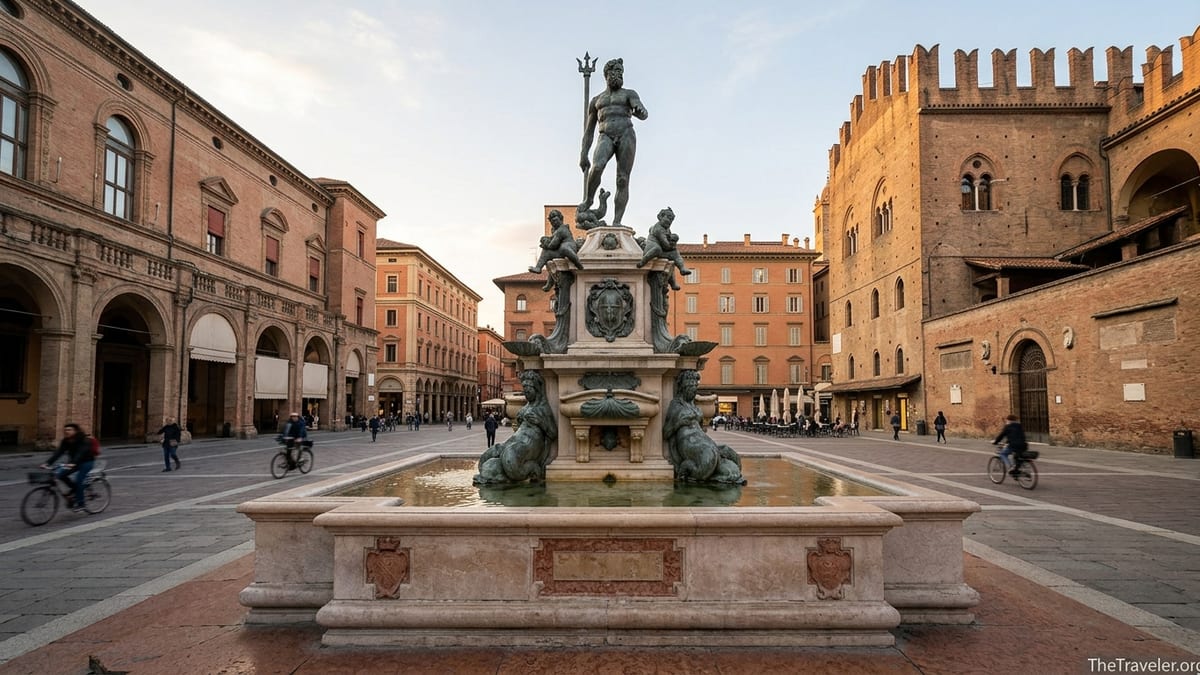
A Political Message Cast in Bronze
Most visitors see the Fountain of Neptune as a generic Renaissance tribute to a sea god. In reality, it was conceived in the 1560s as a bold statement of papal power over Bologna. Commissioned shortly after the Council of Trent by Pope Pius IV and his representatives, the fountain was part of a broader redesign of the city center that included the new Archiginnasio and the Palazzo dei Banchi. Neptune’s muscular body and commanding pose were meant to echo the authority of the pope himself, who, like the god calming the waves, claimed to bring order to the turbulent politics of the region.
If you stand on the north side of the fountain, facing Palazzo d’Accursio, the symbolism becomes clearer. Neptune’s trident points skyward while his free hand is stretched forward in a gesture of dominance, as if he were subduing the waters below. Contemporary viewers would have understood that those waters represented the city and its people under papal control. Even the choice to place the fountain in a newly opened square right beside the civic heart of Bologna was a statement: Rome’s authority was now physically and visually anchored in the middle of local public life.
Travelers today often walk through Piazza del Nettuno without realizing that the entire space was carved out to frame this single work of art. To create room for the fountain and its basin, an entire medieval block between Palazzo Re Enzo and Palazzo del Podestà was demolished in the 1560s. What feels like a naturally generous opening between piazzas is actually a carefully engineered stage, designed so the god and, by extension, the papal government would dominate every approach from Via Rizzoli, Via Ugo Bassi and the edge of Piazza Maggiore.
The Rivers of the Known World at Neptune’s Feet
Look down from Neptune’s outstretched arm and you begin to see another layer that most visitors never identify: the global geography hidden in the putti and dolphins. Around the base of the fountain are four chubby bronze cherubs, each gripping a fishlike dolphin whose mouth spews water into the basin. At first glance they appear to be playful children, but they were meant to personify the great rivers of the continents known to Europeans in the sixteenth century: the Nile, the Ganges, the Amazon and the Danube.
On a quiet morning, when the square is still empty and café chairs are just being arranged along nearby Via Indipendenza, walk slowly around the fountain’s lowest level. Each cherub has slightly different facial features and attributes that hint at the river it represents. One has stylized reeds and lotus forms at its feet, suggesting the Nile Delta. Another is paired with more elaborate foliage, a nod to the dense vegetation of faraway river landscapes that Bolognese citizens would only have known from travel accounts and maps.
The message was simple but powerful: just as these great rivers of the world pour their waters toward Neptune, so the wealth and reach of the papal states extended across continents. For a modern traveler, a circuit around the fountain’s base becomes a miniature geography lesson. You can almost imagine a sixteenth century student of Bologna’s famous university tracing the details and boasting about how the city’s patron in bronze presided over all corners of the globe.
Mermaids, Water and Whispered Myths
Above the cherubs rise four larger bronze figures that many tourists photograph without really seeing: the reclining nereids or mermaids perched at the corners of the main basin. Each one twists her torso in a dynamic spiral, holding her breasts as jets of water arc from them into the pool. Their sensuality has earned the statue a reputation among locals as one of the more risqué monuments in Italy, and it is not unusual to overhear guides warning school groups to keep moving.
These figures are not merely decorative. In period symbolism they represented the fertility of the waters and the bounty that flowed to the city. Watch how the water runs down their bodies on a hot summer afternoon. The patina of the bronze has been polished to a soft sheen by centuries of spray and sunlight, so close that you can see tiny rivulets tracing the sculpted muscles and scales. The fountain was designed so that water does not just emerge from pipes but appears to spring from bodies, an embodiment of abundance.
Bolognese legends have grown up around the mermaids. One of the most repeated stories, told in low voices under the nearby porticoes, claims that Giambologna subtly adjusted their poses to satisfy religious censors who were uncomfortable with their nudity. While documentary proof is thin, the tale reflects how shocked some onlookers were by such explicit bodily forms in a public square. For today’s visitor, those twisting torsos and streaming jets are a reminder that Renaissance Bologna was not a prudish place, and that debates over public art and morality are far from a modern invention.
The Optical Illusion in Neptune’s Hand
Perhaps the most delightful hidden detail is one that almost every visitor misses because it only appears from a precise vantage point. Ask a local student or a walking tour guide and they will point you toward a specific spot behind the fountain, near the steps leading up to Biblioteca Salaborsa. Stand there and look back at Neptune’s outstretched left hand. Thanks to Giambologna’s mastery of perspective, the god’s fingers and thumb line up to form the unmistakable outline of an erect phallus.
In standard tourist photos taken straight on from Piazza Maggiore, the gesture seems innocent, even a little stiff. But from this oblique angle, the silhouette becomes a bold joke carved directly into the city’s most official sculpture. Art historians believe Giambologna originally wanted to give Neptune more pronounced genitals but faced objections from church authorities. By manipulating the pose of the hand instead, he slipped a subversive visual pun into the final composition.
Try this trick late in the afternoon when the sun is low over Palazzo Re Enzo. The angled light sharpens the profile of the fingers, and the bronze surface glows against the warm terracotta façades around the square. You will probably not be alone; in recent years, this hidden image has become a favorite challenge among camera-wielding visitors. Still, even as phones are raised, many passersby walk straight past without knowing that an audacious Renaissance prank is hiding in plain sight just a few steps away.
Technology, Restoration and Nighttime Secrets
Another aspect most travelers overlook is how advanced the fountain’s original hydraulic system was, and how much of what you see today is shaped by modern restoration. When Neptune first began to spout water in the 1560s, the spectacle impressed residents because the jets sprang from dozens of mouths and openings at once. Contemporary descriptions speak of 38 separate nozzles feeding a complex choreography of sprays and cascades, all powered by a sophisticated network of pipes bringing fresh water into the center of Bologna from outside the city walls.
Centuries of wear, pollution and wartime damage took their toll. In the twentieth century, the fountain was repeatedly repaired, and by the early 2000s corrosion had dulled the bronze and clogged many of the channels. A major restoration completed in the late 2010s and refined again in the early 2020s cleaned the metal, consolidated the stone base and updated the lighting. The work revealed fine surface details that had been nearly invisible beneath mineral deposits: scales along the dolphins’ flanks, strands of hair around Neptune’s beard, and delicate shells tucked near the mermaids’ feet.
To appreciate these subtleties, it is worth visiting the square twice in one day. Come in the morning for clear, even daylight that helps you pick out chisel marks in the sandstone and see the slight differences in color between the Verona marble of the basin and the local stone of the steps. Then return after dark, when cool LED spotlights bathe the fountain in a theatrical glow. The new lighting scheme is calibrated to avoid harsh shadows, giving the god’s muscles and the nereids’ curves a soft, almost living presence. Nighttime also quiets the visual distraction of surrounding shopfronts, pulling your eye back to the fountain’s intricate surfaces.
How the Fountain Shapes the Life of the Square
While cameras usually focus tightly on Neptune himself, the fountain only truly makes sense in relation to the buildings and daily life that surround it. Piazza del Nettuno is not a museum courtyard but a working urban space that links several key landmarks: Palazzo d’Accursio and Piazza Maggiore to the south, Palazzo Re Enzo to the east and the glass-roofed Biblioteca Salaborsa to the north. The fountain anchors this junction like a traffic circle for pedestrians, unintentionally forcing everyone to orbit around its basin.
If you spend half an hour on a bench facing the fountain, you will see how it functions as a barometer of the city’s rhythms. In the early morning, municipal workers clean the basin and delivery vans rumble past along Via Rizzoli, while only a few early rising travelers stop to take photos. By late morning, guided groups cluster on the sunlit side to hear about the Medici and the papal legates who commissioned the work. At sunset, when the surrounding porticoes cast long shadows, students from the nearby university lean against the pedestal steps to chat, scroll their phones or eat gelato from one of the shops just off Piazza Maggiore.
Throughout the year, the fountain also plays a quiet supporting role in city events. During outdoor film screenings on Piazza Maggiore in summer, latecomers pass by Neptune’s feet on their way to find a seat, the sound of splashing water blending with the movie soundtrack drifting through the warm night air. On winter evenings, when Christmas lights drape the facades along Via Rizzoli, the bronze figures reflect tiny pinpoints of color that glimmer in the basin. Travelers who treat the fountain as a quick photo stop miss how tightly it is woven into Bologna’s everyday stage.
Modern Echoes: From Car Logo to Street Legends
The Fountain of Neptune’s influence extends far beyond its immediate setting, another facet most visitors never suspect as they circle the basin. In the early twentieth century, the Maserati brothers, who were based in Bologna at the time, chose Neptune’s trident as the emblem for their new car company. Legend has it that one of the brothers sketched the logo after a stroll through Piazza del Nettuno, inspired by the bold silhouette of the bronze spear against the sky. Today, every Maserati that glides along Italian autostrade carries a piece of Bolognese public art on its hood.
The fountain also lives on in countless reproductions, from fridge magnets sold in souvenir shops along Via Clavature to stylized illustrations in local travel guides. A careful observer can spot simplified versions of Neptune and his mermaids on municipal brochures, train station posters and even the labels of regional food products, where the god is sometimes shown lifting a forkful of tortellini instead of a trident. These playful adaptations testify to how deeply the fountain has entered the city’s identity.
Local folklore adds yet another layer. You may hear suggestions that students from the University of Bologna should avoid circling the fountain twice before their final exams, a superstition rooted in the fear of tempting Neptune’s notoriously changeable mood. Others claim that tossing a coin into the basin while secretly tracing the outline of the trident on a postcard will guarantee a return trip to the city. Whether or not you choose to test these tales, they highlight something many travelers miss: for Bolognese residents, Neptune is not just a relic of the Renaissance but a living companion, woven into jokes, rituals and everyday conversations.
Practical Tips for Seeing the Details Up Close
Because the Fountain of Neptune stands in a freely accessible public square, there is no ticket queue or opening time to plan around, but a bit of strategy helps if you want to appreciate its finer points. Light is the main factor. In midsummer, the sun can be intense on the open stone of Piazza del Nettuno around midday, which flattens the sculptural forms and makes it hard to linger close to the bronze. Aim for early morning between roughly 8 and 10 a.m., when the air is cooler and the side of the fountain facing Palazzo d’Accursio is softly lit. In cooler months, this is also the best time to avoid large tour groups arriving from nearby cruise ports via day trips.
Even though the steps and surrounding pavement invite sitting, remember that this is a functioning monument with water features and occasional maintenance. Wear shoes with good grip, as the stone around the basin can be damp and slightly slippery, especially after rain. If you are carrying a camera with a zoom lens, a focal length between about 50 and 85 millimeters allows you to crop in tight on the mermaids’ faces, the dolphins’ eyes and the engraved coats of arms without needing to lean over the protective railings.
Finally, consider pairing your visit with a short stop inside Biblioteca Salaborsa, whose glass floor reveals archaeological remains beneath the square. From the library’s upper windows you can sometimes catch a partial overhead view that emphasizes the fountain’s relationship to the surrounding roofs and streets. Seeing Neptune from ground level and from above in the same day reinforces how carefully the monument was placed and how many layers of urban history ripple out from the plinth beneath his feet.
FAQ
Q1. Where exactly is the Fountain of Neptune located in Bologna?
The Fountain of Neptune stands in Piazza del Nettuno, directly beside Piazza Maggiore and in front of Palazzo Re Enzo in the historic center.
Q2. What is the best time of day to see the fountain’s intricate details?
Early morning and evening provide the most flattering light, with softer shadows that reveal surface textures on the bronze figures and stone base.
Q3. Who designed the Fountain of Neptune and when was it built?
The fountain was designed in the 1560s by architect Tommaso Laureti and sculptor Giambologna, during a major papal redesign of Bologna’s center.
Q4. Is there an entrance fee to visit the Fountain of Neptune?
No, the fountain is in a public square and can be viewed at any time of day without charge, making it an easy stop between other city sights.
Q5. What do the four small children with dolphins around the base represent?
The cherubs holding dolphins symbolize major rivers of the known world, such as the Nile and the Ganges, suggesting global reach under Neptune’s control.
Q6. Why are the mermaids considered controversial?
The reclining mermaids direct water from their breasts into the basin, a sensual detail that shocked some early viewers and still surprises passing visitors today.
Q7. How do I see the optical illusion in Neptune’s hand?
Stand behind the fountain near the steps toward Biblioteca Salaborsa and look at Neptune’s left hand; from that angle his fingers outline a phallic shape.
Q8. Has the fountain been recently restored?
Yes, significant restoration and cleaning in the late 2010s and early 2020s improved the bronze patina, repaired stonework and added subtle, energy efficient lighting.
Q9. What connection does the fountain have with the Maserati logo?
The Maserati brothers, once based in Bologna, adopted Neptune’s trident from the fountain as the inspiration for their car company emblem.
Q10. Are there any etiquette tips for visiting the fountain?
Respect barriers, avoid climbing or sitting on the sculpture, keep food and drinks away from the basin and give space to others who are quietly observing or photographing.