


On paper, Antibes sounds like the prototype of a polished Riviera resort. It has a marina lined with superyachts, a glamorous neighbor in Juan les Pins, and a prime position between Nice and Cannes. I arrived half expecting a stage set: pastel facades perfectly curated for visitors, menus translated into five languages, and a sense that real life had quietly moved somewhere else. What surprised me most was how wrong that assumption turned out to be. Antibes, for all its postcard views, still feels convincingly, sometimes disarmingly, authentic.
Get the latest updates straight to your inbox!
First Impressions Between Ramparts and Superyachts
Stepping through Porte Marine from Port Vauban into the old town, the contrast is almost cinematic. Behind you, the largest marina in the Mediterranean spreads across the bay, its Billionaires’ Quay lined with 70 to 160 meter yachts that look more like minimalist glass villas than boats. A few meters later, the scene shrinks to human scale: stone ramparts, laundry fluttering above narrow lanes, and locals discussing the weather on café terraces at Place Nationale. For a town that could easily lean into pure spectacle, the daily rhythm still feels anchored in the lives of the people who actually live here.
That duality might be the essence of Antibes. On the harbor side, Port Vauban welcomes some of the most luxurious yachts in Europe, with around 1,500 berths for everything from tiny fishing boats to floating palaces. Walk ten minutes into Vieil Antibes and you are more likely to see an electrician unloading a van, a school group filing past the cathedral, or a baker rushing trays of croissants to a corner boulangerie than you are to hear English on the street. It is not that tourism is absent. It is that it coexists with an intact local life that was never fully pushed aside.
The surprise begins with the soundscape. Rather than a chorus of rolling suitcases and tour guides with raised umbrellas, mornings are dominated by the rumble of delivery trolleys and the murmur of conversations in French, Italian and Provençal accents. Even when cruise passengers spill through the gates of the port, they are absorbed quickly into the grid of lanes. You watch them peel off toward the Picasso Museum or the ramparts while life at the tabac and the corner épicerie carries on much as it likely did decades ago.
Market Mornings That Still Belong to Locals
Any Riviera town can stage a market. What sets Antibes’ Marché Provençal apart is how little of a performance it feels like at 7:30 in the morning. Under the covered hall on Cours Masséna, the first people you notice are not photographers or food bloggers, but residents doing their daily shop with woven baskets and reusable sacks. Traders call regulars by name. A cheesemonger slices a sliver of goat cheese for an elderly customer to taste, no showmanship, just the easy shorthand of people who have done this transaction hundreds of times.
The market runs daily in high season and most days the rest of the year, starting before sunrise and winding down around lunchtime. By eight, stalls are heavy with crates of tomatoes still warm from nearby fields, bunches of basil, enormous lemons, and local cheeses. You might pick up a modest picnic for two for around 15 to 20 euros: a small round of fresh chèvre, a bag of Niçoise olives, a punnet of strawberries, and a crusty baguette from L’Epi d’Or or another bakery nearby. Prices are not bargain basement, and some gourmet stands clearly cater to visitors, but the backbone of the market is regional producers and smallholders from the hinterland above Antibes.
Later in the morning, especially in July and August, the crowd shifts. Day trippers arrive from Nice and Cannes, tour guides hover near tables of lavender sachets and painted ceramics, and the atmosphere edges toward the familiar Riviera bustle. Yet even at the busiest times, you still see chefs in whites selecting herbs, retirees comparing melons with the vendor they have favored for years, and parents with strollers cutting through the aisles simply because this is the most direct route home. The market might be photographed like a tourist attraction, but it functions first as a pantry for the town.
Backstreets, Safranier and the Quiet Life Behind the Facades
Step away from Cours Masséna and the ramparts, and Antibes reveals another layer of its character. Within a few minutes you can be entirely alone in a lane so narrow that you can touch the facades on both sides with outstretched arms. In the small quarter of Safranier, officially a free commune inside the city, the streets twist past low houses painted in soft ochres and pinks. Potted geraniums spill over windowsills, scooters lean against stone walls, and cats seem to have assigned themselves ownership of specific doorsteps.
What struck me most here was the absence of overt marketing. Many doors carry simple nameplates instead of plaques for holiday rentals. A few small guesthouses blend in so seamlessly that you only realize they are accommodations when you notice suitcases in the hallway. There are no neon signs for pub crawls, no frozen cocktail boards, and only the occasional discreet notice for a local wine bar or tapas place. It feels like a neighborhood that has decided how much of itself it is willing to share with visitors and has quietly drawn the line.
Even in streets closer to the main squares, signs of everyday life are everywhere. Schoolbags lean in stairwells. A hand-written note on a bakery door explains that the owner is closing for a week to attend a family wedding. In the late afternoon, children race each other on scooters across Place Nationale while their grandparents nurse small coffees at metal tables. A city that lived primarily for tourism would have turned those same squares into constant restaurant seating. Here, there is still open space reserved for the fluid, unplanned uses that make towns feel lived in.
Port Vauban: Billionaires’ Quay Meets Fishermen’s Boats
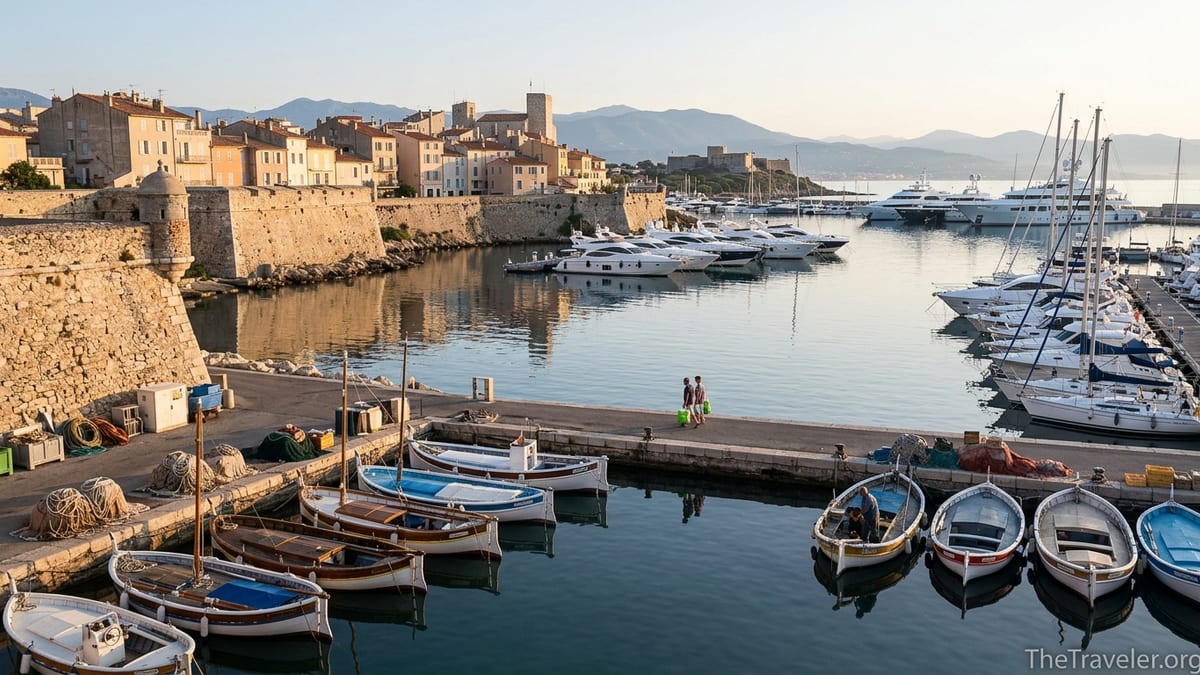
Of all the places where Antibes might have lost a sense of proportion, Port Vauban seemed the likeliest candidate. On one side, the Grande Plaisance quay, often called Billionaires’ Quay, hosts a line of superyachts that can reach 100 meters and beyond, guarded by security teams and discreet crew. On the other, near the old harbor, you still find modest wooden pointus, the traditional fishing boats of the Mediterranean, bobbing on their moorings, paint gently peeling under the salt and sun.
In the early morning, when the light is soft and the Alpes-Maritimes are faint on the horizon, you can watch a fisherman gutting a small catch on the quay while, behind him, the polished hull of a yacht reflects the first rays of sun. It is an almost absurd juxtaposition, but a real one. Port Vauban is a major economic engine and a symbol of modern yachting culture, yet it has not completely erased the working harbor that preceded it. Local guides offer walking tours that explain how the port evolved from a strategic military harbor into the largest marina in the Mediterranean, but they also pause to talk about the families that still fish from these waters.
Stroll further along the quay and you reach the lookout near Fort Carré, a 16th century fortress built to guard this once-vulnerable stretch of coast. From here the view encompasses the entire story: the old town nestled behind its ramparts, the spread of masts across the marina, and the arc of public beaches where families lay out simple towels rather than designer beach club cushions. What surprised me here was not the scale of the wealth on display, which you can find in many Riviera ports, but how visibly it coexisted with traces of a much older maritime life.
Seasons, Crowds and the Times When Antibes Feels Most Itself
Like much of the Côte d’Azur, Antibes lives several lives depending on the month. In high summer, the old town beaches such as Plage de la Gravette fill up quickly, and the narrow lanes can feel choked with visitors by mid-afternoon. Shakespeare-and-jazz filled Juan les Pins swings into high gear, and terrace tables along the ramparts book out weeks in advance. During this window, authenticity can feel buried under the weight of crowds, even if it still exists just beyond the main routes.
Visit in late April, May, September or early October and a different personality emerges. The market is busy but not frantic, locals reclaim more of the seafront benches, and restaurant staff have time to chat about the day’s catch. Hotel prices moderate slightly compared to peak August, and you might find a simple but comfortable double room in a small family-run hotel a short walk from the old town for under 130 to 150 euros per night, rather than the significantly higher mid-summer rates. The sea is still warm enough for swimming well into October in many years, and the light has that softer, honeyed quality that makes the stone ramparts glow at sunset.
Then there is winter, when Antibes becomes, above all, a town for its residents. Cafés still open on Place Nationale, but the clientele is almost entirely local. Attractions like the Picasso Museum see a trickle rather than a flood of visitors, and you can wander the lanes around Safranier in near silence. Restaurants adapt their menus to colder evenings, leaning into heartier Provençal stews, truffle omelettes and generous glasses of local red wine. The authenticity that surprised me most in spring is simply the default setting from November to March.
How to Tap Into Antibes’ Authentic Side as a Visitor
Part of what keeps Antibes feeling real is that it has not been entirely reshaped around tourism. That means visitors need to adapt to its rhythms rather than expecting everything to bend around them. A good start is to time at least one morning to match the market’s earliest hours. Arrive by 8 and resist the urge to photograph every stand immediately. Instead, buy a coffee from a bar near the hall, watch who the locals queue for, and then follow them. You might discover that the most unassuming vegetable stall has the sweetest cherry tomatoes of your trip.
Eating habits matter too. While there are polished seafront restaurants with menus in multiple languages and prices to match the view, some of the most satisfying meals hide on side streets. Look for short menus written on blackboards, often changing daily, where lunch formulas with a starter and main might sit around 22 to 28 euros. You are more likely to be surrounded by local office workers and retirees than tour groups, and dishes will lean on what is in season at the market rather than a fixed list of crowd-pleasers.
Accommodation can shape your experience as well. Choosing a small independent hotel or guesthouse within walking distance of both the old town and the less glamorous parts of Antibes exposes you to early morning school runs, the smell of bread baking at odd hours, and the quiet of mid-afternoon when shutters close against the strongest sun. It is tempting to gravitate straight to the flashiest addresses, especially around Cap d’Antibes, but staying closer to where people actually live gives you a better chance of encountering the town at its most unaffected.
The Takeaway
In an era when many coastal towns along the Mediterranean feel carefully stage-managed, Antibes stands out less for its beauty, which is considerable, than for the way daily life still runs visibly through it. The ramparts and superyachts, the Picasso Museum and jazz festivals, the boutique hotels and beach clubs are real, but so are the schoolyards, the grocery lines, the fishermen in Port Vauban and the elderly couples arguing amiably over which olives to choose at the Marché Provençal.
What surprised me most was not that Antibes had preserved its historic center, or that it still celebrates its maritime heritage. It was the sense that, underneath the Riviera gloss, the town has kept faith with itself. Authenticity here is not a curated aesthetic but the natural byproduct of people who have continued to live, work and shop in the same streets even as the world discovered their home. As a traveler, the most rewarding thing you can do is slow down enough to notice those ordinary moments and make space for them in your own story of Antibes.
FAQ
Q1. Is Antibes still worth visiting if I usually avoid very touristy places?
Yes. While Antibes does get busy in summer, especially around the old town beaches and main squares, much of its residential core, local markets and quieter backstreets still feel lived in rather than staged. Visiting outside peak August, or simply exploring beyond the main thoroughfares, reveals a town that remains surprisingly authentic.
Q2. When is the best time of year to experience Antibes at its most authentic?
Late April to June and September to early October are ideal. The weather is usually warm, the sea is often swimmable, and the Marché Provençal and café terraces are lively without being overwhelmed. In winter the town is even quieter and very local in feel, though some seasonal businesses close.
Q3. How expensive is Antibes compared with other French Riviera towns?
Antibes is not cheap, but it is often a little more approachable than some nearby resorts. In shoulder season you might find small independent hotels or guesthouses from roughly 120 to 180 euros per night, simple bistro lunches from around 18 to 25 euros for a set menu, and market picnics for two for under 20 euros if you choose carefully.
Q4. Does the Marché Provençal feel touristy or local?
It depends on the time of day. Before about 9 a.m., the market feels very local, with residents doing their daily shop and chefs sourcing produce. As the morning goes on, especially in high season, more visitors arrive and the atmosphere becomes busier and more photogenic. Even then, many stalls are run by regional producers and still serve regular local customers.
Q5. Are there still traditional fishing boats in Antibes despite all the superyachts?
Yes. Around the old harbor area of Port Vauban you can still see traditional wooden pointus moored alongside small working boats. They coexist with the larger yachts, especially around the sections of the port closest to the old town, and you will sometimes see fishermen cleaning their catch on the quay early in the morning.
Q6. Is it better to stay in the old town of Antibes or in Juan les Pins?
For an authentic feel, the old town is usually the better choice. Its lanes, market and proximity to the ramparts put you close to daily local life. Juan les Pins, just next door, has a livelier beach resort atmosphere with more nightlife, which appeals to some travelers but can feel less traditional.
Q7. Can I explore Antibes on foot, or do I need a car?
The compact core of Antibes, including the old town, Port Vauban, main squares and nearby beaches, is very walkable. Many visitors arrive by train and explore entirely on foot. A car can be useful for reaching hill villages and more remote coves, but within Antibes itself it is more of a complication than a necessity.
Q8. Are there beaches in Antibes that feel less crowded and more local?
In high summer, most central beaches become busy. However, visiting early in the morning or later in the afternoon often means sharing the sand with more residents than day trippers. Outside July and August, the small coves near the ramparts and the longer stretches toward Cap d’Antibes can feel surprisingly peaceful.
Q9. How can I support local businesses while visiting Antibes?
Shop at the Marché Provençal and nearby specialty stores for food, choose family-run cafés and bistros off the main tourist routes, and consider staying in independent hotels or guesthouses. Booking activities like guided walking tours with local guides also helps money stay in the community.
Q10. Is Antibes a good base for exploring the rest of the Côte d’Azur?
Yes. Antibes sits on the main coastal rail line, with frequent trains to Nice, Cannes, Monaco and smaller towns along the shore. You can enjoy the authentic atmosphere of Antibes in the mornings and evenings while using the efficient local train and bus network for day trips along the Riviera.