


More news on this day
A recent freight train derailment in Hidalgo County during a period of severe winds is drawing renewed scrutiny of how extreme weather may be affecting rail operations and infrastructure across South Texas.
Get the latest news straight to your inbox!
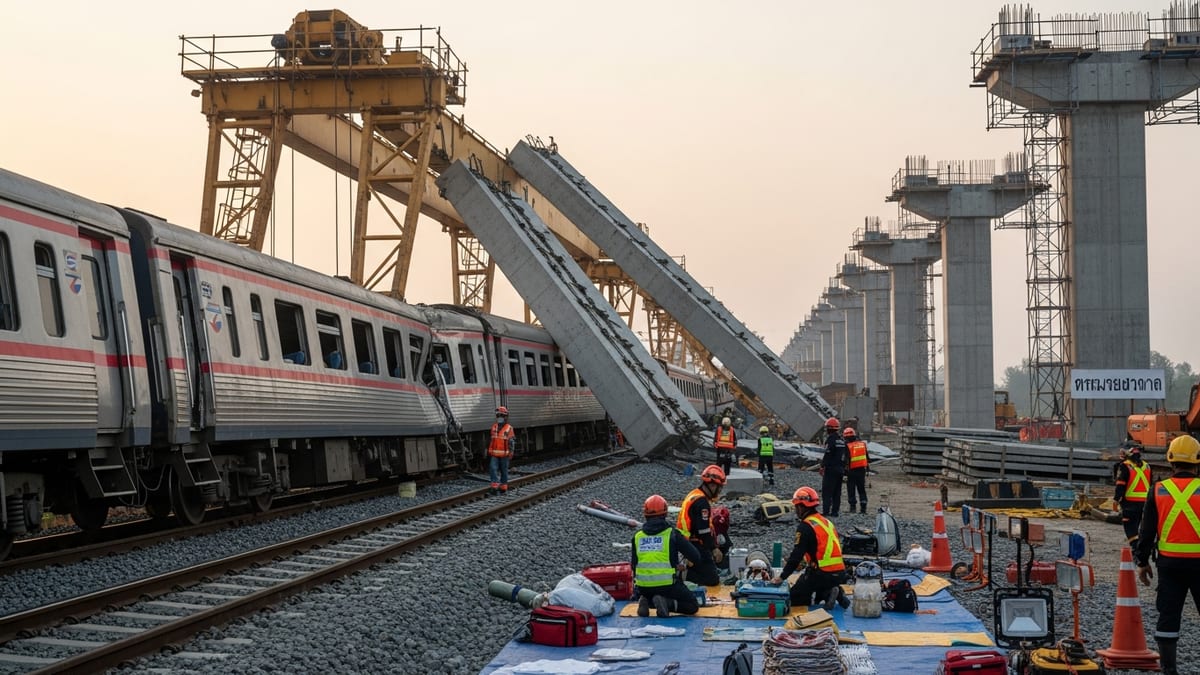
Freight Cars Topple as Storms Sweep Across the County
According to early regional coverage and local emergency summaries, the derailment occurred as a line of intense storms swept across Hidalgo County, bringing gusty winds, heavy rain and rapidly changing visibility. The train, described in public reports as a freight consist hauling mixed cargo, left the tracks near a rural stretch of right of way where open fields can expose trains to strong crosswinds.
Initial information from publicly available incident logs indicates that several railcars tipped onto their sides, scattering debris along the ballast and adjacent easements. No major fire, explosion or large hazardous-materials release has been documented in early summaries, although responders conducted standard checks for leaking fuel and cargo. The locomotive units reportedly remained upright, limiting the footprint of the crash.
Local images shared through regional media show railcars lying at sharp angles to the track, with wheelsets displaced and sections of rail bent or misaligned. Nearby vegetation appears flattened in one direction, consistent with the passage of strong straight-line winds, sometimes associated with severe thunderstorms or microbursts.
Rail traffic through the area experienced temporary disruption while crews assessed track damage and began rerailing operations. Freight movements on parallel or connecting lines were rerouted or slowed as dispatchers worked around the blocked section.
High Winds Emerge as a Leading Line of Inquiry
Meteorological data compiled for Hidalgo County in recent weeks shows episodes of strong thunderstorms capable of producing damaging gusts. Public forecasts for the region have highlighted the potential for outflow winds in the 50 to 70 mile per hour range during the strongest cells, a threshold that rail safety literature notes can pose challenges for tall or lightly loaded freight cars.
Published analyses from federal rail safety investigators have long recognized that extreme wind can contribute to derailments, particularly for double-stacked container trains, empty hopper cars or other high-profile rolling stock. Case studies from other states describe situations in which intense gusts pushed cars off the rails on exposed embankments, bridges or open prairie alignments.
In this Hidalgo County case, early descriptions from regional outlets emphasize that the derailment coincided closely with the passage of a severe storm system. While a full technical investigation is required to determine any official cause, the timing and the pattern of damage have prompted discussion among rail observers about the role of crosswinds, train speed and train makeup.
Analysts note that factors such as the orientation of the track relative to wind direction, the weight distribution of the consist and the condition of the roadbed can all influence how a train responds to sudden gusts. A combination of saturated ground and strong winds can also undermine track stability, particularly where drainage is poor.
Emergency Response and Community Impact
Publicly available information from local emergency channels indicates that responders from nearby communities moved quickly to secure the scene and establish a safety perimeter around the derailed train. Traffic controls were put in place on access roads closest to the right of way, and residents were advised to avoid the area while heavy equipment operated on and around the tracks.
Early accounts suggest there were no mass-casualty injuries, though at least one crew member or contractor is reported to have undergone medical evaluation as a precaution. Nearby homes and businesses did not sustain major structural damage linked directly to the derailment, according to initial visual assessments referenced in local reports.
Residents nonetheless faced short-term disruption as rail and utility crews worked in the corridor. Some rural crossings were temporarily blocked, forcing drivers onto longer detours. Noise from rerailing operations and debris removal continued into the night as contractors used cranes and specialized machinery to lift and reposition overturned cars.
Environmental agencies and railroad personnel monitored for any signs of soil or water contamination in ditches and drainage channels near the crash site. As of the latest public updates, no large-scale release into waterways had been documented, though follow-up inspections typically continue for days or weeks after such incidents.
Rail Safety, Weather Risk and a Changing Climate
The Hidalgo County derailment adds to a broader national discussion about how freight railroads are adapting to more frequent episodes of severe weather. Climate assessments for South Texas highlight the potential for stronger thunderstorms, heavier downpours and more erratic wind events, all of which can stress transportation infrastructure.
Rail safety research indicates that high winds, intense precipitation and flooding can each play a role in derailments by undermining embankments, washing out ballast, loosening fasteners or directly toppling cars. Some railroads have begun investing in additional weather monitoring, wind sensors along vulnerable corridors and operational protocols that require trains to slow or halt when gusts exceed certain thresholds.
Infrastructure specialists point out that older rights of way, originally laid out in more stable climatic conditions, may now face different stress profiles. Embankments built decades ago can be more prone to erosion during repeated heavy rain events, and vegetation along the right of way can become both a windbreak and a hazard if it collapses onto tracks.
Advocates for stronger resilience planning argue that mapping the intersection of severe-weather hotspots with major freight routes could help railroads prioritize upgrades, from additional drainage to reinforced structures, in regions such as Hidalgo County where strong storms are a seasonal reality.
Next Steps for Investigation and Recovery
In the weeks ahead, the Hidalgo County derailment is expected to move from emergency response into a more methodical review phase. Rail accident investigations generally examine event recorder data, train handling, track conditions, maintenance records and available meteorological information to build a timeline of what happened in the moments before cars left the rails.
Engineering teams will likely assess whether any infrastructure repair or reinforcement is warranted beyond basic track restoration. That process can include soil testing, evaluation of drainage patterns and inspection of nearby bridges, culverts or embankments that might have been stressed by the same storm system.
For residents, one of the most visible milestones in the recovery will be the resumption of normal train movements through the affected segment. Once repairs are complete and inspections are passed, freight traffic usually returns under temporary speed restrictions while railroads monitor the rebuilt section for any anomalies.
The Hidalgo County incident, while limited in geographic scope, underscores how quickly a severe wind event can escalate into a transportation emergency. As South Texas heads into the heart of storm season, the derailment is likely to remain a reference point in local conversations about weather, infrastructure and the movement of freight through the region.