


Samaria Gorge is one of Greece’s most iconic hikes, a dramatic canyon cutting through the White Mountains of western Crete before meeting the Libyan Sea at the tiny village of Agia Roumeli. Crossing this gorge is a full mountain-to-sea experience that combines rugged scenery, Cretan nature and village life in a single unforgettable day. It fits easily into a wider Crete itinerary as a long but feasible day trip from Chania or Rethymno, provided you understand the logistics and prepare for the conditions.
Get the latest updates straight to your inbox!
Why Samaria Gorge Is So Famous
Samaria Gorge lies within Samaria National Park in the White Mountains of western Crete, in the Chania regional unit. The protected area preserves steep limestone walls, forests of pine and cypress, and a narrow canyon floor carved by a seasonal river. For many visitors, this is the most spectacular single day in Crete’s interior, offering a strong contrast to the island’s coastal resorts.
The classic route runs predominantly downhill from the Omalos plateau at a high entrance called Xyloskalo to sea level at Agia Roumeli on the south coast. Over the course of the day, hikers pass ruined hamlets, shaded rest spots and the famous “Iron Gates,” where the walls of the gorge narrow to only a few meters apart and soar high overhead. The combination of dramatic geology and accessible infrastructure has made Samaria one of Europe’s best-known canyon walks.
In a typical Crete itinerary, Samaria is tackled as a dedicated full-day excursion, usually from a base in Chania or nearby resorts, sometimes from Rethymno with an early start. It is realistic for moderately fit travelers who are comfortable walking for many hours on mountain paths but may be new to Greek heat, terrain and transport. Understanding how the park operates and how the bus and ferry connections work is essential to making the day smooth rather than stressful.
Route Overview, Distance and Difficulty
The standard hike is a one-way traverse from north to south. Most visitors start at Xyloskalo on the Omalos plateau, at roughly 1,200 meters above sea level, and finish in Agia Roumeli at the Libyan Sea. National park information and recent hiking descriptions indicate a total walking distance of around 15 to 16 kilometers from gate to sea, with a net descent of approximately 1,200 vertical meters.
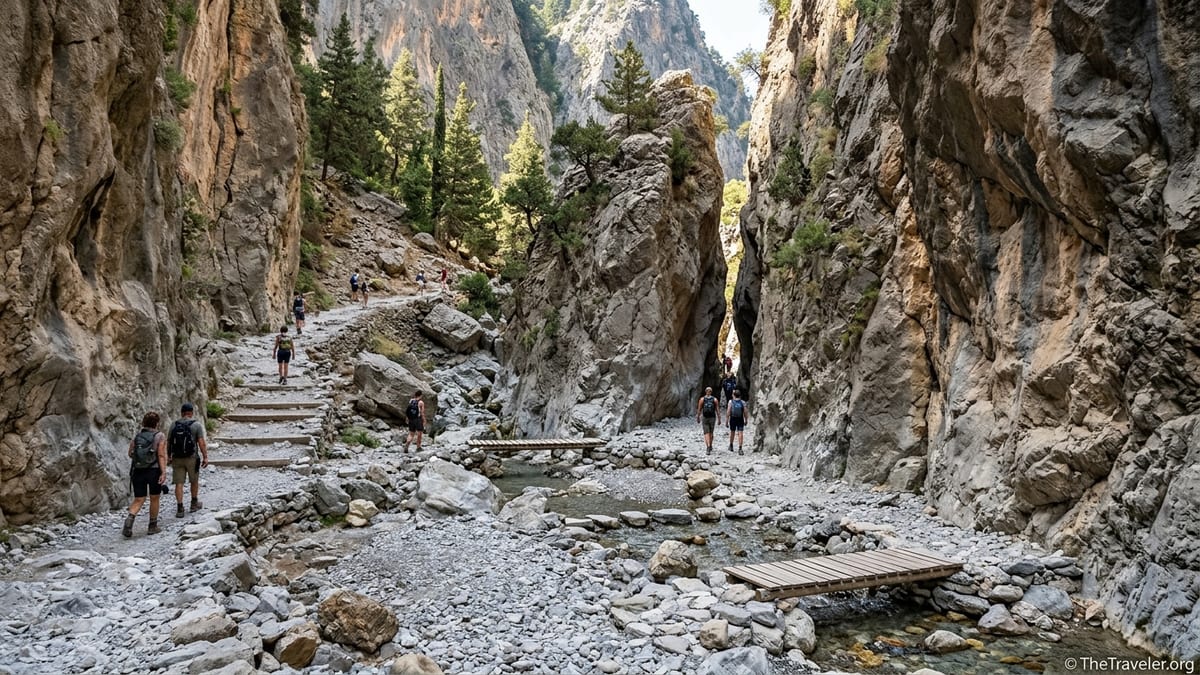
The first section out of Xyloskalo is the steepest, dropping quickly on a constructed but rough path with steps and switchbacks. After this long descent, the trail follows the riverbed and crosses it many times via stones or small bridges. The final approach to the “Iron Gates” and on to Agia Roumeli is mostly on a stony riverbed path with some flatter walking but also loose rocks underfoot. The terrain is consistently uneven, with stones, roots and man-made steps rather than smooth track.
Most moderately fit walkers should expect the crossing from Xyloskalo to Agia Roumeli to take roughly 4.5 to 7 hours, depending on pace, heat, crowding and photo or swim stops. Faster times are possible for experienced hikers, but planning on a full day is sensible. It is crucial to remember that although the route is mostly downhill, the continuous descent can be harder on knees and ankles than an equivalent ascent, and the rocky footing requires concentration.
Samaria is best suited to travelers who already walk several hours comfortably at home and are used to basic mountain paths. Anyone with significant knee, hip or ankle problems, poor balance or very limited fitness should think carefully before committing to the full traverse and consider easier alternatives instead.
Season, Opening Times and Closures
Samaria Gorge is part of a managed national park and is not open year-round. Official park guidance states that the main hiking route is generally open from early May to mid-October, with possible extension toward late October if weather and trail conditions allow. The gorge can close earlier, open later or shut temporarily if there are storms, risk of rockfall, fire danger or maintenance works, and decisions are made by the park authorities.
Typical daily operating hours allow access from early morning, around 6 or 7 a.m., until mid-afternoon. There are cut-off times for entering from each end so that rangers can ensure no one remains in the gorge after dark. These specific times can change, and it is essential to check the current information shortly before your hike, using official national park channels or local tourist information offices in Chania or Omalos.
Short-notice closures do occur, particularly after heavy rain or during periods of high fire risk in summer. Even if you have booked a tour or arranged bus tickets, you must accept that the gorge may close for safety reasons on the day and that operators must comply. When the full route is closed, the park sometimes allows a shorter out-and-back walk from one entrance, but this is not guaranteed and may change year by year.
Because of this variability, travelers should build some flexibility into their Crete plans during shoulder seasons or unsettled weather. If hiking Samaria is a priority, consider allowing two possible days for the trip in case the first date is cancelled due to conditions.
Transport, Access and Typical Itineraries
The classic Samaria day begins with an early-morning journey to Xyloskalo and ends with an afternoon or early-evening ferry from Agia Roumeli to another south coast village, followed by a bus back to your base. Almost no one walks the gorge in reverse or returns uphill to Omalos. Instead, the combination of bus in and ferry out makes the hike a linear traverse from mountains to sea.
Many visitors choose an organized excursion from Chania, Rethymno or resort areas. These typically include coach transport to Xyloskalo, an escort or coordinator to help with timings and tickets, and a rendezvous at the end of the day in Agia Roumeli. Entrance and ferry tickets are often paid separately. The advantage is that the tour company manages the connection between bus and boat, useful if you are unfamiliar with Greek public transport or traveling with a group.
Independent travelers usually rely on regional KTEL buses. From Chania, there are seasonal morning buses to Omalos and Xyloskalo that are timed to reach the park near opening time. Recent published timetables show several departures in the early morning on hiking days, although exact times and frequency vary by season and year and should be confirmed shortly before travel. The journey time from Chania to Xyloskalo is roughly one to one and a half hours.
At the southern end, Agia Roumeli has no road access, so onward travel is entirely by sea. In high season, ferries generally run in the afternoon from Agia Roumeli east to Chora Sfakion and west to Sougia or Paleochora, operated by companies serving the south coast of Crete. These sailings often coordinate with KTEL buses at Sfakia and Sougia for returns to Chania and Rethymno. In shoulder seasons there may be fewer boats, and in early or late season some routes may not run daily. Rather than relying on old brochure times, check current ferry timetables for your exact travel month and allow generous margins.
Tickets, Fees and Typical Costs
Hiking Samaria Gorge requires several separate tickets. First is the national park entrance fee, paid at the Xyloskalo entrance or via authorized outlets. Recent examples from tour documents and local providers suggest this adult fee has been around 10 euros in recent seasons, with reductions for children, students or certain concession categories. However, prices can change and should always be confirmed close to your visit through official park or ticketing channels.
On top of this, you will pay for transport. Public bus tickets between Chania and Xyloskalo or between Chania and the south coast villages are typically priced in the range of several euros each way, varying slightly with route and fuel costs. Organized excursions usually bundle coach transport into a single per-person fee, while leaving the park entrance and ferry to be paid separately in cash or by card.
The ferry from Agia Roumeli to Chora Sfakion or Sougia is a separate ticket again. Recent tour materials indicate that one-way adult fares are commonly in the region of 15 to 25 euros, depending on destination and season, with discounted fares for children. Exact prices and whether deck class or luggage supplements apply depend on the ferry operator and year.
Because so many elements are involved, it is unwise to plan the day around a precise historical fare. Instead, budget for the park entrance, two bus segments and one ferry ticket per person, and then check the most up-to-date prices when booking buses, tours and boats, or at the KTEL bus station and local ticket offices in Chania.
What to Expect on the Trail
From the moment you leave the wooden railing of Xyloskalo, the character of the hike is rugged. The upper section consists of a steep descent on a constructed footpath with steps and switchbacks, often covered in small stones that can roll underfoot. In dry conditions the surface becomes dusty and slippery in places. Most of this part of the walk is shaded by pine forest, which offers some relief from early sun.
Lower in the gorge, the path alternates between broader track beside the riverbed and narrow sections where you cross the stream repeatedly on stones or short bridges. Expect to walk for long stretches on rounded river rocks and gravel, which can be tiring for ankles. The famous “Iron Gates” section, where the canyon narrows dramatically, is one of the stoniest, and you will likely meet more congestion here as hikers pause for photographs.
The park is equipped with basic infrastructure. There are waymarkings, footbridges, simple toilets at several rest stops, and designated places to refill water bottles from natural springs that are monitored by the park authorities. However, there are no shops or cafés inside the gorge itself, and you must be entirely self-sufficient in food and any special drinks or electrolytes. Rubbish must be carried to the bins provided at rest areas.
Mobile phone coverage is patchy and often absent in the deeper parts of the canyon. Park rangers are present along the route and at key points, and they play an important role in monitoring safety and assisting in case of problems. Even so, the responsibility for pacing yourself, staying hydrated and watching your footing remains with you.
Essential Gear, Weather and Safety Considerations
Good footwear is the single most important piece of equipment for Samaria. Sturdy hiking shoes or boots with grippy soles and proper support are strongly recommended. Lightweight trainers or sandals leave you vulnerable to slipping on gravel or twisting an ankle on rocks. Walking poles can be very helpful during the early long descent and on the stony riverbed, especially for anyone with sensitive knees.
Summer in Crete can be intensely hot, especially from late June through August. Even though much of the gorge is shaded for parts of the day, temperatures remain high and humidity can increase in the enclosed canyon. Sun protection, including a hat, high-factor sunscreen and light clothing that covers shoulders, is vital. Carry sufficient water for the first hours and then refill regularly at official springs along the route. Many hikers also bring salty snacks or electrolyte tablets to guard against the effects of sweat and heat.
The park authorities and local guides advise against attempting the full traverse if you have serious heart, respiratory, joint or mobility issues, or if you are unused to walking on rough ground for several hours. Very young children often struggle with the length and heat, and carrying them through the gorge is challenging and potentially unsafe. Families should honestly assess their group’s abilities and consider shorter gorges or partial walks instead.
If you experience injury or become unable to continue, inform the nearest ranger or ask other hikers to alert them. There are established procedures for assisting walkers, including the use of mules or organized evacuations in more serious cases, but these are reserved for genuine need. It is important not to leave the marked trail, not to attempt shortcuts, and to follow all instructions given by park staff regarding weather changes, rockfall risk or path closures.
Guided Tours vs Independent Hiking
Samaria is essentially a self-guided hike. The path is clear, directional choices are limited and there is a steady flow of other walkers throughout the main season. For confident independent travelers who are comfortable using public transport and reading basic trail signs, organizing the day yourself with KTEL buses and standard ferry services is entirely feasible and can be more economical.
However, there are good reasons some visitors opt for an organized excursion. Tour operators arrange early pick-up from multiple hotels or resort areas, handle the coach journey to Xyloskalo, explain how tickets and timings work, and coordinate with the ferry back from Agia Roumeli. For travelers with limited time, those unfamiliar with the Greek language or ticketing systems, or anyone anxious about missing the last ferry or bus, this logistical support can significantly reduce stress.
Guided tours do not typically provide continuous guiding inside the gorge in the way that a high-mountain guide would. Instead, you usually walk at your own pace, perhaps with a guide near the front and another near the back of the group, and meet at a designated time in Agia Roumeli. Travelers should be clear on what is and is not included, especially regarding park entrance and boat tickets, to avoid surprises on the day.
Whichever option you choose, the key to a smooth experience is understanding the sequence: early transport to Xyloskalo, steady self-paced hike, time for a short swim or meal in Agia Roumeli, then afternoon ferry and connecting bus back. Keeping an eye on the clock during rest stops, without rushing dangerously on the path, is part of responsible planning.
Integrating Samaria into a Wider Crete Trip
For most visitors, the easiest base for Samaria is Chania, which offers plenty of accommodation, restaurants and evening atmosphere as well as direct access to the regional bus station and tour operators. Staying at least one night in Chania before the hike avoids a long pre-dawn transfer from elsewhere on the island and makes it easier to catch the earliest buses or tour departures.
Some hikers choose to spend the night before on the Omalos plateau, which allows a slightly later wake-up and immediate access to the park entrance. There are a handful of guesthouses and small hotels in the area. This approach can be especially attractive in high summer, when sleeping at elevation is cooler, and for travelers who prefer a quieter mountain environment to a city the night before a strenuous day.
If the full Samaria crossing seems too demanding, Crete offers numerous shorter or less committing gorge walks, including options closer to Chania and Rethymno. These can deliver impressive scenery with less descent and shorter durations. Consulting local hiking information offices or accommodation hosts is a good way to match a route to your ability and the season’s conditions.
For those completing Samaria as part of a longer Cretan journey, it can also be appealing to spend a night in a south coast village such as Agia Roumeli or Chora Sfakion after the hike instead of immediately returning north. This allows you to recover with a quiet evening by the sea, enjoy a swim at a less hurried pace and catch a later bus north the following day.
Is Samaria Gorge Right for You?
Samaria Gorge is a memorable and rewarding experience, but it is not a casual stroll. The combination of length, continuous descent, rocky terrain and summer heat makes it a serious day out that demands respect. Travelers who are moderately fit, used to walking for several hours, and willing to start early and prepare properly will likely find it a highlight of their time on Crete.
Before you commit, consider your fitness, joint health, and tolerance for heat and crowds. Think about whether you are comfortable managing bus and ferry connections yourself or would feel safer on an organized excursion that handles the logistics. Review current information from the national park, regional bus operator and south coast ferry companies for your planned dates, keeping in mind that all schedules and opening periods remain subject to weather and safety decisions.
If you decide to hike, focus on preparation: secure footwear, water and sun protection, simple food, and a realistic plan for the pace you will keep. Aim for one of the first morning entries, take advantage of shaded rest areas, and leave ample time for the ferry. With thoughtful planning and a safety-conscious approach, hiking Samaria Gorge becomes not just a tick on a list but a deep and rewarding encounter with the wild heart of Crete.