


More news on this day
U.S. holiday travelers heading into the late‑2026 storm season are flying under a tougher federal refund regime that for the first time obliges airlines to issue automatic cash refunds after cancellations or major schedule changes, even as long delays, crowded airports and most weather‑related disruptions remain largely uncompensated under national rules.
Get the latest news straight to your inbox!
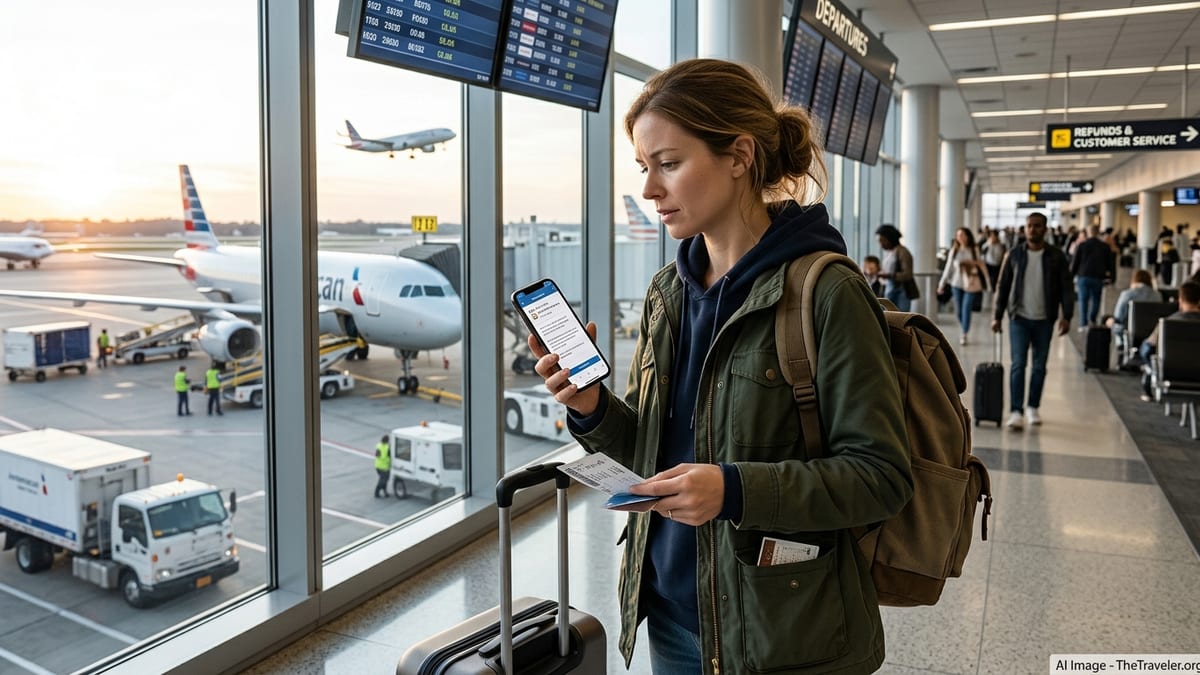
Automatic cash refunds now tied to clear federal definitions
The most significant shift for U.S. flyers in the 2026 holiday period stems from an April 26, 2024 Department of Transportation final rule on refunds and other consumer protections. For flights to, from or within the United States, both U.S. and foreign airlines must now provide prompt refunds in money, rather than travel credits, whenever a flight is canceled or significantly changed and the passenger does not accept the alternative offered. The obligation applies regardless of whether the original ticket was sold as nonrefundable.
The rule also defines when a schedule change becomes “significant” for refund purposes, a question that was left largely to carrier discretion during the pandemic. For domestic itineraries, a significant change includes a departure or arrival time moved by at least three hours compared with the original schedule. For international itineraries, the threshold is six hours. A passenger who decides not to travel under the revised schedule can walk away and is entitled to a refund of the unused portion of the ticket instead of a voucher, provided they decline any alternative transport or compensation the carrier proposes.
Timing is not the only trigger. A change of departure or arrival airport, adding one or more extra connections compared with the original routing, moving a passenger to a lower class of service than the one purchased, or substituting an aircraft in a way that removes a previously available accessibility feature can also qualify as a significant change under the federal definition. In each of these situations, a traveler who chooses not to accept the altered itinerary is entitled to a refund of the fare and eligible taxes and carrier‑imposed surcharges.
Refunds must generally be returned to the original form of payment. Under the rule, airlines and ticket agents have seven business days to process refunds for tickets bought with a credit card, and 20 calendar days for tickets purchased with cash or check, once the traveler becomes entitled to a refund and does not take the changed flight. Carriers can offer a cash‑equivalent such as a prepaid card or voucher, but only if the passenger affirmatively chooses that option instead of cash.
What remains outside federal compensation, including weather and most delays
Despite the tougher refund standards, U.S. federal law still does not require airlines to pay cash compensation simply because a passenger arrives late. If a traveler accepts rebooking and ultimately completes their trip, there is no nationwide obligation for the airline to pay extra money for the lost time, even when the delay runs to many hours. There is likewise no federal requirement to provide meals or hotel rooms when disruptions are caused by weather, air traffic control restrictions or other circumstances outside the carrier’s control.
DOT guidance on flight delays continues to distinguish disruptions that are considered within an airline’s control, such as many maintenance problems or crew scheduling issues, from those that are not, such as snowstorms, hurricanes, airport closures and ground stops imposed by federal authorities. A nonrefundable ticket does not automatically become refundable because a traveler reaches their destination late. As long as the passenger accepts the airline’s revised schedule and flies, the main federal refund right tied to a cancellation or significant change will usually not apply.
Efforts by the administration in 2023 and 2024 to go further, by mandating standardized cash compensation and amenities such as meals and hotels for controllable delays and cancellations, have not yet produced binding compensation rules comparable to those in the European Union. The April 2024 final rule focused instead on ensuring that refunds are automatic when service paid for is not provided, and on clarifying baggage and ancillary fee refunds. As of late November 2026, passengers’ core national remedy is the ability to decline an altered itinerary that meets the federal significant‑change test and receive their money back, while any extra compensation or coverage of collateral expenses remains governed by each airline’s own policies.
How to use the DOT dashboard and airline policies during disruptions
To make those individual carrier commitments easier to compare, the Department of Transportation maintains an Airline Cancellation and Delay Dashboard covering the largest U.S. airlines. The dashboard summarizes what each carrier promises to do for customers when a flight is canceled or significantly delayed for reasons considered within the airline’s control, such as certain mechanical problems, crew availability or baggage handling issues. It lists whether the airline commits to free rebooking in the same cabin, meal vouchers after a specified waiting period, hotel accommodation when an overnight stay is required, or ground transport to and from a hotel.
The dashboard is explicitly limited to controllable events. It does not guarantee meals, hotels or other benefits when a disruption is caused by severe weather, airport or runway closures, security incidents, or national air traffic control system problems. Some airlines may choose to extend courtesies such as hotel or meal vouchers during large‑scale storms, but these remain voluntary gestures. During the 2026 Thanksgiving travel period, for example, airlines that experienced technology outages and weather‑related delays publicly said they were assisting some stranded passengers with lodging and meals, but these actions reflected company policy and real‑time decisions rather than any new federal requirement.
Because the written customer service plans underpinning the dashboard are enforceable as a form of consumer commitment, travelers can refer to them when seeking help. If an airline’s published policy states that it will provide hotel rooms for overnight disruptions it controls, or offer meal vouchers after a three‑hour controllable delay, passengers can point to those statements during irregular operations. DOT has indicated that failure to honor such public commitments can trigger enforcement action on the grounds of unfair or deceptive practices. For travelers who later file a complaint with the department, having a record of the airline’s policy at the time of travel and notes or receipts from the disruption can help support their case.
Checked bags, ancillary fees, bumps and tarmac delays: other key rules
The April 2024 rule also tightened requirements around refunds of ancillary fees, particularly for checked baggage. On domestic itineraries, airlines are already subject to a federal limit on their liability for lost, damaged or delayed luggage when passengers can document their expenses. Building on that, the new rule requires carriers that charge separate checked‑bag fees to refund those fees automatically when a bag is lost or significantly delayed, provided the passenger has filed a mishandled baggage report with the operating or final‑leg carrier.
For most domestic flights, a bag is considered significantly delayed for fee‑refund purposes if it is not delivered to the passenger within 12 hours of the aircraft’s arrival at the gate at the final destination. For international itineraries, the rule allows longer thresholds tied to flight length, typically between 15 and 30 hours. When those thresholds are met and a report has been filed, the airline must return the checked‑bag fee without the traveler needing to submit a separate refund request. The rule also covers a range of baggage types, including gate‑checked bags and certain specialty items, as long as a separate fee was charged for transport.
Ancillary fees for services that are not provided at all must also be refunded. If a passenger has paid in advance for a specific seat selection, onboard Wi‑Fi, or the carriage of sports equipment and the airline fails to deliver that service on the affected flight, the carrier is required to return that charge. As with ticket refunds, the money should be returned to the original form of payment within the same seven‑business‑day or 20‑calendar‑day timeframes, depending on how the purchase was made.
Oversales remain governed by long‑standing rules on bumping and denied boarding. Airlines are still allowed to sell more tickets than seats, but must first ask for volunteers willing to give up their seat in exchange for compensation. When not enough volunteers come forward and passengers are involuntarily denied boarding, carriers must provide a written statement of rights and, in many cases, cash compensation. The amount depends on the one‑way fare and on how long the passenger’s arrival at the final ticketed destination is delayed compared with the original schedule, with federal minimums that scale up for longer delays and are adjusted periodically.
Tarmac delay protections complete the main set of federal rules that matter during congested holiday periods. Under regulations codified in 14 CFR Part 259, airlines operating flights at U.S. airports must allow passengers on domestic flights to deplane before a tarmac delay exceeds three hours, and on international flights before it exceeds four hours, subject to limited safety and air‑traffic‑control exceptions. Carriers are also required to provide food and drinking water no later than two hours into a tarmac delay, maintain operable lavatories and ensure adequate medical attention if needed. DOT continues to bring enforcement cases and impose civil penalties on airlines that allow aircraft to sit on the tarmac beyond these limits without meeting the regulatory exceptions.
What holiday travelers should clarify before deciding whether to fly
In practical terms, the strengthened refund rules mean that holiday travelers in late 2026 need to make an early decision when their flight is canceled or significantly changed. If a revised departure or arrival time, an added connection or a reassignment to a different airport makes the trip unworkable, declining rebooking and explicitly choosing not to travel will generally trigger the clearest federal protections, since the airline must then return the fare and qualifying fees within the mandated deadlines. Accepting an alternative itinerary usually means giving up the right to a refund tied to that disruption, even if the new schedule is inconvenient.
For travelers who still need to reach their destination, the airline’s customer service plan and its entry on the DOT dashboard become the key references. Before booking peak‑season trips, passengers can compare how different carriers say they will respond to controllable cancellations and long delays, including whether they commit to covering hotel rooms when an overnight stay is required and when meal vouchers are offered. During a disruption, it is important to ask staff how the airline is categorizing the cause of the delay or cancellation, since many of the most generous voluntary benefits apply only when the issue is considered within the carrier’s control.
Because federal law continues to offer limited remedies for time lost to delays, some travelers look to travel insurance or premium credit card protections to cover extra accommodation, missed connections or nonrefundable arrangements affected by disruptions. Policies differ significantly in when they will pay out, and many include exclusions or waiting periods, particularly for weather and air‑traffic‑control events. Consumer agencies advise travelers to read coverage terms closely, keep receipts and documentation from any disruption, and confirm with their carrier and with official DOT resources what rights apply in their specific situation.
As winter storms, congestion and periodic technology glitches continue to affect U.S. air travel through the end of 2026 and into early 2027, the combination of automatic refund rules, long‑standing bumping and tarmac protections, and voluntary airline customer service commitments will shape what compensation and assistance passengers can realistically expect. Travelers are being urged to monitor their bookings closely, check the status of their flight before heading to the airport, and be prepared to decide quickly whether to accept rebooking under a changed schedule or to rely on the expanded right to a cash refund instead.