


Hilton Grand Vacations Club Ocean Tower Waikoloa Village on Hawaii Island’s Kohala Coast is a spectacular place to stay, but the bill at checkout can surprise first-time visitors. Beyond the nightly rate, guests face a mandatory daily resort charge, paid parking, taxes, and a range of optional extras that can add significantly to the cost of a stay. This guide breaks down those fees in clear, real-world terms so you can set a realistic budget before you arrive.
Get the latest updates straight to your inbox!
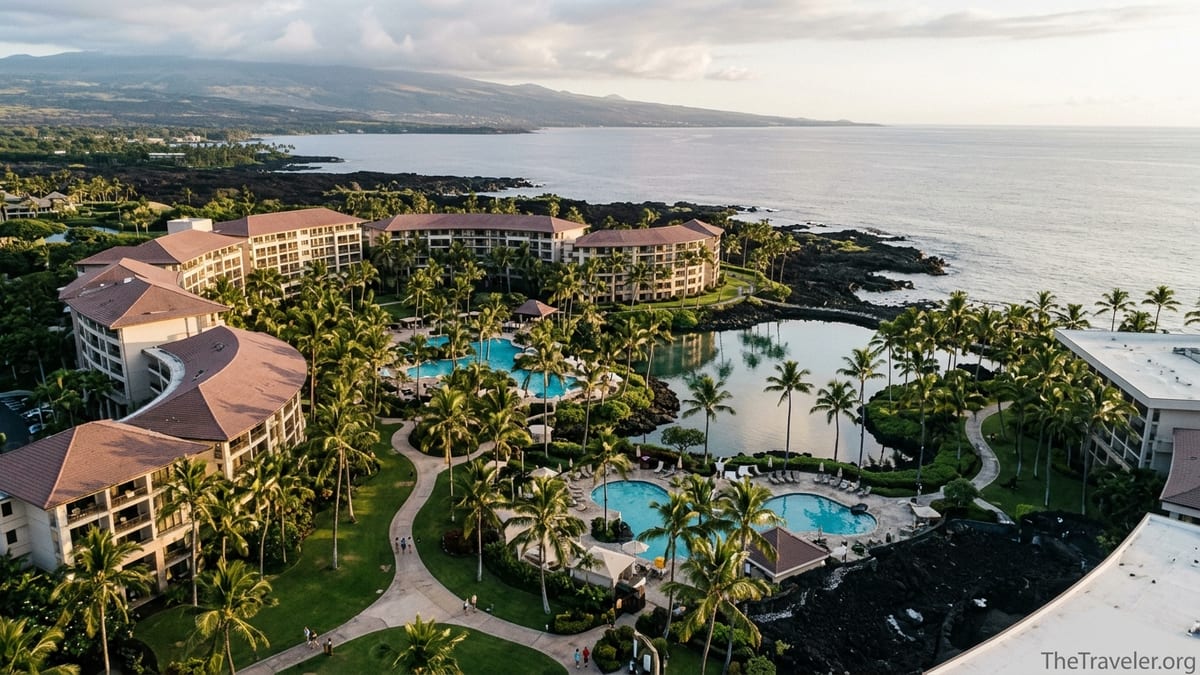
Understanding How Ocean Tower Pricing Works
Hilton Grand Vacations Club Ocean Tower Waikoloa Village operates differently from a typical hotel because it sits within the larger Hilton Waikoloa Village resort and is primarily a timeshare property. That means the way fees are applied can vary depending on whether you booked as a regular cash-paying guest through a site like Hotels.com or the main Hilton website, or as a timeshare owner using Hilton Grand Vacations Club points. The base nightly rate that appears when you reserve your room rarely reflects the full amount you will ultimately pay.
Most retail cash reservations have three major cost components on top of the room price: the daily resort charge, parking, and taxes on both the room and some of those fees. On top of that, many guests also incur add-ons such as food and drinks charged to the room, paid activities, and incidental holds or deposits placed on a credit card at check-in. Understanding each of these categories in advance helps you compare Ocean Tower with other Big Island resorts and avoid sticker shock.
When travelers talk about Ocean Tower expenses, they often compare it to nearby options in Waikoloa such as Kings’ Land by Hilton Grand Vacations or the Waikoloa Beach Marriott. Those alternatives may offer lower or no resort fees, different parking policies, or smaller incidental holds, so it is worth thinking about the full cost picture, not only the nightly rate. For many guests, the appeal of staying oceanfront inside the 62-acre Hilton Waikoloa Village complex outweighs the higher fees, but you should go in with eyes open.
Daily Resort Charge: What It Is and Who Pays It
For retail guests booking Ocean Tower as a standard hotel stay, a mandatory daily resort charge of roughly 47 to 50 US dollars per accommodation, per night is typically added at the property. Recent listings for Ocean Tower on major booking platforms describe a resort fee of about 47.48 US dollars plus tax per night. This fee is per room, not per person, and it is charged regardless of whether you use all the benefits it includes.
The daily resort charge usually covers amenities such as standard internet access, access to the extensive pool complexes and lagoon within Hilton Waikoloa Village, fitness center use, certain local or toll-free calls, and occasional cultural or recreational activities. The exact inclusions can change over time and may be slightly different depending on how you booked, so it is important to check the “Hotel Info” or “Know Before You Go” section in your confirmation email shortly before arrival. Because this fee is collected on-site, it may not always be included in the total shown at the time of online booking.
There is an important exception for some timeshare owners. Information tied to Ocean Tower vacation rentals notes that when you are checking in as an elite Hilton Grand Vacations Club owner or as an owner’s personal guest using a direct Club reservation, standard daily resort fees can be waived. That means an owner using points for a seven-night stay might avoid paying over 300 US dollars in resort charges that a cash-paying guest would owe for the same week. If you booked through Hilton Grand Vacations directly using ownership points, it is worth confirming at check-in that the resort charge is indeed waived for your reservation type.
For regular hotel guests paying cash, you should plan as if you will pay the full resort fee for every night of your stay. For example, on a five-night stay at 300 US dollars per night, adding approximately 47.48 US dollars per night in resort fees brings the pretax cost from 1,500 to roughly 1,737 US dollars before you even factor in parking or taxes. That can be the difference between staying comfortably within budget and overspending.
Parking Costs, Distances and EV Charging
Parking is one of the biggest cost and convenience considerations at Hilton Grand Vacations Club Ocean Tower Waikoloa Village. The resort does not include parking in the room rate, and guests arriving with a rental car should expect to pay for on-site self-parking. Recent hotel information lists on-site self-parking at about 48 US dollars per day, typically including in-and-out privileges, meaning you can come and go without extra charges during that day.
Several traveler reports describe this parking fee as steep, particularly for longer stays. On a seven-night vacation, self-parking alone can add over 330 US dollars to your bill. Some guests also note that the primary resort parking areas are a considerable distance from the Ocean Tower building itself. Depending on where you park within the Hilton Waikoloa Village complex, it can feel like a long walk, and many visitors instead rely on the resort’s internal tram system to move between the main lobby, parking, and the Ocean Tower. When deciding whether to rent a car, consider both the nightly parking fee and the extra time spent getting between your car and your room.
Valet parking has historically been available elsewhere within Hilton Waikoloa Village at a higher nightly rate, often several dollars more than self-parking. However, exact valet availability and pricing for Ocean Tower guests can change depending on the season and occupancy. If valet service is important to you, contact the resort directly before your trip to confirm whether Ocean Tower guests can use the main resort valet and what the nightly charge will be. In many cases, the difference between valet and self-parking has been in the range of 10 US dollars per night, which may be worth it for travelers who want to minimize walking or are arriving late at night.
Electric vehicle drivers should be prepared for limited charging options at Waikoloa resorts in general. While the broader Waikoloa Beach Resort area has gradually added public and semi-public EV chargers, on-site dedicated EV charging for guests at Ocean Tower is not heavily advertised and may be limited. In practice, many EV renters in the area plan their charging around stops at shopping centers or public stations near Waikoloa Beach Drive or in nearby towns rather than relying on charging at the resort itself. If you must have guaranteed overnight charging at your accommodation, confirm details with the property or consider a hotel or vacation rental that clearly lists on-site EV chargers as an amenity.
Taxes, Deposits and Incidentals at Check-in
Hawaii has some of the highest combined hotel tax rates in the United States, and those taxes apply to more than just your base room rate. When staying at Hilton Grand Vacations Club Ocean Tower Waikoloa Village, expect the room rate to be subject to state general excise tax and transient accommodations or hotel taxes, which together can exceed 17 percent. In many cases, the mandatory resort fee is also taxable, meaning you effectively pay tax on that daily charge as well.
To see how this plays out in real numbers, consider a sample night where the base room rate is 300 US dollars plus a resort fee of about 47.48 US dollars. Before taxes, that totals 347.48 US dollars. Applying a combined tax rate in the high teens can add roughly 60 US dollars or more in tax for that one night, taking your total nightly cost above 400 US dollars. Over a five-night stay, that difference becomes significant. Taxes are not optional, so it helps to mentally add close to one-fifth to whatever pretax total you are seeing when you plan your budget.
Like most large resorts, Ocean Tower and Hilton Waikoloa Village also place an incidental hold or deposit on your credit card at check-in. This is designed to cover potential room charges, parking, and damages. The exact amount can vary, but at comparable Hawaii resorts it is common to see holds in the range of 50 to 150 US dollars per night. For a seven-night stay, that could mean a temporary hold of 350 to over 1,000 US dollars on your card. While this amount is usually released after checkout once final charges are settled, it still counts against your available credit during the stay, so make sure your card limit is high enough to accommodate both the room cost and the hold.
If you prefer not to place a large hold on a debit card, consider using a major credit card for check-in and then paying the final bill with whichever payment method you like. Parents traveling with teens should also remember that any restaurant, bar, or activity charges signed to the room by family members will add to the final amount before the hold is released. Checking folio details periodically during your stay, either at the front desk or via the Hilton app if your booking is connected, can help you avoid surprises on departure day.
Common Extra Charges: Food, Activities and Transport
Beyond resort fees and parking, many guests at Hilton Grand Vacations Club Ocean Tower Waikoloa Village find that food and drinks become the largest variable expense. On-site restaurants and bars within Hilton Waikoloa Village generally price meals at resort levels, which means breakfast entrees often in the 20 to 30 US dollar range, casual poolside lunches around 20 to 25 US dollars per person before drinks, and sit-down dinners that can easily climb beyond 60 US dollars per person if you order cocktails or seafood. Grabbing coffee and pastries for a family of four at a resort café every morning can add 30 to 40 US dollars a day to your bill.
One way to manage this cost is to use the in-room mini-fridge or kitchenette features that come with many Ocean Tower timeshare units. Stocking simple breakfast items and snacks from local grocery stores such as the supermarket at Queens’ Marketplace or the KTA store up in Waikoloa Village town can dramatically cut your daily food spending. For example, a week’s worth of yogurt, fruit, cereal, and drinks bought off property might cost less than two sit-down breakfasts at the resort. Many repeat guests plan to eat one meal per day on-site and the rest off property or in their unit.
Activities also add up quickly. Within the larger Hilton Waikoloa Village complex you will find paid experiences like dolphin encounters, stand-up paddleboard and kayak rentals in the saltwater lagoon, and cabana or daybed rentals near the pools. Individual activities can range from tens to hundreds of dollars per person. For a family of four, booking one dolphin encounter, renting water gear for a couple of hours, and reserving a cabana for a day can easily push your activity bill into the high hundreds of dollars over the course of a week.
Transportation costs outside the resort should not be overlooked either. Waikoloa is a drive from both Kona International Airport and many Big Island attractions such as Hawaii Volcanoes National Park. If you skip a rental car to avoid parking fees, you may rely on taxis, rideshares, or shuttles, which can be expensive for multiple trips. Some guests opt to rent a car only for certain days of their stay, arranging pickup from nearby rental offices so they pay parking fees only on days when they are actively touring the island. This hybrid approach can make sense if you want to relax at the resort for part of your trip and explore by car on focused days.
Owner vs Cash Guest: How Costs Differ
Because Hilton Grand Vacations Club Ocean Tower Waikoloa Village is a timeshare property, the cost structure for owners using points versus cash-paying hotel guests can be quite different. An owner using points may not see a nightly room rate in dollars at all, but instead will pay annual maintenance fees and possibly housekeeping charges related to their ownership. In some cases, owners and their direct guests may have resort fees waived, which can save hundreds of dollars over a week-long stay.
Parking, however, is where many owners and guests share the same pain point. Even those staying on points generally pay the same nightly parking rate as cash guests, and owner forums often describe parking at Waikoloa as “exorbitant” compared with other destinations. While staying at Kings’ Land or other nearby timeshare properties sometimes includes free or lower-cost parking and shuttle access to Hilton Waikoloa Village pools, Ocean Tower guests are typically subject to the posted overnight parking rates unless a particular promotion states otherwise.
Another subtle difference lies in housekeeping and mid-stay cleaning. Traditional hotel guests often expect daily housekeeping included in the room rate, but many timeshare-oriented properties operate on a different model where full service cleans are less frequent and additional services can be requested for a fee. At Ocean Tower, daily housekeeping may be listed as available but can have an extra charge attached for certain booking types, especially owner stays. If you are used to a hotel-style daily clean and towel refresh, check in advance whether your specific rate includes this or if there is a per-visit fee for additional housekeeping.
For travelers who are not timeshare owners but are considering discounted promotional stays in exchange for attending a sales presentation, it is important to clarify what fees are and are not included in the package. A low advertised nightly price for a promotional stay may still be subject to full resort fees, parking, and taxes. When reviewing the terms of any vacation package, ask for an estimated total including mandatory charges so you can compare it fairly with standard reservations or alternative properties.
Strategies to Keep Your Total Bill Under Control
Although many of the main fees at Hilton Grand Vacations Club Ocean Tower Waikoloa Village are fixed, you still have several levers to manage your total cost. The first is simply length of stay. Because resort fees and parking are charged per night, trimming even one night from your itinerary can save the combined daily resort charge, parking, and taxes for that night, which can easily reach 120 to 150 US dollars when everything is added up.
Next, consider your transportation plan. If you intend to spend most of your time within the resort and only take a couple of off-site excursions, it may be more economical to arrange airport transfers and a rental car only on the days you plan to explore the island, rather than keeping a car parked for your entire stay. For example, a couple staying five nights might skip a rental car on their arrival day and final day, use shuttles or rideshares for transfers, and rent a car for the three middle days to visit beaches and attractions. That approach would incur parking fees for only three nights instead of five.
Food budgeting is another powerful tool. Many guests bring nonperishable snacks in their luggage and then supplement with a single grocery run after arrival. Planning to eat breakfast in your room, enjoy a light lunch at the pool or while out exploring, and reserve full-service dinners for select evenings can keep daily food costs manageable. Families in particular often set a daily food budget and track it via room charges and card receipts, adjusting as needed to stay on target.
Finally, be realistic about which paid activities matter most to you. The Hilton Waikoloa Village complex already includes several pools, water slides, and a saltwater lagoon accessible as part of your stay and resort fee. You do not need to book every premium activity to enjoy the property. Many travelers select one or two “big-ticket” experiences, such as a single dolphin encounter or a special occasion dinner at one of the resort’s signature restaurants, and otherwise enjoy the complimentary elements of the grounds. Taking this curated approach helps ensure you remember your favorite highlights more than the final bill.
FAQ
Q1. Does Hilton Grand Vacations Club Ocean Tower Waikoloa Village charge a daily resort fee?
Yes. Most cash reservations are subject to a mandatory daily resort charge of roughly 47 to 50 US dollars per room, per night, plus tax, collected at the property.
Q2. Is the resort fee ever waived for guests at Ocean Tower?
Some Hilton Grand Vacations Club owners and their direct guests using points-based reservations may have the resort fee waived, but standard hotel bookings through typical travel sites almost always pay it.
Q3. How much does parking cost at Hilton Grand Vacations Club Ocean Tower Waikoloa Village?
Recent information lists on-site self-parking at about 48 US dollars per day with in-and-out privileges, and the charge is applied for each night you park a vehicle.
Q4. Is valet parking available and is it more expensive than self-parking?
Valet parking has historically been available within the Hilton Waikoloa Village complex at a higher nightly rate than self-parking, but availability and exact pricing can change, so confirm directly with the resort before arrival.
Q5. Are parking and resort fees taxable in Hawaii?
Yes. In addition to taxes on the room rate, Hawaii typically applies taxes to resort fees and may apply taxes to parking charges, so expect your final total to be higher than the pretax amounts.
Q6. Does Ocean Tower offer electric vehicle charging for guests?
On-site dedicated EV charging is limited and not prominently advertised, so most EV drivers plan charging stops at public or shopping-center stations in the broader Waikoloa area rather than relying solely on the resort.
Q7. What kind of incidental deposit or hold should I expect at check-in?
As with many Hawaii resorts, you can expect a daily incidental hold on your credit card, often in the range of roughly 50 to 150 US dollars per night, to cover potential room and parking charges.
Q8. Is daily housekeeping included in the price at Ocean Tower?
Daily housekeeping may be included for some cash hotel stays, but at timeshare-oriented properties it can be limited or carry an extra charge for owner reservations, so confirm what your specific booking includes.
Q9. Can I avoid parking fees by skipping a rental car at Waikoloa?
Yes, you can choose to use shuttles, taxis, or rideshares instead of renting a car, though you will then pay per-trip transport costs to and from the airport and island attractions.
Q10. What is the best way to estimate my total stay cost at Ocean Tower?
The simplest approach is to add your room rate, roughly 47 to 50 US dollars per night for resort fees, about 48 US dollars per night for parking if you have a car, then apply a tax rate in the high teens and add a realistic daily budget for food and activities.