


Hol Chan Marine Reserve is the classic Belize snorkeling trip. Just offshore from San Pedro and Caye Caulker, this protected channel in the Belize Barrier Reef delivers shallow coral, sea turtles, nurse sharks and rays on most visits. It is also the country’s first marine protected area, and later expanded to include Shark Ray Alley. This guide explains how to book from San Pedro and Caye Caulker, what the different tours actually look like in practice, and what you can realistically expect to see in the water.
Get the latest updates straight to your inbox!
Understanding Hol Chan Marine Reserve and Shark Ray Alley
Hol Chan Marine Reserve lies a short boat ride east of Ambergris Caye and Caye Caulker, where a natural break in the barrier reef forms the Hol Chan Channel. The main snorkel site sits along a cut in the reef about 10 meters deep at its center, with ledges and walls that rise to snorkel-friendly depths around 3 to 4 meters. Because it is a protected area managed by Belize Fisheries, boat traffic, fishing methods and visitor behavior are regulated to reduce pressure on the reef.
Belize Fisheries identifies Hol Chan, established in 1987, as the country’s first marine protected area. Decades of protection mean coral formations here are generally healthier and fish more abundant than on many unprotected reef patches. In 1999, Shark Ray Alley, an area of shallow reef and seagrass where fishermen once cleaned their catch, was formally added as Zone D of the reserve to safeguard the nurse sharks and rays that gather there.
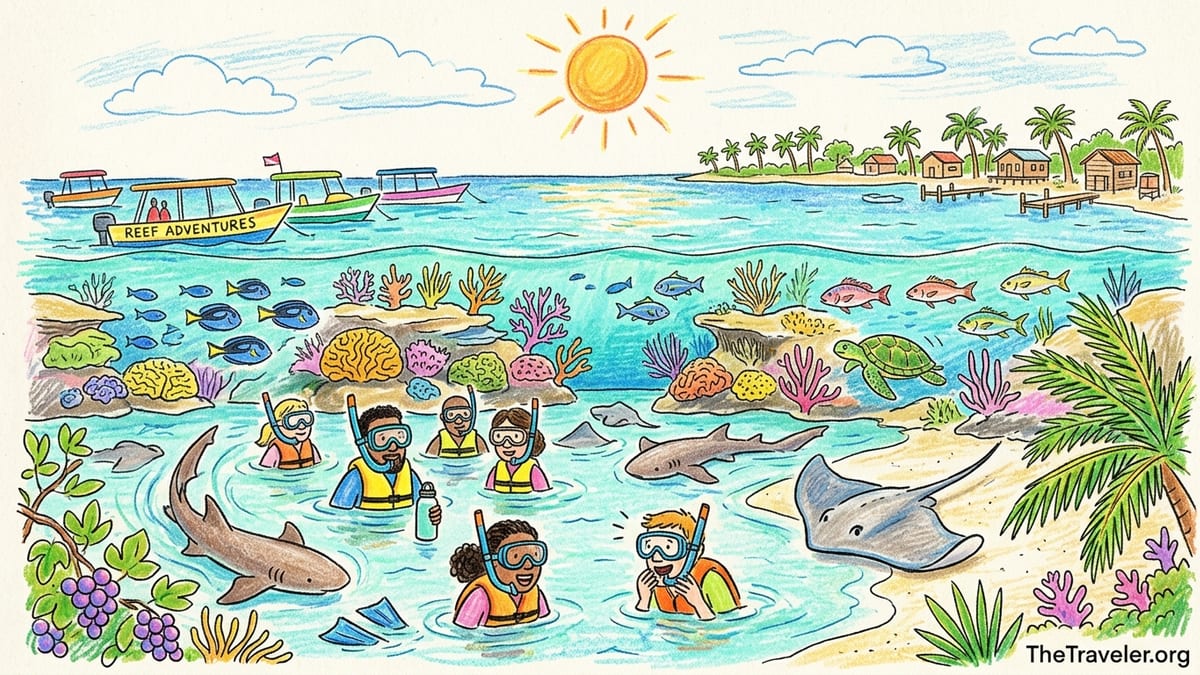
Most visitors experience Hol Chan as a combination tour that includes the channel itself plus a separate stop at Shark Ray Alley. From the water, this feels like two distinct experiences. At Hol Chan you drift over coral gardens, sand channels and reef ledges while guides point out turtles and groupers. At Shark Ray Alley you slip into 2 to 3 meters of water to float among swirling nurse sharks and southern stingrays that have become accustomed to boats.
Compared with snorkeling a random patch of reef, Hol Chan and Shark Ray Alley are coordinated, supervised experiences. Every boat must carry a licensed guide, briefings are mandatory before you enter the water, and group sizes are usually capped. For travelers who may be new to snorkeling or simply want to maximize their chances of seeing larger marine life in a short time, that structure is often worth the added cost and formality.
Reef, Seagrass and Channel: What You See in the Water
Hol Chan is divided into zones that protect different habitats, but the typical snorkel focuses on the coral channel and nearby seagrass. In the channel itself you can expect hard corals like brain, boulder and star corals forming knobby ridges, along with waving sea fans and gorgonians. On a clear day visibility often runs 15 to 25 meters, so you can easily watch schools of blue tang, grunts and snappers moving across the reef slope beneath you.
On the sand and seagrass flats edging the channel, guides frequently find southern stingrays half-buried in the sand and hawksbill or green sea turtles grazing on the grass. Parrotfish, angelfish and sergeant majors are common. At Shark Ray Alley, which sits over a mix of shallow sand and seagrass, you are unlikely to see much coral structure. The appeal there is the concentration of large animals. Boats often arrive to find a dozen or more nurse sharks circling and rays gliding through the water column.
Wildlife sightings are never guaranteed, but patterns are fairly consistent. On a typical modern full-day snorkel circuit that includes Hol Chan, Shark Ray Alley, Coral Gardens and perhaps the North Channel near Caye Caulker, visitors commonly report encounters with nurse sharks, southern stingrays, several species of reef fish and at least a few sea turtles. Manatees are more hit-or-miss and appear more often in the North Channel than inside Hol Chan itself.
The protected status of Hol Chan means fish tend to be less wary of people than on heavily fished reefs. Snorkelers sometimes find themselves drifting beside groupers and snappers that hold their ground rather than darting away. That behavior is a visible reminder that this is more than just a pretty snorkel spot. It is also a functioning marine reserve designed to maintain fish stocks and reef health in the long term.
Booking from San Pedro: Typical Tours, Prices and Logistics
From San Pedro on Ambergris Caye, Hol Chan is the standard snorkeling outing. Tour desks line the waterfront and the main streets, and most hotels will book on your behalf with local operators. Common names you will see around town include Reef Adventures, Ambergris Divers, Chuck & Robbie’s and a number of smaller outfits that operate one or two boats. In practice, the itineraries they run to Hol Chan and Shark Ray Alley are broadly similar, differing mainly in group size, style of boat and what extras are included.
A typical half-day Hol Chan and Shark Ray Alley tour from San Pedro lasts about 3.5 to 4 hours. Many operators schedule morning departures around 8:30 or 9:00 and afternoon departures around 13:30. Boats usually reach Hol Chan in about 15 minutes. After a safety briefing, you spend around 45 to 60 minutes in the water at the channel, then move to Shark Ray Alley for another 25 to 35 minutes before returning to town. Recent local listings place these half-day trips in the region of 60 to 90 US dollars per person, often including snorkel gear, drinking water and sometimes fruit or light snacks. The marine reserve fee is typically an additional cash payment at check in.
Full-day excursions from San Pedro often combine Hol Chan and Shark Ray Alley with at least one extra snorkel stop and some time on Caye Caulker. An example itinerary offered by several operators departs San Pedro around 8:30 in the morning, snorkels Hol Chan and Shark Ray Alley before midday, stops at Coral Gardens and a manatee area near Caye Caulker, then gives one to two hours of free time on the island for lunch before returning to San Pedro in the late afternoon. Prices for these longer days commonly fall between about 110 and 150 US dollars per person, with lunch, soft drinks and sometimes rum punch included.
Private charters from San Pedro raise the cost significantly but give you more control over timing and crowd levels. A small private boat that fits four to six snorkelers might start around 350 to 500 US dollars for a half day, plus marine reserve fees, while larger catamaran charters with catering can climb much higher. These private options are worth considering for families with young children who need flexible schedules, or for travelers who prefer to avoid being in the water with a dozen other people at the same time.
Booking from Caye Caulker: Laid-back Vibes and 7-stop Days
Caye Caulker sits closer to several popular snorkel sites and has built a reputation for relaxed, all-day reef trips that mix Hol Chan and Shark Ray Alley with a circuit of other stops. You will see chalkboards around the village advertising “7-stop” or “full-day” tours that run from roughly 10:00 in the morning to 16:30 or 17:00. Operators such as Salt Life Eco Tours, E-Z Boy Tours and a handful of other local outfits compete on service and extras rather than on route, because almost all include Hol Chan and Shark Ray Alley in the core itinerary.
On these Caye Caulker full-day trips, expect a pattern like this: snorkel Hol Chan mid-morning, move to Shark Ray Alley, continue to a reef site such as Coral Gardens, then on to a manatee area, a visit with giant tarpon near the docks, and a quick stop at a seahorse viewing area or a shallow sandbar. Many tours include a simple Belizean lunch such as stewed chicken with rice and beans, fresh fruit and water or juice. Some add beer or rum punch on the return sail. Recent price examples place these days in the region of 100 to 120 US dollars per person, plus the separate marine reserve fee.
Caye Caulker also offers shorter half-day options that focus only on the closest reef sections or on a reduced version of the Hol Chan and Shark Ray Alley circuit. One operator, for instance, advertises a half-day reef tour starting around 50 to 60 US dollars per person and a full Hol Chan and Shark Ray Alley day around 100 to 110 US dollars per person, with gear provided. Because the island is small, you can usually walk the main street in half an hour and compare two or three shops in person before deciding.
For travelers who are already staying on Caye Caulker, booking is often as simple as choosing a company whose style matches yours. Some outfitters lean into a party atmosphere with loud music and free-flowing drinks after the last snorkel stop, while others market their trips as eco-focused with extended briefings on reef conservation and stricter no-touch, no-chase policies in the water. Both types generally visit the same Hol Chan and Shark Ray Alley sites, so your choice is more about group dynamic than about the snorkel itself.
Half-day vs Full-day, Morning vs Afternoon
Choosing between half-day and full-day tours comes down to energy level, budget and how central snorkeling is to your Belize trip. Half-days work well for visitors who have limited time in San Pedro or Caye Caulker and simply want to be sure they experience the signature Hol Chan and Shark Ray Alley combination. They also suit families with younger children who might tire after a couple of hours in the water, or travelers prone to seasickness who prefer shorter boat rides.
Full-day tours offer better value per hour and more variety in what you see. By adding extra stops such as Coral Gardens or the North Channel, operators increase your chances of spotting species like manatees or spotted eagle rays that are less common directly inside Hol Chan. These longer days can also feel more relaxed, with time for a proper lunch and a walk around Caye Caulker or a spell on a sandbar. The trade-off is fatigue. After three or four snorkel sessions and hours in the sun, some visitors find that their enjoyment starts to taper off by late afternoon.
Morning departures generally benefit from lighter winds and calmer seas, especially during the trade-wind months when afternoons can become choppier. Early trips are also less likely to be affected by afternoon thunderstorms in the wet season. Underwater, visibility does not usually change dramatically between morning and afternoon on the same day, but lower sun angles in very late afternoon can make the water feel slightly darker in deeper parts of the channel.
Afternoon half-days work well if you want to relax in the morning or if you arrive on an early boat or flight and hope to be in the water the same day. In high season, some travelers report that mid-morning and mid-afternoon slots at Hol Chan can feel busy, with multiple boats in the area at once. If you prefer quieter conditions and your schedule allows, ask your operator whether they run slightly off-peak departures such as early morning or late afternoon, or look for smaller-group boats that time their swims to avoid the biggest crowds.
Group Tours vs Private Trips and What It Means Underwater
Most visitors to Hol Chan join small to mid-sized group tours. On busy days, a typical boat from San Pedro or Caye Caulker might carry 8 to 16 snorkelers plus guides. These trips are affordable and social, and the guides are accustomed to managing a mix of confidence levels in the water. If you are a comfortable swimmer who does not mind sharing space at Shark Ray Alley, group tours are often the most efficient option.
Private trips change the experience in several ways. With only your own party in the water, guides can tailor the route and pace to what you want to see, whether that is spending extra time photographing corals at the channel edge or focusing on finding turtles on the seagrass flats. Families traveling with grandparents and young children sometimes appreciate the ability to adjust the duration of each swim on the fly, shortening a stop if someone becomes tired or nervous without affecting strangers who paid for the same tour.
In the water, group tours tend to follow a fixed circuit. At Hol Chan, your guide will usually ask everyone to follow behind as they point out key species, occasionally diving down to bring attention to an eel in a crevice or a turtle passing below. On a private charter, there is more flexibility to break the swim into sections or split the group if one or two people prefer to float in the shallower parts while others venture closer to the channel edge.
Cost is the obvious trade-off. A couple booking a group tour may pay around 130 to 200 US dollars in total for a half-day, including marine reserve fees. The same couple hiring a private boat might pay two or three times that amount once charter rates and fees are added. For travelers marking a special occasion or keen on photography without fins in every frame, that premium can feel justified. For many others, a well-run group trip strikes a good balance between price and experience.
Fees, Skill Levels and Safety: What You Need to Know
Every visitor to Hol Chan Marine Reserve, including Shark Ray Alley, must pay a conservation fee set by the managing authorities. As of recent operator information, this fee is commonly quoted around 10 US dollars per person for day visits, payable in cash at check in or collected by your tour company as part of the total. Some operators fold it into their headline price, while others list it separately. When comparing tours from San Pedro or Caye Caulker, ask whether the marine reserve fee is included so you can compare like with like.
Snorkeling Hol Chan does not require advanced swimming skills, but you should be able to float comfortably and kick short distances with fins. Depths at the main snorkel site generally range from about 2 to 5 meters where snorkelers spend most of their time, dropping deeper in the center of the channel. Guides commonly bring flotation devices such as life jackets or foam noodles for anyone who prefers extra support. If you are a nervous swimmer, mention this when booking so the operator can place you on a boat known for patient guiding and strong safety briefings.
Currents in the Hol Chan Channel vary with tide and wind. On calm days, snorkelers may barely feel a drift. At stronger tidal flows, guides may choose routes that move with the current so the group can simply float along without much effort. You will be given a safety briefing before entering the water that covers staying close to the guide, avoiding standing on coral or touching turtles, sharks or rays, and what hand signals to use if you feel uncomfortable or need assistance.
Life in the water is wild, and while nurse sharks and rays at Shark Ray Alley are used to human presence, they are not domesticated animals. Recent social media clips from Belize and elsewhere have highlighted the importance of keeping hands away from shark mouths, not attempting to ride rays and following your guide’s instructions when feeding occurs from the boat. Reputable operators have adjusted practices in response to evolving safety guidance, so choosing companies that emphasize responsible wildlife interaction is an important part of planning your visit.
Why Hol Chan Feels Different from an Unprotected Reef Patch
It is possible to snorkel the barrier reef from various points along Ambergris Caye and Caye Caulker, including unprotected patches where boats moor outside marine reserve boundaries. These sites can be beautiful in their own right, especially less trafficked sections where healthy coral heads still dominate. However, Hol Chan’s status as a marine reserve affects both what you see and how your visit is structured, and those differences are noticeable to many travelers.
On unprotected patches of reef, fishing pressure tends to be higher and enforcement lighter. Spearfishing and certain net types that are restricted inside Hol Chan may still occur nearby. Over time, that can lead to fewer large fish and more cautious behavior among the animals that remain. In Hol Chan, the combination of long-term protection and controlled visitor use has created an environment where groupers, snappers and jacks are relatively abundant compared with many open-access sites, and where turtles often pass quite close without veering away.
The requirement to visit Hol Chan with licensed guides also changes your relationship with the reef. Each tour begins with an orientation that covers basic ecology, safe snorkeling techniques and the specific rules of the reserve, such as no touching coral or collecting shells. In practice, that means even first-time snorkelers receive a mini-course in reef etiquette before entering the water. On unregulated sites, visitors who arrive independently or with informal transport may receive little or no guidance, which can contribute to accidental damage such as standing on living coral while adjusting a mask.
Finally, Hol Chan’s combination with Shark Ray Alley, Coral Gardens and other nearby stops creates a compact itinerary that delivers many of the animals people most hope to see in Belize in a single day: turtles, rays, sharks and dense schools of reef fish. While you might encounter some of these on a random patch of reef, the likelihood of ticking them all off on the same short trip is significantly higher within the structured circuits built around the marine reserve. That reliability is a major reason Hol Chan remains the most popular marine excursion from both San Pedro and Caye Caulker.
The Takeaway
Hol Chan Marine Reserve and Shark Ray Alley have earned their place on most Belize itineraries for good reason. As the country’s first marine protected area and one of its busiest, Hol Chan offers a combination of accessible depths, healthy coral, abundant reef fish and frequent turtle and ray encounters that is hard to match so close to major tourist hubs. When paired with Shark Ray Alley and other nearby stops, it becomes a full day of underwater wildlife concentrated within a short boat ride of San Pedro and Caye Caulker.
Planning your visit comes down to a few key choices: San Pedro or Caye Caulker as your base, half-day or full-day itineraries, group or private boats, and morning or afternoon departures. Prices vary by operator and inclusions, but in general you can expect to pay in the region of 60 to 90 US dollars for half-day group trips and around 100 to 150 US dollars for full-day excursions, plus the mandatory marine reserve fee. Most tours include snorkel gear, and reputable operators place a strong emphasis on safety and reef-friendly behavior.
Whether you float quietly above the Hol Chan Channel watching parrotfish graze, or find yourself surrounded by a carousel of nurse sharks at Shark Ray Alley, visiting this protected corner of the Belize Barrier Reef is likely to be one of the most memorable days of your trip. With realistic expectations about conditions and wildlife, respect for the reserve rules and the right choice of tour format for your group, you will be well positioned to experience Hol Chan at its best.
FAQ
Q1. How much does a Hol Chan and Shark Ray Alley snorkel tour usually cost?
Prices vary by operator and inclusions, but recent examples place half-day group tours from San Pedro or Caye Caulker roughly between 60 and 90 US dollars per person, with full-day circuits that add extra stops and lunch often around 100 to 150 US dollars per person. Marine reserve fees are sometimes included and sometimes charged separately, so always confirm what is in the final price.
Q2. Do I need to be a strong swimmer to snorkel Hol Chan?
You do not need to be an expert swimmer, but you should be comfortable floating and kicking with fins in open water. Depths at the main snorkel areas are generally 2 to 5 meters, and guides usually provide life jackets or flotation noodles for those who want extra support. If you are nervous in the water, mention this when booking so the operator can assign you to a guide and group suited to beginners.
Q3. What marine life am I most likely to see?
On a typical Hol Chan and Shark Ray Alley tour you can reasonably expect to see a variety of reef fish such as parrotfish, snappers and blue tangs, as well as southern stingrays and nurse sharks at Shark Ray Alley. Sea turtles are frequently spotted grazing on seagrass inside the reserve. Manatee sightings are less predictable and are more common on itineraries that include the North Channel near Caye Caulker.
Q4. Is Hol Chan better from San Pedro or Caye Caulker?
The underwater experience at Hol Chan itself is very similar whether you depart from San Pedro or Caye Caulker. The difference lies in the style of the day. San Pedro departures lean slightly more toward shorter half-day trips, while Caye Caulker has a strong culture of full-day, multi-stop reef tours. Your choice should depend on where you are staying and whether you prefer a quick outing or a full day on the water.
Q5. When is the best time of day to go snorkeling there?
Morning departures often benefit from calmer seas and lighter winds, particularly in the dry season when trade winds can pick up during the afternoon. Water clarity is usually good throughout the day, but very late afternoon sun angles can make deeper sections appear slightly darker. If you want smoother conditions and are an early riser, a morning trip is a solid choice. If you prefer a slower start or are arriving that day, an afternoon outing can still be excellent.
Q6. Are marine reserve fees included in tour prices?
Some operators include the Hol Chan Marine Reserve fee in their advertised price, while others list it separately and collect it in cash at check in. The fee is set by the authorities, not by individual tour companies, and applies to all visitors entering the protected area. When comparing tours, always ask whether the marine reserve fee is included so you are not surprised by an additional charge on the day.
Q7. Can children and older travelers join Hol Chan tours?
Yes, children and older travelers commonly join Hol Chan snorkel trips, but it is important to choose an itinerary that matches their comfort level. Half-day tours with smaller boats and attentive guides can work well for families, while full-day outings may feel long for very young children or anyone who tires easily in the sun. Discuss ages and mobility issues with the operator in advance so they can advise on suitable options and provide extra flotation if needed.
Q8. What is the difference between Hol Chan and Shark Ray Alley?
Hol Chan is a reef channel inside the marine reserve where you snorkel over coral formations, seagrass beds and sand, with chances to see turtles and schools of fish. Shark Ray Alley is a separate, shallow area of reef and seagrass that became known as a gathering point for nurse sharks and stingrays, and was later added to the reserve. Most tours visit both, but the feel is different: Hol Chan is more about the reef itself, while Shark Ray Alley focuses on close encounters with larger animals.
Q9. Can I snorkel Hol Chan without a tour guide?
No, access to Hol Chan Marine Reserve is regulated and visitors are required to be accompanied by licensed guides and operators. This rule is designed to protect both people and the reef by ensuring that everyone entering the water receives safety and conservation briefings. If you want to visit, you will need to book through a recognized tour company or arrange a private charter with a licensed guide.
Q10. What should I bring on a Hol Chan snorkeling trip?
Wear a comfortable swimsuit and bring a long-sleeved rash guard or T-shirt for sun protection, as sunscreen can harm coral. Pack a towel, reef-safe sunscreen for exposed skin, a hat, sunglasses with a strap, and a waterproof bag for valuables. Most operators provide snorkel gear and fins, but if you have a well-fitting mask of your own, bringing it can improve comfort. Drinking water is usually supplied, though carrying your own reusable bottle is a good idea.