


Few city walks capture Istanbul’s character as vividly as the uphill route from Karaköy’s busy waterfront to the stone crown of Galata Tower. In less than 30 minutes of actual walking, you move from ferries and fish boats to steep cobbled lanes, design boutiques and coffee bars, and finally to one of the city’s most famous viewpoints. Done right, this is far more than just “getting from A to B” – it is a compact neighborhood walk with great photography angles, café stops, shortcuts, and an easy extension to İstiklal Avenue for the evening.
Get the latest updates straight to your inbox!
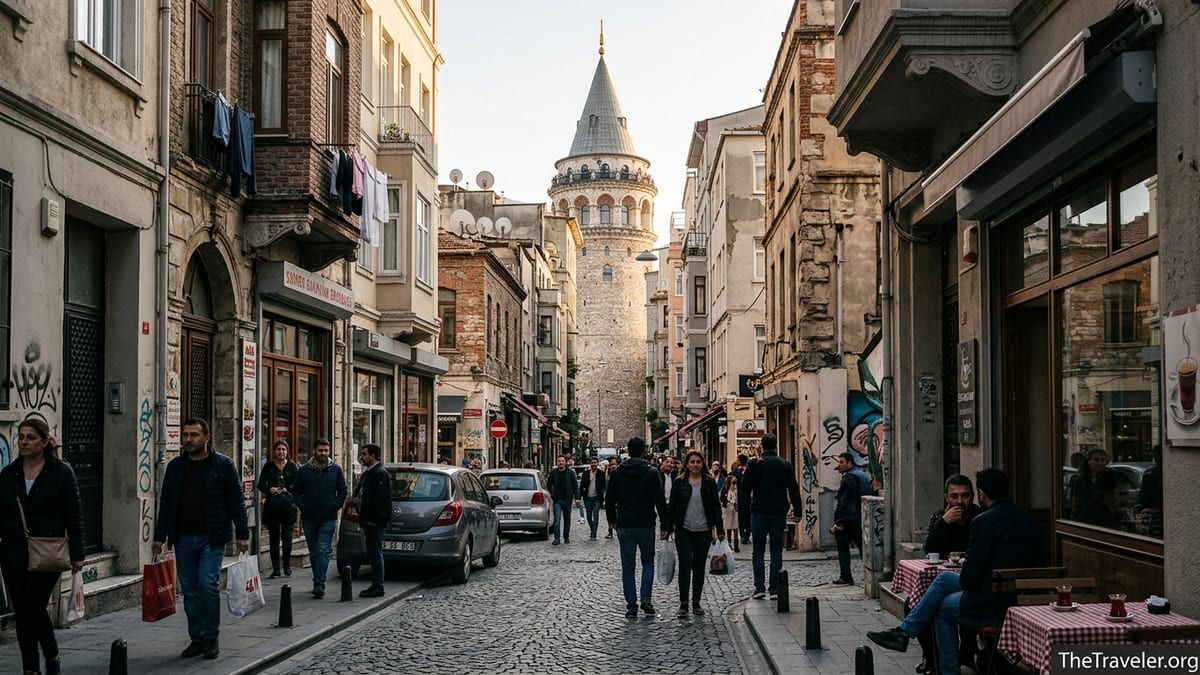
Orientation: From Waterfront Docks to Hilltop Tower
The classic walk starts in Karaköy, the historic port on the northern side of the Golden Horn. Today it is a mix of old workshops and newly polished waterfront around Galataport, with ferries shuttling to Kadıköy and Üsküdar and trams gliding toward Sultanahmet. From almost anywhere along the water, you will see the cylindrical silhouette of Galata Tower rising above low rooftops. The tower effectively becomes your compass: as you walk, you simply keep heading uphill in its direction.
Most visitors begin either near the Karaköy tram stop or the cluster of ferry piers by the Galata Bridge. From the tram stop, it is a 15 to 20 minute uphill walk to the base of the tower if you go directly, without photo stops. From the ferry piers, add five minutes, since you first skirt the fish sandwich stalls and cross Bankalar Caddesi, the historic “Banks Street” lined with former Ottoman-era financial buildings and today’s arts venues.
Even though the distance is short, the walk feels substantial because you are climbing a real hill. The elevation gain from the waterfront to the tower is roughly the equivalent of walking up eight to ten residential floors. Istanbul locals do this daily, but if you are not used to hills or are carrying luggage, build in time for pauses and café breaks. Fortunately, some of the most atmospheric coffee spots and street corners fall perfectly along the way.
For photographers, the key to this route is that the streets are never perfectly straight. Each bend reveals a new wedge of the tower between buildings, a side alley lined with drying laundry, or a glimpse back toward the Golden Horn. You are not only heading to a landmark; you are collecting a sequence of small city scenes that feel very different from the grand Ottoman silhouettes of the Old City across the water.
The Scenic Waterfront Start in Karaköy
Begin at the water’s edge to capture the contrast between old and new Istanbul. If you arrive by tram, step first toward the Galata Bridge side. Here you can photograph fishermen lined along the railings, the domes of the New Mosque and the market roofs across the water, and ferries pulling in and out. In the early morning, this area is bathed in soft light and is relatively quiet, with only commuters and a few street vendors setting up, which makes it easier to photograph without crowds.
Walk west along the promenade toward the Galataport complex. The new cruise terminal and waterfront development have opened up a long pedestrian zone where you can stroll with uninterrupted views of Topkapı Palace, the minarets of Sultanahmet, and the Bosphorus shipping lanes. You will pass outdoor terraces where locals linger over Turkish tea, sometimes with tulip-shaped glasses balanced on small saucers and a simit, the sesame bread ring, beside them. Prices for a simple tea or Turkish coffee here are usually only slightly higher than standard neighborhood spots, but you are paying for the view as much as the drink.
If you prefer to dive into neighborhood life immediately, cut inland behind the tram line into the grid of streets between the water and Bankalar Caddesi. Here, galleries and design shops sit next to electrical supply stores and hardware merchants. Third-wave coffee bars like Karabatak or popular baklava institutions such as Karaköy Güllüoğlu draw both locals and visitors. A rough guide is that a flat white or cappuccino from a specialty café here will cost a little more than a basic Turkish coffee from a traditional lokanta, but still feels reasonable by major European city standards.
As you walk inland, keep glancing back toward the Golden Horn for wide shots that frame the water, bridge and the Old City skyline. Late afternoon, just before sunset, is particularly good from this level, with warm light on the mosques and soft shadows in Karaköy’s streets. It is worth taking a few minutes to find a gap between buildings or a corner balcony that lets you shoot back toward the water before you fully commit to the uphill streets.
Through Bankalar Caddesi and the Kamondo Stairs
The most characterful way to transition from waterfront to hill is via Bankalar Caddesi, known in English as Banks Street. This slightly elevated boulevard runs parallel to the water and was once the financial heart of the Ottoman Empire. Today, stately stone facades house institutions like SALT Galata in a former Ottoman bank and a scattering of offices, cafés and cultural spaces. The tall buildings and narrow canyon-like feeling here are already photogenic, especially when captured with a wider lens that emphasizes their height.
From Bankalar Caddesi, look for the famous Kamondo Stairs, a sculptural, double-helix stone staircase built by the prominent Camondo family in the late 19th century. The stairs run between Bankalar Caddesi and a higher street on the Galata slope. They are one of the most photographed spots in the neighborhood, thanks to their curving lines and mix of late Neo-Baroque and early Art Nouveau details. Arrive early in the morning if you want clean shots without anyone else in the frame; by late morning, there is often a small queue of people taking portraits on the steps.
The Kamondo Stairs offer both a shortcut and a photo stop. Walking from the Karaköy tram stop to the base of the stairs normally takes around 8 to 10 minutes at an easy pace. Climbing the stairs themselves adds just a couple of minutes of exertion but saves you time compared with winding around on the steeper side streets. Once at the top, you are effectively halfway up the hill and already beginning to see glimpses of the tower between rooftops.
If you prefer a quieter but slightly longer approach, you can bypass the Kamondo Stairs and continue along Bankalar Caddesi before angling uphill on one of the perpendicular streets. These are home to workshops and less polished corners that make excellent documentary photographs: faded wall ads in Ottoman script, old shop signs, and locals sitting on low stools outside tea houses. This is the stretch where a fast lens helps; in the narrow shade, light can be low, and you may want to shoot at wider apertures to keep ISO down while still capturing the grit and texture of the walls.
Choosing Your Climb: Shortcuts, Stairs and Gentler Slopes
From the top of the Kamondo Stairs and neighboring streets, the climb to Galata Tower can be tackled in several ways. The most direct is to follow the steepest alleys that point straight toward the tower. Locals often take these when they are in a hurry. Expect narrow cobbles, mixed paving, and the occasional car squeezing past you. This approach is physically demanding but gets you from the top of Bankalar Caddesi to the tower square in roughly 10 minutes of steady uphill walking if you do not stop.
A more pleasant option for most travelers is to zigzag on slightly longer but gentler streets. These wind back and forth across the slope, often lined with small hotels, boutiques and cafés. Because the streets curve, the tower periodically pops into view ahead or above you, giving natural places to pause and frame a shot with balconies, laundry lines, or colorful facades as foreground. If you walk this way at a relaxed pace, with a couple of short stops, expect 15 to 20 minutes from the Kamondo level to the tower square.
For those who want to minimize uphill walking altogether, there is a mechanical shortcut: the historic Tünel funicular. You can, if you prefer, ride Tünel from Karaköy up to the Beyoğlu plateau and then walk downhill back to Galata Tower, finishing in Karaköy later. This reverses the direction of the climb and is especially useful in hot summer weather. The funicular ride itself takes about 90 seconds and deposits you near the top of İstiklal Avenue; from there, it is a 10 to 15 minute gentle downhill to the tower, mostly on paved streets.
Whichever option you choose, allow for brief rest stops. Istanbul’s hills can be unexpectedly tiring, particularly in July and August when temperatures and humidity climb. Carry a bottle of water from one of Karaköy’s corner shops; prices are generally modest compared with cafés near the tower. Benches are limited on the steeper streets, but small tea houses and bakeries function as informal resting points where ordering a drink or simit grants you a seat and shade.
Galata’s Café Streets and the Best Tower Angles
As you approach the upper section of the hill, the atmosphere shifts from working neighborhood to classic Beyoğlu charm. Streets like Serdar-ı Ekrem and Galip Dede are known for their combination of independent boutiques, record and instrument shops, and good coffee. Here you will find atmospheric roasters, dessert bars and breakfast cafés with outdoor tables on sloping pavements. Prices are higher than in backstreet Karaköy but still moderate compared with large European capitals, and there is usually free Wi‑Fi and a mix of locals, students and travelers.
These streets also offer some of the best street-level photographs of Galata Tower. One popular angle is from the lower end of the cobbled street that leads directly to the tower base, where the round stone tower fills the frame above a corridor of buildings and café awnings. Early morning or late afternoon works best if you want side light that gives the stone texture and avoids harsh midday contrast. A standard or slightly wide lens is enough; there is no need for an ultra-wide that might exaggerate distortion.
If you plan to go up the tower itself, timings matter for both crowds and light. In summer, visiting right after opening time often gives relatively short lines, while sunset is prized for sweeping Golden Horn views but can mean longer waits. Many travelers now book timed tickets online or through local passes so they can walk straight up to the security check without queuing at the ticket window. Always check the latest opening hours a day or two in advance, as they can shift with the season and special events.
Even if you decide not to climb the tower, the square at its base is a lively place to pause. Street musicians sometimes perform here in the evenings, and there are cafés where you can sit outside with a Turkish tea or a glass of freshly squeezed pomegranate and orange juice. From certain corners of the square, you can shoot portraits that include just a segment of the stone tower frame, hinting at the landmark without turning it into a postcard cliché.
Continuing to İstiklal Avenue and Planning Your Loop
From the tower square, it is easy to extend your walk to İstanbul’s most famous pedestrian boulevard, İstiklal Avenue. One common continuation is to follow the gentle uphill stretch of Galip Dede Street, which is lined with music shops selling ouds, guitars and traditional instruments, and stores offering calligraphy supplies, souvenirs and Turkish delight. Street-level graffiti and murals provide colorful photo subjects along the way.
At the top of this slope, you emerge near the Tünel square, the lower end of İstiklal Avenue. From here you can either ride the historic red tram up to Taksim Square or walk the 1.4 kilometer length of the avenue at your own pace. The street is full of side alleys leading to meyhanes (traditional taverns), rooftop bars and small passages with galleries and bookshops. Evening is the most atmospheric time, when neon signs glow, buskers perform, and the tram clanks past every 10 to 15 minutes.
One practical strategy is to make this entire route a loop: start in Karaköy in the late afternoon, walk up to Galata Tower as the light softens, continue to İstiklal Avenue for dinner or evening strolling, then either walk or ride Tünel back down to Karaköy. This way you experience the hill in both directions and see the waterfront with nighttime reflections. If you are staying in a hotel in the Karaköy or Galata area, you can easily end the night with a short walk back, even quite late, as these streets stay lively.
For travelers with limited time, another option is to reverse the loop. Begin near Taksim or along İstiklal, walk down through Galata Tower in the afternoon, then descend into Karaköy for a seafood dinner by the water. Street stands under or near the Galata Bridge serve fish sandwiches, while more polished restaurants cluster around the Galataport side. You can then hop a tram or ferry back to your base on the historic peninsula, Kadıköy, or Üsküdar.
Timing, Light and Practical Tips for Photographers
The Karaköy to Galata Tower walk is photogenic at almost any time of day, but certain windows are particularly rewarding. Early morning, roughly between sunrise and 09:00, gives you softer light, fewer crowds and cooler temperatures. This is ideal for shooting the Kamondo Stairs, empty café-lined streets and the tower from below without constant pedestrian traffic. Some coffee shops open later, but small neighborhood bakeries and simit sellers usually serve locals from early hours, adding life without congestion.
Late afternoon into golden hour is the second great window. The sun falls behind the Beyoğlu ridge, creating long shadows in the side streets and a warm glow on facades facing the Golden Horn. From the tower’s observation deck, this is when you are most likely to capture dramatic color over the Old City skyline. However, it is also when queues peak, particularly in the peak visit months of April to October, so build in buffer time if your plan centers on sunset views.
In terms of gear, there is no requirement for heavy equipment, and in fact a streamlined setup is more comfortable on the hill. A small mirrorless camera with a standard zoom, or even a good smartphone with a wide and tele lens, is enough for most travelers. If you carry a dedicated camera, consider a lens in the 24 to 70 millimeter equivalent range, which allows both narrow alley shots and tighter crops on architectural details. A lightweight cross-body bag or daypack with a secure closure is practical in crowds, although the area is not notably more prone to petty theft than other busy European city centers.
Weather in Istanbul is variable across the year. In winter, expect possible rain and slippery cobblestones; waterproof shoes with some grip are useful. In summer, carry sunscreen and a hat, especially if you plan to spend time on the tower terrace or walking the exposed stretches of İstiklal. Year-round, having a thin layer to put on when the wind picks up near the waterfront makes the transition from sheltered backstreets to the open promenade more comfortable, particularly in the evenings.
The Takeaway
The walk from Karaköy to Galata Tower is short on distance but rich in atmosphere. In a compact slice of Istanbul, you experience ferry life on the Golden Horn, the grand stone facades of the former banking street, the sculptural Kamondo Stairs, steep residential lanes, and the café culture of Galata’s hilltop streets. With a bit of planning, you can align your walk with the best light for photography and combine it seamlessly with an exploration of İstiklal Avenue and the broader Beyoğlu district.
Whether you treat Galata Tower as a viewpoint to climb, a backdrop for your street images, or simply a navigational anchor as you wander, the route from Karaköy makes the journey part of the reward. Pause in a waterside café, stop for baklava or a simit on a quiet corner, adjust your path based on which alley looks most inviting, and let the tower guide you upward. If you have only one free afternoon to feel the contemporary side of Istanbul while still anchored in deep history, this uphill walk is one of the most satisfying ways to spend it.
FAQ
Q1. How long does it take to walk from Karaköy to Galata Tower?
The direct uphill walk from the Karaköy tram stop to Galata Tower usually takes around 20 to 25 minutes at a normal pace, without photo stops or café breaks.
Q2. Is the route from Karaköy to Galata Tower very steep?
Yes, it is noticeably uphill, equivalent to climbing several flights of stairs, but most reasonably fit travelers manage it by taking short breaks and choosing gentler zigzag streets instead of the steepest alleys.
Q3. What is the easiest route if I want to avoid steep climbs?
The gentlest approach is to ride the Tünel funicular from Karaköy up to the Beyoğlu plateau, then walk downhill to Galata Tower and continue on to Karaköy or İstiklal Avenue.
Q4. When is the best time of day to walk and take photos?
Early morning for quiet streets and soft light, and late afternoon into golden hour for warm tones on buildings and panoramic views from the tower, are generally the most rewarding times.
Q5. Are the Kamondo Stairs worth including in the route?
Yes, the Kamondo Stairs are both a practical shortcut between Bankalar Caddesi and the upper streets and one of the most distinctive architectural photo spots on the walk.
Q6. Can I combine Karaköy, Galata Tower and İstiklal Avenue in one outing?
Easily. Many travelers start at the Karaköy waterfront, walk up to the tower, then continue to İstiklal Avenue for dinner or evening strolling before returning via Tünel or on foot.
Q7. Is it safe to walk this route after dark?
The main streets between Karaköy, Galata and İstiklal are generally busy and feel safe in the evening, though, as in any large city, it is sensible to stay on well-lit routes and watch your belongings.
Q8. Do I need to buy Galata Tower tickets in advance?
Buying a timed ticket in advance is not strictly necessary outside peak times, but it can reduce waiting if you want to visit near sunset or during busy holiday periods.
Q9. What should I wear for the walk?
Comfortable walking shoes with some grip are important because of cobblestones and slopes; in summer, light clothing and a hat help with heat, while in winter a waterproof layer is useful.
Q10. Is this route suitable for strollers or people with limited mobility?
The steep, uneven streets and frequent stairs make the direct walk challenging for strollers or those with limited mobility, so using the Tünel funicular and focusing on the flatter sections near İstiklal and the waterfront is usually more practical.