


Ambergris Caye offers two headline snorkeling trips that visitors hear about again and again: Hol Chan Marine Reserve, almost always paired with Shark Ray Alley, and Mexico Rocks, the newer, shallower marine reserve to the north. If you only have time for one reef excursion, choosing between them can feel like a high stakes decision. Both deliver bright coral, clouds of reef fish and a real chance of turtles, rays and nurse sharks, but the conditions and overall feel in the water are very different.
Get the latest updates straight to your inbox!
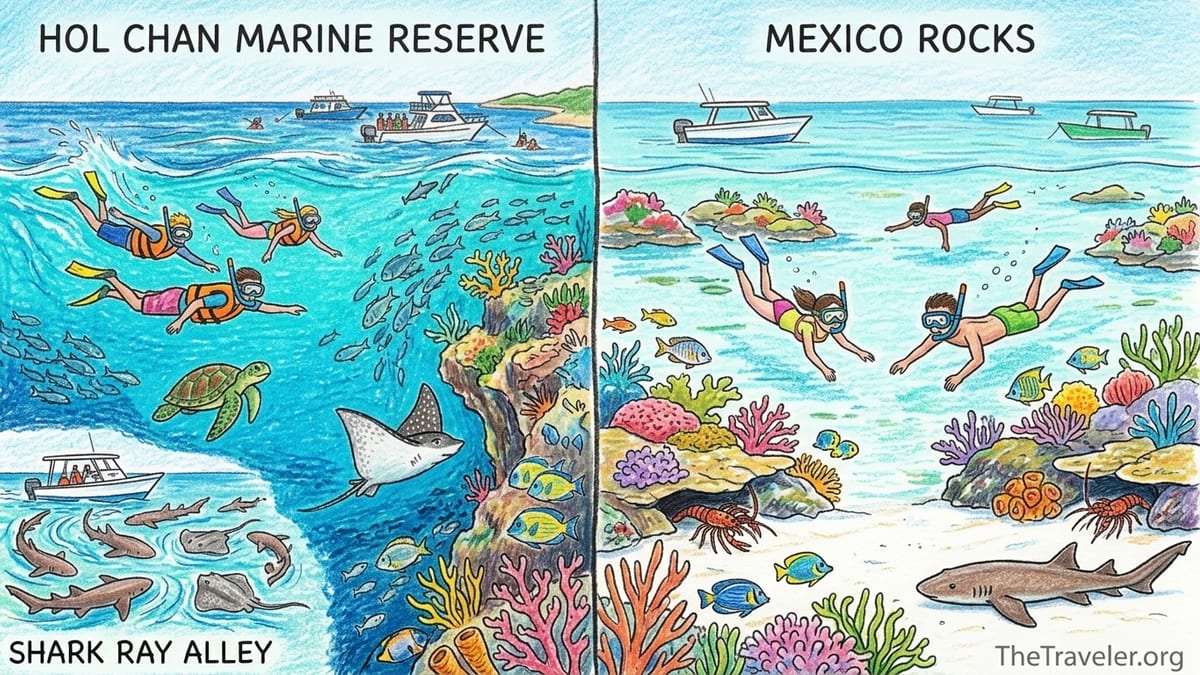
Hol Chan vs Mexico Rocks at a Glance
Hol Chan Marine Reserve sits in a natural break in the Belize Barrier Reef about 4 miles southeast of San Pedro. The channel itself drops to roughly 20 to 30 feet in places, with reef walls rising toward the surface and a steady, sometimes noticeable current running through. Most tours from San Pedro combine a 40 to 45 minute guided snorkel at Hol Chan with a second stop at nearby Shark Ray Alley, where nurse sharks and southern stingrays gather in 5 to 12 feet of water.
Mexico Rocks, by contrast, is a shallow patch reef system north of town. Current tour operators describe depths of roughly 8 to 12 feet, often even shallower in spots, with very little current and typically calm surface conditions. Boats anchor inside the reef behind the breakers, over coral heads that rise from a sandy bottom. The feel is less like a dramatic underwater canyon and more like drifting through an aquarium that was laid out for relaxed exploring.
In practice, this means Hol Chan tends to feel more adventurous: slightly deeper water, more sense of movement from the current and big schools of fish riding the channel. Mexico Rocks usually feels easier and more peaceful, with fewer boats and more freedom to paddle at your own pace. A couple who spent a week near San Pedro in early 2026, for example, booked Hol Chan one day with a popular operator out of Mahogany Bay, then Mexico Rocks with a small shop near the bridge. They described Hol Chan as “busier and more intense” and Mexico Rocks as “where we’d take our parents or kids.”
Price-wise, half day snorkel trips to either site tend to fall in a similar band, often around 40 to 60 US dollars per adult plus a small marine park fee collected in cash on board. Many resorts on Ambergris Caye sell their own branded trips that are actually run by a handful of local operators, so once you know which reef best fits your style, it is easy to find a departure that matches your schedule.
Depth, Current and Ease of Snorkeling
The most practical difference between Hol Chan and Mexico Rocks is how the water feels once you slide off the boat. At Hol Chan’s main channel, you will usually be snorkeling over a 20 to 30 foot deep cut through the reef, with coral walls stepping up toward the surface and a moderate current that can help or hinder depending on direction. Guides often brief guests on staying close, because if you drift too far you can end up among other groups or pushed down the channel faster than you might expect.
Mexico Rocks, on the other hand, is consistently shallow, often between 3 and 12 feet. In many areas you can see individual coral heads almost touching the surface, with white sand in between. Current is generally light enough that even first timers can float without feeling pulled. One family who booked a Mexico Rocks tour through a small north island resort described it as “like snorkeling in a pool, but with better fish,” a good indication of how unintimidating it can feel to someone who is unsure in the ocean.
If you are a confident swimmer, the deeper water and gentle drift at Hol Chan can be a plus. You can duck dive down a few meters to inspect a coral head or follow a passing turtle along the wall without worrying about bumping into the reef. For less confident swimmers and children, however, the knowledge that the bottom is far below and that the current is doing some of the moving can increase anxiety. Many guides counter this by providing life jackets worn around the waist or under the arms and by towing a buoy that nervous snorkelers can hold.
Because Mexico Rocks is shallower and more protected, it is often the better choice on windier days when seas are choppy on the outside of the reef. Several San Pedro dive shops now explicitly recommend Mexico Rocks as their go to snorkel for beginners or those prone to seasickness, noting in their brochures that it has “less currents and waves” and is “an easier snorkel, especially if it is your first time.” Hol Chan, while still very manageable for most visitors, is best enjoyed when you are comfortable with the idea of swimming in slightly deeper ocean water.
Coral, Fish and Overall Marine Life
Hol Chan Marine Reserve has been protected since the late 1980s and is one of Belize’s signature marine parks. Surveys list well over a hundred fish species and dozens of coral types inside the reserve, including brain coral, staghorn, elkhorn and vibrant sea fans. In the channel you may glide past schools of blue tang, grunts, snapper and sergeant majors, with the occasional barracuda hanging at the edge of the group. It is common to see a green or hawksbill turtle browsing the reef or surfacing near the group during a 45 minute snorkel.
Mexico Rocks is a younger reserve but benefits from its patch reef structure. Coral heads are bunched like small islands, separated by sand, which makes it easy to slowly circle each formation looking for life. Guides routinely point out lobsters under ledges, tiny cleaner shrimp, juvenile angelfish and the occasional porcupinefish wedged under a coral overhang. Because depth is shallow, colors here can appear especially vivid, even for those using only a basic mask and snorkel without filters.
In terms of sheer fish and coral variety, Hol Chan probably still has the edge, simply because it covers a larger, more varied area, including seagrass and mangrove nursery zones. However, reports from recent visitors suggest that Mexico Rocks is catching up in perceived quality. Travelers who have snorkeled both sites within a single week often describe them as “equally good but very different,” with Hol Chan winning for busy reef scenes and Mexico Rocks for relaxed, close up coral viewing.
Another subtle difference is how close the marine life comes to you. In heavily visited areas like Hol Chan and Shark Ray Alley, fish, rays and nurse sharks are very accustomed to people and often approach within arm’s length. At Mexico Rocks, without the same degree of daily feeding, fish behavior can feel slightly more natural, though rays and turtles still come close enough for excellent photos.
Sharks, Rays and Turtle Encounters
If your top priority is swimming with nurse sharks and southern stingrays, Hol Chan plus Shark Ray Alley is the itinerary that almost guarantees it. Most boats stop at Shark Ray Alley after the main Hol Chan snorkel and arrive to find a crowd of nurse sharks circling expectantly around the stern. In water only 5 to 12 feet deep, you can slip over the side and find yourself surrounded by dozens of sharks and rays, especially when the crew begins to toss small pieces of fish into the water.
Mexico Rocks also sees nurse sharks and rays, but usually in smaller numbers and with less predictable timing. Tour descriptions mention that you “may” see nurse sharks and turtles, and operators note that sightings are common but not guaranteed. On a typical half day excursion you might see a lone nurse shark gliding over the sand, a couple of southern stingrays foraging near the coral heads and, if you are lucky, a turtle passing by. Guests on recent tours have reported that their guides occasionally bring a small container of chum, which can quickly draw in a handful of sharks, but the intensity is rarely as high as at Shark Ray Alley.
For turtles, both sites offer realistic chances, with Hol Chan perhaps slightly more reliable. The channel’s mix of reef and seagrass makes good turtle habitat, and many groups report at least one turtle sighting during a standard snorkel circuit. Mexico Rocks has fewer seagrass patches but still sees resident turtles, and when one appears in shallow, clear water, the experience can feel especially intimate because it is so close to the surface.
From an ethical standpoint, some visitors are uncomfortable with the heavy feeding that happens at Shark Ray Alley and appreciate that Mexico Rocks encounters can feel more natural. If this is important to you, it is worth asking potential tour operators how they handle wildlife interactions. Some newer, more conservation focused outfits emphasize minimal feeding and keeping respectful distance from animals, while more traditional operators still stage those classic swirling shark moments that appear in many Ambergris Caye brochures.
Crowds, Boats and Overall Atmosphere
Hol Chan is one of the most popular day trips in Belize and draws boats not only from San Pedro but also from Caye Caulker and even the mainland on busy days. At peak times you might see a dozen or more skiffs and dive boats anchored along the channel moorings. Guides typically lead their groups in a line, with everyone wearing brightly colored vests to make head counts easier amid the crowd. Several travelers on recent seasons have noted feeling a bit rushed through the site due to time limits and the number of groups sharing the same circuit.
Mexico Rocks, while steadily growing in popularity, still tends to feel quieter. Because it is located north of San Pedro and not as easily included on full day Caye Caulker tours, fewer boats make the trip. A couple staying at a mid island resort in 2025, for example, reported sharing the reef with only one other boat during a morning snorkel, compared with at least eight boats around them at Hol Chan the previous afternoon. This relative lack of congestion can make the experience feel more personal and less like a group excursion.
The type of boat and group size can matter just as much as the site. Local operators offer everything from small, open skiffs that take six to eight snorkelers to larger covered boats carrying 20 or more. On Ambergris Caye you will see names like Tuff E Nuff, Chuck and Robbie’s, Salt Life Eco Tours and numerous resort based operators such as those serving SunBreeze Hotel or Mahogany Bay. If you lean toward Hol Chan but worry about crowds, looking for a trip that advertises “small groups” or caps numbers can make a noticeable difference in how it feels in the water.
Timing also helps. Early morning Hol Chan departures often reach the reserve before the bulk of day trippers arrive, while late afternoon trips can enjoy softer light and slightly quieter moorings. Mexico Rocks is less sensitive to timing but still benefits from early starts, both for calmer conditions and for beating any boats departing from the larger beachfront resorts north of town.
Families, Children and Nervous Snorkelers
For families traveling with young children or adults who are not strong swimmers, Mexico Rocks is usually the safer bet. The shallow depth, lighter current and calmer surface make it easier for kids to build confidence and for parents to relax. Many family friendly resorts along the north and south ends of Ambergris Caye now market Mexico Rocks specifically as their “gentle” snorkel option, noting in their descriptions that it is “perfect for all skill levels” and that even guests who only feel comfortable in waist deep water at first often gain enough trust to explore more freely by the end of the tour.
At Mexico Rocks, guides often allow more independent exploration once they know everyone is comfortable. You might start by following the guide around the first couple of coral heads, then be given the freedom to loop back over a favorite spot while staying within easy sight of the boat. For children, the ability to pop their heads up and see the boat nearby and the shore in the distance can dramatically lower anxiety.
Hol Chan can still work well for families, but it calls for a bit more preparation and honest self assessment. Children and adults need to be comfortable floating in deeper water for 40 minutes or more, following the guide in a group and occasionally swimming against a mild current. Many operators require life vests to be worn or at least carried in the water, and some may decline very young or visibly anxious children for safety reasons. If your family has only ever snorkeled from shore in calm bays, Mexico Rocks is a more forgiving first step.
If someone in your party is particularly nervous, consider booking a private or semi private tour regardless of site. Several small shops around San Pedro and north of the bridge offer private Mexico Rocks or Hol Chan trips at a modest premium over group prices. With a dedicated guide who can match the pace to your comfort level and, if necessary, tow a float for guests to hold, even first timers often finish the day talking about how much they enjoyed the reef.
Which Should You Choose if You Can Only Do One?
For travelers with just one open half day on Ambergris Caye, the choice between Hol Chan plus Shark Ray Alley and Mexico Rocks comes down to water confidence, appetite for excitement and wildlife priorities. If you are a confident swimmer who wants dramatic reef scenery, a good chance of turtles and those classic swim with the sharks photos, Hol Chan is usually the better match. The deeper channel, stronger fish life and guaranteed Shark Ray Alley stop make for a memorable, high energy outing.
If, however, you prefer calmer water, are bringing children or older relatives, or simply want a more peaceful experience with fewer boats around, Mexico Rocks is likely to leave you happier. The shallow patch reefs, gentle conditions and growing fish life provide plenty to see without the bustle. You will still have a realistic chance of encountering rays, turtles and even a nurse shark or two, just with less of the feeding frenzy atmosphere.
To put it concretely, imagine you and a partner landing in San Pedro on a Friday afternoon with only Saturday free. One of you is an experienced snorkeler who has dived in Cozumel and Hawaii, the other is a bit nervous in open water. Booking Hol Chan might thrill the experienced swimmer but leave the other tense the entire time. Choosing Mexico Rocks would give both of you a relaxing, shared experience that builds confidence and still delivers impressive coral and fish scenes.
On the other hand, a group of friends in their 20s staying in town for a long weekend, comfortable in the water and excited about underwater photography, will almost certainly get more out of the Hol Chan and Shark Ray Alley combo. Many photographers mention the dramatic silhouettes of turtles over the channel and the close passes of nurse sharks at Shark Ray Alley as some of their favorite Ambergris Caye images.
If You Are Staying Several Days, Should You Do Both?
For visitors with three or more days on Ambergris Caye, the real answer is simple: if your budget allows, you should strongly consider doing both Hol Chan and Mexico Rocks. The sites complement each other rather than compete, and experiencing both gives you a fuller picture of what the Belize Barrier Reef around Ambergris can offer. Many repeat visitors now book one early in their stay and the other later, often choosing different operators to compare styles.
In practical terms, this might look like a half day Hol Chan and Shark Ray Alley trip on your first full day, followed by a Mexico Rocks excursion on day three, with a rest day or mainland tour in between. Prices for each typically fall in a similar range, so doing both might bring your total snorkeling spend to around 100 to 150 US dollars per person once park fees and taxes are included. For travelers who have flown all the way to Belize specifically for the reef, that is usually money well spent.
Doing both also helps with weather flexibility. If wind or swell makes Hol Chan choppy on the day you booked it, you can often switch to Mexico Rocks with the same operator, since many run both trips. Likewise, if your first outing leaves you wishing for either more excitement or more calm, you can choose the second site accordingly. A couple who initially picked Mexico Rocks because one partner was nervous later decided, after a very positive shallow reef experience, to add Hol Chan before leaving. By then, both felt comfortable enough that even the stronger current at the channel felt like part of the adventure rather than a source of stress.
For keen snorkelers and underwater photographers, doing both sites creates variety in your images. Hol Chan will likely give you wide angle shots of reef walls, schools of fish and turtle silhouettes, while Mexico Rocks excels at close ups of coral textures, small reef fish and rays against white sand. Even using a simple action camera or phone in a waterproof housing, you will notice the difference in mood and color between the two sites.
Recommendations by Swimming Ability and Wildlife Priorities
When deciding which site is “better,” it helps to match the choice to your swimming ability first and your wildlife wish list second. For strong swimmers, comfortable in open water and able to move calmly even when there is a bit of current, Hol Chan plus Shark Ray Alley is the higher impact experience. You will likely see denser schools of fish, have a very good chance of turtles and almost certainly be in the water with nurse sharks and rays at close range. The slightly deeper channel also makes it more interesting for those who like to duck dive.
For beginners, children, older travelers and anyone who feels even slightly uneasy in water over their head, Mexico Rocks is typically the smarter pick. The shallow depth, limited current and smaller crowds make it much easier to focus on enjoying the coral instead of worrying about staying with the group. You still get colorful fish, healthy coral heads and a realistic chance of spotting rays and turtles, just in a calmer setting.
If your top priority is turtles, Hol Chan probably has a small edge given its seagrass and reef combination, but Mexico Rocks can still deliver very satisfying encounters. If your priority is sharks and rays and you do not mind the ethical questions around feeding, the certainty and density at Shark Ray Alley are hard to beat. If, on the other hand, you care more about tranquil coral gardens and fewer people, Mexico Rocks should rise to the top of your list.
Ultimately, there is no single best Ambergris Caye snorkel for every traveler. Both Hol Chan and Mexico Rocks are special for different reasons. The key is to be honest about your comfort in the water and to talk openly with potential tour operators about conditions, group size and their approach to wildlife before booking. A good match between site, guide and swimmer ability will do more to shape your day on the reef than any small difference in fish counts.
The Takeaway
If you only have time and budget for a single Ambergris Caye snorkel trip, choose Hol Chan and Shark Ray Alley if you are a confident swimmer seeking a high energy, wildlife heavy experience that almost guarantees close encounters with nurse sharks, rays and a good chance of turtles. Choose Mexico Rocks if you value calm water, shallow depth, fewer boats and a slower, more relaxed exploration of coral gardens that is ideal for families, beginners and anyone prone to nerves or seasickness.
For travelers staying several days, doing both is the best of all worlds. Start with the site that best matches your comfort level, then add the other once you have your bearings in Belize’s clear Caribbean water. Hol Chan will give you the drama of a living reef channel with abundant fish and the spectacle of Shark Ray Alley, while Mexico Rocks will balance that with quieter patch reefs where you can linger over individual coral heads and watch rays glide over pale sand.
Whichever you choose, remember that conditions can vary with weather and season, and individual experiences will differ from one tour to the next. Focus on reputable operators, realistic expectations and honest self assessment, and your day on the reef off Ambergris Caye is likely to be a highlight of your time in Belize rather than a source of stress.
In the end, Hol Chan and Mexico Rocks are not rivals so much as complementary chapters in the same story of the Belize Barrier Reef. Whether you find yourself drifting along Hol Chan’s deeper channel or hovering above the patch reefs of Mexico Rocks, you will be snorkeling in one of the Caribbean’s most accessible and rewarding marine environments.
FAQ
Q1. Which is better for beginners, Hol Chan or Mexico Rocks?
Mexico Rocks is generally better for beginners because it is shallow, usually 8 to 12 feet or less, with little current and fewer boats, which makes the experience calmer and easier to manage for new snorkelers.
Q2. Will I definitely see sharks and rays at both sites?
Shark and ray encounters are almost guaranteed on Hol Chan trips that include Shark Ray Alley, where nurse sharks and stingrays regularly gather, while Mexico Rocks offers frequent but less predictable sightings of nurse sharks and rays.
Q3. How deep is the water at Hol Chan compared with Mexico Rocks?
Hol Chan’s main channel typically runs around 20 to 30 feet deep, giving it a more dramatic, open water feel, while Mexico Rocks is much shallower, often 3 to 12 feet, with coral heads rising close to the surface.
Q4. Which trip is better for families with small children?
Most families with small children do better at Mexico Rocks, where calm, shallow conditions and smaller crowds make it easier for kids to gain confidence and for parents to supervise without worrying about stronger current or deeper water.
Q5. If I only have one day, which site should I choose?
If you are a confident swimmer who wants high energy wildlife encounters, choose Hol Chan plus Shark Ray Alley; if you prioritize calm water and an easier, less crowded snorkel, pick Mexico Rocks.
Q6. Are the tours to Hol Chan and Mexico Rocks similarly priced?
Yes, half day snorkel tours to both sites usually fall in a similar price range, often around 40 to 60 US dollars per person plus a small marine park fee, though exact prices vary by operator and season.
Q7. Is it worth doing both Hol Chan and Mexico Rocks on one trip?
For visitors staying several days, doing both is highly worthwhile because Hol Chan offers deeper channel scenery and Shark Ray Alley, while Mexico Rocks delivers calmer, shallower coral gardens and a quieter atmosphere.
Q8. Which site is better for seeing turtles?
Hol Chan has a slight edge for turtle sightings thanks to its mix of reef and seagrass habitat, but turtles are also seen regularly at Mexico Rocks, especially around the patch reefs where they sometimes cruise past snorkelers.
Q9. Do I need to be a strong swimmer for Hol Chan?
You do not need to be an athlete, but you should be comfortable floating in deeper water and following a guide in light to moderate current; nervous or weak swimmers may find Mexico Rocks more suitable.
Q10. How crowded are the two snorkel sites?
Hol Chan and Shark Ray Alley can be busy, with multiple boats and groups in the water, while Mexico Rocks usually has fewer boats and feels more relaxed, especially on morning departures or with small group operators.