


Swimming over Hol Chan’s cut in the Belize Barrier Reef and drifting among nurse sharks at Shark Ray Alley is the classic Belize snorkel outing. Dozens of tour boats run this route every day from Ambergris Caye and Caye Caulker, yet itineraries, prices and time in the water vary more than most visitors realize. Understanding how the standard three to four hour excursion works, and which add ons are worth the extra time and money, will help you choose a tour that actually matches your expectations.
Get the latest updates straight to your inbox!
Hol Chan & Shark Ray Alley: How the Classic Combo Works
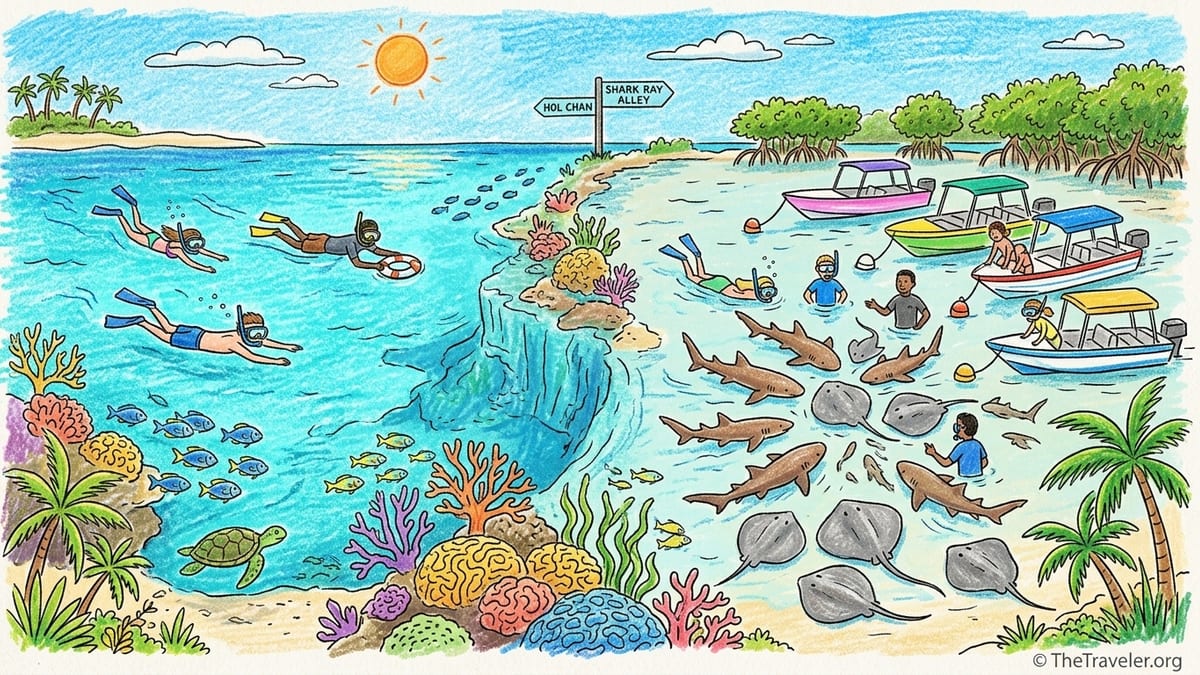
A combined Hol Chan and Shark Ray Alley tour is essentially two separate snorkel stops inside the same protected area, Hol Chan Marine Reserve. Hol Chan itself is a narrow channel cut through the Belize Barrier Reef, with coral walls and sand channels that act as a highway for fish and turtles moving between lagoon and open sea. Shark Ray Alley is a shallower sandy zone where nurse sharks and southern stingrays congregate when boats arrive.
From San Pedro on Ambergris Caye, most basic tours run either in the morning (often around 8:30 or 9:00 departure) or early afternoon, and last about three hours dock to dock. Examples sold through hotels on the island typically advertise “two snorkel stops” and specify Hol Chan first, Shark Ray Alley second. One San Pedro operator’s half day run, for instance, leaves at 8:45, spends roughly 45 minutes in the water at Hol Chan, then another 25 to 30 minutes at Shark Ray Alley before cruising back along the reef crest.
From Caye Caulker, the same combined experience is usually framed as a 3 to 3.5 hour reef tour. A typical small boat itinerary heads straight to Hol Chan’s reef cut, continues to Shark Ray Alley a short ride south, and may tack on a quick swim at nearby shallow coral patches if conditions and timing allow. In both cases, the key pattern is the same: the longer, more guided snorkel happens at Hol Chan, while Shark Ray Alley is a shorter, more adrenaline focused stop.
Boats usually make Hol Chan the first in water session while guests are still fresh and the light angle is good for spotting turtles and eagle rays. Shark Ray Alley comes second because it does not rely as much on visibility; the sharks and rays often gather directly under the boat once chum enters the water. The order rarely reverses unless a captain is deliberately trying to avoid another group’s schedule.
Step by Step: A Typical Three to Four Hour Tour
Most basic Hol Chan and Shark Ray Alley excursions follow a fairly predictable rhythm. After check in at the dock, staff verify that each guest has paid or will pay the Hol Chan Marine Reserve conservation fee. The current published fee is around 15 US dollars per person, per day for access to the reserve, collected once even if your boat visits multiple zones such as Hol Chan’s main channel and Shark Ray Alley. Some operators include this fee in their advertised price, while others request cash on the boat, so it is important to confirm ahead of time.
On the outbound ride, which can take 15 to 25 minutes depending on where your hotel dock sits along Ambergris Caye or Caye Caulker, guides deliver a safety and snorkeling briefing. This typically covers how to use the gear, signals for help, rules about not standing on coral and not touching wildlife, and the exact route the group will swim at Hol Chan. Boats tie to fixed mooring buoys at the reserve, and groups enter the water in stages while guides check masks and fins at the surface.
At Hol Chan, snorkelers generally follow a guide in a slow loop around the channel, often in water 6 to 15 feet deep. Expect around 35 to 50 minutes in the water here on a standard three hour tour. Stronger swimmers may be allowed to explore a slightly wider arc within sight of the guide, but most operators keep the group fairly tight. You are likely to see schools of snappers and grunts, parrotfish on the coral, and often a sea turtle or nurse shark gliding below or resting in the sand.
Back on the boat, there is usually a short ride of 5 to 10 minutes to reach Shark Ray Alley. Here the captain positions the boat in shallow, sandy water, often chest deep for an average adult. Guides may toss a limited amount of fish scraps or simply let the sound of the arriving boat draw in sharks and rays that have learned to associate the area with food. Snorkelers slip in as the animals circle under and around the boat. Time in the water at Shark Ray Alley is commonly 20 to 30 minutes, enough for several passes through the densest cluster of animals and some surface photos before the group climbs back aboard for the return ride.
Snorkeling Time, Equipment and What Guides Actually Do
When comparing tours, one of the most practical questions is how much true snorkeling time you receive. On a three to four hour Hol Chan and Shark Ray Alley combo, a realistic expectation is about one to one and a quarter hours in the water, split roughly 60 percent at Hol Chan and 40 percent at Shark Ray Alley. The remainder of the tour time goes to boat transfers, safety briefings, fitting equipment and moving on and off the boat.
Almost all reputable operators include masks, snorkels and fins in their base price. Resorts such as upscale beachfront hotels near San Pedro, and independent outfits running small speedboats, clearly list “snorkeling equipment included” in their brochures. A few budget or transport style operators, particularly some that combine Hol Chan with Mexico Rocks or other sites, may charge extra to rent fins or masks, so it is wise to ask whether gear is included and what condition it is in. Travelers frequently comment that a poorly fitting mask can cut into limited in water time, so bringing your own mask can be worthwhile if you snorkel often.
Guides are more than chaperones on these tours. At Hol Chan they lead the route, point out camouflaged creatures like lobsters and moray eels, manage group spacing and keep an eye out for currents. Many carry a life ring or small flotation device for less confident swimmers to hold onto while still seeing the reef. At Shark Ray Alley, guides usually enter the water alongside guests, positioning themselves between snorkelers and the boat’s ladder, and reminding people to keep arms relaxed at their sides rather than reaching down to touch sharks and rays. Some give a short talk about the history of fishermen cleaning their catch there, which taught the animals to gather around boats.
Most tours provide basic refreshments such as drinking water and sometimes sodas or fresh fruit. Shorter three hour outings generally do not include full meals. Masks, snorkels and fins are standard, but wetsuits, prescription masks and underwater cameras are usually on you to bring or rent separately. If you know you chill easily in the water, packing a thin rash guard or swim top is a good idea, since operators rarely stock thermal gear for half day snorkel trips.
Understanding Fees, Prices and What Is Really Included
Costs for Hol Chan and Shark Ray Alley excursions vary widely between operators, but recent listings from responsible tour companies place a half day group snorkel in the range of about 50 to 100 US dollars per person from San Pedro or Caye Caulker. That figure may or may not include the Hol Chan Marine Reserve conservation fee, typically set around 15 US dollars per person per day. Reading the fine print on whether the park fee is included is critical, particularly for families or groups where the extra charge adds up quickly.
Many hotel based tour desks in Ambergris Caye advertise a simple price such as 85 US dollars per adult for a morning Hol Chan and Shark Ray Alley snorkel, specifically noting that “park fee included.” In contrast, some independent operators or online booking platforms might list a slightly lower price, say 65 or 70 US dollars, but indicate that the park fee is not included and will be collected in cash on the day. On paper the two offers look different, but once you add the 15 dollar fee, total out of pocket costs are relatively similar.
Equipment policies and other inclusions can also change the value equation. A tour that includes high quality snorkel gear, drinking water, fruit snacks and hotel dock pickup might represent better value than a cheaper listing that requires you to walk to a central pier, pay separately for fins, and bring all your own refreshments. Ask directly whether the advertised price covers equipment, marine park fees, taxes, and, for longer tours, lunch. For full day itineraries that include Caye Caulker or a barbecue beach stop, lunch may be either included or an additional cost at a restaurant onshore.
Private charters follow a different pricing logic, often quoting a flat boat rate instead of per person charges. For example, a small speedboat charter from San Pedro might charge a set fee for up to four people for a custom Hol Chan and Shark Ray Alley trip, with additional guests at a lower incremental cost. In those cases, the conservation fee is almost always a separate, per person charge. Couples traveling in low season sometimes find that joining a small group tour is significantly more economical than booking privately, unless they highly value setting their own pace.
Longer Tours: Coral Gardens, Caye Caulker, Manatees and Lunch Stops
Beyond the classic three hour combo, many operators sell expanded itineraries that bundle Hol Chan and Shark Ray Alley with other reef sites or island time. Full day tours of six to seven hours are common from both Ambergris Caye and Caye Caulker, and generally cost more than half day outings, often roughly 100 to 150 US dollars per person depending on group size, boat type and whether lunch is included.
One popular pattern from Caye Caulker, for example, is a full day “marine reserve adventure” that includes Hol Chan, Shark Ray Alley, a stop at Coral Gardens, a manatee search in sea grass shallows, and one to two hours of free time on Caye Caulker town for lunch and exploring. Travelers who have taken these trips describe a sequence of multiple short snorkel sessions interspersed with boat rides and onshore breaks. Hol Chan remains the longest and most structured snorkel, Shark Ray Alley offers the shark and ray encounter, while Coral Gardens provides a gentler, shallow reef drift suited to less confident swimmers.
Full day sailing catamaran trips from San Pedro often follow a similar pattern but stretch transfers and surface time. A catamaran might leave around 9:00, motor or sail to Hol Chan for a guided snorkel, proceed to Shark Ray Alley, then continue on to Caye Caulker for lunch and free time. Guests may enjoy the extra comfort, shade and space of a large sailboat, along with rum punch on the ride back, yet their actual in water snorkeling time can be similar to or only slightly more than on a shorter speedboat tour. Some reviews note as little as 45 to 60 minutes total snorkeling across a full day outing when socializing and sailing were the focus.
Manatee add ons introduce another variable. Boats often transit an area of shallow sea grass where manatees sometimes feed, briefly stopping if a captain spots one near the surface. In good conditions this can be a memorable bonus: snorkelers slide in quietly and observe the animals from a respectful distance. In many cases, however, boats simply idle while guests scan the water without success, after which they continue to the next stop. Because of the animals’ seasonal movements and protected status, sightings are never guaranteed, and tours that heavily market manatee encounters should be approached with realistic expectations.
Which Extras Are Worth It and Which Just Make the Day Longer
Deciding whether to book a basic three to four hour combo or a longer excursion with Coral Gardens, Caye Caulker and manatee stops comes down to your priorities. For travelers who primarily want quality reef snorkeling and a focused experience with sharks and rays, the standard half day tour from Ambergris Caye or Caye Caulker usually delivers the best ratio of in water time to total hours spent. You get a solid guided loop around Hol Chan and an intense Shark Ray Alley session, with minimal padding.
Adding Coral Gardens is often a genuinely valuable upgrade if you enjoy colorful, shallow reef and want an easier second or third snorkel beyond the channel’s mild current. Coral Gardens usually features lower relief coral heads and calmer water, so it suits families, beginners, or anyone who tires quickly. The actual time spent snorkeling here on a full day trip tends to be modest, perhaps 20 to 30 minutes, but it provides a contrasting environment and increases the variety of what you see without substantially cutting into Hol Chan or Shark Ray Alley time.
Time on Caye Caulker can also enhance the day if you like mixing snorkeling with a laid back island atmosphere. A typical schedule allows around 1.5 to 2 hours ashore, enough for lunch at a local café, a stroll to see resident tarpon being fed at a dock, or a quick visit to the “Split” swimming area. However, adding Caye Caulker inevitably stretches the overall day, and some itineraries compensate by slightly shortening at least one snorkel stop. If snorkeling is your main goal and you are already staying on Ambergris Caye, you might prefer to book a separate water taxi visit to Caye Caulker on another day rather than combining both into a single long tour.
Manatee promises and extended sailing time are the extras that most often turn out to be more about marketing than substance. Because sightings are unpredictable and regulations require keeping a respectful distance, any time with manatees should be considered a welcome bonus rather than the core reason to pick one tour over another. Likewise, a slow sailing return with open bar can be lovely for groups of friends who want a social afternoon on the water, but if you are mainly interested in snorkeling, you pay for those hours one way or another in the trip price, even though they do not increase your time with reefs, sharks or rays.
Wildlife Expectations and Responsible Touring
The main wildlife draws at Hol Chan and Shark Ray Alley are relatively reliable, but it is still important to set expectations correctly. At Hol Chan’s reef cut, visitors frequently see schools of reef fish such as sergeant majors, blue tangs and snappers, along with parrotfish grazing on coral. Green sea turtles and southern stingrays are common, though not guaranteed on every single outing. Nurse sharks are often present on the sandy bottom or cruising the channel edges. Visibility can range from excellent, where you can see the sand clearly 15 feet below, to more muted on windy days when waves stir up sediment.
Shark Ray Alley is known for close passes of nurse sharks three to four feet long and broad southern stingrays that glide between swimmers. On busy days, several boats may share the area, and dozens of sharks and rays may gather beneath them. Regulations and operator policies increasingly discourage aggressive feeding and touching. Many guides emphasize viewing the animals with hands at your sides and maintaining space rather than trying to ride or grab them. Small reef fish also appear among the sharks, attracted to the same food source.
Other species such as eagle rays, tarpon and occasionally dolphins may appear during boat rides between sites, but these are opportunistic bonuses. Manatees, as mentioned earlier, are seasonal; some full day tours check likely seagrass spots along the way without any guarantee. A conservative mindset is to book the tour for Hol Chan’s coral and Shark Ray Alley’s nurse sharks and rays, then treat everything else as a pleasant surprise.
Choosing an operator that respects wildlife and the reef is central to keeping the experience sustainable. Look for signs that a company uses mooring buoys instead of anchoring on coral, gives thorough briefings about not touching animals or standing on the reef, and limits the number of guests per guide in the water. Recent traveler reports have highlighted differences between companies, with some smaller outfits praised for attentive guiding and reef friendly practices, while others are criticized for crowding, leaky gear and lax supervision. A little research before booking can help you land with a responsible operator.
Booking Tips: How to Choose the Right Hol Chan & Shark Ray Alley Tour
When scanning booking platforms, hotel tour desks and dockside signs, start by deciding whether you want a compact three to four hour experience or a longer six to seven hour day. If your trip schedule is tight or you have kids who tire easily, the classic half day Hol Chan and Shark Ray Alley outing is usually the smartest choice. Look for a tour that clearly states its total duration, approximate in water time, and maximum group size. Small groups of around 8 to 12 snorkelers per guide often feel more relaxed than boats carrying 20 or more people.
Next, verify what is included. Ask whether the Hol Chan Marine Reserve conservation fee is already built into the advertised price, or whether you will need to bring cash on the day. Confirm that snorkel gear is included, and, if you care about comfort, whether masks and fins are well maintained or if you should plan to bring your own. For full day tours, clarify whether lunch is provided on the boat, at a beach barbecue, or onshore at Caye Caulker, and whether drinks beyond water are complimentary.
Consider boat type as well. Smaller speedboats typically get you to the sites faster and sometimes allow a bit more flexibility to move between moorings if one area is crowded. Larger sailing catamarans offer more shade, bathrooms on board and a smoother ride, but may be slower and carry bigger groups. Think about whether you prioritize comfort and space on deck or maximum snorkeling time and agility. Reading recent guest reviews can reveal patterns, such as consistent praise for a guide’s attentiveness or repeated complaints about equipment issues.
Finally, pay attention to timing and weather. Morning tours often enjoy calmer water and better visibility, especially in the trade wind season when afternoons can be choppier. If you are prone to seasickness, an earlier departure and a smaller dose of rum punch are both wise. Booking at least a day or two ahead is advisable in high season, while in slower months some operators require a minimum number of guests to confirm a trip. It is always worth reconfirming your tour the day before, in case weather or numbers prompt a schedule change.
The Takeaway
A Hol Chan and Shark Ray Alley tour is popular for good reasons: it pairs one of the most accessible coral channels on the Belize Barrier Reef with a thrilling but manageable encounter among nurse sharks and stingrays. Most visitors leave talking about turtles gliding under them at Hol Chan and the soft brush of a ray’s wing at Shark Ray Alley. Yet not all tours are created equal, and understanding the nuts and bolts of how they operate puts you in control of your day.
If meaningful time in the water is your priority, a focused three to four hour combo that devotes about an hour to snorkeling and minimizes extra frills is often the best value. Longer itineraries that add Coral Gardens and a relaxed island lunch can genuinely enrich the experience for those who want variety and do not mind stretching the day. Manatee promises and drawn out sailing segments, on the other hand, are best viewed as potential bonuses rather than must have features.
By checking what is included in the price, how much snorkeling time is scheduled at each stop, and how your chosen operator treats the reef and its wildlife, you can book a Hol Chan and Shark Ray Alley tour that matches your style. With a bit of preparation, the classic Belize snorkel combo becomes not just a box to tick, but a highlight that feels tailored rather than generic.
FAQ
Q1. How long does a standard Hol Chan and Shark Ray Alley tour last?
A typical combined tour from Ambergris Caye or Caye Caulker lasts about three to four hours dock to dock, with roughly one to one and a quarter hours spent actually snorkeling between the two sites.
Q2. How much snorkeling time will I get at each stop?
On most half day tours you can expect around 35 to 50 minutes of guided snorkeling at Hol Chan’s reef channel and about 20 to 30 minutes in the water at Shark Ray Alley, depending on group size and conditions.
Q3. What is the current Hol Chan Marine Reserve fee and is it included?
The conservation fee for entering Hol Chan Marine Reserve is typically around 15 US dollars per person per day. Some operators include it in their tour price, while others collect it separately in cash, so always confirm ahead of time.
Q4. Do I need to bring my own snorkeling equipment?
Most reputable operators include masks, snorkels and fins in the tour price. However, quality and fit can vary, so frequent snorkelers often prefer to bring their own mask, and you should ask in advance if any operator charges extra for gear.
Q5. Are longer tours with Coral Gardens and Caye Caulker worth the extra cost?
They can be, if you want more variety and do not mind a six to seven hour day. Coral Gardens usually adds a gentler shallow reef snorkel, while time on Caye Caulker offers a relaxed lunch and island atmosphere, though not significantly more total snorkeling than a focused half day trip.
Q6. Will I definitely see sharks, rays and turtles?
Nurse sharks and stingrays are very common at Shark Ray Alley and are seen on most tours, while turtles are frequently but not always spotted at Hol Chan. Wildlife is never guaranteed, but these two sites offer some of the most reliable encounters in the area.
Q7. What is the difference between a speedboat and catamaran tour?
Speedboats usually reach the sites faster, allow slightly more flexible timing and often carry smaller groups. Catamarans provide more deck space, shade and amenities and may include drinks, but they can carry more passengers and devote more of the day to sailing rather than snorkeling.
Q8. Is a full day tour too long for children or first time snorkelers?
It depends on the child and the itinerary, but many families find that a three to four hour combo provides plenty of excitement without overtiring kids or beginners. Full day trips work best for confident swimmers who enjoy boat time and multiple short snorkels.
Q9. How far in advance should I book a Hol Chan and Shark Ray Alley tour?
In high season it is wise to book at least a few days in advance, especially for small group or boutique operators. In shoulder or low season, one to two days notice is often enough, but tours may require a minimum number of guests to run.
Q10. What should I bring to make the most of the tour?
Bring a swimsuit, towel, reef safe sunscreen, a rash guard or swim shirt, water resistant bag, and some cash for park fees or tips if they are not included. If you have a well fitting mask or prescription goggles, bringing those can also improve your comfort in the water.