


eSIMs have gone from a niche tech perk to a staple of modern travel. Instead of hunting for a local SIM card at the airport, you can now land almost anywhere, scan a QR code, and be online within minutes. Two of the biggest names in this space are Holafly and Airalo. Both promise easy setup and global coverage, but they take very different approaches to pricing, data limits, and what “unlimited” really means. This comparison looks at how each provider performs in real travel scenarios from city breaks and business trips to long-term backpacking, so you can decide which one actually fits the way you travel.
Get the latest updates straight to your inbox!
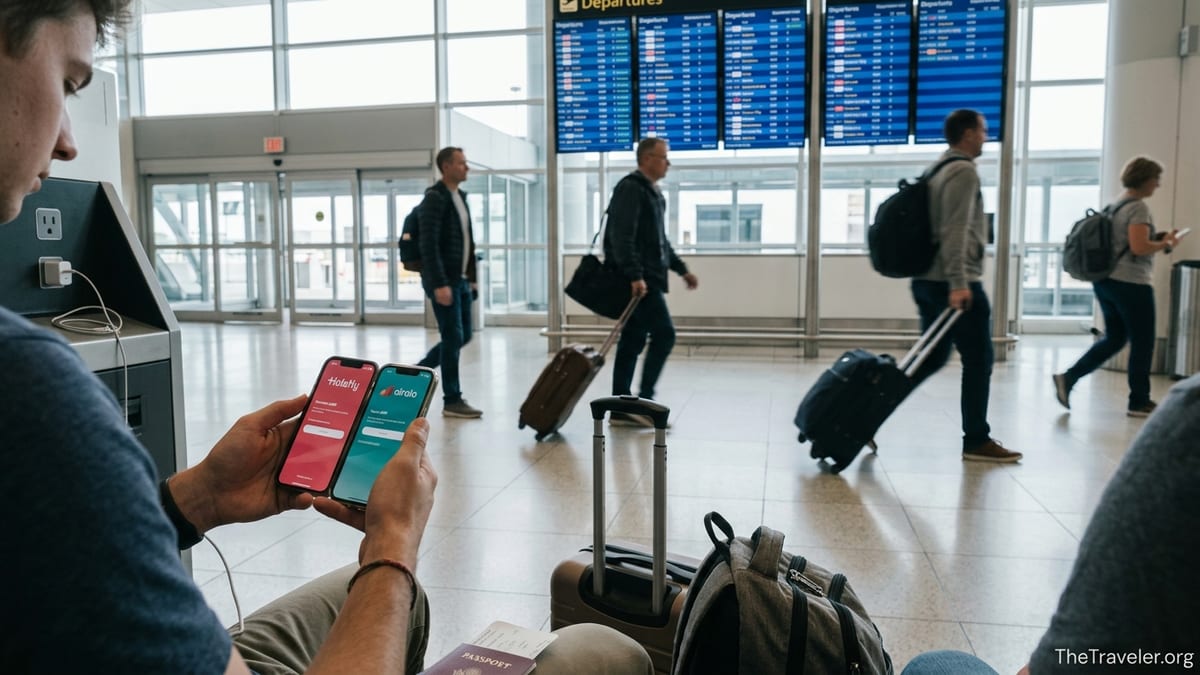
Holafly and Airalo in a Nutshell
Holafly and Airalo are both app-based eSIM providers aimed squarely at international travelers, but their core philosophies differ. Holafly is best known for its unlimited data plans across popular destinations such as Europe, Japan, Mexico, and the United States. Its marketing focuses on simplicity: pay once for a trip, enjoy “unlimited” data for a set number of days, and stop thinking about gigabytes altogether.
Airalo, by contrast, built its reputation on highly granular, data-capped plans. Instead of unlimited packages, it offers local, regional, and global eSIMs with clearly defined data buckets and validity periods. For example, in many countries you can choose anything from 1 GB for a few days up to large 20 GB or even 30-day “unlimited-style” plans, all at relatively low entry prices. This makes Airalo particularly appealing to cost-conscious travelers who are willing to think in terms of data usage.
Both companies support a huge list of destinations. Airalo advertises coverage in more than 200 countries and regions, with regional bundles like Asia, Europe, and Latin America that combine multiple countries into a single eSIM. Holafly covers over 190 destinations, with strong emphasis on Europe, Asia-Pacific hubs such as Japan and South Korea, and event-oriented products like a World Cup 2026 eSIM for the United States, Canada, and Mexico.
In practice, travelers rarely ask which brand is “objectively best.” Instead, the better question is which one fits a specific trip. Heavy data users staying a couple of weeks in one country may gravitate toward Holafly’s unlimited offers, while city-hopping backpackers watching their budget often favor Airalo’s flexible, capped plans.
Pricing: Unlimited Ease vs Granular Control
Pricing is where the contrast between Holafly and Airalo really shows. Holafly typically charges a premium for the reassurance of unlimited data. A common pattern is a flat-rate package such as 10 or 15 days of unlimited data in Europe, Japan, or the United States, often costing somewhere between the price of a modest restaurant meal and a budget hotel night. For example, travelers report paying in the ballpark of 25 to 35 US dollars for roughly 5 days of unlimited data in a single country, and significantly more for multiweek or regional passes.
Airalo, on the other hand, usually starts at very low price points for small data amounts and scales up. For instance, TechRadar’s recent testing in Turkey highlighted Airalo’s local plans starting at only a few US dollars for 1 GB over a week, with step-ups to 5, 10, or 20 GB over 30 days at prices still well below most unlimited options. In Japan, Airalo’s offers begin around the price of a coffee for 1 GB over several days and rise toward more expensive 30-day plans that can approximate unlimited usage for some travelers without technically being unlimited.
Consider a concrete example. A traveler spending 10 days in Istanbul mostly using maps, messaging, email, and occasional social media might find that 5 GB is more than enough, especially with hotel Wi-Fi. On Airalo, that sort of 5 GB, 30-day plan could cost little more than airport coffee and a snack combined. A comparable Holafly unlimited Turkey eSIM is likely to cost multiple times that amount, even though the traveler will never come close to using “unlimited” data.
Flip the scenario, and the value calculus changes. Imagine a content creator spending 14 days in Tokyo filming and uploading short videos daily, running Instagram Stories throughout the day, and using tethering for a laptop on trains. That user could easily burn through 1 to 2 GB per day. With Airalo, they might need a large regional or country-specific plan or several top-ups. Holafly’s higher, but fixed, price for 10 or 15 days of unlimited data can feel like an insurance policy, even though the fair usage policy means not all of that usage will be at full speed.
Coverage and Network Quality on Real Trips
Both Holafly and Airalo partner with local operators rather than owning physical networks. That means coverage quality largely mirrors local carriers wherever you go. However, there are differences in how each provider structures its roaming agreements, and that can affect your experience in specific places and at busy times.
In popular tourist destinations such as Spain, France, Italy, and the United Kingdom, travel bloggers testing Airalo’s European eSIMs report very solid performance on major networks with 4G and increasingly 5G support in big cities and along main transport corridors. For example, a traveler using Airalo’s Europe regional plan to take a train from Paris to Amsterdam is likely to see consistent coverage in cities and occasional drops in rural patches, in line with the local network’s strengths and weaknesses.
Holafly’s unlimited European eSIMs often connect to similar underlying networks, so signal bars on your phone may look nearly identical. The practical difference can show up when those networks are congested. During peak season in cities like Rome or Barcelona, some Holafly users report being deprioritized at busy times after heavy usage, with speeds slowing while locals on the same carrier stay fast. This reflects the trade-off of unlimited-style roaming deals, where high-volume travelers may get pushed into a lower priority band when the network is busy.
In Asia, Airalo has earned strong reviews for destinations like Japan and South Korea, where its local and Asia-wide plans often partner with major carriers that have excellent nationwide coverage. A traveler riding the Shinkansen bullet train from Tokyo to Osaka with an Airalo Japan eSIM typically sees coverage in most tunnels and countryside stretches, similar to native subscribers. Holafly also provides solid connectivity in major Asian hubs, but some long-term users in high-demand cities such as Tokyo and Seoul describe more frequent slowdowns after periods of heavy data use compared with capped-data competitors.
Speed, “Unlimited” Data and Fair Usage Policies
One of the most important differences between Holafly and Airalo lies in how they handle speed and “unlimited” data. Holafly advertises unlimited data on many of its flagship products, but in practice these are unlimited in volume rather than in high-speed capacity. Independent reviewers and frequent travelers consistently note that Holafly’s unlimited plans come with a fair usage policy. After a certain daily threshold that is not always clearly disclosed, speeds are throttled, often to levels suitable for messaging and email but frustrating for video, tethering, or large downloads.
For example, some travelers in Japan and Europe report that after streaming video and uploading a batch of photos early in the day, their Holafly connection later slowed to roughly 1 to 2 megabits per second. At that speed, maps and chat apps still work, but HD streaming, video calls, or cloud backups feel sluggish or unreliable. Others have described even harsher slowdowns when they pushed daily usage into double-digit gigabytes, such as uploading large amounts of 4K footage from a laptop tethered through their phone.
Airalo’s model is different. Most of its plans are strictly capped in data volume but deliver full network speed until that cap is reached. If you buy 5 GB, you get full-speed access to that 5 GB, then you are offline unless you top up or switch to Wi-Fi. Some regions now offer unlimited-style Airalo plans, but these too come with fair use clauses, and the company is generally clearer in listing data amounts or speed expectations than many competitors.
For a real-world scenario, consider a business traveler on a 4-day trip to New York whose needs are mostly email, Slack, maps, and occasional browsing. On Holafly, they might never hit the fair use threshold, so speeds remain fast and the unlimited promise feels true. On Airalo, a small 3 to 5 GB plan easily covers the trip at full speed, often at a fraction of the cost. But for a digital nomad working from cafés in Lisbon or Bangkok for a month, constantly on video calls and syncing large design files, Airalo’s fixed caps may mean watching usage closely, while Holafly’s unlimited volume brings peace of mind but sometimes at the cost of afternoon slowdowns.
Apps, Setup and Everyday Usability
Both Holafly and Airalo are designed for travelers who want connectivity without technical hassle, and in practice setup is straightforward with each. You typically choose a plan in the app or on the website, pay with a card or digital wallet, then receive installation instructions and a QR code. On most recent iPhones and Android flagships, scanning the code installs the eSIM profile in a minute or two, and you can pre-install before departure so that the line activates automatically when you land.
Airalo’s app is widely praised for its clean, utilitarian design. It presents country and regional plans in a catalog-style interface with clear data amounts, validity, and prices, which is helpful if you are comparing multiple destinations while backpacking through Southeast Asia or Europe. Once you have installed a plan, real-time usage tracking usually works well, letting you see exactly how many megabytes you have left. That makes it easy, for example, for a family in Italy to see that their 10 GB plan is half used halfway through a 2-week vacation and top up on the spot if needed.
Holafly’s app emphasizes destination-based discovery and simple trip planning. You select your destination, pick an unlimited plan length such as 5, 10, or 20 days, and then follow clear installation steps. Usage tracking is somewhat less critical since the data is marketed as unlimited, but the app still helps you monitor connection status and manage multiple eSIMs if you travel frequently. For a traveler flying into Mexico City for World Cup 2026 matches across Mexico, the United States, and Canada, Holafly’s event-focused product promises one eSIM covering all three countries, with activation that starts on arrival and runs seamlessly as you cross borders.
In day-to-day use, both providers rely on your phone’s native eSIM tools. That means you can keep your home carrier number active for calls and texts while using Holafly or Airalo solely for data. Many travelers, for example, keep their US number live for banking codes and two-factor authentication, while running an Airalo data plan in the background as the default for mobile internet.
When Holafly Makes More Sense
Holafly tends to shine in scenarios where simplicity matters more than squeezing every dollar of value out of each gigabyte. If you are the kind of traveler who does not want to think about data usage at all, especially on a time-limited trip, the appeal of a single up-front payment for unlimited data is significant.
Take a two-week honeymoon in Italy as an example. The couple plans to stream music constantly, video call family back home, upload dozens of high-resolution photos to cloud storage, and navigate on foot around cities like Florence and Rome. They do not want to worry about topping up halfway through the trip or calculating whether 5 GB is enough. A Holafly unlimited Italy or Europe package gives them one predictable cost that covers their entire stay. While the connection might slow if they binge-stream high-definition video every day, their general travel use is likely to stay comfortably within the plan’s high-speed range.
Holafly can also be compelling for event-based or multi-country travel where convenience is paramount. World Cup fans traveling between stadiums in Toronto, Mexico City, and New York in 2026 may prefer one unlimited eSIM that follows them across borders. Similarly, travelers on an organized coach tour visiting 10 European countries in 12 days might find that a single Holafly Europe unlimited plan eliminates the friction of managing multiple regional or local data caps.
Finally, some travelers simply place a premium on not running out of data at an inopportune time. A solo traveler relying heavily on navigation in unfamiliar cities, or someone traveling for medical reasons who needs constant access to messaging and telehealth apps, may value Holafly’s unlimited volume even if it is more expensive and subject to fair usage slowdowns.
When Airalo Is the Smarter Choice
Airalo usually wins for travelers who care about transparent pricing and who have at least a rough sense of their data needs. Because most Airalo plans are data-capped at clear amounts, you can match your purchase to your itinerary far more precisely than with a blanket unlimited plan.
Imagine a long weekend city break in Paris. A traveler who mainly uses hotel Wi-Fi and only needs mobile data for maps, restaurant searches, and occasional social media can easily manage on 1 to 3 GB over four days. Airalo’s small French or Europe plan at a low cost fits that pattern perfectly. Buying a more expensive unlimited plan from Holafly for such a short, light-use trip would likely lead to paying significantly more for capacity that is never used.
Airalo also tends to be more cost-effective for extended but light-to-moderate travel, such as a month-long rail journey through Central Europe or Southeast Asia where the traveler spends much of the day offline or on Wi-Fi. In these cases, a 10 or 20 GB Airalo regional plan can comfortably span several weeks of normal usage for maps, messaging, and browsing. Many digital nomads also appreciate that they can stack or switch between country-specific plans as they move, such as using Airalo’s Turkey plan for two weeks in Istanbul, then activating a separate plan for Georgia or Greece.
Another advantage is predictability of performance. Since Airalo’s capped plans do not rely on daily fair usage thresholds in the same way as Holafly’s unlimited offers, heavy usage on a single day is less likely to trigger throttling. A traveler attending a three-day tech conference in Berlin might upload large slide decks, join several video calls, and download conference apps all in one day without seeing speed penalties, so long as they do not exhaust their overall data allowance.
The Takeaway
Holafly and Airalo each offer credible, traveler-friendly ways to get online abroad without relying on traditional roaming, but they target slightly different priorities. Holafly’s headline promise is unlimited data: pay once for a set number of days and stop worrying about gigabytes. In reality, those plans are subject to fair use limits that can reduce speed after heavy daily use, but for many travelers focused on maps, messaging, and social media, the experience still feels effectively unlimited, especially on short trips.
Airalo’s strength lies in transparent, flexible, and usually cheaper data-capped plans. You pick exactly how much data you think you will need and pay accordingly, with clear visibility into remaining usage. For short breaks, budget travel, and most business trips, this often represents better value than an unlimited plan, particularly in destinations where Airalo’s local pricing is very competitive.
If you are planning a data-heavy trip and do not want to micromanage usage, Holafly is often the easier choice despite its higher cost and potential speed throttling. If you want to maximize value, maintain more control, and are comfortable roughly estimating your data needs, Airalo is usually the smarter pick. In many cases, travelers use both at different times: Holafly for a high-intensity, short trip like a festival, and Airalo for longer, slower travel where every dollar counts.
Before you choose, check the latest plans in each app for your specific destination, look at how much data you used on your last international trip, and decide whether you value simplicity or price more. With that information, picking between Holafly and Airalo becomes less about brand loyalty and more about matching the right tool to the way you actually travel.
FAQ
Q1. Is Holafly really unlimited?
Holafly’s unlimited plans are unlimited in data volume but subject to a fair usage policy. After you exceed an undisclosed daily threshold, speeds may be throttled, often enough for messaging and maps but not ideal for heavy video streaming or large uploads.
Q2. Which is cheaper overall, Holafly or Airalo?
For most typical trips, especially short city breaks or moderate usage over a couple of weeks, Airalo’s capped data plans usually work out cheaper because you pay only for specific data amounts rather than a premium for unlimited usage.
Q3. Which is better for a two-week Europe trip?
If you expect heavy daily data use, such as constant social media posting and frequent video calls, Holafly’s unlimited Europe plan may feel simpler. If your use is moderate and you are price-sensitive, an Airalo Europe regional plan with a clear 10 or 20 GB cap is often better value.
Q4. Can I use Holafly or Airalo for tethering and hotspots?
Technically both can work for tethering, but heavy hotspot use is more likely to trigger fair usage throttling on Holafly and can burn through data quickly on Airalo. For sustained laptop use, many travelers prefer larger capped plans on Airalo or a combination of eSIM and local Wi-Fi.
Q5. Do either Holafly or Airalo include a phone number?
Most Holafly and Airalo plans are data-only and do not provide a traditional phone number. Travelers commonly keep their home SIM active for calls and SMS while using the eSIM purely for data, then rely on apps like WhatsApp or Signal for voice and messaging.
Q6. Which is easier to install for first-time eSIM users?
Both are straightforward to install by scanning a QR code, and both apps provide step-by-step instructions. Airalo’s interface is often praised for clarity when comparing multiple plans, while Holafly’s destination-based flow can feel simpler if you only care about one country or region.
Q7. How do speeds compare between Holafly and Airalo?
On light to moderate usage, speeds are usually similar because both rely on the same local networks. Under heavy usage, Holafly users are more likely to see speed reductions due to fair usage rules, whereas Airalo users experience full speed until their data cap is reached.
Q8. Which is better for long-term digital nomads?
Digital nomads who move slowly and value budget control often prefer Airalo’s capped regional plans combined with local Wi-Fi. Some choose Holafly for shorter, high-intensity working periods or in destinations where unlimited-style roaming is more convenient than juggling multiple top-ups.
Q9. Can I switch between Holafly and Airalo on the same trip?
Yes. Modern phones support multiple eSIM profiles, so you can install both and switch as needed. For instance, you could use a Holafly unlimited plan for the first, data-heavy week of a trip, then rely on a smaller Airalo plan for lighter usage later.
Q10. How should I estimate how much data I need with Airalo?
A rough guide is about 0.5 GB per day for light use such as maps and messaging, 1 GB per day for typical social media and browsing, and 2 GB or more for frequent video or tethering. Checking your past mobile data usage before a trip can refine this estimate and help you choose an appropriately sized Airalo plan.