


Landing at Daniel K. Inouye International Airport in Honolulu and heading to Waikiki on a budget is very doable, but only if you understand how Honolulu’s public bus system works. Between the long-running Route 20 and the newer W Line that links the airport, Ala Moana and Waikiki, you can get from the terminal curb to your hotel for only a few dollars. The catch is that TheBus has strict luggage rules and the ride is not ideal for everyone. This guide walks you through the current routes, airport stops, approximate fares as of mid‑2026, luggage limitations, and realistic examples of when the bus is a great deal and when it is not.
Get the latest updates straight to your inbox!
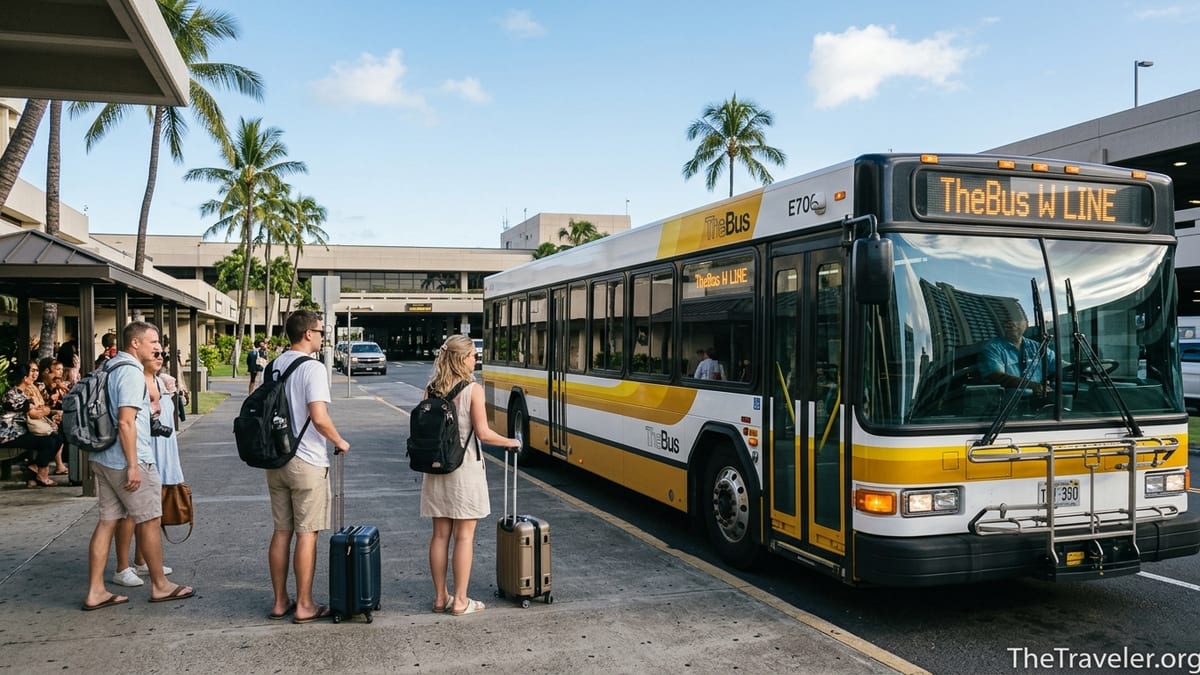
Honolulu Airport to Waikiki by Bus: The Big Picture
The public bus system on Oahu is simply called TheBus, operated by the City and County of Honolulu. From Daniel K. Inouye International Airport, most budget travelers heading to Waikiki will use either Route 20 or the limited-stop W Line, which both connect the airport to Downtown, Ala Moana Center and the Waikiki hotel district. Since late 2025, the W Line has become the primary airport–Waikiki service, while Route 20 still runs through the airport but continues farther west to the Hālawa Aloha Stadium Skyline rail station and beyond.
In practical terms, this means you can step out of baggage claim, walk to the curbside bus stop, and ride straight into Waikiki without changing vehicles. Typical ride times range from about 45 minutes in light traffic to well over an hour during weekday rush periods, as both routes travel along Nimitz Highway and Ala Moana Boulevard before looping through Waikiki’s hotel streets. Compared with a 35 to 45 dollar rideshare or taxi for two people, paying just a few dollars per person on TheBus is a substantial saving if you can travel light and are comfortable on city transit after a flight.
However, this is not a private airport coach. There is no dedicated luggage storage and no guarantee of a seat during busy times. You will be riding with local commuters and other visitors. For solo travelers or couples with only small carry‑ons, the experience is usually straightforward. For families with strollers, surfboards or multiple checked suitcases, the rules and realities of space on board can quickly make the bus a poor choice, no matter how attractive the fare may look on paper.
Where to Catch TheBus at Honolulu Airport
TheBus stop serving Route 20 and the W Line sits on the ground level outside the main terminal complex, near the lei stands and the Lelepaua Skyline rail station on Ala Onaona Street. After exiting baggage claim, follow the ground transportation signs for public bus and Skyline. You will see standard TheBus shelters and signage indicating routes that serve the airport. Unlike some mainland airports, you are not loading at an offsite park‑and‑ride; the bus pulls right up to the curb in front of the terminal area.
If you arrive at one of the overseas or interisland concourses, the airport’s internal Wiki Wiki shuttles can carry you to the main terminal area and the Lelepaua rail station zone, where the bus stop is located. Many visitors simply follow the crowd headed toward the lei stands and rail station and then look for the yellow and white TheBus vehicles. The front headsign will typically read something like “W Line Airport – Waikiki” or “20 Waikiki – Beach & Hotels” when the bus is heading into town.
As a concrete example, a traveler landing on a midday flight from Los Angeles can collect a small roller bag, walk out of Terminal 2 baggage claim, cross to the median where the bus shelter sits, and usually see a W Line bus arrive within 20 to 30 minutes, depending on the time of day. During peak periods around late afternoon, the same traveler should be prepared for a fuller bus and possibly standing room only for at least part of the ride into Downtown and Ala Moana.
TheBus Routes from HNL: W Line vs Route 20
Today there are two practical city bus options from Honolulu airport into Waikiki. The newer W Line is a limited‑stop service designed specifically to link the airport with Downtown Honolulu, Ala Moana Center and Waikiki via Nimitz Highway and Ala Moana Boulevard. It started operating in October 2025 alongside the expansion of the Skyline rail line and uses many of the same roadway segments that older express routes once covered. In most cases this is the fastest and most straightforward choice if you are heading directly to Waikiki with light luggage.
Route 20, officially published as “Waikiki – Aloha Stadium,” continues to run through the airport as a regular all‑stops city route. Heading eastbound, it connects the Hālawa Aloha Stadium rail station to the airport, Downtown, Ala Moana Center and Waikiki, then continues to the Honolulu Zoo and Paki Avenue area. This route is especially useful if you are coming from the rail line or planning to reach Ala Moana first and then connect to other buses for places like the North Shore or Kailua. It is slightly slower through town than the W Line because it makes more stops, but it still delivers you directly to central Waikiki along Kuhio Avenue and Monsarrat Avenue.
In practice, many locals and repeat visitors simply board whichever bus comes first. For example, if you are standing at the airport stop and the headsign shows a W Line heading to Waikiki, you take that. If a Route 20 pulls up first and is going toward Waikiki Beach & Hotels, you take Route 20 instead. Both will typically pass Ala Moana Center and then head into the Waikiki corridor, stopping at familiar cross streets such as Ala Moana Boulevard near Waikiki, Saratoga Road, Kuhio Avenue and Kapahulu Avenue near the Honolulu Zoo.
Fares, Payment Options and Realistic Costs
As of July 1, 2026, single adult cash fares on TheBus and Skyline have risen modestly. TheBus cash fare for adults is now in the low three‑dollar range per ride; local coverage and rider reports put it at approximately 3 dollars and 25 cents for a single adult trip, with reduced fares for youth and seniors. Exact change is required when paying cash on board. Drivers do not make change and cannot feed the farebox for you, so arriving with small bills and coins matters. One frequent visitor described being denied boarding with only 2 dollars in cash until another passenger contributed the final dollar, a reminder that the farebox rules are enforced.
TheBus also offers reloadable smart cards and daily or multi‑day caps that integrate with the Skyline rail system. However, most short‑stay visitors arriving at the airport find it easiest to pay cash for the first ride, then purchase a card or day pass later at convenience stores and outlets in Waikiki such as ABC Stores. Around the airport itself, card vendors are limited, so counting out exact fare before you land can save stress.
On a purely financial level, the value proposition is strong. Two adults taking TheBus from the airport to Waikiki will pay around 6 dollars and 50 cents total in 2026, compared with roughly 35 to 45 dollars for a standard UberX or Lyft ride under normal traffic conditions, and sometimes more during surge pricing late at night. Shared airport shuttles often advertise fares around 20 to 25 dollars per person to Waikiki hotels, which means a family of four could save more than 100 dollars round‑trip over the course of their vacation by using TheBus both ways, assuming they can meet the luggage rules.
Luggage Rules on TheBus and What They Mean in Real Life
The most important fine print for airport passengers is TheBus luggage policy. Officially, only bags that can fit on your lap or under the seat in front of you are allowed. The rule exists to keep aisles and doorways clear for safety reasons. There is no dedicated luggage rack and drivers are instructed not to permit large suitcases that would block space for other riders. This applies system‑wide, not just on airport routes.
In practice, this means a standard airline carry‑on roller bag and a personal item like a backpack or tote are usually acceptable, as long as you can comfortably hold them in your own space. Think of what fits easily in an overhead bin on the plane. A full‑size 28‑inch checked suitcase that barely met your airline’s 50‑pound limit is almost certainly too large for TheBus’s official standards. Riders with such bags sometimes report being turned away at the door, especially during busy times of day or on crowded routes.
The W Line’s introduction prompted a temporary baggage allowance that some riders interpreted as more generous, and online anecdotes now show a mix of experiences. A few visitors describe riding the W Line to and from the airport with one full‑size checked suitcase each without issue, provided they kept the bags close and out of the aisle. Others report drivers refusing boarding for oversized bags or asking passengers to wait for a less crowded bus. The safest assumption for travelers is conservative: if you cannot easily lift your suitcase onto your lap or tuck it neatly under a seat, it is not a good candidate for TheBus.
For a real‑world example, imagine a solo traveler with a 21‑inch carry‑on roller and a small backpack. This person can usually sit in a forward‑facing seat, place the backpack under the seat, and keep the roller on the floor between their legs or on their lap, satisfying the rule. By contrast, a family of four each carrying a large checked suitcase and additional carry‑on bags will likely struggle to fit without blocking aisles, and one firm driver could politely refuse the entire group. In that scenario, a shuttle van, rideshare or prearranged transfer is a more realistic choice.
Using TheBus to Reach Waikiki and Connect via Ala Moana Center
Both the W Line and Route 20 run from the airport into central Honolulu and then along Ala Moana Boulevard to Ala Moana Center, the island’s largest shopping mall and a major bus hub. Many riders choose to exit at Ala Moana Center first, especially if they want food, restrooms, or to transfer to another route. Ala Moana’s food court and supermarket options are popular with budget travelers looking to stock up on groceries or a quick meal before heading to their hotel.
From Ala Moana Center, dozens of routes radiate around the island. Visitors headed to the North Shore might transfer to Route 60, which travels to Haleiwa and beyond, or to routes serving Kailua, Kaneohe and other Windward communities. Even within Waikiki, some people find it easier to change to another bus at Ala Moana to reach a specific end of the district. For example, someone staying near Diamond Head might transfer from the airport bus to a route that continues along Monsarrat Avenue and past the Honolulu Zoo, depending on current schedules.
That said, most first‑time visitors simply stay on the bus past Ala Moana Center and ride it directly into Waikiki. The buses proceed along Ala Moana Boulevard, then turn onto streets such as Saratoga Road or Kuhio Avenue, stopping every few blocks in the main hotel corridor. A traveler staying at a hotel near the International Market Place, for instance, would watch for stops along Kuhio Avenue around Seaside Avenue or Kanekapolei Street and ring the bell once the bus approaches. Google Maps and TheBus’s own trip planner tools are extremely useful for identifying the nearest stop to your hotel and whether you should exit closer to the Ala Wai Canal side or the beach side of Waikiki.
When Taking TheBus Is Not Practical
For all its strengths as a cheap airport transfer, TheBus is not the right choice for every traveler or every situation. The most common deal‑breaker is luggage. If you are arriving with bulky checked suitcases, golf clubs, a large stroller, or multiple bags per person, you risk being denied boarding or creating an uncomfortable situation for yourself and other passengers. For example, couples on extended cruises often arrive with two or three large cases each. For them, a 60‑dollar taxi or rideshare may be expensive but is still more realistic than trying to juggle gear onto a crowded city bus.
Timing is another key factor. Very early morning or late‑night arrivals may face infrequent bus service, longer waits, or slightly more complicated walks between terminal doors and stops if certain entrances are closed. After a red‑eye flight from the mainland or Asia, standing in humid air at the curb for 25 minutes while watching a nearly full bus arrive can feel more punishing than the money saved justifies. Families with jet‑lagged children, elderly relatives or mobility issues are often better served by door‑to‑door transport, even if it costs more.
Comfort and travel style matter too. TheBus is everyday public transport, not a dedicated airport shuttle with luggage racks and guaranteed seats. Expect stop‑and‑go traffic on Nimitz Highway, plenty of stops before reaching Waikiki, and a mix of local commuters, students and workers alongside fellow visitors. If you value a quiet ride directly to your hotel lobby, or you are anxious about navigating a new city’s transit system, a shuttle van or rideshare provides a smoother arrival. TheBus remains an excellent tool for exploring Oahu after you have checked in and dropped off your bags, even if you choose a different mode for the first leg from the airport.
Practical Tips for a Smooth Airport–Waikiki Bus Ride
To make TheBus work for you from Honolulu airport, planning a few details in advance helps. Before flying, check TheBus’s official website or a current trip planner app for the latest W Line and Route 20 timetables and any service alerts. Because bus and rail schedules are occasionally adjusted to match Skyline extensions and demand patterns, looking up same‑month information is wiser than relying on a blog post from years past. Having a screenshot of your planned route and stop names on your phone can be invaluable when you are tired and roaming data is spotty.
Carry small bills and coins and aim for exact fare for everyone in your group. At the airport, if you arrive with only large bills from a currency exchange, buying a bottle of water or snack at a newsstand is an easy way to break them down. Many visitors also carry a small collapsible tote or daypack so that once they reach their hotel and unpack, they can switch to lighter gear for everyday bus rides around the island, leaving big suitcases behind.
On board, move promptly away from the doors, keep your bags consolidated on your lap or under the seat, and be prepared to stand if seats are full. Watch the live location of the bus on a map app if possible and pull the stop cord about a block before your desired stop. For example, if you are staying at a hotel on the western end of Waikiki near Fort DeRussy Beach, you might exit along Ala Moana Boulevard or Saratoga Road; if you are staying near the zoo and Kapiolani Park, you will likely stay on until the bus reaches Kapahulu Avenue and Monsarrat Avenue.
FAQ
Q1. Can I take a full‑size checked suitcase on TheBus from Honolulu airport to Waikiki?
Officially, TheBus only allows bags that fit on your lap or under the seat, so a large checked suitcase is usually not permitted and may get you turned away.
Q2. Which bus should I look for at the airport if I am going straight to Waikiki?
Most travelers use either the W Line, which is a limited‑stop airport–Waikiki route, or Route 20, which also serves the airport and continues into Waikiki.
Q3. How much does it cost to ride TheBus from the airport to Waikiki in 2026?
As of July 2026, an adult cash fare is a little over 3 dollars per ride, so a couple will pay around 6 to 7 dollars total for the one‑way trip.
Q4. Do I need exact change to pay the bus fare at Honolulu airport?
Yes. TheBus requires exact change for cash fares. Drivers do not make change, so bring small bills and coins or break larger bills at airport shops.
Q5. Where exactly is the bus stop at Daniel K. Inouye International Airport?
The main stop for TheBus and the W Line is on the ground level near the lei stands and the Lelepaua Skyline station, along the airport access road.
Q6. How long does the bus ride from the airport to Waikiki usually take?
Depending on traffic and time of day, the ride typically takes between 45 minutes and a bit over an hour, with longer times during rush hour.
Q7. Can I use TheBus to get from Waikiki to Ala Moana Center and then around the island?
Yes. Both airport routes pass Ala Moana Center, a major hub where you can transfer to buses heading to the North Shore, Kailua, Kaneohe and other areas.
Q8. Is TheBus a good option for families with young children and strollers?
It can work if you travel light and can fold the stroller quickly, but many families prefer a shuttle or rideshare for door‑to‑door convenience with kids and gear.
Q9. What if my flight arrives very late at night or very early in the morning?
Service is less frequent during overnight hours, so you may face longer waits or gaps; in those cases, a taxi or rideshare is often more practical despite the higher cost.
Q10. Should I use TheBus for my arrival if I have never used city buses before?
If you are comfortable following directions from a transit app and traveling with only small bags, TheBus is manageable; if you are anxious or overloaded with luggage, a shuttle may be a better first‑night choice.