


Landing at Honolulu’s Daniel K. Inouye International Airport (HNL) is the moment many Oahu trips truly begin. For first-time visitors, though, this busy island hub can feel confusing: multiple terminals, a new rail station, a maze of shuttles and buses, and decisions about whether to grab a taxi, rideshare or rental car. This guide walks through the airport step by step, using real-world examples and current information so you can move from plane door to Waikiki beach, Ko Olina resort or North Shore bungalow with confidence.
Get the latest updates straight to your inbox!
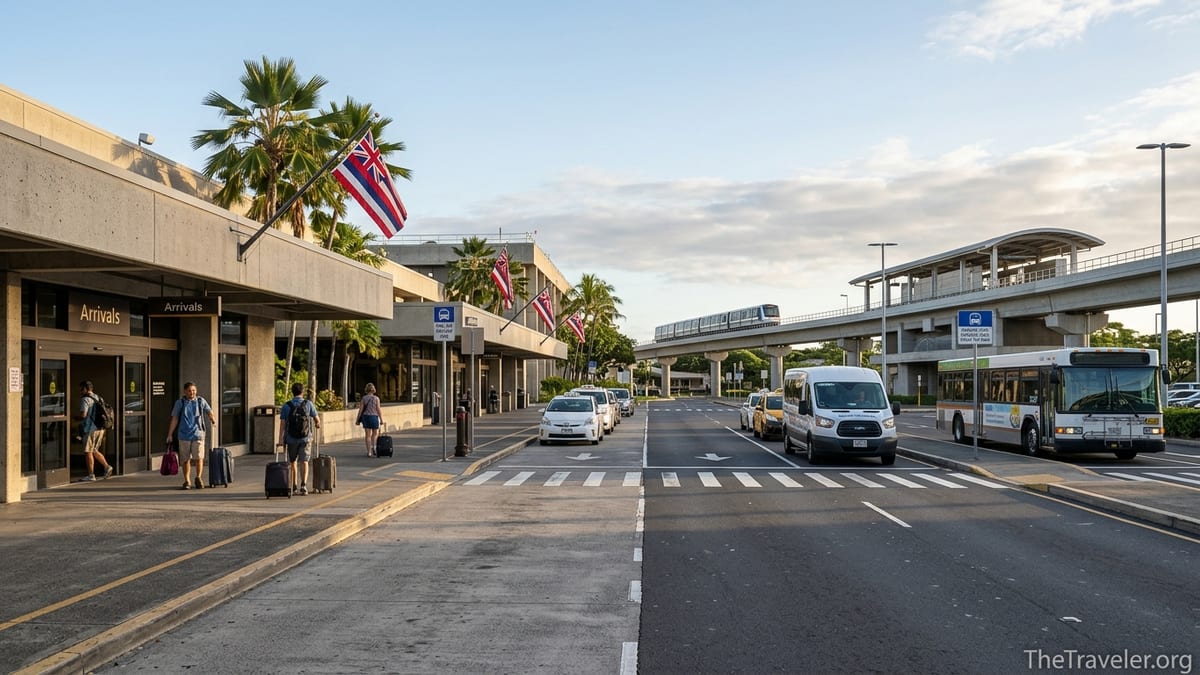
Understanding HNL: Layout, Terminals and How They Connect
Honolulu’s airport is officially Daniel K. Inouye International Airport, and it functions as Hawaii’s main gateway as well as the hub for interisland flights. For a first-time visitor, the most important detail is that the airport is essentially three terminal areas: Terminal 1 on the west side, Terminal 2 in the center, and smaller Terminal 3 across the runway. Most mainland U.S. and international flights arrive at Terminal 2, while Hawaiian Airlines uses Terminal 1 heavily for both interisland and many mainland routes. Terminal 3 handles a small number of commuter flights.
If you are flying from the U.S. mainland on airlines like United, American, Delta, Southwest or Alaska, you will almost always arrive in Terminal 2. Many international carriers also use Terminal 2. Hawaiian Airlines guests may arrive in either Terminal 1 or 2 depending on route and gate assignments. Neighbor-island airlines such as Southern Airways Express or Mokulele can use Terminal 3, which sits on the opposite side of the airfield and requires a shuttle transfer.
To keep everything connected, HNL operates a free intra-airport “Wiki Wiki” shuttle that circulates between Terminals 1, 2 and 3 roughly every 20 minutes. In practice, this means that if your long-haul flight from Los Angeles lands in Terminal 2 and your interisland connection to Kauai departs from Terminal 1, you follow the signs for “Inter-terminal Shuttle” or “Wiki Wiki” and ride the small bus across. The system is not glamorous, but it saves a lot of walking and is worth seeking out if you are tired or traveling with kids.
Inside the terminals, wayfinding is reasonably clear but can feel open-air compared with many mainland airports. Much of the walk between gates happens on outdoor or semi-open walkways. Allow yourself a bit of extra time to orient on arrival; if in doubt, follow signs for “Baggage Claim” first, then step outside landside where transportation options are better marked and staff can assist.
Arriving and Baggage Claim: What To Expect When You Land
After deplaning in Honolulu, you will follow overhead signs to “Baggage Claim / Ground Transportation.” International passengers arriving from abroad clear U.S. Customs and Border Protection first, then recheck any bags for onward flights. Most domestic arrivals from the mainland simply walk to the assigned carousel. Baggage claim areas are on the lower level of Terminals 1 and 2 and are numbered, so you might see your carousel listed as, for example, “Baggage Claim 18.”
Typical bag delivery times on medium to large aircraft are in the range of 20 to 40 minutes after arrival, though it can be quicker on late-night flights when the airport is less busy. While you wait, you will notice kiosks offering shuttle bookings, lei greetings, and activity desks advertising luaus and circle-island tours. First-time travelers sometimes feel pressure to commit immediately. You rarely need to book an excursion at the carousel; most of the same operators can be booked later via hotel concierges or online, so focus on your luggage and transportation into town first.
Once you collect your bag, look for the overhead “Ground Transportation” signs. These direct you toward lanes for taxis, rideshares, hotel shuttles, tour buses and TheBus, as well as the pedestrian path to the new Skyline rail station. At a practical level, it helps to pause for 30 seconds just outside baggage claim, check your phone for your hotel’s address, and decide whether you are heading to Waikiki, Ko Olina, Kapolei, the North Shore or elsewhere. Your destination heavily influences which transportation option makes the most sense both in time and money.
The climate is warm and often humid year-round, so dress in layers on your flight that you can easily adapt once you step outside. Many first-timers arrive in jeans and a sweatshirt from cooler mainland cities and immediately feel overdressed. Light clothing and footwear that are easy to remove at security checkpoints on the way home will also make your departure smoother.
Getting from HNL to Waikiki: Shuttles, Taxis, Rideshare and TheBus
For most first-time visitors, Waikiki is the primary destination. The hotel district is roughly 9 to 10 miles from the airport, and travel time runs about 25 to 40 minutes depending on traffic. A taxi from the official airport taxi queue typically costs in the ballpark of 40 to 50 US dollars before tip for a one-way ride to a central Waikiki hotel. This figure can vary slightly with time of day and traffic lights, but it is a realistic estimate for budgeting.
Shared-ride shuttles are a popular middle ground for solo travelers or couples. Companies such as Roberts Hawaii and Aloha Airport Shuttle routinely advertise flat rates per person from HNL to Waikiki. As an example, it is common to see shared shuttle prices in the rough range of 18 to 22 dollars per adult to Waikiki, while private shuttles or SUVs for families and small groups might be 70 to 120 dollars total depending on size and stop pattern. A typical scenario: a family of four might pay around 80 dollars total for a pre-booked shared shuttle, compared with 45 dollars for a taxi that provides a direct ride. In exchange for the lower per-person price, shared shuttles may stop at several hotels on the way and take longer.
Rideshare services like Uber and Lyft are widely used in Honolulu and generally pick up on the airport’s second level at designated “Ride Share” or “TNC” (transportation network company) locations near Terminals 1 and 2. Pricing is dynamic, but a mid-afternoon trip to Waikiki often runs somewhere between 30 and 45 dollars in a standard vehicle. At very busy times or during heavy rain, surge pricing can push that higher, so always check the app before committing. For two or three travelers without bulky luggage, rideshare often ends up similar to taxi rates while providing clearer upfront pricing.
Budget-conscious visitors sometimes choose TheBus, Honolulu’s public transit system. The dedicated W Line and route 20 serve the airport and run into town, ultimately reaching Waikiki via Ala Moana Center. TheBus currently uses a flat adult fare that is a little over 3 dollars per ride, with options to cap daily spending if you use a HOLO smart card rather than cash. That means a solo traveler could reach Waikiki for roughly the cost of a cup of coffee instead of a 40 dollar taxi. The catch: buses allow only carry-on size luggage, can be crowded at commute times, and will take longer, often 50 to 70 minutes door to door including walking from the terminal to the stop.
Interisland Connections: Flying On To Maui, Kauai or the Big Island
If Oahu is just your entry point and you are continuing to another island, you will most likely connect onto a Hawaiian Airlines flight or a smaller carrier such as Southern Airways Express. Most Hawaiian Airlines neighbor-island departures operate from Terminal 1, using gate areas that used to be known as the “Interisland Terminal.” Flights to Maui’s Kahului (OGG), Kauai’s Lihue (LIH) and the Big Island’s Kona (KOA) and Hilo (ITO) run frequently throughout the day, with flight times of roughly 30 to 50 minutes.
When your incoming mainland flight and outgoing interisland flight are on the same ticket, your bags are usually checked through, and you only need to walk or shuttle between terminals. If you booked separate tickets, for example a discounted Los Angeles to Honolulu fare with one airline and then a separate interisland ticket with another, you will need to claim your bags at HNL, exit to landside, and then recheck them with the interisland carrier. This can easily add 45 to 60 minutes to your connection, so many island regulars aim for at least a 2.5 to 3 hour gap between separate-ticket flights.
The free wiki-wiki shuttle is especially helpful for interisland transfers. For example, imagine you land in Terminal 2 from San Francisco at 11:15 a.m. with a 1:40 p.m. neighbor-island flight from Terminal 1. After getting your bags by about noon, you follow signs for “Inter-terminal shuttle,” ride the bus to Terminal 1, and are in the Hawaiian Airlines lobby by about 12:20 p.m. That leaves over an hour to check bags, clear security, and perhaps grab a quick local lunch such as a plate lunch or spam musubi before boarding.
Terminal 1 has undergone renovations in recent years, and check-in is largely self-service through kiosks followed by bag drop counters. Many first-time visitors are surprised that security lines for interisland flights can resemble those for mainland flights, especially during morning and late afternoon peaks. Plan to arrive at your interisland terminal at least 90 minutes before departure if you are checking luggage, and more if you are unfamiliar with the airport or traveling during holidays.
Rental Cars, Taxis and Rideshare: When To Drive Yourself
Honolulu’s consolidated rental car facility sits just across the access road from Terminal 2, connected by a pedestrian walkway and airport shuttle stops. Major national brands such as Enterprise, Hertz, Avis, Budget, National, Alamo and others operate from this structure, which was built to centralize what used to be scattered lots. After baggage claim, you will see overhead signs for “Rental Cars” directing you to crosswalks and a short walk or shuttle ride to the building.
Renting a car from HNL makes sense if you plan to explore beyond Waikiki, especially to the North Shore, windward beaches like Kailua and Waimanalo, or hiking areas such as the Koʻolau range. Typical daily base rates vary widely based on season and demand, but it is common to see economy cars in the rough range of 50 to 90 dollars per day before taxes and fees, and higher for SUVs or convertibles. Add to that hotel parking, which at many Waikiki properties runs around 25 to 45 dollars per night, and a long weekend car rental can easily approach several hundred dollars total.
Because of those costs, many first-time visitors choose a hybrid strategy. One common pattern: take a taxi or shuttle from HNL to a Waikiki hotel, for perhaps 45 dollars, and then rent a car for only one or two specific days from an in-town location. Several major car rental brands maintain desks along Kalakaua Avenue, Ala Moana Boulevard or within large hotels, allowing you to pick up a vehicle after a relaxed breakfast and return it the same evening, avoiding multiple nights of parking fees.
Taxis and rideshare remain practical for shorter stays focused on Waikiki, Pearl Harbor and central Honolulu. For example, a visitor staying four nights only planning to visit Pearl Harbor and a sunset dinner at Kakaako might spend around 40 dollars from the airport into town, 25 dollars each way on a taxi to Pearl Harbor, and 20 to 25 dollars each way for the dinner outing. That total still undercuts a multiday rental once parking is factored in. Before deciding, sketch out your planned excursions and compare rough taxi or rideshare costs with published rental rates and hotel parking charges.
Parking at HNL and Using TheBus & Skyline Like a Local
If you are a mainland traveler who will leave a rental car at the airport for a quick overnight hop to a neighbor island, or a friend is dropping you in their vehicle, parking at HNL becomes relevant. Recent adjustments have steadily increased rates, and as of mid-2026 the maximum daily parking charge is in the high 20 dollar range for on-site airport garages, with official plans to climb further in coming years. Short-term parking for just an hour or two is cheaper, but anyone leaving a car for a full day or more should expect close to 30 dollars per 24 hours.
The airport has several parking garages and surface lots adjacent to Terminals 1 and 2, with overhead signs guiding drivers toward “International Parking Garage,” “Terminal 2 Parking” and “Economy” areas. All accept major credit cards, and there are electronic signs near the entrances showing approximate available spaces. A common real-world scenario: an Oahu resident dropping family at HNL will park in the Terminal 2 garage, escort relatives inside to help with bags, and pay only for the first hour or two, while a traveler heading to another island overnight might park in a long-term area and pay the 24-hour maximum.
TheBus and the Skyline rail can be extremely useful for cost-conscious visitors and locals alike. The W Line provides a direct connection between the airport and Waikiki, while route 20 connects the airport with Downtown Honolulu, Ala Moana Center and other urban neighborhoods. Buses stop at marked platforms near the terminals, and clear “Airport – Waikiki” or route number signage is posted on the vehicles. With fares for adults a little over 3 dollars for a single ride and daily spending capped when using a HOLO card, a couple traveling light can get from the airport to their Waikiki hotel for roughly the cost of two coffees rather than a taxi bill.
The Skyline rail runs on an elevated guideway across parts of west Oahu and now serves the airport at Lelepaua Station, located a short walk from the terminals via a signed path. Many residents park at outlying stations with cheaper or free parking and then ride Skyline to work or to the airport, avoiding rising on-site parking costs. A visitor staying in a vacation rental near a rail station in Kapolei, for example, might roll their carry-on to the station, tap onto Skyline, and connect to TheBus W Line at the airport for a very low total cost.
For most first-time Oahu vacationers, buses and rail are best used once you have settled at your lodging and want to explore town without a car, but it is valuable to know that these options exist from the moment you land. If your flight arrives outside the core service hours, or if you have large checked suitcases or surfboards, taxis, rideshare and shuttles remain the more practical choice.
First-Time Arrival Tips: Security, Timing and Island Etiquette
A smooth first day on Oahu often comes down to a few practical habits. First, build some buffer into your schedule. Honolulu’s airport is compact compared with big mainland hubs, but early afternoon arrivals can coincide with multiple international flights, leading to longer taxi queues and more competition for rideshare vehicles. Rather than booking a tightly timed dinner reservation for the evening you land, consider a casual first night within walking distance of your hotel, such as a beachside food court or open-air restaurant.
Second, have a transportation plan before your wheels touch down. For example, decide that your family of four will use a pre-booked shared shuttle for about 80 dollars round-trip, or that you and a friend will split an Uber, expecting around 35 to 45 dollars each way, depending on the time of day. Knowing your strategy in advance eliminates the stress of comparing options at the curb after a long flight and makes you less vulnerable to fatigue-driven decisions.
Third, remember that Hawaii’s security and agricultural rules are strict, both on arrival and departure. You cannot take most fresh fruits or plants back to the mainland without inspection, and you will pass through an agriculture screening checkpoint with your luggage before leaving. On arrival, you will see forms and signs reminding you not to bring certain foods or animal products into the islands. When in doubt, declare items or simply discard them before landing. The goal is to protect Hawaii’s fragile ecosystems from invasive species, and both visitors and residents take this seriously.
Finally, keep local etiquette in mind from the moment you step off the plane. Give priority to families with small children and kūpuna (elders) at crowded elevators, speak quietly in queues, and remember that many workers you meet are commuting long distances from other parts of the island. A simple “mahalo” when a shuttle driver loads your bag, or patience when traffic is slow on Nimitz Highway into Waikiki, sets the tone for a more relaxed and respectful stay.
The Takeaway
Honolulu’s Daniel K. Inouye International Airport can feel like a maze on a first visit, but once you break it down into its basic pieces it becomes manageable. Terminal 2 handles most mainland and international flights, Terminal 1 focuses on Hawaiian Airlines and interisland services, and a free shuttle links them. From there, your key decision is how to reach Waikiki or other parts of Oahu, whether that is a straightforward 40 to 50 dollar taxi, a budget-friendly ride on TheBus, or a rented car from the consolidated facility across from Terminal 2.
Real-world numbers help you decide: a couple can expect to pay in the 30 to 45 dollar range for a typical rideshare into Waikiki, shared shuttles often fall around 18 to 22 dollars per person, and public transit costs just a few dollars if you travel light and accept a longer ride. On the other end of the spectrum, renting a car for multi-day island exploring may cost 50 to 90 dollars per day plus hotel parking, so many travelers mix and match public transit, taxis and short-term rentals to keep budgets under control.
Most importantly, do not rush your first steps in Oahu’s warm air. Take a moment after baggage claim to confirm your hotel address, follow signs for your chosen transport, and remember that everyone from the Wiki Wiki shuttle driver to the taxi dispatcher is used to helping first-timers. With realistic expectations and a simple plan, HNL can be your smooth and welcoming gateway to everything else you came to experience on Oahu.
FAQ
Q1. How long does it usually take to get from Honolulu Airport to Waikiki?
In normal traffic it is about 25 to 40 minutes by taxi, rideshare or shuttle, and closer to 50 to 70 minutes if you take TheBus, depending on time of day.
Q2. What is a realistic taxi or rideshare cost from HNL to Waikiki?
Most visitors pay roughly 40 to 50 dollars before tip for a metered taxi into central Waikiki, and about 30 to 45 dollars for a standard rideshare, with prices higher during peak demand.
Q3. Is TheBus from the airport to Waikiki a good option for first-time visitors?
It can be, especially for budget travelers with only carry-on luggage. Expect to pay a little over 3 dollars per adult and allow around an hour or more including walking and waiting.
Q4. How early should I arrive at HNL for an interisland flight?
Plan to be at the interisland terminal at least 90 minutes before departure if you are checking bags, and 2 hours or more during busy holiday periods or if you are unfamiliar with the airport.
Q5. Do I need a rental car for a short stay in Waikiki?
Not necessarily. Many first-time visitors rely on taxis, rideshare, shuttles and TheBus, then rent a car only for one or two specific days to explore farther parts of the island.
Q6. How much does on-site parking cost at Honolulu Airport?
As of mid-2026, you can expect to pay close to 30 dollars per day for on-site airport parking, with lower hourly rates for short stays and gradual increases planned in coming years.
Q7. Where do I catch the free shuttle between HNL terminals?
Follow signs in any terminal for “Inter-terminal shuttle” or “Wiki Wiki.” Stops are on the curb outside the check-in and baggage claim areas and the small buses circulate roughly every 20 minutes.
Q8. Can I bring surfboards or large luggage on TheBus from the airport?
Generally no. TheBus has strict size limits and is mainly intended for passengers with carry-on size bags, so surfboards and very large suitcases are not practical on regular routes.
Q9. Is the new Skyline rail useful for travelers coming from or going to the airport?
Yes, especially if you are staying near a rail station or connecting from western Oahu. You can ride Skyline to Lelepaua Station by the airport and then walk or transfer to TheBus or the terminal shuttles.
Q10. What should I keep in mind for my first few hours after landing in Honolulu?
Have a transportation plan in mind, dress for warm weather, be patient with queues, respect agricultural rules about bringing food and plants, and allow enough time to get settled before booking any fixed-time activities.