


Landing in Honolulu is exciting, but figuring out exactly where to meet your Uber or Lyft at Daniel K. Inouye International Airport (HNL) can be confusing, especially if it is your first time on Oahu. Rideshare rules, pickup zones and traffic patterns around the terminals change regularly. This guide walks you step by step from baggage claim to pickup, explains how surge pricing works in real life, and compares Uber, Lyft and regular taxis for popular hotel areas like Waikiki, Ala Moana and Ko Olina.
Get the latest updates straight to your inbox!
Know Your Terminal: How HNL Is Laid Out
Honolulu’s Daniel K. Inouye International Airport (HNL) has two main passenger terminals that matter for most visitors: Terminal 1 and Terminal 2. Terminal 1 is the Hawaiian Airlines hub, used mainly for interisland flights plus some mainland routes. Terminal 2 handles most other U.S. mainland and international carriers, including United, Delta, American, Southwest, Alaska and many foreign airlines. Your rideshare pickup point depends heavily on which terminal you arrive at.
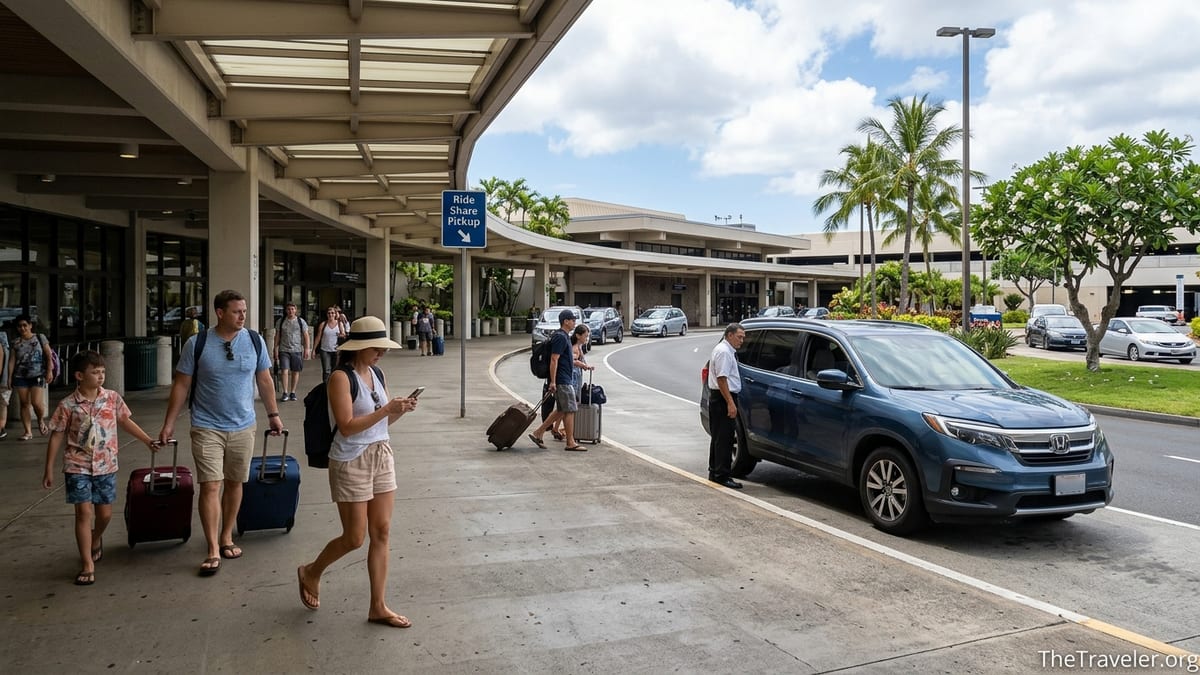
Both terminals are fairly spread out along the same horseshoe-shaped roadway, and construction and traffic management projects have been ongoing in recent years to improve ground transportation. The airport and Hawaii Department of Transportation have created dedicated ride-app pickup lanes on the second level departure roadway, with signs labeled "Ride Share" or "Ride App Pickup" in front of each terminal. That means that, unlike some airports where rideshare pickups are buried in a remote garage, at HNL you are generally meeting your driver curbside but in clearly marked zones that differ from standard taxi areas.
If you are connecting between terminals, the free intra-airport Wiki Wiki Shuttle and walkways can help you move between Terminal 1 and Terminal 2 without exiting to the street. This is useful if, for example, you arrive on a Hawaiian Airlines interisland flight in Terminal 1 but are traveling with a group whose luggage is coming into Terminal 2, and you plan to share a single Uber or Lyft to Waikiki.
Before you land, it is worth checking your boarding pass or airline app to confirm whether you are arriving at Terminal 1 or Terminal 2. That way you can already picture which level you need to reach for rideshare and avoid wandering between baggage claim doors looking for your driver.
Where to Go After Baggage Claim for Uber & Lyft
At HNL, the key idea is simple: baggage claim is on the ground level, but Uber and Lyft pickups are on the upper, departure level median. Once you collect your bags, you will ride an escalator or elevator up one level, then walk out toward the road and follow the "Ride Share Pickup" signs to the center median.
If you arrive in Terminal 1 with Hawaiian Airlines, baggage claim is immediately landside on the ground floor. After collecting your suitcase, follow signs for "Departures" or "Level 2." Once upstairs, walk outside toward the roadway and look for the ride-app pickup area near the center median across from Lobby 2. In practice, this means you might walk 1–3 minutes from the escalator to reach the marked rideshare curb with painted signs and a cluster of people checking their phones.
For Terminal 2 arrivals, your carousel will be in the long row of baggage claims numbered in the teens, 20s or 30s. After you retrieve your bags, again follow the signs to "Departures" or "Level 2." Recent airport maps show designated ride-app pickup spots along the second-level center median near multiple lobbies so you do not have to hike the full length of the terminal. If you are near baggage claim 19 or 20, for example, you can usually reach a rideshare zone directly above in under 5 minutes of walking.
Both Uber and Lyft apps are geofenced to place the passenger pin only in approved pickup areas at HNL. When you request a car, the app will show wording such as "Meet your driver at the Ride App Pickup area, Level 2 center median near Lobby X." It is important to read that description and walk to the actual zone before you press "Confirm pickup" when possible. Doing so reduces cancellations and avoids the all-too-common situation where the driver circles the terminal while you are still on the wrong level.
Step-by-Step Rideshare Flow: From Plane Door to Car Door
From the moment you step off the aircraft, timing matters. It typically takes 10–25 minutes to walk from the gate, pass through the open-air concourses, use the restroom and arrive at baggage claim. Bags for mainland flights in Honolulu often take another 10–20 minutes to reach the carousel, occasionally longer during evening bank periods.
A practical approach is to wait until your bags start appearing on the carousel before opening Uber or Lyft. For example, if you land on a 2:15 p.m. flight from Los Angeles in Terminal 2, you might reach baggage claim by 2:30 p.m. and see the first bags by 2:40 p.m. Once you spot your suitcase on the belt, open the rideshare app and check estimated pickup times. If it shows cars 6–8 minutes away, you can request a ride as you pull your bag off the carousel and start walking toward the escalator.
Reserving rides in advance can be tempting, but at HNL same-day demand and flight delays often make on-demand requests more reliable. Uber’s Reserve feature may be available for scheduled departures back to the airport from Waikiki, but reserved arrivals are less useful if your plane is early or late. Lyft typically restricts scheduled pickups at some airports in favor of regular on-demand rides, so most visitors simply book once they have their luggage in hand.
When the ride is confirmed, check two details: the pickup area description in the app and the driver’s license plate. Honolulu’s airport roadway is busy and many vehicles are white or silver SUVs or minivans. Reading the plate number before you step off the curb prevents hopping into the wrong car, which is especially important in Hawaii where unlicensed curbside solicitations occasionally happen during peak tourist seasons.
Typical Costs, Surge Pricing & How to Save
Real-world prices between HNL and Waikiki shift throughout the day. In normal daytime conditions without heavy surge, many visitors in 2026 report UberX or Lyft standard fares in the rough range of about 30 to 45 US dollars for a one-way trip from the airport to central Waikiki. Early mornings or late evenings can sometimes dip a bit lower, while busy weekend evenings, major conference weeks or holidays can push rates higher.
Surge pricing at Honolulu airport tends to kick in when multiple large mainland flights arrive within a short window or when weather and traffic clog the H-1 freeway. For instance, at 9:30 p.m. on a Saturday with several full flights from the West Coast landing at once, it is not unusual to open Uber and see an HNL to Waikiki estimate jump from around 40 dollars to closer to 65–75 dollars for UberX. Lyft shows similar patterns, sometimes slightly cheaper or more expensive by a few dollars depending on driver supply at that moment.
If your app shows a sharply elevated price, a simple tactic is to wait 10–15 minutes inside baggage claim or on the departures level before booking. As some travelers give up and opt for taxis or shuttles, the multiplier often relaxes. Another strategy is to compare different ride types: Uber Comfort or Lyft Preferred may occasionally be only a few dollars more than a heavily surged UberX, making the nicer car the better value. Conversely, shared options, when available, can shave a small amount off if you do not mind an additional stop.
Beyond Waikiki, budget more. An Uber or Lyft to Ko Olina on the west side can easily run in the 80 to 120 dollar range depending on traffic and time of day, while trips to Turtle Bay on the North Shore can approach or exceed 140 dollars. Because these prices fluctuate, treat examples as ballpark figures rather than guarantees and always check the live estimate in your app before confirming.
Comparing Uber, Lyft, Taxis & Shuttles by Hotel Zone
For central Waikiki hotels along Kalakaua Avenue and Kuhio Avenue, rideshare is often competitive with or cheaper than taxis for one or two people, especially outside extreme surge periods. A family of four heading to a mid-range property near the International Market Place might find that an UberX at about 40 dollars compares favorably to a metered taxi that could reach a similar or slightly higher amount once airport fees and traffic delays are included.
In Ala Moana and Kakaako, which are slightly closer to HNL than Waikiki, rideshare fares are usually a little lower than to beachfront hotels. Travelers staying at a business-class hotel near the Ala Moana Center, for example, might regularly see UberX estimates in the high 20s to mid 30s in dollars in moderate traffic. Taxis serving this area may be marginally more expensive but still reasonable for business travelers expensing the ride.
For resort areas farther afield, taxis and fixed-price shuttle services start to look more attractive. Couples headed to Disney Aulani or other Ko Olina resorts, about 17 miles west of the airport, often receive rideshare fare estimates that approach the cost of a pre-booked private shuttle, especially during rush hour on the H-1 freeway. In these cases, pre-arranged transportation with a set price or a shared shuttle can provide cost certainty and extra luggage space.
On the North Shore, where distances and driving times increase significantly, many visitors choose rental cars or private transport rather than relying on airport-to-resort rideshare alone. It is technically feasible to book an Uber or Lyft from HNL to Turtle Bay Resort, but the cost and potential wait times for a return trip may outweigh the convenience if you expect to explore the island frequently.
When a Taxi or Shuttle Is Simply Easier
There are scenarios at Honolulu airport where a traditional taxi is easier than rideshare. If you walk out of baggage claim late at night with several large surfboard bags or golf club cases, hailing a taxi from the dedicated cab queue at the curb can be quicker than hoping for an UberXL or Lyft XL with enough cargo space to be nearby. Taxi dispatchers at HNL are accustomed to handling oversized luggage and can often direct you to a minivan quickly.
Another situation where taxis shine is when your phone battery is nearly dead or you have limited mobile data. Because Uber and Lyft pickups at HNL must be arranged in-app, you cannot simply wave down a rideshare. By contrast, you can still step into the taxi line even if your phone is off, which can be a relief after an overnight flight or unexpected delay when your charger is buried deep in a checked suitcase.
Fixed-price shuttle services may also beat rideshare in simplicity for families or cruise passengers. For example, cruise transfer companies commonly offer per-person rates between HNL and the Honolulu harbor cruise pier, coordinating around ship boarding times. While a family of five might technically fit into a single UberXL, a pre-booked shuttle that meets the whole group at once and loads multiple suitcases can be less stressful.
Finally, if the apps show severe surge pricing because of a sudden rainstorm or local event, taxis become relatively more attractive. Even if the base taxi fare is not dramatically cheaper, avoiding an unpredictable multiplier and the risk of an in-app price spike while you hesitate can make the taxi stand the calmer choice.
Timing Your Request Around Baggage & Traffic
Honolulu traffic patterns play a huge role in how long your airport ride takes and how much it costs. Morning rush hour on weekdays typically builds from about 6:30 a.m. to 8:30 a.m., especially in the eastbound direction toward downtown and Waikiki. Evening congestion is common from roughly 3:30 p.m. to 6:30 p.m. On bad days, the H-1 freeway crawl can add 15–20 minutes to what would normally be a 20-minute drive from HNL to Waikiki.
If you are landing at 4:45 p.m. on a weekday from San Francisco, for example, you might not collect your bags until 5:15 p.m., right in the middle of peak traffic. Your rideshare app may show an estimated travel time closer to 35–40 minutes into Waikiki, and prices often reflect this with slightly elevated base fares even without strong surge. In that situation, ordering your ride as soon as you have your luggage and are heading upstairs helps you reach your hotel as quickly as possible.
On the other hand, if you land at 10:00 p.m. and notice that baggage is moving slowly, there is rarely a need to rush a rideshare request. With less freeway traffic late at night, journey times drop and driver supply can be steadier. You can comfortably wait until you have your suitcase, then check both Uber and Lyft to see which offers a better rate at that exact moment.
One more timing tip: if you are traveling as a group on separate reservations, coordinate your meeting point inside the terminal before requesting a car. For example, two friends arriving on different flights can agree to meet at the Starbucks near certain baggage claims, then call a single UberX once both parties and all bags are present. This avoids your driver idling while half the group is still in another concourse.
Practical Tips for Smooth Rideshare Pickup at HNL
Small choices can make your Honolulu airport rideshare smoother. Before your trip, ensure your Uber and Lyft apps are updated, your payment method is valid, and international roaming or local data works if you are coming from abroad. That way you are not hurriedly troubleshooting logins on the curb while traffic whizzes past.
Once at the airport, follow airport signage rather than relying solely on memory or third-party blogs. Ground transportation patterns at HNL have changed over the past few years, with new ride-app medians and updated signage. When in doubt, ask an airport employee or security officer, “Where is the ride share pickup for Uber and Lyft?” They can point you toward the latest approved zones without you wandering in the heat with luggage.
Communication with your driver is also key. If you are unsure which lobby you are near, use in-app messaging to describe visible landmarks such as nearby airline check-in counters or large signs, for example, "I am at Terminal 2, upper level, near Lobby 6, across from the Delta check-in." Drivers familiar with HNL know the lobbies and can find you quickly with that detail.
Finally, have some patience during peak arrival banks. When four or five widebody flights land within 30 minutes, the ride-app pickup median can become crowded. Allow a few extra minutes to locate your car, and step slightly back from the curb until your driver pulls up and confirms your name. This helps keep traffic flowing and avoids confusion for other passengers and drivers.
FAQ
Q1. Where exactly do Uber and Lyft pick up at Honolulu airport?
Pickups are on the second-level departure roadway in front of Terminals 1 and 2 at marked "Ride Share" or "Ride App Pickup" zones along the center median. After baggage claim, go up one level, walk outside and follow the signs to the designated rideshare curb for your terminal.
Q2. How much does an Uber or Lyft from HNL to Waikiki usually cost?
Prices vary by time and demand, but many travelers see standard rides in the approximate range of 30 to 45 US dollars one way in normal conditions. During busy evening arrival periods, fares can rise higher due to surge pricing, so always check the live estimate before you confirm.
Q3. How long does the ride from Honolulu airport to Waikiki take?
In light traffic, the drive from HNL to central Waikiki typically takes about 20 minutes. During peak rush hour or after an accident on the H-1 freeway, it can stretch to 35–40 minutes or more. The rideshare app will display an estimated travel time based on current conditions.
Q4. Should I order my Uber or Lyft before my plane lands?
It is better to wait until you have landed and collected your luggage. Deplaning, walking to baggage claim and waiting for bags can easily take 20–40 minutes, and requesting too early risks driver cancellations or extra wait fees. Open the app when your bags reach the carousel or as you start walking toward the departures level.
Q5. Is taxis or rideshare cheaper from HNL?
For most central Waikiki and Ala Moana hotels, Uber and Lyft are often comparable to or slightly cheaper than taxis for one or two passengers outside strong surge. For larger groups, heavy surge periods, or distant resorts like Ko Olina and Turtle Bay, taxis or fixed-price shuttles can sometimes be more predictable or cost-effective.
Q6. Can I use Uber or Lyft if I do not have mobile data in Hawaii?
You need an internet connection and the app to request Uber or Lyft, so if you do not have roaming or local data, it is difficult to rely on rideshare. In that case, consider using airport Wi-Fi to order a ride while you are still connected, or use the traditional taxi rank or pre-booked shuttle, which do not require an app.
Q7. Where do I meet my rideshare driver if I arrive late at night?
Even late at night, the pickup locations are the same: second-level departure roadway at the marked rideshare zones in front of each terminal. Follow the "Ride Share" signs after you collect your bag, then request your ride in-app. At quieter hours, the area will be less crowded, and wait times for a car are often shorter.
Q8. What if the price in the app looks very high because of surge?
If the estimate is much higher than you expected, you can wait 10–15 minutes to see if surge eases, compare Uber and Lyft prices, or walk to the taxi stand to ask about approximate fares. During major surges, taxis and some shuttles become more competitive, and you may prefer their more stable pricing.
Q9. Is it easy to get Uber or Lyft from Honolulu hotels back to the airport?
Yes. In Waikiki, Ala Moana and downtown Honolulu, rideshare coverage is generally strong. Many travelers simply request Uber or Lyft from their hotel entrance 30–45 minutes before they want to be at the airport, or earlier during rush hour. For more distant areas like Ko Olina or the North Shore, allow extra time in case driver availability is limited.
Q10. Can my rideshare driver help with large luggage or surfboards?
Many UberX and Lyft standard vehicles are sedans or small SUVs that can handle typical suitcases but may struggle with large surfboard bags. If you have bulky gear, request a larger vehicle type such as UberXL when available, or consider a taxi or private shuttle that explicitly accepts oversized luggage. Always mention special items in the in-app message so the driver is prepared.