


Landing in Honolulu hours before hotel check-in or flying out late at night does not have to mean babysitting suitcases all day. Between the bag rules at Pearl Harbor, Waikiki hotel policies, and the options at Daniel K. Inouye International Airport, a bit of planning can turn an awkward luggage day into extra beach time, a smoother tour, or a relaxed final meal with ocean views. This guide walks through practical, real-world ways to stash your bags safely and make the most of your first and last moments on Oahu.
Get the latest updates straight to your inbox!
Understanding Your First Luggage Decision at HNL
Most Oahu trips begin at Daniel K. Inouye International Airport, better known as Honolulu International Airport or simply HNL. After a long transpacific flight, many visitors arrive mid-morning while their Waikiki hotel room will not be ready until 3 p.m. or later. The first decision is whether to keep bags with you, store them at the airport, or send them straight to your hotel. Each choice shapes what you can realistically do on day one.
If you are connecting to an interisland flight on Hawaiian Airlines, Southwest or Mokulele, your checked luggage will usually be tagged to your final island. In that case, carry-on bags are the only pieces you need to think about for a layover. Travelers starting their stay on Oahu, however, collect all bags at the HNL baggage claim and step into the arrivals area with full suitcases in tow.
This is where timing matters. A family landing from Los Angeles at 9:30 a.m. with a Pearl Harbor reservation at 11:30 a.m. needs a very different plan than a couple whose room at the Outrigger Waikiki Beach Resort is already confirmed for early check-in. The good news is that HNL now has an official baggage storage service inside the airport as well as independent luggage delivery services that run between the terminals and Waikiki.
Luggage Storage Options at Honolulu Airport
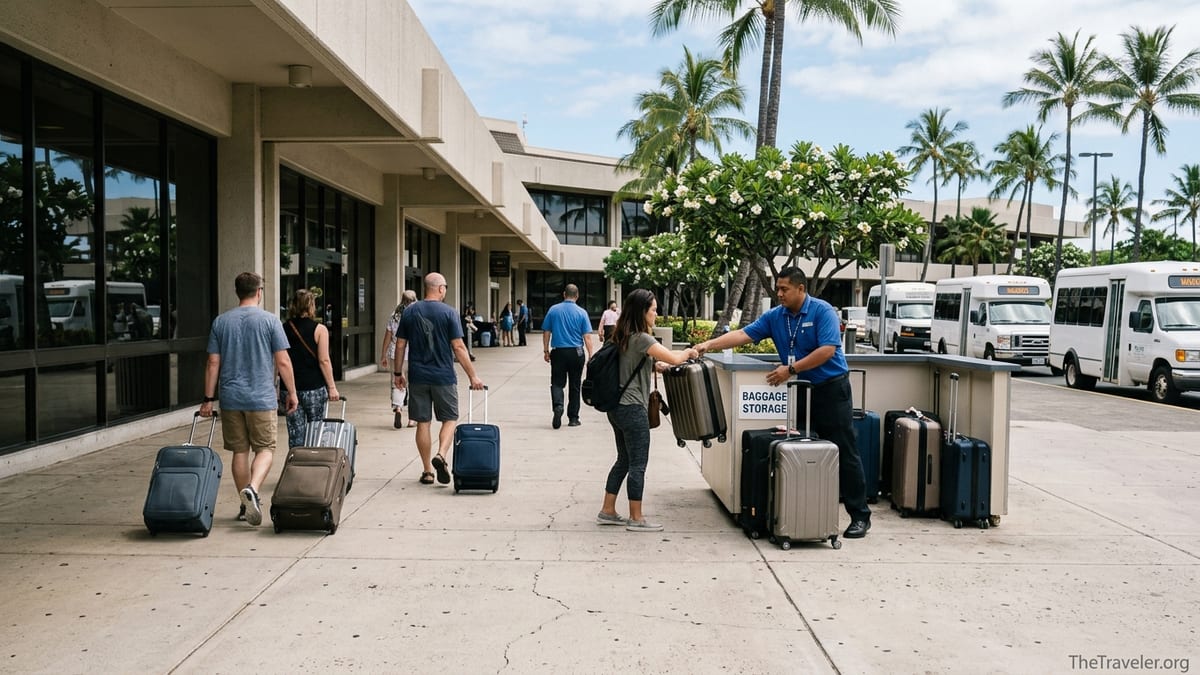
Honolulu’s official airport website lists a dedicated baggage storage operator inside the Daniel K. Inouye International Airport complex. The service, sometimes branded as "Baggage Storage," offers short- and longer-term storage for everything from carry-on rollers to larger checked suitcases. Travelers can drop bags for a few hours between a red-eye arrival and lunch or leave them for several days while island hopping if they prefer to travel light on a side trip.
The independent company Aloha Luggage Delivery and Storage operates at HNL and in Waikiki and focuses on combining storage with hotel delivery. Their published rates show a common package where approximately 23 dollars covers storage and same-day delivery between the airport and Waikiki for up to two pieces, with around 10 dollars for each additional item. That means a couple arriving at 8 a.m. with two checked suitcases can hand everything over at the airport, spend the day exploring, and find their bags waiting at the hotel bell desk by check-in time.
For travelers who prefer to keep control of their luggage until they leave for the hotel, the HNL storage counters work more like conventional airport luggage rooms. You check in your bags, receive claim tags, and pay per item for the number of hours or days you need. This setup is helpful if, for example, you have a late-night flight back to the mainland and want to store your bags at HNL in the afternoon before returning a rental car and going through security.
One practical detail to remember is that while these services are inside or adjacent to the terminal complex, they are on the public side of security. You will need to allow time to walk from your gate or rental car shuttle stop, check your bags in, and then later return to retrieve them and clear security again. Building an extra 30 to 45 minutes into your schedule on busy days can prevent a last-minute rush.
Decoding the Pearl Harbor Bag Policy
Pearl Harbor is one of Oahu’s most important and moving sites, but it is also a U.S. military base with very specific security rules. The most important one for luggage planning is the no-bag policy at the Pearl Harbor National Memorial and the neighboring historic sites. In practice, that means any purse, backpack, camera bag, diaper bag, tote or piece of luggage larger than a very small hand-held wallet is not allowed beyond the entrance checkpoint.
Current guidance from Pearl Harbor Historic Sites and visitor information outlets explains that clear bags, fanny packs and traditional purses are all considered bags if they can conceal contents. The rule is intentionally simple: if it looks like a bag, you should assume it is not allowed. Instead, visitors can carry items in their hands or in pockets, and may bring cameras, phones, wallets, and water bottles as long as they are not inside a bag.
For travelers heading to Pearl Harbor directly from the airport or hotel checkout, this rule has major implications. You cannot simply roll your suitcase into the visitor center while you wait for your USS Arizona Memorial boat time. Leaving luggage in a rental car trunk is possible, but many locals and recent visitors warn that break-ins sometimes occur in large tourist parking lots. To address this, Pearl Harbor offers an on-site bag storage facility near the entrance that accepts everything from daypacks to full-size checked suitcases.
As of mid 2026, recent visitor reports and Pearl Harbor information sources describe storage fees in the range of about 7 dollars for standard bags and around 10 dollars for oversized items or large suitcases. The storage is typically operated through the Pacific Fleet Submarine Museum complex and can be used during visits to all Pearl Harbor historic sites such as the USS Arizona Memorial, Battleship Missouri, and Pacific Fleet Submarine Museum itself. Lines can form around peak morning arrival times, so those coming from HNL with luggage should aim to arrive at least 45 to 60 minutes before their first timed reservation.
Planning a Same-Day Arrival and Pearl Harbor Visit
Many itineraries try to combine an early arrival at HNL with a mid-day visit to Pearl Harbor before checking into a Waikiki hotel. This can work very well if you account for traffic, luggage, and the no-bag policy. A typical real-world scenario might look like this: a family of four lands from Seattle at 9 a.m., picks up a rental car by 10 a.m., and has 1 p.m. USS Arizona Memorial tickets that were reserved in advance.
In that case, the simplest approach is usually to keep luggage in the rental car trunk and plan to use Pearl Harbor’s official bag storage for carry-on backpacks, purses, and diaper bags. Before leaving the airport, the family might repack valuables like passports, cash, and camera gear into smaller items they can carry in pockets or in hand. At Pearl Harbor, they would follow signs on arrival to the bag storage facility, pay the per-item fee, receive claim checks, and then enter the security queue bag-free.
Travelers who do not want their big suitcases parked at Pearl Harbor at all have another option: store or hand off luggage at HNL before driving out. Using a service such as the official airport baggage storage or a delivery service to Waikiki allows them to arrive at Pearl Harbor with only small personal items. For example, a couple arriving on a red-eye might pay a modest fee at the airport to have two suitcases delivered to their Waikiki hotel, then drive to Pearl Harbor in a compact rental with only a camera and water bottle in hand.
Public transport visitors need to be especially strategic. The city bus route from HNL and Waikiki to Pearl Harbor does not have dedicated luggage racks, and large suitcases can be awkward on crowded buses. In that case, checking bags into storage at the airport or in Waikiki first, then taking a small day pack that can be stored at Pearl Harbor, will make the journey more comfortable and compliant with both bus etiquette and Pearl Harbor rules.
Using Waikiki Hotels and Luggage Storage Services
Once you are checked into Waikiki, luggage usually becomes easier. Most full-service hotels and many mid-range properties along Kalākaua Avenue and Kuhio Avenue offer complimentary or tip-based luggage storage through the bell desk. For example, the Hyatt Regency Waikiki Beach Resort and Spa notes in its guest information that the bell staff can assist with luggage services and storage, and the Outrigger Waikiki Beach Resort lists 24-hour luggage storage among its services. Guests can typically leave bags with the bell desk after checkout and return later in the day before heading to the airport.
Not every accommodation has the same policy. Some condo-style rentals, smaller boutique hotels, and vacation rentals either have limited storage space or no staffed front desk. Guests who discover at check-in that their property will not hold luggage after checkout often turn to third-party services. In central Waikiki, companies like First Cabin Waikiki and Bounce-affiliated storage points partner with local businesses to accept suitcases and backpacks for day-use storage at per-bag rates.
First Cabin Waikiki, for example, promotes a luggage storage plan for visitors spending the day in Waikiki before or after hotel stays. Travelers can roll a suitcase to the property near the main shopping and dining district, pay a flat fee per item, and explore Ala Moana Center, the International Market Place, or Waikiki Beach unencumbered. Some travelers book a short day-use lounge package there so they can shower, work, or rest while their bags are stored.
App-based providers such as Bounce list multiple storage locations around Waikiki, including near large resort clusters around Waikiki Beach Marriott and the Duke Kahanamoku statue. Recent visitors mention paying a modest per-bag charge for all-day storage when their hotel did not allow multi-day bag holding between island hops. The advantage of these services is flexibility: you can often choose a drop-off spot close to your next activity, whether that is a catamaran sail off Waikiki or an afternoon at Ala Moana Beach Park.
Designing a Smart Last-Day Plan Before a Late Flight
One of the most common luggage puzzles on Oahu happens on the final day. Check-out time at many Waikiki hotels is around 11 a.m. or noon, while flights to the mainland United States often depart between 8 p.m. and 11 p.m. That leaves a full afternoon and early evening to enjoy, but only if you are not dragging suitcases along Kalākaua Avenue.
The classic solution is to use the hotel bell desk. A family staying at the Sheraton Waikiki, for example, can check out at 11 a.m., leave three suitcases and two carry-ons with the bell staff, and spend the afternoon at the pool, on the beach, or shopping. When they are ready to leave, they pick up bags, call a rideshare or airport shuttle, and head to HNL. Tipping a few dollars per bag is customary, especially for larger parties or longer storage hours.
When a hotel does not offer bag storage or when guests are switching accommodations, independent luggage storage services fill the gap. An example: a couple checks out of a small Waikiki boutique hotel at 10 a.m., but their next stay in Ko Olina does not begin until late afternoon and their flight home is at 10 p.m. They might store their luggage at a Waikiki bag storage shop for the day, rent e-bikes to ride to Diamond Head, and return around 5 p.m. to grab bags and catch a shuttle west.
Another last-day strategy uses the airport as the base. Some travelers with rental cars choose to check out of their Waikiki hotel in the morning, drive to HNL, drop off luggage at the airport storage facility, then continue driving to attractions closer to the airport such as Pearl Harbor, Bishop Museum, or the west side beaches. Later, they return the rental car, pick up their stored bags in the terminal, and walk to airline check-in. This minimizes backtracking through Waikiki traffic in the late afternoon.
Tour-Day Tactics: Luaus, Island Circuits, and Luggage
Day tours are a highlight for many Oahu visitors, but they bring their own luggage issues when schedules do not line up perfectly with check-in or checkout. Popular itineraries include all-day circle island tours, evening luaus at venues such as Paradise Cove or Polynesian Cultural Center, and early morning snorkeling or hiking trips that depart before hotel rooms are ready. Operators often run tight schedules and may or may not be able to accept luggage on their buses.
When booking tours, it is worth asking directly how they handle luggage. Some Pearl Harbor plus island tour packages starting from Waikiki explicitly state that large suitcases are not permitted on the coach and that travelers must arrange storage separately. Others, especially small-group or private tours, are more flexible and will allow guests to place a single suitcase or duffel in the back of a van for the day. Clarifying this before you arrive avoids awkward surprises in the hotel driveway at 6 a.m.
Couples planning an evening luau on their last night sometimes hope to go directly from the luau to the airport. Because many luau venues are 30 to 45 minutes from HNL and not suited for rolling suitcases through crowds, a better approach is often to leave baggage at a Waikiki storage facility or with the hotel bell desk for the afternoon, retrieve everything after the luau shuttle returns to Waikiki, and then head to the airport. This avoids hauling luggage through sand, grass, and buffet lines.
For visitors transferring between hotels or neighborhoods during the day, luggage delivery services can simplify logistics. One scenario: you check out of a Waikiki hotel in the morning, book a circle island tour that ends near Ala Moana in late afternoon, and start a new stay in a hotel near Ala Moana Center. A service operating between Waikiki and the airport corridor could collect your luggage at the first hotel after checkout, hold it, and deliver it to your second hotel so that your room is already staged with bags by the time the tour ends.
Safety, Security, and Practical Tips for Bags on Oahu
Regardless of where you choose to store luggage, it is wise to think about security. At reputable airport storage counters, Pearl Harbor’s official bag facility, and established companies like Aloha Luggage Delivery and Storage, bags are typically kept in monitored, access-controlled rooms. Still, most travelers keep valuables such as passports, cash, and high-end electronics with them rather than in stored suitcases when possible.
When leaving luggage in a hotel room before official check-in or checkout, consider using in-room safes for passports and small electronics or asking the front desk if they have a secure back-office safe for items you are particularly concerned about. If your plan involves leaving suitcases in a car trunk while visiting a beach or trail, try to avoid loading bags into the trunk in a crowded parking lot where it is obvious to onlookers, and do not leave small bags or electronics visible inside the car.
On the practical side, packing a compact foldable tote bag or lightweight crossbody that can be flattened into a suitcase can make bag policy days more comfortable. For a Pearl Harbor visit, for instance, you can store your main daypack or purse at the facility and still carry a foldable tote containing sunscreen, a water bottle, and a guide booklet in your hand, which complies with the no-bag rule. Small zip pouches for passports and cards keep important documents organized in pockets.
Finally, keep time zones and jet lag in mind when planning. A late-night departure feels even later after a full day in the sun. Using stored luggage access as a scheduled break point can help. You might plan to collect bags from a Waikiki storage spot around 5 p.m., shower and change into comfortable travel clothes at your hotel or a day-use lounge, and then head to the airport feeling refreshed instead of sandy and exhausted.
FAQ
Q1. Is there luggage storage inside Honolulu International Airport? Yes. Daniel K. Inouye International Airport lists an official baggage storage service in the terminal complex where travelers can store suitcases and smaller items for a few hours or several days.
Q2. Can I bring a backpack or suitcase into Pearl Harbor? No. Pearl Harbor has a strict no-bag policy that applies to backpacks, purses, diaper bags, and suitcases. Only very small wallets and items carried in hand or pockets are allowed, but an on-site storage facility near the entrance can hold bags for a fee.
Q3. How much does bag storage at Pearl Harbor cost? Recent information and visitor reports indicate typical fees of about 7 dollars per standard bag and around 10 dollars for oversized luggage or large suitcases, though prices can change and are posted at the storage facility.
Q4. Will my Waikiki hotel hold bags before check-in or after checkout? Many full-service Waikiki hotels, such as large beachfront resorts and major chains, offer complimentary or tip-based luggage storage through their bell desks, but some smaller properties and vacation rentals do not, so it is wise to confirm policies in advance.
Q5. Are there independent luggage storage services in Waikiki? Yes. Companies such as First Cabin Waikiki and app-based services like Bounce work with local businesses and lounges in central Waikiki to store suitcases and backpacks for day use at per-bag rates.
Q6. What is the best way to handle luggage on my last day before a late-night flight? A common strategy is to leave bags with your Waikiki hotel bell desk or a nearby storage service after checkout, enjoy the beach or shopping, then retrieve everything a few hours before your flight and head to Honolulu airport.
Q7. Can I store my bags at Honolulu airport, go sightseeing, and pick them up before my flight? Yes. Many travelers drop their luggage at HNL’s baggage storage, visit places like Pearl Harbor or downtown Honolulu, then return later to collect bags, return rental cars, and check in for flights.
Q8. Is it safe to leave luggage in a rental car while visiting attractions? While many visitors do so without problems, there are occasional reports of car break-ins at busy tourist parking lots, so using official storage facilities at Pearl Harbor, your hotel, or the airport is generally safer for important items.
Q9. Do day tour buses on Oahu allow large suitcases? Policies vary. Some group tours do not allow large luggage on board and expect guests to arrange storage separately, while some private or small-group tours can accommodate a suitcase if arranged in advance.
Q10. Should I book luggage storage in Honolulu ahead of time? For peak seasons or when you have tight connections between flights, tours, and hotel check-in, reserving a spot with an airport or Waikiki storage service in advance can provide extra peace of mind and save time on arrival.