


There is a moment, just a few steps from Dubrovnik’s famous bell tower, when Luža Square stops being a backdrop for quick photos and reveals itself as a living stage. You stand half in shadow, face turned to the light spilling down Stradun, and suddenly the square’s palaces, loggias, columns and crowds line up in a way that tells the city’s story in one frame. That single view changed how I travel Dubrovnik and how I think about seemingly familiar European squares.
Get the latest updates straight to your inbox!
Finding the Angle That Changes Everything
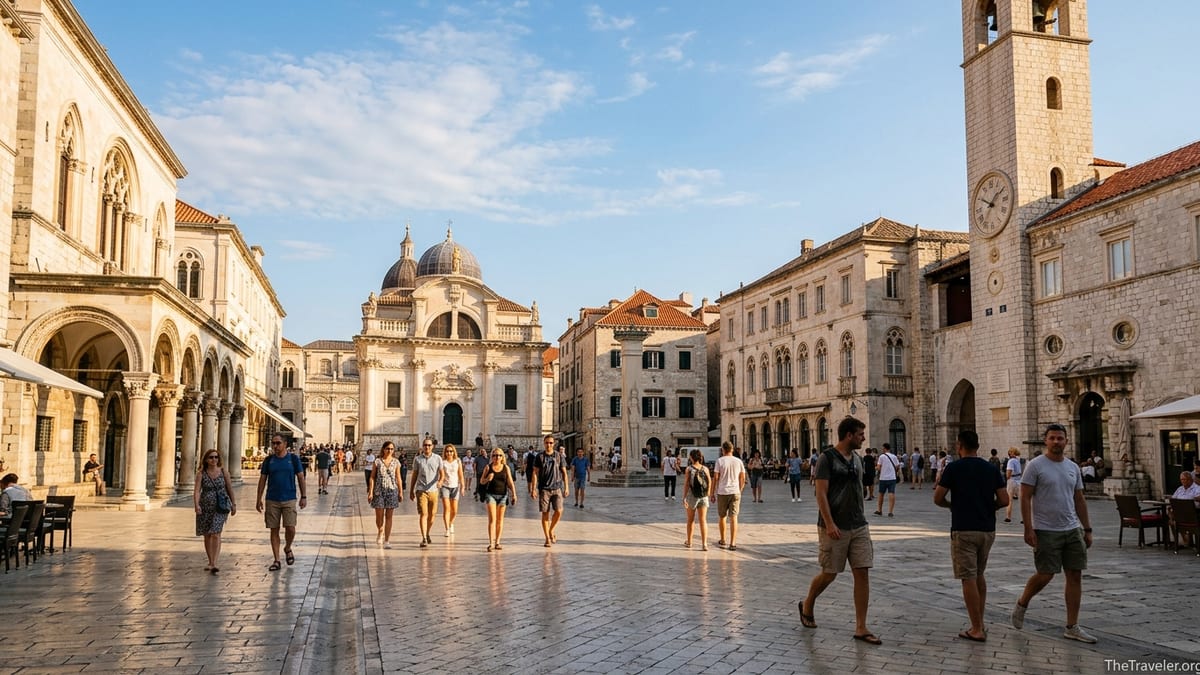
The transformation began with something simple: moving three or four meters to the left. I had already crossed Luža Square several times that hot July morning, dodging tour groups and Game of Thrones fans posing at every corner. The bell tower, 31 meters of pale stone at the eastern end of Stradun, rang on the hour as it always does, but I barely looked up. It was only when I slipped into the narrow slice of space between the base of the tower and the corner of Sponza Palace that the square rearranged itself before my eyes.
From this angle, the Old Town opened like a theater set. Straight ahead, Stradun stretched west in a glimmering line of polished limestone, the kind that grows glossy from centuries of footsteps. To the right, Sponza’s arcaded loggia framed a cool, shaded edge to the square. To the left, the facade of the Church of St Blaise and the Rector’s Palace stepped forward in layers of stone and sculpture. Orlando’s Column, which had seemed like a lonely monument when I stood in the middle of the square, now became the central figure of a scene, perfectly framed between bell tower and church.
Most visitors never pause here. The flow pushes them either down to the Old Port or up Stradun toward the Pile Gate. Yet at this slight remove, backed by the bell tower’s stone, the noise dropped a notch. I could watch Luža Square breathe instead of being swallowed by it. That change of perspective, physical and mental, turned an already beautiful space into a map of Dubrovnik’s layered identity.
Reading Centuries in a Single Square
Luža Square looks compact but it condenses much of Dubrovnik’s history into a few paces. The bell tower itself, first erected in the mid 15th century and rebuilt after earthquake damage in the late 20th century, stands exactly where the medieval city met the harbor and the world beyond. Just beneath it, the small open belfry of Luža once sounded out government sessions and alarms, a civic voice distinct from the church bells further up the hill.
Turn your eyes slightly and Sponza Palace, completed in the 16th century, tells a different story. This was customs house, mint and trade hub, the place where goods from the Adriatic and the wider Mediterranean were weighed, taxed and recorded. Today, its colonnaded courtyard hosts exhibitions and the city archives rather than barrels of spice or cloth, but from the tower’s side view you still sense Sponza as a threshold between sea and city.
Opposite Sponza, the Baroque Church of St Blaise and the graceful arches of the Rector’s Palace carry the weight of spiritual and political power. The Rector once governed the Republic of Ragusa from behind those carved windows, serving single-month terms that symbolized the city’s obsession with preventing tyranny. When you stand tucked by the bell tower and let your gaze sweep from palace to church to loggia, the square becomes a timeline: commerce, governance, faith and defense all pressed together.
Even Orlando’s Column, frequently used as a quick selfie prop, looks different from this angle. Locals still recall that it once held the city’s flag and served as a symbol of civic freedoms granted under the protection of the legendary knight Roland. Seeing it in line with the tower’s clock face and the doorway of Sponza restored the column to its role as anchor of public life rather than anonymous statue in the crowd.
Daily Rituals: How Luža Square Moves Through the Day
The view from the bell tower’s flank also tuned me into the rhythm of Luža Square as it moves from dawn to night. In the earliest morning, around 7 or 8 am in high season, the light comes soft from the east, catching only the upper half of the tower and leaving the paving stones in gentle shadow. This is when municipal workers wheel carts across the square, waiters roll out awnings, and the first walking tours gather under the tower’s clock for introductions.
From my sheltered vantage point, I watched one guide raise a bright yellow paddle as she explained that the two bronze figures atop the tower, known affectionately as Maro and Baro, or the green men, strike the bell every hour. Above us, the replicas performed their familiar movement, while the originals rest in the nearby museum for preservation. At each chime, latecomers jogged into place, eyes darting between guide, tower and the arrivals board on their phones that told them which cruise ship’s tenders were docking in the Old Port below.
By midday, when the sun sits high over the limestone rooftops, the square fills with a rolling wave of people. Stradun becomes a bright river of hats, cameras and gelato cups, flowing straight toward the bell tower. Temperatures in July can push well over 30 degrees Celsius and the reflected heat from the stone makes it feel warmer, so the slim shadow next to the tower suddenly becomes precious. From that shade I saw people linger a few seconds longer than strictly necessary, pretending to frame a photo while catching their breath and scanning the square for the nearest cold drink.
Come evening, especially in July and August, Luža Square transforms again as the Dubrovnik Summer Festival opens or one of the city’s concerts unfolds. A temporary stage appears in front of the Church of St Blaise, sound technicians perch cords along the colonnades of Sponza, and chairs spread in neat rows that seem to soften the hard lines of stone. From the tower’s side, the square becomes an open-air auditorium, with the bell striking above head as a kind of curtain rise. Even if you are not seated for the performance, you can stand in that alcove, hear the music drift upward and watch the sky behind the tower shift from gold to violet.
Practical Ways to Experience This View
If you want to see Luža Square through this same frame, you do not need special access or a ticket. Start at the base of the bell tower where Stradun spills into the square, then walk toward Sponza Palace for a few steps and hug the tower’s eastern wall. There is usually a low stone barrier and sometimes a modest flow of people heading to the Old Port. Position yourself so that Orlando’s Column stands roughly in the center of your line of sight, with the Church of St Blaise beyond it and the western corridor of Stradun receding into the distance.
Time of day matters. Early morning and late afternoon are kinder to both your camera and your patience. In high season, between June and September, cruise ship schedules can mean crowds peak from around 9 am to 3 pm. Arriving before 9 or after 5 often gives you space to linger in that corner without jostling shoulder to shoulder with other visitors. In shoulder months like May or October, the square can feel calmer throughout the day, especially if the weather is slightly overcast and tour groups shorten their routes.
Entry costs are not an obstacle to this view. Walking Stradun and Luža Square is free, and while many visitors purchase tickets for the city walls or museums, you can stand beside the bell tower and absorb the scene without spending anything. That said, planning your stop here alongside other sights in the square makes sense. Sponza’s exhibitions and the Rector’s Palace museum both charge modest entry fees and are typically open mid-morning through late afternoon, allowing you to dip inside for art and archives before or after your contemplative pause outside.
For photographers, a standard smartphone can handle the scene well, but a wider lens on a mirrorless camera, around 24 to 28 millimeters, lets you include tower, column and church in a single frame. Shoot slightly off-center to avoid an overly symmetrical composition and pay attention to reflections in the polished paving stones after a rain shower, when the entire square turns into a mirror for the bell tower and facades.
Context From Above: Linking Luža Square to the City Walls
The view beside the bell tower is most powerful when you connect it with what you see from higher up on Dubrovnik’s walls. Many travelers start their visit with the famous wall walk, entering near Pile Gate and circling above the Old Town for about 2 kilometers. The full circuit usually takes between one and two hours depending on how often you stop for pictures or gelato breaks at the small kiosks perched near the towers.
From the wall section above the Old Port, shortly after passing near St John Fortress, you get a bird’s eye view straight down into Luža Square. The bell tower becomes a narrow white strip against the darker roofs, Sponza’s courtyard shows its geometry clearly, and Stradun runs away like a pale runway of stone. If you have already stood beside the tower’s base, this aerial perspective feels less abstract. You can see exactly where that slim slice of shadow lies in relation to the square and where crowds tend to cluster and thin.
Wall tickets are one of Dubrovnik’s main expenses, often costing the equivalent of several simple restaurant lunches, but the payoff is that you gain a mental map of the Old Town that keeps you oriented later among its alleys. Standing above Luža Square, you can trace your eye from the bell tower to the cathedral dome, then to the fortresses that guarded the city’s seaward approaches. Later, when you return to ground level and slip once more beside the tower, those high vantage points remain in your mind, making the square feel less flat and more three dimensional.
The combination of lofty overview and intimate ground-level angle mirrors the way Dubrovnik itself balances grandeur and detail. From Mount Srđ or from the outer stretches of the walls, the Old Town is a perfect terracotta jewel. Beside the bell tower, the same city becomes a textured story of clock mechanisms, flagstones worn like glass, and the murmur of waiters calling out coffee orders in Croatian and English.
Seasons, Crowds and the Subtle Art of Slowing Down
The way Luža Square feels from that bell tower corner changes with the seasons. In spring, when the first cruise lines return but the summer heat has not yet set in, there is a freshness to the light. Locals cross the square in lighter jackets, balancing paper cups of coffee as they cut between Sponza and the church. School groups cluster under Orlando’s Column while teachers gesture toward the tower, explaining histories that echo the material you see on plaques nearby.
By late June and July, the square can tip toward overwhelming around midday, particularly on days when more than one large ship is anchored offshore. Prices at cafes around the Old Town tend to rise in step with demand, and you may find basic espresso or bottled water costing more than in other Croatian cities. Watching the scene from your patch of shade, it becomes easier to understand local debates about overtourism and the measures the city has taken in recent years to manage bus arrivals and cruise schedules.
In autumn, especially from late September into October, Luža Square relaxes. Air temperatures usually drop into a range more comfortable for long walks, and accommodation prices in the Old Town often soften compared to August peaks. From the bell tower’s side, you see more independent travelers with guidebooks or offline maps, fewer massed umbrella tours, and a noticeable number of locals reclaiming the space in the quieter hours, chatting near the steps of St Blaise or pausing under the tower to check the time.
Winter brings a different charm. Dubrovnik’s New Year celebrations and occasional Advent markets string lights across Stradun and around Luža Square, turning the area into a festive corridor of stalls and small stages. Even though some tourist services close or shorten their hours, the bell tower’s regular chimes persist, and you may find yourself nearly alone at that favored spot, listening to the echo off rain-darkened stones while a handful of residents cross the square with shopping bags instead of cameras.
From Viewpoint to Mindset: Learning to Look Twice
What stayed with me long after leaving Dubrovnik was not only the postcard-perfect picture from the bell tower corner, but also the habit it suggested. In every crowded historic center since, I have tried to find the equivalent of Luža Square’s unnoticed angle. It might be the shadow of a tower in Split, a colonnade edge in Venice, or a side staircase in Prague. The principle is the same: step a little sideways from the standard route and give yourself permission to stand still.
In Dubrovnik, this simple act changed my relationship to a place many people experience as a checklist of top sights. Instead of racing from Pile Gate to the harbor, I used the bell tower as a fixed point, circling back to it at different times of day. I watched how a violinist set up near Orlando’s Column in the late afternoon, how a group of teenagers used the church steps as an impromptu meeting spot, how delivery staff navigated the square in the early evening when most eyes were trained upward on the clock.
For travelers, this is a gentle antidote to the pressure of “doing” a destination thoroughly. The city walls, the cable car up Mount Srđ, the island boat trips and museum visits are all worthy, but so is spending twenty unhurried minutes beside a single tower, noticing how a square works. You will likely remember more from that quiet observation than from one more rushed photo stop further along the route.
In that sense, the bell tower view is not only a compositional trick for photographers but a mindset you can pack for the rest of your journeys. When a place feels overrun or flattened into a series of familiar images, search for the corner where the city’s everyday life lines up in an unexpected way. In Dubrovnik, that corner is beside the bell tower at Luža Square. Elsewhere, it will be somewhere different, but the patient way of looking remains the same.
The Takeaway
Standing a few steps to the side of Dubrovnik’s bell tower, pressed gently against old stone, I saw Luža Square change from busy intersection to layered story. The shift was small in physical terms yet enormous in how it altered my memory of the city. From that spot, trade, faith, politics and present-day tourism all revealed themselves in a single glance, framed by Orlando’s Column and the arcades of Sponza Palace.
For travelers planning a visit, this is an invitation to go beyond the obvious angles. Walk the walls, sit at a cafe, photograph Stradun’s glittering stones, but also make time to return to the bell tower corner at different hours and in different moods. Watch the square from the cool of morning to the heat of midday and into festival evenings, and let the rhythm of the city sink in.
In the end, one view of the bell tower did more than give me a beautiful photograph. It taught me to slow down in places that are often rushed, to notice the choreographies of locals and visitors, and to seek out perspectives that turn famous spaces into personal ones. In Dubrovnik and beyond, the most meaningful travel often begins not with moving farther, but with standing still and really looking.
FAQ
Q1. Where exactly is Luža Square in Dubrovnik?
It sits at the eastern end of Stradun in Dubrovnik’s Old Town, directly beside the city bell tower and in front of Sponza Palace and the Church of St Blaise.
Q2. Can I go up the Dubrovnik bell tower for a view?
At present, visitors generally view the bell tower only from ground level. The perspective described in this article is from the base of the tower, not an internal lookout.
Q3. Do I need a ticket to experience the bell tower viewpoint of Luža Square?
No. Standing beside the bell tower and taking in the square is completely free. You only pay if you choose to visit nearby museums or walk the city walls.
Q4. When is the best time of day to enjoy this view?
Early morning and late afternoon are usually best, with softer light and smaller crowds. Midday in high summer can be very hot and busy in the square.
Q5. How long should I plan to spend in Luža Square?
You can cross it in minutes, but allowing 20 to 40 minutes to linger beside the bell tower at different times of day gives you a much richer experience.
Q6. Is Luža Square accessible for travelers with limited mobility?
The square itself is flat and paved with smooth limestone, though the stones can be slippery when wet. There are no steps required to reach the bell tower viewpoint from Stradun.
Q7. Are there cafes or services near Luža Square?
Yes. Within a short walk you will find cafes, restaurants, small shops and ATMs throughout the Old Town. Prices can be higher than in less central parts of Dubrovnik.
Q8. Can I combine a visit to Luža Square with walking the city walls?
Very easily. Many visitors walk the walls first, gain an overview of the Old Town, then come down to ground level to experience Luža Square and the bell tower from below.
Q9. Is Luža Square very crowded during peak season?
In summer, especially on busy cruise days, it can be crowded from late morning through mid-afternoon. Visiting early or later in the day helps you find calmer moments.
Q10. Is it safe to be in Luža Square at night?
Dubrovnik’s Old Town, including Luža Square, is generally considered safe in the evenings. As in any busy destination, keep an eye on your belongings and be mindful of late-night crowds during major events.