


Like most travelers landing in Dubrovnik for the first time, I came for the drama: the stone city walls dropping into the Adriatic, the terracotta roofs, the Game of Thrones filming spots. I did not expect a relatively modest, 31 meter high bell tower at the end of the main street to be the thing I could not stop staring at. Yet the Dubrovnik Bell Tower, or City Bell Tower, kept pulling my eyes and my camera back to it, morning and night, until it quietly became the landmark that defined the city for me.
Get the latest updates straight to your inbox!
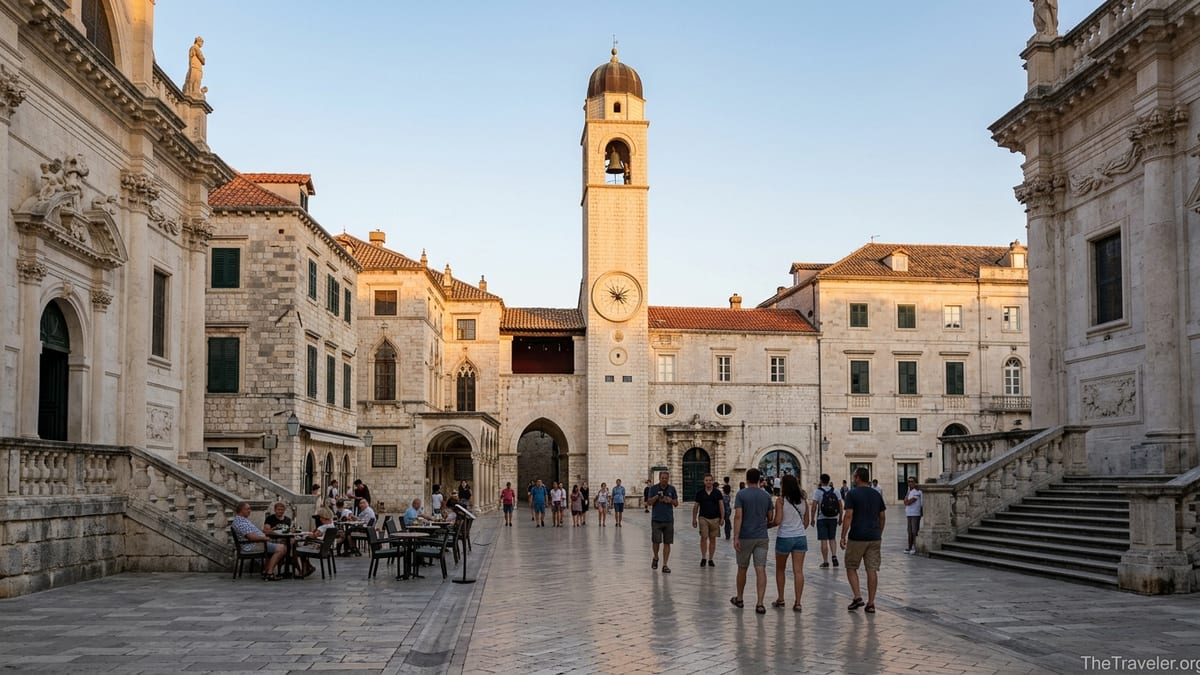
A Tower You Keep Meeting Again And Again
The Bell Tower sits at the eastern end of Stradun, Dubrovnik’s polished limestone main street, where the thoroughfare empties into Luža Square between Sponza Palace and the Rector’s Palace. Many visitors first glimpse it just after walking through Pile Gate: a slender vertical accent in the distance, topped with a pale dome and a clock face that looks almost playful above the surrounding stone facades. It does not try to dominate the skyline the way cathedral spires do in other European cities, but because Stradun naturally funnels you toward it, the tower becomes an anchor point you subconsciously navigate by.
Over a few days in the Old Town, you realize how often you “meet” the tower. It is behind you in reflections on the marble pavement after an evening rain. It appears framed between café umbrellas when you look up from your espresso at the bar tables along Stradun. Climb the city walls in late afternoon and it pops in and out of view, aligning with alleyways one moment and rising cleanly above the rooftops the next. Even travelers who arrive with a long checklist of churches, fortresses, and filming locations quickly discover that almost every route runs through this same visual full stop at the end of the street.
What surprised me most is how the tower changes character through the day. In bright mid-morning sun, its stone surfaces look almost chalky white, blending into the palaces around it. At golden hour, the dome and clock face warm to honey tones, standing out sharply against the blue of the Adriatic behind the city. Late at night, when cruise ship passengers have gone back to their cabins and only a soft murmur remains on Stradun, the illuminated clock dial and the silhouette of the tower give the Old Town a small-village feel, as if the entire city still runs on the rhythm of that single bell.
If you are staying inside the walls or just outside at Pile, your first and last walks of the day will probably pass within a few meters of the base. It is this repetition, more than its size, that makes the Bell Tower start to feel like Dubrovnik’s quiet, reliable heartbeat.
Seven Centuries Of Survival In A Shaky City
The Bell Tower’s current lines are deceptively clean. The structure dates back to 1444 in its original form, but what you see today is the result of several cycles of destruction and careful rebuilding. Dubrovnik stands in a seismically active region, and the catastrophic earthquake of 1667 destroyed much of the medieval city. The tower survived damaged, and over the centuries repeated tremors weakened it further. By the early 1800s it had begun to lean toward Stradun strongly enough that locals worried it might one day topple into the street.
In 1928 the decision was made to demolish the unstable structure and rebuild it stone by stone according to the original Renaissance design. The current tower was completed in 1929, keeping the same footprint and overall proportions. The bronze bell from 1506, cast by master bell and cannon maker Ivan Rabljanin from the island of Rab, returned to its home high above Luža Square. For a traveler today, that means you are listening to a sound that has marked the hours in Dubrovnik for more than five centuries, through the Republic of Ragusa, the fall of Napoleon, the arrival of steamships, and the era of budget flights.
The story did not end there. Another major earthquake in 1979, centered in neighboring Montenegro, damaged the tower again. Engineers in the late 1980s undertook a structural reinforcement project that tied the Bell Tower to the surrounding buildings and inserted steel cables inside to help it flex with future tremors rather than crack. When you stand in Luža Square and look up at the neat stone courses and the simple dome, it is easy to miss how much modern engineering is quietly at work behind the historic facade.
For many visitors, learning this layered history changes how the tower feels. It stops being just a pretty vertical accent in vacation photos and becomes part of a longer narrative of survival. In a city where much of what you see is a reconstruction after 1667, the Bell Tower’s bell and its ritual of hourly striking give a sense of continuity that reaches back far beyond the modern tourism boom.
Maro, Baro, And The Personality Of A Clock
Look closely at the big bell near the top of the tower and you will notice two small figures standing with hammers raised. These are Maro and Baro, the famous “zelenci,” or “green ones,” named for the patina that coats their bronze bodies. They are Dubrovnik’s equivalent of the animated clock figures you find in places like Prague or Venice, but with a distinctly local twist. The original figures, installed in the late 1400s, worked the bell for centuries before being retired to the Cultural History Museum in the Rector’s Palace. The ones you see on the tower today are faithful 20th century replicas, and they still strike the hours.
The figures are a favorite detail for travelers with cameras or binoculars. On a clear day, standing near Orlando’s Column in Luža Square, you can zoom in with a 70–200 mm lens and capture the green soldiers mid-swing against the sky. Parents traveling with children often turn spotting Maro and Baro into a small game: first from the square, then from the city walls above, then again from the terraces of cafés tucked into the side streets. You can even buy miniature souvenir versions of the pair in shops just off Stradun, a step up from the usual magnets and postcards.
At street level, the clock itself has personality. The main clock face, with its sunburst center and elegant numerals, sits above a simpler lunar phase dial that once helped locals track the cycles of the moon. The design is not ornate by Central European standards, but its restrained style suits Dubrovnik perfectly. Travelers who arrive expecting grand Baroque flourishes are often charmed instead by this practical, almost minimalist piece of civic timekeeping. It feels like a working clock for a working seaport rather than a showpiece.
Spend more than a day in the Old Town and you start to plan by the bell almost unconsciously. Meeting friends for an evening drink at a terrace bar near Sponza Palace becomes “Let us meet when Maro and Baro strike eight.” Wandering photographers wait for the top of the hour to catch the moment the figures move. The sound of the bell, deeper and less sharp than many cathedral bells, marks out the rhythm of the day in a city where so many other sounds are temporary: suitcase wheels on stone, rolling tour groups, café glasses clinking on tabletops.
Seeing The Tower From Every Angle
One reason the Bell Tower stands out so much in memory is that Dubrovnik constantly offers new vantage points on it. The most obvious is from Stradun itself. Early in the morning, around 7 or 8 am in high season, the street is quiet enough that you can stand near the Fountain of Onofrio at the western end and photograph the full length of the marble-paved street with the tower as a vertical exclamation mark at the far end. By mid-morning, tour groups fill the space and the tower acts as a backdrop to human drama: guides raising colored umbrellas, cruise passengers comparing gelato flavors, school groups gathering for class trips.
Climbing the city walls, which cost around 35 to 40 euros for adults in recent seasons, might be the single best way to appreciate how the tower knits the urban fabric together. From the northern wall, especially near the stretch above the Franciscan Monastery, you can see the Bell Tower rise above a sea of terracotta while glimpses of the Adriatic flash between rooftops. Walk farther east and you get a bird’s-eye view directly down onto Luža Square, with the tower casting a sharp shadow across the flagstones in early afternoon. Photographers often time their wall walk so they reach this section when the sun is high enough to carve out distinct tones between sunlit and shaded sides of the tower.
Other angles are more intimate. From the side streets around Gundulić Square Market, the tower sometimes appears unexpectedly at the end of an alley, framed by hanging laundry and café signs. On a humid summer night, standing at a high table outside a wine bar on nearby Boškovićeva Street, you may look up from your glass of plavac mali and suddenly notice the illuminated dome just peeking above the roofline. For such a modest structure by height, the Bell Tower seems to find its way into almost every postcard-ready composition in the Old Town.
Even travelers who spend most of their time at the beaches outside the walls end up drawn back here. A late swim at Banje Beach, with the Old Town as a backdrop, gives you a distant but clear view of the tower in profile. Boat trips returning from the Elaphiti Islands in late afternoon frequently approach the harbor with the city framed in soft haze, the Bell Tower standing like a slender landmark that signals you are home again for another evening on Stradun.
Practical Tips For Experiencing The Bell Tower
The Bell Tower itself is not an observation deck open to the public in the way that Split’s Cathedral of Saint Domnius bell tower is, so you will not be climbing inside it. Instead, the experience is about integrating it into your broader exploration of the Old Town. The simplest advice is to give yourself time in Luža Square at different hours of the day. Early morning is quiet and good for photography. Midday is lively and loud, with the bell ringing over the hum of tour groups. Late evening, around 10 or 11 pm in summer, is surprisingly peaceful, with the sound of the bell bouncing softly off nearly empty stone facades.
If you want a front-row seat to the hourly strikes, stand between Orlando’s Column and the entrance of Sponza Palace a few minutes before the top of the hour. You will hear the mechanical gearing begin to move just before Maro and Baro swing their hammers. Travelers report that children, in particular, love this mini show, and because it repeats every hour, you can easily work it into a stroll between sights or dinner reservations. There is no ticket, no queue, just a bit of old-world clockwork playing out above your head.
Consider pairing your time in Luža Square with a visit to the Rector’s Palace, where the original 15th century Maro and Baro figures are kept in the cultural history collection. Exhibitions there often include information panels in English that explain how the bell and the automata were made and maintained over centuries. This gives context to what you see outside. Plan for around 1 to 1.5 hours inside the palace; combined with a slow coffee at one of the square’s outdoor tables afterward, you have an easy half-day centered on the Bell Tower and its immediate surroundings.
Season matters too. In July and August, average daytime temperatures in Dubrovnik can push toward the low 30s Celsius, and Stradun becomes very busy when multiple cruise ships are in port. If you visit in shoulder seasons like late April, May, September, or early October, the light is softer, crowds are thinner, and the tower feels more like part of a lived-in city than a stage set. In winter, when some businesses close and daylight hours are shorter, the Bell Tower’s clock and bell feel even more essential. Locals bundle up and cross Luža Square with shopping bags as the bell marks the passing hours in a much quieter Old Town.
Context: How The Bell Tower Fits Into The Rest Of Dubrovnik
On a first visit, it is tempting to treat Dubrovnik’s highlights as a checklist: walk the walls, ride the Mount Srđ cable car, visit Fort Lovrijenac, swim at Banje Beach, find a Game of Thrones filming spot. The Bell Tower is easy to categorize as one item on that list, just another sight. Yet its location and function make it more like the city’s axis. From Luža Square you have the entrance to the Old Port on one side, the start of Stradun on the other, and the most important civic buildings of the former republic arrayed around you. The tower rises exactly where merchants, sailors, nobles, and ordinary townspeople would have looked when they needed to know the hour.
Consider a typical visitor day. You might start with breakfast at a simple bakery just off Stradun, then head to Pile Gate to buy your wall ticket. As you complete the full loop of the walls over about two hours, the Bell Tower remains your visual marker of the Old Town’s “front door.” Later, you take the cable car up Mount Srđ, where the entire walled city becomes a miniature model, the Bell Tower a visible spike within the rectangle of stone. After dinner at a konoba tucked into one of the steep lanes near Buža Gate, you return to Stradun and once again end up in Luža Square almost without planning to. The tower is there in every chapter of your day.
In practical terms, the Bell Tower area also concentrates many useful services. Nearby ATMs line the side of Stradun, and a couple of small supermarkets and bakeries sit within a two or three minute walk. Evening street performances often take place in this square because the backdrop of the tower and surrounding palaces feels tailor-made for live music. In high season you might find a classical trio playing Dalmatian standards under the clock while visitors sit on the steps of Saint Blaise’s Church. It is this layering of the everyday with the historic that makes the tower feel more like a living piece of the city than a museum object.
For travelers weighing where to stay, choosing guesthouses or small hotels within a five to ten minute walk of Luža Square makes it easy to encounter the tower at off-peak moments. Waking up before the day-tripping crowds, grabbing a coffee to go from a bar just off Stradun, and watching the first sunlight hit the Bell Tower’s dome is a very different experience from squeezing into the square at noon. Even if your accommodation is in Lapad or further along the coast, planning at least one early or late visit to the square simply to sit and observe gives you a sense of Dubrovnik’s rhythms that most quick visits miss.
The Takeaway
When I arrived in Dubrovnik, I expected the city walls and sea views to dominate every memory. Instead, the Bell Tower quietly claimed the central role. Its modest height, almost austere design, and simple hourly ritual contrast sharply with the visual drama of the cliffs and fortresses. Yet precisely because it is so woven into the everyday, the tower becomes the element that stitches all of Dubrovnik’s experiences together.
Travelers who allow themselves to slow down in Luža Square, to listen to the 1506 bell mark the hours, and to notice how often the tower appears at the edge of their vision, usually leave with the same impression. Long after the exact details of their wall walk or boat trip fade, they remember the sound of Maro and Baro striking the bell and the way that slender tower watched over every stroll along Stradun. In a city of big vistas, it is this surprisingly understated landmark that lingers.
FAQ
Q1. Where exactly is the Dubrovnik Bell Tower located?
The Bell Tower stands at the eastern end of Stradun in Luža Square, between Sponza Palace and the Rector’s Palace in Dubrovnik’s Old Town.
Q2. Can visitors go inside or climb the Bell Tower?
No, the Bell Tower itself is not open for public climbs. To get elevated views of the tower and Old Town, you can walk the city walls or take the cable car up Mount Srđ.
Q3. How old is the Dubrovnik Bell Tower?
The original tower was completed in 1444. The current structure is a 1929 reconstruction that follows the original design, incorporating a 1506 bronze bell.
Q4. Who are Maro and Baro on the Bell Tower?
Maro and Baro are the two bronze “green men” figures that strike the bell every hour. The present figures are 20th century replicas of 15th century originals.
Q5. When is the best time of day to see or photograph the Bell Tower?
Early morning offers calm streets and soft light along Stradun, while late afternoon and golden hour provide warm tones and dramatic shadows on the tower.
Q6. Is there an entrance fee to see the Bell Tower?
No, viewing the Bell Tower from Luža Square and Stradun is completely free. You only pay if you choose nearby attractions like the city walls or Rector’s Palace.
Q7. How often does the bell ring?
The main bell rings on the hour, struck by Maro and Baro. You may also hear shorter chimes at certain times, especially during local events and holidays.
Q8. What other sights are near the Bell Tower?
Within a minute’s walk you will find Sponza Palace, the Rector’s Palace, Saint Blaise’s Church, Orlando’s Column, and the entrance to the Old Port.
Q9. Is the area around the Bell Tower crowded?
Yes, in peak season Luža Square can be very busy during late morning and midday, especially on cruise ship days. Early mornings and late evenings are much quieter.
Q10. When is the best season to visit Dubrovnik to enjoy the Bell Tower?
Shoulder months such as May, June, September, and early October offer pleasant weather, softer light, and fewer crowds, making it easier to appreciate the tower and Old Town.