

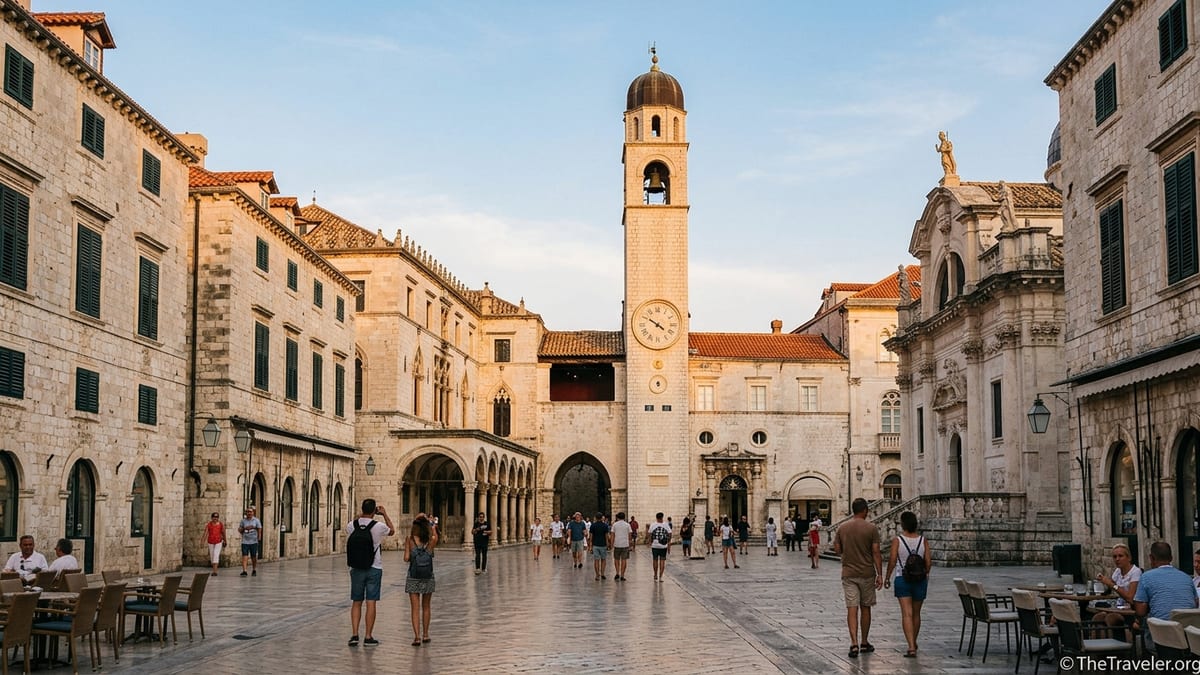
Stand anywhere along Dubrovnik’s polished limestone main street and your eye is naturally drawn eastwards, toward the elegant stone shaft that anchors the skyline. The Bell Tower, capping the end of Stradun at Luža Square, may not be the tallest structure you ever see, but in Dubrovnik’s compact Old Town it is a constant point of reference, a timekeeper, and a powerful symbol of the former Republic of Ragusa. Understanding why this relatively slender tower has become one of the city’s most recognizable landmarks means looking at its layered history, its prominent setting, and the rituals that still revolve around it today.
Get the latest updates straight to your inbox!
A Timekeeper at the Heart of the Old Town
The Bell Tower stands at the eastern end of Stradun, Dubrovnik’s main promenade, where the city’s daily life has unfolded for centuries. At around 31 meters in height, it rises just enough above the surrounding palaces and townhouses to be visible from most corners of the Old Town. Walk from Pile Gate toward the harbor and the tower acts as a visual anchor, pulling you along the street and helping you orient yourself among the tangle of side alleys and stairways. For many visitors, that first full view of the tower framed by the stone facades of Stradun becomes the mental snapshot they associate with Dubrovnik.
Practical function helped make the Bell Tower so central to local life. Long before smartphones and wristwatches, its large clock face and deep, resonant bell kept the population in step. The bell still strikes the hours, echoing down Stradun and out toward the harbor. If you are sitting at a café terrace on Luža Square around midday, you will hear the unmistakable clang accompanied by the rhythmic motion of the striking figures at the top of the tower. Even in an age of digital time, locals still glance up instinctively at the clock when crossing the square on their way to work or errands.
Modern tourism has added another layer to the tower’s role. Because it stands between several of Dubrovnik’s marquee sights, it naturally becomes a meeting point. Walking tours focused on the Old Town’s history or on Game of Thrones filming locations often gather in the shadow of the tower before setting off. Cruise ship visitors with only a few hours ashore are typically told to “meet back under the Bell Tower,” making it one of the few places every visitor is likely to pass several times in a single day.
Six Centuries of History Compressed into Stone
The Bell Tower’s story begins in the mid 15th century, when Dubrovnik, then known as the Republic of Ragusa, was a wealthy maritime city-state competing with Venice and other Adriatic powers. Records note that a bell tower roughly 100 feet high was completed in 1444, forming part of a carefully planned ensemble of civic architecture around Luža Square. At the time, installing a public clock and bell on such a scale was a clear statement that Ragusa was a modern, self-confident republic that valued order and precision.
Earthquakes have shaped Dubrovnik’s skyline as much as any architect, and the Bell Tower is no exception. The devastating 1667 earthquake damaged the structure, and repeated tremors over the following centuries gradually undermined its stability. By the early 19th century, observers recorded it leaning toward Stradun, raising fears that a collapse could bring down nearby buildings or injure people in the busy square. The decision was eventually taken to dismantle the compromised tower in 1928, a painful step in a city so attached to its built heritage.
Rather than replacing it with a new design, Dubrovnik chose to rebuild the Bell Tower in 1929 following the original Renaissance proportions and silhouette. The current tower is therefore both old and new: a 20th century reconstruction that faithfully preserves a 15th century profile. The original 1506 bronze bell, cast by the famed bell- and cannon-maker Ivan Krstitelj Rabljanin, was retained and rehung in the new structure. Later, the 1979 Montenegro earthquake inflicted fresh damage and prompted another carefully managed restoration in the late 1980s, when engineers discreetly reinforced the tower with modern techniques while keeping its historic appearance.
For travelers, this layered history is not merely a set of dates. When you stand in Luža Square and look up, you are seeing a tower that has collapsed, been rebuilt, and survived wars and earthquakes, yet still performs essentially the same function it did in the 1400s. The continuity speaks to Dubrovnik’s determination to maintain its identity even through political upheaval and natural disasters.
Maro and Baro: The Green Figures Everyone Remembers
What many visitors remember most about the Bell Tower are not its stones or its clock, but the two small bronze figures that strike the bell. Perched high up under the cupola, they are nicknamed the Zelenci, “the green ones,” because of the patina that has developed on their surface. Locals also know them affectionately as Maro and Baro, traditional Dubrovnik names that lend the statues a slightly mischievous, human personality.
The idea of mechanical figures striking the hour dates back to the tower’s early years. In the 15th century, the city installed wooden figures that were later replaced, around 1478, by bronze automatons. These early jacquemarts became a source of pride. In a period when only a handful of European cities boasted such sophisticated public clocks, Dubrovnik’s “green men” symbolized its technological progress. Today the originals are preserved in the city’s Cultural History Museum, while replicas installed in 1929 continue the ritual on the tower itself.
If you stand in Luža Square a few minutes before the hour, you can watch locals and guides glance up in anticipation. At noon, when walking tours are typically in full swing and the square is at its busiest, the double strike is especially atmospheric. Guides often time their commentary to pause just before the bell sounds so their groups can experience the moment. For many travelers, this becomes an unexpectedly charming memory: the clatter of the hammers, the bell’s deep note hanging in the air, and the sense that the whole square has briefly synchronized around the same sound.
The figures themselves reward a closer look through a camera zoom or binoculars. They are dressed as stylized soldiers, with short tunics and helmets, capturing the martial character that fortified maritime republics liked to project. Yet there is also a playful quality to them. Souvenir shops along nearby side streets sell miniature versions of Maro and Baro on keychains and magnets, evidence that the “green men” have become mascots of Dubrovnik in their own right.
An Architectural Focal Point in Luža Square
Part of what makes the Bell Tower so recognizable is the company it keeps. Its base stands directly on Luža Square, a compact rectangle ringed by many of Dubrovnik’s most important public buildings. On one side is Sponza Palace, a blend of Gothic and Renaissance forms that once housed the customs office and now preserves some of the city’s most valuable archives. On another stands the baroque Church of Saint Blaise, dedicated to Dubrovnik’s patron saint. The Rector’s Palace, former seat of the rector who governed the republic in month-long terms, is only steps away.
In this setting, the Bell Tower works like the exclamation point at the end of a sentence. Its vertical line closes the perspective of Stradun, while its clock face and bell provide a visual and auditory counterpoint to the more ornate decoration of the surrounding palaces. Photographers and postcard designers have long recognized this. Many classic Dubrovnik images frame the tower alongside Sponza Palace’s arcades or catch it reflected in the polished slabs of Stradun after a brief rain shower.
Architecturally, the tower’s design is simple but refined. The square shaft tapers only slightly and is pierced by small openings that allow sound to carry, culminating in an octagonal drum and a modest dome. Compared with the soaring campaniles of cities like Venice or Florence, it is understated. That restraint fits Dubrovnik’s building traditions, which favor elegance and proportion over extreme verticality. When you walk the city walls above Luža Square, you can appreciate how the tower’s height has been carefully calibrated to stand out without overwhelming the skyline.
For travelers exploring on foot, the Bell Tower also serves as a spatial marker. If you exit the Old Town at Ploče Gate to visit the nearby cable car station or Banje Beach, you will often navigate back by seeking out the tower as it peeks between terracotta roofs. Approaching again along Stradun, the first glimpse of its familiar outline reassures you that you are on the right track.
Daily Rituals, Festivals, and Living Tradition
Although the Bell Tower is an architectural monument, it is not a static relic. Its bell, clock, and figures still structure daily and seasonal rhythms in the Old Town. On an ordinary weekday morning, the hours sound for commuters heading through Pile or Ploče Gates, shopkeepers opening shutters, and café owners arranging outdoor chairs along Stradun. In peak summer, when cruise visitors and independent travelers fill Luža Square, each strike punctuates the constant flow of walking tours and photo stops.
The tower takes on an even more symbolic role during local festivals. During the Feast of Saint Blaise, usually celebrated in early February, processions pass directly under the Bell Tower as banners and reliquaries are carried from the Church of Saint Blaise through the Old Town. The sound of the bell mixing with church chimes and marching bands emphasizes the tower’s place at the ceremonial heart of Dubrovnik. Similarly, when the Dubrovnik Summer Festival opens in July with a dramatic ceremony in front of the Rector’s Palace, the illuminated tower provides an unmistakable backdrop for performances, speeches, and fireworks.
These events matter because they show that the Bell Tower is woven into how residents experience their city. It is not just a photo stop but a stage prop for civic pride, religious devotion, and cultural life. Even small, everyday rituals reflect this. Children learn to tell time by the tower’s clock; older residents swap stories about where they were during the last major earthquake or during the 1990s shelling when damage to the Old Town, including the area around Luža Square, made global headlines.
As a visitor, you can tap into this living tradition simply by spending unhurried time around the square. Instead of snapping a quick picture and moving on, consider nursing a coffee at a nearby terrace and watching how guides, shopkeepers, and residents respond to each toll of the bell. That observational experience often leaves a more lasting impression than any scheduled tour stop.
How Travelers Encounter the Bell Tower Today
For most travelers, the Bell Tower is not a stand-alone attraction with tickets or queues, but an integral part of moving through the Old Town. If you purchase a Dubrovnik Pass, which typically bundles access to the city walls and several museums, you will almost certainly use Luža Square as a crossroads between the walls entrances, the Rector’s Palace, and the harbor. Each time, the Bell Tower will be in your peripheral vision, quietly orienting you.
Walking tours of Dubrovnik’s history usually begin either at Pile Gate or directly under the Bell Tower. Guides often start their narrative here because the tower provides an immediate way to illustrate the city’s mix of medieval roots, Renaissance elegance, and 20th century reconstruction. They may point out the original 16th century bell, explain how the tower was demolished and rebuilt, and use Maro and Baro as a charming human detail to draw in the group. Visitors sometimes arrive knowing only that “there’s a famous clock tower at the end of the main street,” but leave with a sense of its deeper significance.
In the peak summer season, expect Luža Square to be busiest in the late morning and early afternoon when tour groups converge, and again in the early evening as people stroll before dinner. If you prefer to experience the Bell Tower in a quieter atmosphere, come just after sunrise, when cafes are only beginning to open and the stone of Stradun still holds the cool of the night. In those quieter moments, the sound of the bell carries clearly up the narrow lanes, and the tower’s pale facade slowly shifts color as the sun climbs higher.
Photography enthusiasts will find the best natural light on the tower’s western face in the late afternoon, when the sun drops toward the hills above Pile Gate and bathes Stradun in a warm glow. Many travelers notice that after a brief Adriatic shower, the rain-slicked limestone paving turns the square into a mirror, doubling the Bell Tower in reflections that make for striking images without any special equipment.
The Bell Tower as a Symbol of Dubrovnik’s Resilience
Beyond its practical and aesthetic roles, the Bell Tower has come to embody Dubrovnik’s resilience. Few cities have endured as many challenges in such a compact space: catastrophic earthquakes, the decline of maritime trade, shifts from republic to empire to modern nation-state, and the bombardment of the early 1990s. Through each crisis, residents and conservationists have repeatedly chosen to restore their landmark structures as faithfully as possible, the Bell Tower among them.
This continuity matters for how Dubrovnik presents itself to the world. Visitors arrive expecting the romantic “pearl of the Adriatic” often described in guidebooks. The sight of the Bell Tower standing unwaveringly at the end of Stradun helps confirm that image. Yet knowing that the tower you see today is a careful reconstruction of a 15th century original, strengthened after a late 20th century earthquake and preserved through wartime damage, adds a more complex dimension. It represents not an untouched relic, but a heritage that has been actively defended and renewed.
For travelers interested in heritage preservation, the Bell Tower offers a concise case study. From the decision in the 1920s to dismantle the leaning structure, to the 1980s reinforcement using modern engineering hidden inside historic masonry, each intervention has balanced safety, authenticity, and aesthetics. When you compare the tower to historic photographs in local museums, you can see how closely the current profile matches earlier versions, down to the proportion of the dome and the position of the clock face.
Ultimately, this is why so many visitors find themselves turning back for one last look at the tower as they exit the Old Town. It encapsulates what makes Dubrovnik memorable: a sense of stepping into a layered past that remains firmly connected to the present, where bells still ring, figures still strike the hour, and life continues to flow through the same small square.
FAQ
Q1. Where exactly is the Bell Tower in Dubrovnik’s Old Town?
The Bell Tower stands at the eastern end of Stradun on Luža Square, next to Sponza Palace and close to the Church of Saint Blaise and the Rector’s Palace.
Q2. How old is the Bell Tower?
The original tower was completed in 1444. The current structure is a faithful reconstruction from 1929 that incorporates the original 1506 bronze bell.
Q3. Can you go inside or climb the Bell Tower?
At present, visitors generally view the Bell Tower from the outside only. The interior is not a regular public lookout like some church towers in other European cities.
Q4. Who are Maro and Baro on the Bell Tower?
Maro and Baro are the nicknames of the two bronze figures known as the Zelenci, “the green ones,” who strike the bell on the hour at the top of the tower.
Q5. When is the best time to see or photograph the Bell Tower?
Late afternoon and early evening offer warm light on the tower’s facade. Early morning is ideal if you prefer fewer crowds in Luža Square and along Stradun.
Q6. Does the Bell Tower have any special role during festivals?
Yes. Processions for the Feast of Saint Blaise and the opening of the Dubrovnik Summer Festival both pass in front of the Bell Tower, which provides a prominent backdrop.
Q7. Was the Bell Tower damaged in earthquakes and war?
Yes. It was badly affected by past earthquakes, dismantled and rebuilt in the 1920s, reinforced after the 1979 earthquake, and stood near fighting during the 1990s conflict.
Q8. Is the Bell Tower part of Dubrovnik’s UNESCO World Heritage status?
The Bell Tower sits within Dubrovnik’s UNESCO-listed Old Town, contributing to the area’s overall historical and architectural significance recognized by the World Heritage designation.
Q9. Do I need a ticket to see the Bell Tower?
No ticket is required to see the Bell Tower from Luža Square or Stradun. It is a public landmark visible as you walk through the Old Town.
Q10. Why is the Bell Tower considered one of Dubrovnik’s most recognizable landmarks?
Its prominent position at the end of Stradun, its distinctive clock and green striking figures, and its long history as a timekeeper and civic symbol make it instantly recognizable.