


As you walk Dubrovnik’s polished limestone main street, the Stradun, your eye is naturally pulled toward a slim stone tower closing the view at the eastern end. This is the City Bell Tower, a 31‑metre landmark that has watched over the Old Town’s daily life for centuries. The question for many visitors planning a limited-time Old Town walk is simple: is it worth making the Bell Tower a deliberate stop, or is it just a nice backdrop for photos as you hurry past?
Get the latest updates straight to your inbox!
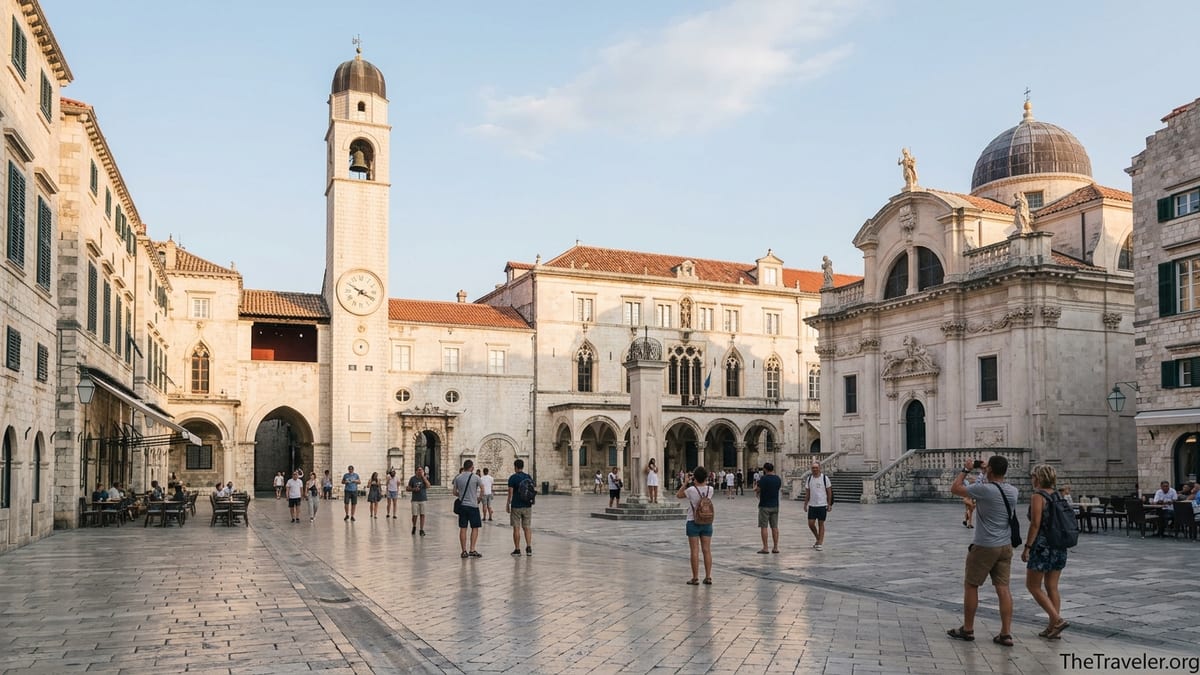
What Exactly Is the Bell Tower in Dubrovnik?
Dubrovnik’s City Bell Tower stands on Luža Square at the eastern end of the Stradun, the main street that slices through the Old Town from Pile Gate to the old harbour. At about 31 metres high, it is not tall by modern standards, but its narrow profile and pale stone make it one of the most recognisable silhouettes in the city skyline. Locals treat it as a visual full stop to the Stradun: when you see the Bell Tower and the square around it, you have reached the historic heart of Dubrovnik.
The first version of the tower was completed in 1444, built by local masters to align perfectly with the axis of the Stradun. Over time, its wooden clock figures were replaced by bronze “green men” known as the Zelenci, added in the late 15th century. After a major earthquake in 1667 and structural problems in later centuries, the tower was rebuilt in the 1920s following the original design, so what you see today is a careful reconstruction that keeps its medieval proportions and details.
At the top hangs a bell cast in 1509 by master founder Ivan Rabljanin. That bell still sounds over the Old Town, striking the hours and adding a steady, almost ceremonial rhythm to life in Luža Square. Even if you are simply crossing the square at midday, the ringing of that bell is part of the sensory experience of Dubrovnik, linking your visit directly to centuries of local history.
Unlike some famous towers in Europe, Dubrovnik’s Bell Tower is primarily admired from the outside. There is currently no regular public access to climb inside for a viewing platform. Its value for visitors lies instead in how it shapes the square, anchors your orientation in the Old Town, and connects to other nearby landmarks.
Where the Bell Tower Fits on a Classic Old Town Walk
Most self-guided walks through Dubrovnik’s Old Town naturally run the length of the Stradun from Pile Gate in the west to Luža Square and the Bell Tower in the east. If you have only a few hours, this route already includes most of the city’s headline sights: Onofrio’s Fountain, the Franciscan Monastery, clusters of narrow side streets, then finally the Bell Tower rising above the eastern end of the street.
When you step into Luža Square, the Bell Tower stands slightly set back from the line of the Stradun, forming one corner of a tight cluster of major monuments. To one side is Sponza Palace, a Gothic–Renaissance building that now houses the city archives and often hosts exhibitions. Directly in front of the tower is Orlando’s Column, a medieval stone pillar used historically as a symbol of civic freedom and as a practical measuring standard. A few steps away stands the baroque Church of St Blaise, dedicated to Dubrovnik’s patron saint. Together, these buildings and monuments create one of the densest historical ensembles in the Old Town.
In real terms, this means that adding the Bell Tower as a point of focus rarely costs you extra time. If you are already walking Stradun, you will arrive at its base simply by continuing to the end of the street. Many guided walking tours time their route so that the group reaches Luža Square just before the hour, allowing participants to pause, listen to the bell strike, look up at the clock faces, and take in the atmosphere before dispersing to explore side streets, the old harbour, or the nearby city walls entrance.
For independent travellers, treating the Bell Tower as a key waypoint on your Old Town loop helps with orientation. It marks the transition between the main thoroughfare and the cluster of attractions that lead toward the harbour and the Ploče Gate side of the city. Whether you veer toward the Rector’s Palace, continue to the cathedral, or head for the water, the Bell Tower acts as a reliable visual anchor.
History, Legends and the Character of Luža Square
Part of what makes the Bell Tower worth noticing is the way it gathers stories around it. The square at its feet, sometimes referred to as Luža or Loggia Square, has served as Dubrovnik’s ceremonial and commercial heart for centuries. Market stalls once filled the space, public proclamations were read from the base of Orlando’s Column, and legal disputes and civic decisions were framed by the sound of the bell striking overhead.
On the side facing the tower, Sponza Palace adds another historical layer. Built in the early 16th century as a customs house and trading centre, it survived the 1667 earthquake largely intact, making it one of the best-preserved secular buildings in Dubrovnik. The palace arcades and inner courtyard served as a hub for merchants, bankers and city officials. Today the building houses the state archives, and during events like the Dubrovnik Summer Festival it often serves as a performance or ceremony backdrop, with the Bell Tower rising in the frame of photographs and television footage.
Orlando’s Column in front of the tower carries its own legends. Medieval tales credit the knight Orlando (or Roland) with saving the city from a siege, and his stone likeness became both a symbol of liberty and a practical tool: the length of his forearm was once used as a standard unit of measure for merchants. Each summer, the raising of the Libertas flag on the column marks the opening of the Dubrovnik Summer Festival, with the Bell Tower and its clock forming a prominent part of the setting.
When you stand in Luža Square today, you are in a compact open-air history gallery. Street musicians play under the arches, café tables spill along the edges, and crowds drift through on their way to the harbour or the cathedral. Yet if you pause for a few minutes to look up at the Bell Tower, you are reminded that for centuries the hours have been measured here in the same way: by the same bell, the same striking mechanism, and the same stone façade bearing silent witness to the square below.
Practical Value: Orientation, Atmosphere and Photography
If you are trying to decide whether the Bell Tower deserves more than a passing glance, it helps to think in terms of practical value. First, it is one of the easiest landmarks to use for navigation. From almost anywhere along Stradun, the tower remains visible, so if you stray into side alleys and then want to return to the main axis of the Old Town, walking toward the sight or sound of the Bell Tower reliably brings you back.
Second, the square around it offers some of the best people-watching and atmosphere in the city. Because several important buildings meet here, small events, processions, and festival activities often start or finish on Luža Square. During the July and August Dubrovnik Summer Festival, for example, evening performances and ceremonies regularly use this area as a stage, and the illuminated Bell Tower becomes a vertical accent in night-time photos.
For photography, the tower’s value is more about context than close detail. A common real-world composition pairs the Bell Tower with Sponza Palace and Orlando’s Column in a wide shot taken from mid-Stradun. Another practical angle is from the steps of St Blaise Church, looking back toward the tower and the street. Even visitors with smartphones can easily capture the interplay of pale stone, red roofs, and the clock faces framed against the sky.
If you are visiting Dubrovnik on a cruise stop or a short day trip and have perhaps three or four hours in the Old Town, allowing ten or fifteen minutes to linger around the Bell Tower is often enough. Use that time to grab a coffee from a nearby café, find a spot at the edge of the square, and simply watch the rhythm of the city unfold in front of you as the hour strikes.
Is There an Inside Visit or Viewpoint from the Bell Tower?
Many travellers arrive in Dubrovnik expecting the Bell Tower to function like the campanile in Split or the bell towers in Venice and Florence, where you can climb internal stairs or take a lift for a paid viewpoint. In Dubrovnik’s case, the situation is different: there is currently no standard public access to the interior of the City Bell Tower. It is managed primarily as a historic structure and working clock and bell, not as a regular viewing platform.
This means that if your main goal is a panoramic view over the Old Town’s terracotta roofs, the Bell Tower itself will not provide it. Instead, visitors typically turn to the city walls walk, which completely encircles the Old Town and offers repeated high vantage points, or to viewpoints outside the walls such as Mount Srđ, accessed by cable car or a steep hiking trail. From these spots you can see the Bell Tower as a slim vertical marker amid the dense urban fabric.
The lack of an interior visit does not mean the tower has no experiential value. If anything, it encourages you to appreciate it as part of a larger ensemble. The best way to “use” the Bell Tower is to let it structure your walk and photographs, rather than treat it as an isolated ticketed attraction. Many travellers combine a pause at the tower with a visit to Sponza Palace or the Rector’s Palace, forming a compact historical loop within a few minutes’ walk.
If you are someone who prioritises climbs and towers on city visits, you might choose to allocate your energy and time to the city walls rather than searching for non-existent tickets to the Bell Tower. However, even then, knowing where the tower stands and how it features in the skyline will enrich your understanding of the views you get from elsewhere.
Who Will Appreciate the Bell Tower Most?
Not every traveller connects with the same sights in the same way. The Bell Tower tends to appeal strongly to visitors who are interested in urban history, architecture, or the feeling of being in a place where everyday routines have continued for centuries. If you are the kind of person who enjoys observing how a public square functions at different times of day, you will likely find yourself drawn back to Luža Square, with the Bell Tower as a constant point of reference.
Photography enthusiasts also benefit from treating the tower as a key subject. Early in the morning, when cruise groups have not yet filled the streets, soft light hits the tower and the façades of Sponza Palace and St Blaise Church from different angles, creating strong compositions that work even in simple snapshots. In the evening, as the stone surfaces reflect street lighting, the Bell Tower adds vertical drama to night scenes without the need for a tripod or special equipment.
Travellers with a tight schedule who mainly want high-impact views and clear “must-see” attractions may not feel the Bell Tower deserves special attention on its own. They might be better served by focusing on the city walls, a short walk to the old harbour, and perhaps one or two key interiors such as the cathedral treasury or the Rector’s Palace. In these cases, the Bell Tower will still appear in their experience simply because it stands at a natural crossroads, even if it is not consciously highlighted.
Families, on the other hand, often find that the Bell Tower and its surroundings provide an easy break point. Children can count the chimes on the hour, look for the small bronze figures that strike the bell, and run around the relatively open centre of the square while parents rest on nearby steps or at a café table. Because vehicle traffic does not enter the Old Town, this is one of the safer open spaces to linger with younger travellers.
Tips for Timing Your Visit and Avoiding Crowds
Dubrovnik’s Old Town can feel crowded during peak summer months, especially on days when several large cruise ships are in port. The area around the Bell Tower and Luža Square is one of the main pinch points, as almost all walking routes funnel through this space. If you want to experience the tower with a bit more breathing room, timing matters.
Early morning, roughly between 7:30 and 9:00 in high season, often provides the calmest atmosphere. Local residents head to work, shop deliveries roll in, and tour groups are still assembling at Pile Gate. At this hour you can stand near Orlando’s Column, look up at the Bell Tower, and take unobstructed photographs along the length of the Stradun. The bell strikes at the top of each hour, so aiming to be there around 8:00 or 9:00 helps you experience the sound with fewer people around.
Late evening, after most day-trippers have returned to their buses or ships, offers a different kind of charm. Street lighting picks out the architectural details on the tower and surrounding façades, and the stone of the square holds some of the day’s warmth. Couples often stop here between dinner and a nightcap, while small performances associated with the summer festival occasionally animate nearby stages. In high season, this might be around 10:00 or 11:00 at night.
Midday is the busiest period, with strong sun reflecting off the pale stone and crowds spilling through from both ends of the Old Town. If you only have time to pass by at noon or early afternoon, try stepping slightly to the sides of the square, for example into the shade of Sponza Palace’s loggia, to get a more comfortable view of the tower and escape the densest foot traffic.
The Takeaway
So, is Dubrovnik’s Bell Tower worth adding as a deliberate stop on your Old Town walk? For most visitors, the answer is yes, with the understanding that its value lies less in being a standalone attraction and more in how it shapes the experience of Luža Square and the Stradun. You are unlikely to spend more than fifteen or twenty minutes here unless you are deeply interested in architecture or photography, but those minutes will help anchor your mental map of the city and connect you more strongly to its history.
If your time in Dubrovnik is extremely limited and you must choose between, say, the city walls and a quiet pause under the Bell Tower, the walls will usually win. They offer broad views and a clear sense of achievement that many travellers prioritise. Yet even then, your route through the Old Town will almost inevitably lead you to the foot of the Bell Tower at some point. Taking the opportunity to pause, look up, and listen to the bell rather than simply pushing through the crowd can transform a rushed transit point into one of your most vivid memories of the city.
For travellers with a half-day or more to explore, the Bell Tower earns its place as a key waypoint. It is free to admire, central to the Old Town’s history, and woven into everyday local life. From families enjoying the chimes to photographers chasing early-morning light, many types of visitors find something quietly satisfying in spending a few unhurried minutes here.
Ultimately, adding the Bell Tower to your Old Town walk is not about checking off another attraction. It is about understanding how a single slender tower can knit together streets, stories, and generations, turning an already beautiful square into the living heart of Dubrovnik.
FAQ
Q1. Can you go inside or climb Dubrovnik’s Bell Tower?
Public access to the interior of the City Bell Tower is not currently offered, so you can admire it from the outside but should not plan on climbing it.
Q2. Where exactly is the Bell Tower located in the Old Town?
The Bell Tower stands on Luža Square at the eastern end of the Stradun, close to Sponza Palace, Orlando’s Column, and the Church of St Blaise.
Q3. Does it cost anything to visit the Bell Tower?
There is no specific ticket to see the Bell Tower from the square. The Old Town itself is free to enter, and you can view the tower as you walk.
Q4. What is the best time of day to see the Bell Tower?
Early morning and late evening are generally the most pleasant times, with softer light, fewer crowds, and a more relaxed atmosphere around Luža Square.
Q5. Is the Bell Tower worth seeing if I am only in Dubrovnik for a few hours?
Yes. Because it sits at a natural crossroads on most walking routes, you can easily include a short stop at the Bell Tower without adding extra distance or cost.
Q6. Can I get good photos of the Bell Tower without special equipment?
Yes. Simple wide shots from mid-Stradun or from the steps of St Blaise Church work well, and most visitors are satisfied with images taken on a phone.
Q7. How does the Bell Tower compare with other viewpoints in Dubrovnik?
The Bell Tower itself does not offer a viewing platform, so for panoramic city views you are better off walking the city walls or going up Mount Srđ.
Q8. Are there any events or festivals that feature the Bell Tower?
During the Dubrovnik Summer Festival, ceremonies and performances often take place on or near Luža Square, with the Bell Tower forming an atmospheric backdrop.
Q9. Is Luža Square around the Bell Tower very crowded?
In peak season it can be busy, especially midday when tours converge. Visiting early or late in the day helps you experience the square with fewer crowds.
Q10. What other sights can I combine with a stop at the Bell Tower?
Within a short walk you can visit Sponza Palace, Orlando’s Column, the Church of St Blaise, the Rector’s Palace, the cathedral, and the old harbour.