


I grew up thinking I knew what a Southern road trip looked like: straight interstates, billboards for fireworks and fast food, and gas stations that all felt the same. North Carolina proved me wrong in a matter of days. Winding from the Blue Ridge Parkway to the Outer Banks, I found a state where driving becomes the main attraction, the small towns are the real destinations, and the spaces in between are what stay with you longest.
Get the latest updates straight to your inbox!
From Interstates to Byways: The Moment Everything Shifted
Like most travelers, I entered North Carolina on an interstate that could have been almost anywhere in the South. It was only when I exited onto a signed scenic byway outside Asheville that the tone of the trip changed. The lanes narrowed, the pace slowed, and the billboards disappeared. Instead of chain exits, I passed farm stands selling just-picked peaches and family-run diners advertising daily meat-and-three plates for under 15 dollars. It felt less like a commute and more like slipping into a story.
North Carolina has an unusually rich network of scenic byways, with routes created to highlight history, geography, and culture. You can feel the difference immediately. On these roads, you are not rushing toward a big-name attraction; you are moving through layers of mountain coves, mill towns, and former tobacco country at a speed that lets you notice church marquees, front-porch swings, and the way the light settles into the hollows at dusk. It is still the South, but it feels quieter, more self-assured, and far less commercial than I expected.
Pulling into a country store where the parking lot was a mix of pickup trucks, Subarus, and motorcycles, I realized that this was not the monolithic “Southern drive” I had pictured. The conversations at the counter moved easily from college basketball to trout hatches in local rivers and which bakery in town had the best sourdough. This blend of old and new would become a theme across the state, stitched together by roads that invite you to linger rather than pass through.
Blue Ridge Parkway: A Mountain Drive That Feels Suspiciously Like a National Park
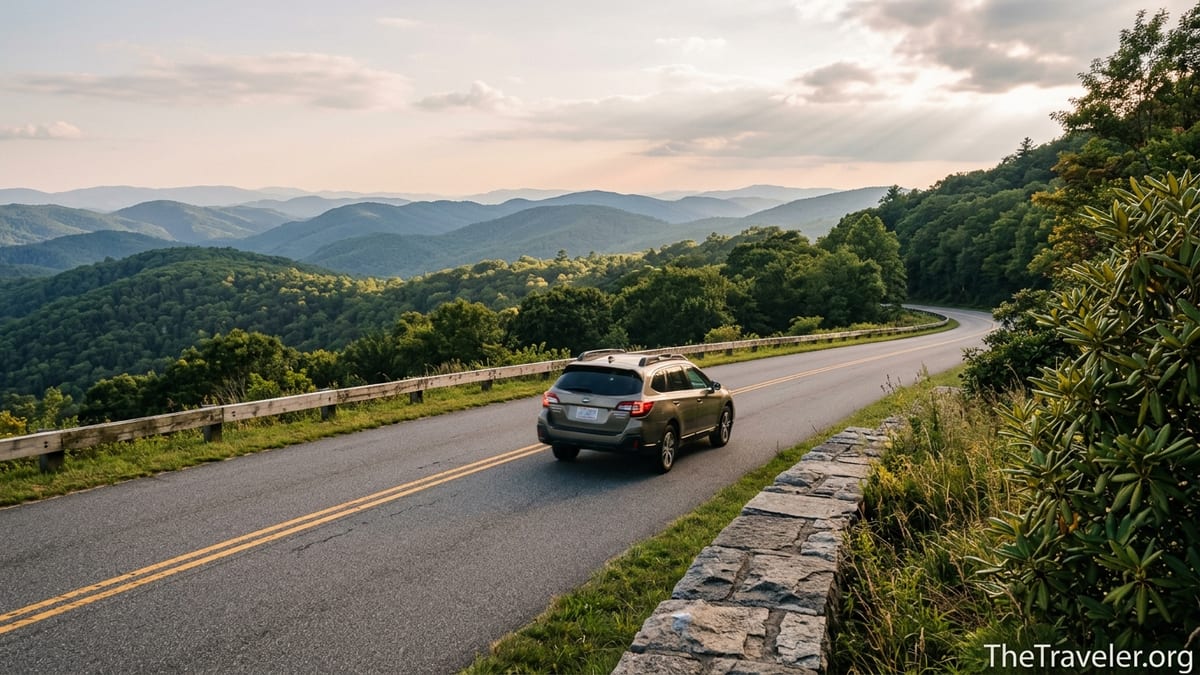
The Blue Ridge Parkway is where my idea of a road itself as destination finally clicked. Entering near Asheville, I left behind traffic lights and entered a world of 35 to 45 mile-per-hour curves, stone tunnels, and overlooks that seem deliberately placed to make you pull over every few minutes. Uncluttered by billboards or commercial trucks, the parkway feels more like a linear national park than a highway, with picnic areas, trailheads, and campgrounds strung along its 400-plus miles.
On an early summer morning, fog pooled in the valleys below as the higher ridges caught the first light. I pulled into an overlook where a couple from Ohio had set up camp chairs at the tailgate of their SUV, quietly sipping coffee from stainless-steel mugs. Families wandered out for quick photos, then stayed longer than they intended, watching the clouds drift across the hills. No one was in a hurry. The road itself enforced a different pace and, in doing so, a different mindset.
Later that day, near the Linville Falls area, I swapped the driver’s seat for a short hike. The trail wound through rhododendron thickets to overlooks where the waterfall carved its way into the Linville Gorge far below. The parking lot told its own story: North Carolina plates, yes, but also campers from Florida, Quebec, and Ohio. People compared notes on which mileposts had the best picnic spots, which campgrounds still had openings, and where to find a decent dinner in nearby mountain towns like Spruce Pine and Little Switzerland.
It would have been easy to rush a day on the parkway, but the road resists that. With speed limits kept intentionally low and no gas stations on the route, you are nudged to prepare, slow down, and actually inhabit the journey. That alone makes the experience feel different from a typical Southern drive, where efficiency usually trumps everything else.
Forest Heritage & Mountain Waters: Two-Lane Roads With Story in Every Curve
If the Blue Ridge Parkway is the famous scenic spine, the lesser-known mountain byways are the ribs: quieter, more intimate, and full of surprise. South and west of Asheville, the Forest Heritage Scenic Byway winds through Pisgah National Forest, connecting river valleys, roadside waterfalls, and trailheads just far enough from the city to feel like another world. On a weekday, you can pull off at Looking Glass Falls and find only a handful of people admiring the water as it plunges into a deep pool a few yards from the parking area.
Driving that route, I stopped at a fly shop in Brevard where the staff were just as happy to talk hiking boots and waterfall loops as they were about trout gear. A hand-lettered sign advertised guided wading trips starting around 200 dollars for a half day, but most visitors walked out with trail maps, local beer recommendations, and a sense of how to blend into the forest instead of simply driving past it. The man behind the counter, a transplant from New England, shrugged and said, “You come for the waterfalls, you stay because the roads keep pulling you deeper in.”
Farther west near Franklin, the Mountain Waters Scenic Byway follows the Cullasaja River through a narrow gorge. Here, hairpin turns hug rock walls while cascades drop directly beside the shoulder. It is the opposite of an anonymous freeway: 20 to 30 mile-per-hour curves, no passing lanes for long stretches, and local drivers who know the rhythm instinctively. You learn quickly to pull into a turnout, let the regulars slip by, and then enjoy the quiet as you ease your way through the gorge, windows down, with the sound of the river rising and falling beside you.
In Highlands, a tidy mountain town that feels more like a mountain village than a resort strip, I ducked into a coffee shop where a blueberry scone and cappuccino came to about 10 dollars. At the next table, a pair of retirees compared driving notes on nearby byways, circling names on a paper map: Waterfall Byway, Nantahala Byway, Cherohala Skyway just over the state line. It underscored one of the pleasures of North Carolina road tripping: there is always another curving, scenic option that values character over convenience.
Small Towns, Slow Evenings, and a Softer Version of “Southern”
One of the biggest surprises of driving across North Carolina was how its small towns challenged my assumptions about Southern culture. In places like Sylva, Morganton, and Hillsborough, the traditional markers are there: historic brick storefronts, courthouse squares, and afternoon heat that sends people in search of shade. Yet the atmosphere felt less performatively “Southern” than I expected. Instead, there was a quiet mix of college students, multigenerational families, remote workers, and long-time locals sharing the same sidewalks.
In Morganton, I wandered into a brewery housed in a former textile mill, where a hazy IPA cost about 7 dollars and the menu offered both pimento cheese dip and tofu banh mi. On the patio, a group in hiking gear traded trail reports while a nearby table debated which public school magnet program had the best dual-language track. No one fit neatly into the clichés that many road trippers carry with them when they cross the Mason-Dixon Line.
Even food stops pushed past old stereotypes. In one courthouse-town diner, I ordered a plate of pulled pork with collards and mac and cheese for under 12 dollars, and the server automatically brought a taste of the vinegar-based Eastern North Carolina sauce when she heard I was from out of state. Later in Durham, a sit-down dinner at a contemporary Southern spot cost more like 25 to 30 dollars per entree, but the menu threaded local ingredients through dishes that would not have been out of place in Brooklyn or Portland. It felt like the same state, simply another facet.
Driving from town to town, the most distinct feature was not a particular accent or slogan on a T-shirt but the easy way people suggested alternatives when they heard where I was headed next. “If you are taking the back way to the coast, stop in Kinston for barbecue,” one gas station attendant suggested, pointing me toward a route that zigzagged through fields of corn and tobacco rather than sticking to the multi-lane highway. These were not detours so much as continuations of a theme: in North Carolina, the road you choose can change the whole emotional texture of the trip.
Reaching the Coast: When the Road Becomes a Ribbon of Sand
After days in the mountains, the approach to the coast felt like a whole new chapter of the same book. The Outer Banks, a chain of barrier islands off the mainland, are threaded by a two-lane road that behaves more like a village street than a traditional coastal highway. On North Carolina Highway 12, speed limits fluctuate with development, and you are never far from sand, sea oats, or a glimpse of the Atlantic.
My first base was Nags Head, where motel-style oceanfront rooms in mid-range properties often start around 140 to 200 dollars a night in shoulder seasons, rising higher in peak summer. From there, a short drive south brought me to Cape Hatteras National Seashore, a long, protected stretch of dunes and beaches with only the bare essentials: a few campgrounds, ramps for vehicles with beach-driving permits, and access points where wooden boardwalks lifted you over the sand to the open ocean.
Here, too, the road shapes the experience. Passing the tall black-and-white spiral of Cape Hatteras Lighthouse, you are only ever a short walk from the surf. Parking areas are simple pull-offs, some with just a set of trash cans and a vault toilet. Families unload coolers from minivans while kiteboarders rig lines in the wind and anglers set up long surf rods in PVC holders embedded in the sand. The vibe is casual, transient, and deeply tied to the weather. A blue-sky morning can yield to fast-moving storms by late afternoon, and locals plan their days accordingly.
Driving south through tiny communities like Rodanthe, Avon, and Buxton, I noticed how different this felt from the polished resort towns found in other Southern coastal states. There were beach houses and rental agencies, of course, but also independent surf shops renting foam boards for around 25 to 40 dollars a day and seafood markets where you could pick up a pound of shrimp to sauté in a vacation rental kitchen. The road never let you forget that the islands were narrow, shifting places where dunes, sound, and ocean kept trading territory.
Ferries, Ocracoke, and the Unhurried Joy of Not Being in Control
The most transformative moment on the coast happened when the pavement abruptly ended at the southern tip of Hatteras Island and the only way forward was a free car ferry. Boarding the Hatteras-to-Ocracoke ferry felt like stepping into a slower dimension of travel. Drivers eased their vehicles into tightly packed rows under the guidance of crew members, then climbed out to lean on railings and watch dolphins surf the wake as the boat crossed Hatteras Inlet.
The crossing typically takes under an hour, but it erases the mindset that everything should happen immediately. Without any cell service breaks or rest stops to plan, people talk to one another. A couple from Pennsylvania compared rental prices on the islands, noting that basic summer vacation rentals in Ocracoke Village can easily start around 250 to 300 dollars per night and climb higher for waterfront homes. A local fisherman offered tips on which stretches of beach were best for shelling after a storm, and which soundside coves held red drum when the wind turned right.
On Ocracoke Island itself, the road continues for about 13 miles from the ferry dock to the village, slicing through undeveloped dunes protected as part of the national seashore. There are no high-rise hotels, no neon mini-golf courses. Instead, a single two-lane road, pull-offs for beach access, and a scattering of weathered cottages shaded by live oaks in town. Bicycles outnumber cars on many side streets, and golf carts swerve gently around pedestrians in flip-flops carrying takeout cups of iced coffee.
It was here that I realized just how thoroughly North Carolina had altered my expectations. A Southern road trip, in my mind, had always meant pushing through long distances to reach stand-alone attractions. On Ocracoke, the attraction was the fact that you could not rush: ferries ran on their own timetable, restaurants closed when the kitchen ran out of fresh fish, and the only evening decision was whether to walk to the harbor for sunset or stay on the quieter soundside shore to watch the light fade behind the marsh.
Practical Ways to Recreate This Kind of North Carolina Road Trip
You do not need weeks off or an elaborate budget to experience this softer, more immersive version of a Southern road trip. A long weekend can be enough if you choose your segments carefully. One popular pattern is to fly into Asheville or Charlotte, rent a reasonably efficient car or small SUV in the 50 to 90 dollars per day range depending on season, and devote two days to the Blue Ridge Parkway and nearby byways before looping through small towns on the way to Raleigh or Durham.
Another option is to focus entirely on the coast. Many travelers rent in Nags Head, Kill Devil Hills, or Avon, then spend a day driving the Outer Banks Scenic Byway, pausing frequently rather than racing to the end. You can spend a few dollars on a day-use parking area, then walk out to the beach with your own cooler and beach chairs instead of paying for resort day passes. If you choose to visit Ocracoke, plan around ferry schedules and build in extra time on either side of the crossing for traffic lines and the 13-mile drive between the ferry dock and village.
Regardless of your route, the key is to lean into two-lane roads and scenic byways rather than interstates whenever possible. Having an offline map app helps, as cell coverage can be spotty in mountain valleys and along stretches of the coast. Booking lodging with kitchens or at least mini-fridges lets you stock up at local grocery stores or farm stands, which often carry regional specialties like country ham, hoop cheese, and seasonal produce. Gas prices vary, but in many small towns you will find independent stations that are only a few cents higher or lower than what you might pay near the interstates.
Finally, it pays to be flexible with timing. Afternoon thunderstorms are common in the mountains during summer, and coastal storms can kick up winds that make driving over long, exposed bridges feel more dramatic. Building extra time into each day lets you pull over during a sudden downpour, linger over an unexpectedly good meal, or detour to a waterfall or historic site that locals recommend. The more elastic your schedule, the more North Carolina can show you sides of itself that never appear in quick-hit itinerary checklists.
The Takeaway
By the time I crossed back over the state line at the end of my trip, my sense of what a Southern road trip could be had changed completely. North Carolina had traded the clichés of billboards and blazing interstates for something quieter and more textured: slow switchbacks through spruce forests, ferries gliding across inlets, conversations on general-store porches, and meals that felt anchored to specific places instead of generic exits.
The state’s mix of mountains, piedmont, and coast might be its obvious selling point, but what really stays with you is the way its roads invite you to experience that variety without rushing. Scenic byways, protected seashores, and modest small towns work together to turn driving into an act of exploration rather than endurance. You begin to see that a long way around is often the better way, especially in a state that rewards curiosity at almost every bend.
If you arrive expecting the South to feel a certain way, North Carolina will complicate that picture. It is still a place of sweet tea, barbecue smoke, and hot summer nights, but it is also a place of mountain trailheads packed with out-of-state plates, coastal villages governed by the tides, and college towns where new ideas sit comfortably beside long-held traditions. On its back roads and barrier islands, a Southern road trip stops being about getting somewhere fast and becomes a way of learning to travel slower, notice more, and let the journey reshape you.
FAQ
Q1. How many days do I need for a North Carolina mountain and coast road trip?
Most travelers are happy with 7 to 10 days, which allows 3 to 4 days in the mountains, a travel day across the state, and 3 to 4 days on the coast without rushing.
Q2. When is the best time of year to drive the Blue Ridge Parkway and Outer Banks?
Late spring and early fall tend to offer milder temperatures, fewer crowds than peak summer, and changing foliage in the mountains or pleasant water temperatures at the coast.
Q3. Do I need a four-wheel-drive vehicle for this kind of North Carolina road trip?
No, a standard car is fine for paved roads and scenic byways. Four-wheel drive is only helpful if you plan to drive on designated beach areas that require permits.
Q4. How expensive is lodging along the Blue Ridge Parkway and Outer Banks?
Expect a wide range, from simple motels and cabins starting around 90 to 150 dollars per night in shoulder seasons to beach rentals and boutique inns that can cost several hundred dollars per night in summer.
Q5. Are the ferries to Ocracoke Island reliable for road trippers?
Yes, ferries generally run multiple times a day, but schedules can change with weather and demand, so it is wise to check current times and allow extra time for lines.
Q6. Can I camp along the way instead of staying in hotels?
There are campgrounds in and near the Blue Ridge Parkway and Cape Hatteras National Seashore, along with private campgrounds inland, though reservations are recommended in busy seasons.
Q7. Is cell phone service available in the mountains and Outer Banks?
Coverage is decent near towns but can be patchy on remote byways, in deep valleys, and along some stretches of the islands, so offline maps are helpful.
Q8. Do I need to reserve anything in advance for this kind of trip?
Lodging and popular campgrounds often book up for summer and fall weekends, and some ferries recommend or require reservations during busy periods, so planning ahead is smart.
Q9. Is this North Carolina road trip suitable for families with children?
Yes, families often enjoy the combination of short hikes, waterfalls, beach time, lighthouses, and ferry rides, though it helps to limit daily driving hours and schedule frequent stops.
Q10. How different does North Carolina feel from other Southern road trip destinations?
Many visitors find it less commercial and more varied, with a strong emphasis on scenic byways, public lands, and small towns that reward slower, more curious travel.