


Few states make it as easy to combine misty mountains, classic small towns, and sandy Atlantic beaches as North Carolina. With a bit of planning, you can watch sunrise over the surf near Wilmington, wind through Blue Ridge Parkway overlooks by afternoon a couple of days later, and spend your evenings in walkable Main Street towns where craft beer, live music, and old brick storefronts set the scene. This guide walks you through how to knit those landscapes together into one realistic, road-trip friendly itinerary, with concrete suggestions on routes, budgets, and stops that feel distinctly North Carolina.
Get the latest updates straight to your inbox!
Choosing the Best Time and Route for Your North Carolina Loop
The simplest way to weave together beaches, the Blue Ridge, and small towns is to think in terms of a loop. Many travelers start and end in Raleigh or Charlotte, which both have major airports and rental car fleets. A common pattern is to begin on the coast around Wilmington and its barrier island beaches, then drive inland toward the Piedmont cities, continue to the high country around the Blue Ridge Parkway, and finally wind back through foothill towns to your starting point. Driving from Wrightsville Beach to Asheville, for example, typically takes about five to six hours of highway time, without stops.
Spring and fall are the sweet spots for this kind of trip. From late April through early June and again from late September into late October, temperatures are usually mild enough for hiking along the Parkway while still being comfortable for beach walks and shoulder-season swimming. Coastal humidity and summer crowds hit their peak in July and early August, when hotel prices near beaches like Carolina Beach and Kure Beach often jump noticeably compared with May or early June. In the high country, October weekends can be very busy because of fall foliage, so you will want to reserve mountain town lodging several months ahead if your dates are fixed.
Weather matters because mountain and coastal conditions can change quickly. Fog can roll over the Blue Ridge Parkway any month, making scenic driving slower than expected, while afternoon thunderstorms are common along the coast in summer. When you are stitching beaches and mountains into one itinerary, keep a little flex in your schedule. Leave at least half a day “blank” between leaving the coast and tackling any big mountain hikes so you are not rushing from sea level to summit plans if the weather shifts.
For many visitors, a week to ten days is the ideal length for this kind of loop. That gives you two or three nights at the beach, three or four nights in or near the mountains, and one or two nights in smaller towns in between. If you only have five days, it is still realistic to pair one beach base with a taste of the Blue Ridge, but you will want to keep your driving days focused and selective.
Anchoring Your Trip on the Blue Ridge: Parkway & Mountain Lakes
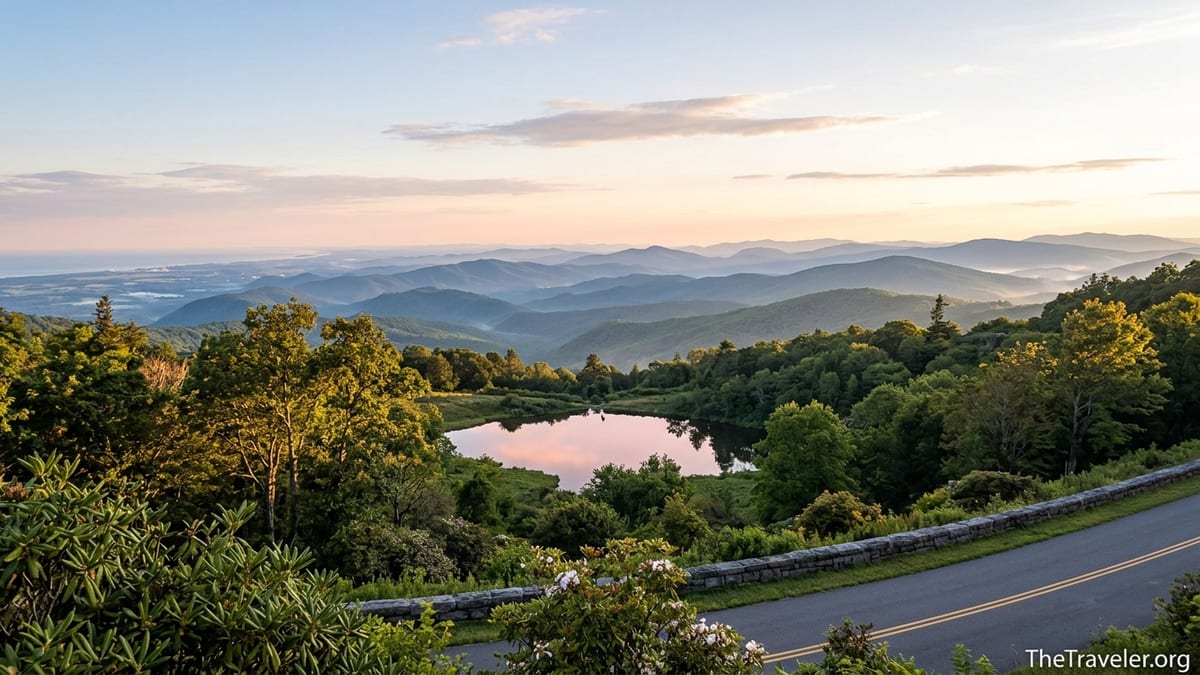
The Blue Ridge Parkway, which runs through western North Carolina as part of its 469-mile length, is the spine of the mountain side of your trip. Even if you do not drive long stretches, using a couple of Parkway access points near small towns lets you tap into big scenery without overly complex logistics. Around the Boone and Blowing Rock area, for example, access ramps lead you quickly up to overlooks such as Thunder Hill and the Price Lake area, yet you are still only a short drive from coffee shops and inns in town.
While you cannot swim in rivers and lakes that lie directly within Parkway boundaries, there are plenty of nearby options that feel like Blue Ridge “beaches.” South of Asheville, Lake Lure has a managed sandy swimming area right in town, usually open in the warm months with a modest day-use fee, and is ringed by wooded hills that mirror the surrounding mountains. Closer to the high country, small lakes such as Wildcat Lake near Banner Elk or community lakes around Blowing Rock provide family-friendly swimming piers, grassy lawns, and picnic tables that give you the experience of a mountain beach day, complete with cool water and long-range ridge views.
If you prefer calmer water and easy paddling over full-on swimming, places like Price Lake along the Parkway near Blowing Rock offer boat rentals for canoes and kayaks in season. You can drift along mirrored water looking up toward Grandfather Mountain while loons and ducks cut across the surface. Trails like the Price Lake loop skirt the shoreline through rhododendron thickets, letting you walk off your drive without committing to a strenuous backcountry trek. Because these are popular spots, especially in June and October, arriving early in the day keeps parking straightforward and lets you linger at overlooks without jostling for space.
To build your days around the Blue Ridge, aim to combine one marquee scenic drive or lake stop with time in a town. You might spend a morning driving a 30 to 40 mile stretch of Parkway between Asheville and Mount Mitchell, stopping at a couple of overlooks, then drop down to Black Mountain for an afternoon of breweries and galleries. Or choose a circuit around Grandfather Mountain, with a few hours on the Parkway and at Price Lake, followed by dinner in Blowing Rock’s compact, walkable center.
Charming Mountain Town Bases: Blowing Rock, Black Mountain & Brevard
What turns a scenic drive into a memorable trip are the small towns that serve as your base. In western North Carolina, places like Blowing Rock, Black Mountain, and Brevard have built strong followings thanks to walkable main streets, easy trail access, and a steady undercurrent of arts and live music. They are compact enough to feel human-scale but large enough to offer a range of lodging and dining options that work for different budgets.
Blowing Rock, perched on a ridge not far from Boone, leans into its resort-town heritage with manicured public parks, historic inns, and inviting sidewalk patios. You can spend a morning exploring boutiques around Main Street, grab lunch at a cafe that overlooks the town park, and then be on the Blue Ridge Parkway in minutes for an afternoon up at Moses H. Cone Memorial Park or the Linn Cove Viaduct area. In high summer and peak foliage, rooms in historic properties and newer boutique hotels here can climb toward upper mid-range prices, but shoulder seasons and midweek dates often open up more moderate nightly rates.
Farther south, Black Mountain sits just east of Asheville and feels like a slower-paced alternative to the city. Its downtown is lined with independent bookstores, coffee shops, and restaurants that put local ingredients front and center. From a practical standpoint, staying in Black Mountain can be a way to enjoy access to Asheville’s dining scene and the central section of the Parkway while paying slightly less on lodging than in Asheville’s busiest neighborhoods. Travelers often combine a Black Mountain stay with visits to Lake James State Park or to trails in the nearby Swannanoa Valley.
Brevard, southwest of Asheville near the entrance to Pisgah National Forest, is another strong candidate for a mountain base. The town is known among hikers and cyclists for its proximity to hundreds of miles of trails and waterfalls in Pisgah and DuPont State Recreational Forest. Downtown, you will find a classic courthouse square, a cluster of outdoor gear shops, and cafes that cater to early-morning trail-goers. If your idea of a “beach” is a flat rock beside a clear mountain stream, Brevard’s surrounding forests will keep you busy with swimming holes and riverside picnic spots rather than formal beaches.
Where the Mountains Meet the Water: Mountain “Beaches” and Lakes
Although North Carolina’s true sand beaches line the Atlantic, inland lakes and riverbanks in the western part of the state can provide a surprisingly similar experience at cooler temperatures. Lake Lure is the best-known example, with its sandy shoreline, roped-off swimming area, and views toward the rocky cliffs of Chimney Rock State Park. Families often build a day here around paddleboat rentals, playground time, and ice cream from spots just off the lakefront, turning a mountain day into something that feels as relaxed as a seaside outing.
Near Waynesville and the Cataloochee area, Lake Junaluska offers another sort of mountain waterfront. A paved trail circles the lake, making it easy to stroll at sunrise or sunset as mist rises off the water and church steeples and conference buildings reflect on the surface. Small pocket parks and piers around the shoreline allow visitors to sit with a picnic and watch kayakers and paddleboarders glide by. Although the atmosphere is quieter and more retreat-like than a bustling beach town, it still fills the same role on your itinerary: a place to slow down, swim or paddle if conditions allow, and recharge between more strenuous hiking or driving days.
Even tiny lakes and riverside parks around towns like Boone, Sylva, and Bryson City can fit this “mountain beach” niche. Wildcat Lake, near Banner Elk, includes a small sandy strip and a pier that local families frequent on hot afternoons. City riverfront parks in Bryson City or in sections of the French Broad River near Asheville have grassy banks where people bring camp chairs, let kids splash in shallows under adult supervision, and watch tubers float past. When you are planning your route, scanning for these kinds of lakes and river parks near your chosen small-town bases can add welcome low-key downtime to a trip that might otherwise be packed with viewpoints and driving.
Because water temperatures in mountain lakes can be brisk even in midsummer, pack layers and realistic expectations. Rather than banking on long swims, think of these stops as chances to wade, paddle, and relax in the shade. A lightweight camp blanket, compact chairs, and a small cooler work just as well on the banks of a Blue Ridge lake as they do on the sand at the coast.
Adding the Atlantic: Pairing Blue Ridge Towns with Wilmington’s Beaches
On the coastal side of your loop, the easiest cluster of beaches to combine with a Blue Ridge itinerary lies around Wilmington. This historic port city sits on the Cape Fear River and acts as a gateway to several nearby barrier islands: Wrightsville Beach, Carolina Beach, and Kure Beach. Each has a slightly different character. Wrightsville tends to attract surfers and active travelers, with outfitters renting boards and offering lessons, while Carolina Beach mixes an old-fashioned boardwalk feel with a state park and long, walkable shoreline. Kure Beach is a bit quieter, with residential streets, a fishing pier, and access to the preserved dunes and Civil War-era earthworks at Fort Fisher.
Hotel and vacation rental rates in this area vary widely by season. In midsummer, a standard hotel room within an easy walk of Wrightsville Beach’s oceanfront can climb into higher nightly rates, especially on weekends. Travelers who are willing to base themselves a short drive inland in Wilmington proper, or to visit in May, early June, or September, often find more moderate prices. At Carolina Beach, older motels, small inns, and condo rentals create a broader range of options that can work for couples, families, or groups of friends traveling together.
In practical terms, driving from Wilmington’s beach area to Asheville or to towns like Black Mountain or Brevard is a full travel day, usually about five to six hours depending on traffic. Many road trippers break this up with a night in a smaller inland town, such as Southern Pines or one of the Sandhills communities, then continue on to the mountains the following day. Others do the drive in one go, leaving the coast early in the morning so that they arrive in the mountains with enough time to settle into a rental and take an evening stroll around town.
If you are starting your trip in Charlotte or Raleigh, you can reverse the order: head first to the Blue Ridge, spend several days based in a mountain town, then end with beach time near Wilmington. Finishing the trip on the coast can be a relaxing way to wind down after more active hiking and scenic driving days, giving you time to simply sit by the ocean and process the mountain memories you have just made.
Budgeting, Lodging, and Practical Trip Planning
Costs for a North Carolina loop that combines the Blue Ridge, beaches, and small towns can be kept fairly moderate with thoughtful planning. Lodging is likely to be your biggest expense. In high-demand periods such as July at the coast or October in the mountains, nightly rates in beach towns and popular mountain hubs like Asheville and Blowing Rock rise compared with shoulder seasons. One strategy is to mix a couple of splurge nights in signature locations with more budget-friendly nights in neighboring towns. For example, you might spend one night in a boutique inn in Blowing Rock and two nights in a simple but comfortable motel in nearby Boone or a rental cabin just outside town.
Vacation rentals can be cost-effective for families or small groups, especially in mountain towns where cabins and small cottages are plentiful. Around Brevard, Black Mountain, and outside Asheville, it is common to find one- or two-bedroom cabins with kitchenettes and porches, set within a short drive of both town centers and trailheads. At the coast, condominiums near Carolina Beach or Kure Beach give you easy access to the ocean plus the option to cook some meals at home, which can make a noticeable difference in total trip cost over several nights.
Day-to-day expenses, such as fuel, groceries, and casual restaurant meals, are often more manageable in smaller inland towns than in the most heavily touristed neighborhoods. Grabbing breakfast at a local bakery in Black Mountain or Brevard, picking up picnic supplies from a small-town supermarket before a Parkway drive, and choosing one or two “big” restaurant meals in Asheville or Wilmington, rather than dining at higher-end places every night, can all help keep your budget in balance. Entrance fees for state parks, lake beaches, and public piers are typically modest, though parking at popular beaches may carry additional costs in summer.
When mapping your days, be honest about driving tolerance. It can be tempting to string together back-to-back scenic routes, but winding mountain roads take longer than interstates, and you will want time at overlooks and lakes. Build in buffer time for each driving segment, especially if you are traveling with kids or if you plan to stop for farm stands, roadside barbecue, or photo pauses. Keeping most days to three or four hours of planned driving, with only one or two longer hauls between coast and mountains, usually results in a more enjoyable trip.
Sample 7-Day Itinerary Linking Blue Ridge, Beaches and Small Towns
To see how all of these elements fit together, imagine a one-week itinerary that starts in Wilmington and ends back in Charlotte. On Day 1, you arrive in Wilmington, pick up a rental car, and settle into lodging near Wrightsville Beach or Carolina Beach. You spend the afternoon walking the shoreline, perhaps catching a sunset over the Intracoastal Waterway from one of the public access points. On Day 2, you enjoy a slow morning beach walk, then head into Wilmington’s historic downtown for lunch and a stroll along the riverfront before one more swim in the late afternoon.
On Day 3, you make the inland drive toward the mountains, breaking up the trip with a lunch stop in a small Piedmont town and arriving in Black Mountain or Asheville by late afternoon. After checking into a guesthouse or cabin, you take an evening walk along Black Mountain’s Cherry Street or in Asheville’s South Slope, picking a casual spot for dinner. Day 4 is devoted to the Blue Ridge Parkway: you drive a scenic stretch toward Mount Mitchell or Craggy Gardens, stopping at overlooks and taking a short hike, then return to town for a relaxed evening at a local brewery or live music venue.
On Day 5, you relocate to another mountain town, perhaps driving north toward Blowing Rock. Along the way, you detour to a lake like Price Lake or to a riverside picnic area, spreading out a blanket under shaded trees while you watch paddlers glide by. You arrive in Blowing Rock by late afternoon, wander through the park at the center of town, and have dinner overlooking Main Street. Day 6 gives you flexibility: you might visit nearby Grandfather Mountain, seek out another lakeside “beach” for swimming or paddling, or simply linger in town, shopping and relaxing on porch rockers at your inn.
On Day 7, you begin your journey back toward Charlotte. Depending on your flight time or drive home, you can stop for brunch in a foothills town or in a place like Hickory or Morganton, stretch your legs along a riverfront greenway, and arrive at the airport or your final destination with time to spare. This outline can be reversed, shortened, or expanded, but it demonstrates how coastal and mountain experiences can fit naturally into a single, manageable week.
The Takeaway
Planning a North Carolina trip that weaves together the Blue Ridge, mountain “beaches,” and charming small towns is less about squeezing in every famous viewpoint and more about balancing your days. Mix a couple of full scenic drives on the Blue Ridge Parkway with time wandering the sidewalks of towns like Blowing Rock, Black Mountain, and Brevard. Pair those high-elevation days with a relaxed stay on the beaches near Wilmington, where ocean breezes and boardwalk strolls provide a gentle counterpoint to the ridgeline vistas.
With realistic drive times, a flexible budget that blends splurge nights and simple stays, and an eye for small-scale places where locals gather, your itinerary will feel cohesive rather than rushed. Mountain lakes and riverfront parks stand in for traditional beaches when you are high in the Blue Ridge, while the Atlantic shore delivers the classic sand-and-surf finale. Put it all together, and you end up with a loop that showcases the full sweep of North Carolina’s landscapes, anchored by the human warmth and walkable charm of its small towns.
FAQ
Q1. How many days do I need to combine the Blue Ridge, beaches, and small towns in one trip?
Most travelers find that seven to ten days works well. That allows two or three nights at the coast, three or four nights in the mountains, and one or two nights in smaller towns in between without feeling rushed.
Q2. What is the best time of year to plan this kind of North Carolina loop?
Late April through early June and late September through late October usually offer pleasant temperatures and fewer crowds than midsummer, while still being warm enough for coastal walks and some swimming.
Q3. Which mountain town makes the best base for first-time visitors?
Blowing Rock, Black Mountain, and Brevard are all strong choices. Blowing Rock has quick Blue Ridge Parkway access, Black Mountain offers a quieter alternative near Asheville, and Brevard is ideal for waterfall and trail lovers.
Q4. Can I realistically drive from the Wilmington beaches to the Blue Ridge in one day?
Yes, but expect five to six hours of driving. Many travelers leave the coast early in the morning, stop for lunch in the Piedmont, and arrive in the mountains by late afternoon.
Q5. Are there true sandy beaches in the Blue Ridge Mountains?
There are no ocean-style beaches in the mountains, but lakes such as Lake Lure and small community lakes have sandy swimming areas and piers that offer a similar relaxed atmosphere.
Q6. Do I need a four-wheel-drive vehicle for this itinerary?
No. The Blue Ridge Parkway and main access roads to towns and lakes are paved. A standard rental car is fine, though winter travelers should monitor weather and road conditions carefully.
Q7. How far in advance should I book lodging in popular mountain towns?
For peak seasons such as October foliage or midsummer weekends, booking two to three months ahead is wise, especially in smaller towns with limited room inventory.
Q8. Is it cheaper to stay in Asheville or in nearby small towns?
Staying in nearby small towns like Black Mountain or Weaverville is often slightly more affordable than central Asheville, while still keeping you close to the Blue Ridge Parkway and city dining options.
Q9. Can I visit both the coast and the Blue Ridge without renting a car?
It is difficult. Public transportation between coastal areas, small towns, and the mountains is limited. Renting a car gives you far more flexibility for scenic drives and lake or beach stops.
Q10. Are there family-friendly activities along this route besides hiking and the beach?
Yes. Options include boat and kayak rentals on lakes, river tubing near mountain towns, small-town playgrounds and parks, boardwalk amusement rides at some beaches, and kid-friendly museums in cities like Asheville and Wilmington.